
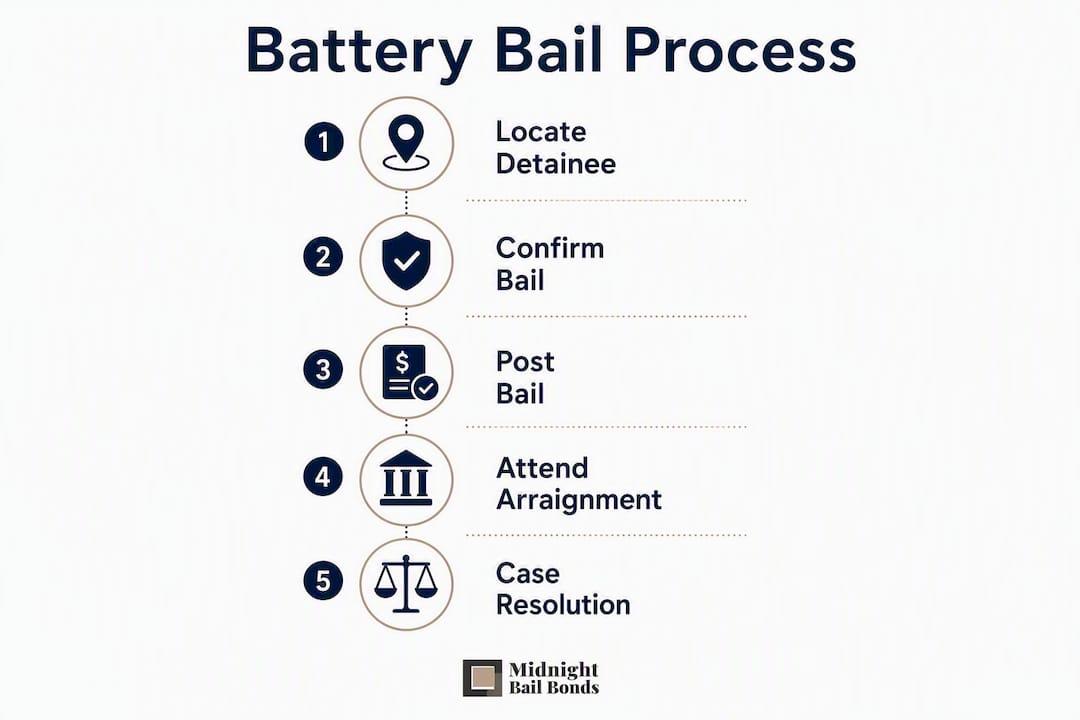
Getting someone out after a battery arrest comes down to three immediate steps: locate the detainee and confirm which facility they're in, find out the exact bail amount, then post cash or contact a licensed bail bondsman. Here's how to move quickly.
- Call the jail or use an online inmate locator to confirm where your person is being held and whether booking is complete.
- Ask booking staff for the bail amount — or check the county's published bail schedule if a judge hasn't set an individualized amount yet.
- Contact a licensed bondsman or criminal defense attorney. A bondsman typically charges a non-refundable 10% premium of the total bail amount and handles the paperwork. Midnight Bail Bonds is available 24/7 and can start the process while you're still on the phone.
Battery cases move faster when you act before the first court appearance. The judge or bail magistrate who sets bail at that hearing will weigh factors specific to the charge, so having a bondsman and attorney ready beforehand cuts hours off custody time.
Table of Contents
- What is bail, and why does it matter after a battery arrest?
- Who sets bail, and when does it happen?
- What release options do you have after a battery arrest?
- How do battery charges specifically affect bail amounts?
- How to post bail after a battery arrest, step by step
- What happens at the arraignment, and how can an attorney help?
- What happens to bail money after the case ends?
- What conditions come with battery bail, and what happens if you break them?
- How Midnight Bail Bonds helps families through the battery bail process
- Key Takeaways
- Why fast, licensed help changes the outcome for battery cases
- Midnight Bail Bonds is available right now for battery cases in California
- Useful sources to check for local bail information
- FAQ
What is bail, and why does it matter after a battery arrest?
Bail is a financial or non-monetary guarantee that a defendant will return for scheduled court hearings. The court isn't punishing anyone by setting bail — it is securing a promise to appear. Once the case resolves and all court obligations are met, cash bail is returned. A bondsman's premium is not.
The most common forms of bail you'll encounter after a battery arrest:
- Cash bail: You pay the full amount directly to the court. It's refundable at case resolution if all appearances are made.
- Surety bond (bail bondsman): A licensed agent posts the full bond; you pay a non-refundable premium, typically 10%. The bondsman assumes financial liability if the defendant doesn't appear.
- Property bond: Real estate is pledged as collateral. It is slower to process and less common.
- Release on recognizance (OR): The defendant is released on a signed promise to appear, with no money exchanged.
- Supervised release: Similar to OR but with check-ins, GPS monitoring, or other conditions attached.
Pro Tip: Battery charges often fall outside the streamlined low-risk release tracks that courts use for minor offenses. Don't assume OR is on the table — especially if the charge involves a domestic relationship, a weapon, or visible injury. Ask your attorney directly.
Who sets bail, and when does it happen?
Bail can be set by a police officer using a local schedule, a bail magistrate, or a judge at the defendant's first court appearance. Which one applies depends on the charge and the jurisdiction.
The typical post-arrest timeline looks like this:
- Booking (2–4 hours): Booking typically takes 2–4 hours depending on facility volume. Fingerprints, photos, and records checks happen here.
- Mandatory holds: Domestic battery and weapon-related arrests frequently trigger statutory hold periods before the defendant is even eligible for release. In Nevada, for example, certain violent arrests carry a mandatory 12-hour detention hold before bail processing can begin.
- Initial appearance or arraignment (within 24–72 hours): A judge or magistrate reviews the case and sets or confirms bail. Exact timing varies by jurisdiction and whether the arrest falls on a weekend or holiday.
Bail schedules serve as a baseline — police or jail staff can use them to release defendants before the first hearing. But Florida law, for instance, explicitly requires individualized judicial review for domestic battery, felony battery, and offenses against elderly victims. Many other states follow similar logic. When a battery charge carries aggravating factors, a preset schedule amount doesn't apply, and the defendant waits for a judge.
What release options do you have after a battery arrest?
Several legitimate routes to release exist. Which one makes sense depends on the bail amount, available cash, and the specific charge.
| Release Type | Speed | Upfront Cost | Risk of Loss |
|---|---|---|---|
| Release on recognizance (OR) | Fastest | None | Low (no money at stake) |
| Citation release | Fast | None | Low |
| Cash bail | Fast once paid | Full bail amount | Full amount if defendant fails to appear |
| Surety bond (bondsman) | Fast with agent | 10% premium (non-refundable) | Premium lost; cosigner liable for full bond |
| Property bond | Slow (days) | None upfront | Property at risk |
| Supervised release | Moderate | Minimal | Conditions must be met |
A few scenarios that shape which option is realistic:
- Simple misdemeanor battery on a bail schedule: Bond amounts for simple battery in some jurisdictions commonly fall in the $1,000–$5,000 range. Cash bail is manageable; a bondsman typically charges a non-refundable 10% premium of the total bail amount as an upfront fee.
- Domestic or weapon-enhanced battery: No preset schedule applies. A judge sets the amount at the first appearance, and it can be significantly high. OR is rarely granted.
- First-time offender, minor injury, strong community ties: OR or supervised release is possible, but the prosecutor's recommendation and victim statement carry real weight.
Local bail schedules and practices vary widely — a bond amount in one county can differ substantially from an adjacent county. Always verify the specific facility's procedures before arranging payment.
How do battery charges specifically affect bail amounts?
Battery cases frequently require individualized judicial review and potentially higher bail when aggravating factors are present, as the baseline schedule serves only as a starting point.
Common aggravating factors and what they mean for bail:
- Use of a weapon: Elevates the charge toward felony battery. Nevada bail for weapon-enhanced battery can be substantial, and preset schedules no longer apply.
- Domestic relationship: Nearly every state removes battery from the standard schedule when the alleged victim is a household member, spouse, or intimate partner. A judge must set bail individually.
- Victim age (65+ or a minor): Courts apply heightened scrutiny. Florida statute specifically lists offenses against elderly victims as requiring individualized bail determination.
- Severity of injury: Visible or documented injury raises the perceived danger to the community, which directly influences the bail amount.
- Victim is a law enforcement officer: Treated as a separate, more serious charge category in most states.
- Prior criminal history: A defendant with prior battery or violent-offense convictions will face a substantially higher bail amount than a first-time offender.
Pro Tip: Tell your attorney and bail agent every relevant detail early — the household relationship, whether any object was involved, the victim's age. Small facts change the bail picture fast, and your agent needs accurate information to prepare the right paperwork before the hearing.
How to post bail after a battery arrest, step by step
Follow these steps in order to secure release as quickly as possible.
- Find the facility. Use the county sheriff's inmate locator or call the jail's booking line directly. You need the exact facility name, the defendant's booking number, and the charges listed.
- Confirm the bail amount. Ask booking staff or check the court's published bail schedule online. If a judge hasn't set bail yet, ask when the first appearance is scheduled.
- Choose your payment route. Cash bail goes directly to the court. A bondsman requires the 10% premium plus a signed agreement. Licensed bail agents frequently handle the process remotely with secure electronic signing, so you don't have to be physically present at the jail.
- Gather documents and information. Have the defendant's full legal name, booking number, date of birth, and the name of the facility. Bring a valid government-issued ID and your payment method.
- Submit the bond paperwork. The bondsman submits the bond to the jail's release window. Processing time after submission varies by facility — typically one to several hours.
- Prepare during mandatory holds. Some jurisdictions recommend contacting a bail agent during mandatory statutory holds so all paperwork is ready the moment the hold expires. This is one of the fastest ways to cut total custody time.
Accepted payment methods vary by bondsman. Midnight Bail Bonds accepts cash, credit and debit cards, Zelle, and financing — useful when the premium needs to be split.
Documents and information to have ready:
- Defendant's full legal name and date of birth
- Booking number and facility name
- Your government-issued ID (for the cosigner)
- Payment method for the premium
What happens at the arraignment, and how can an attorney help?
At the arraignment or bail hearing, the judge decides bail using individualized factors. Defense counsel can request a reduction or argue for OR release based on the defendant's ties to the community and their history.
Judges typically weigh:
- Criminal history, including prior failures to appear
- Flight risk (ties to the community, employment, family, length of residence)
- Seriousness of the alleged injury and the circumstances of the incident
- The victim's statement or the prosecutor's recommendation
- Whether the defendant poses an ongoing danger to the alleged victim or the public
A skilled defense attorney can intervene in several ways. They can file a motion for bail reduction, present evidence of stable employment or family responsibilities, propose pretrial services as an alternative to high cash bail, or argue that the facts don't support the aggravating factors the prosecution is citing. Victim statements carry real weight at this stage, and an attorney who prepares a counter-narrative before the hearing gives the defendant a much better shot at a manageable bail amount.

What happens to bail money after the case ends?
Cash bail is refundable once all court obligations are met. A bondsman's premium is not, regardless of the outcome.
If you paid cash bail directly to the court and the defendant appeared at every hearing, the court returns the full amount after the case closes — minus any administrative fees the jurisdiction charges. If the defendant is convicted, acquitted, or the charges are dropped, the cash comes back as long as court appearances were honored.
A bondsman's 10% premium works differently. That fee is non-refundable once the defendant is released, full stop. It doesn't matter if the charges are dropped the next day. The bondsman earned the fee by assuming the financial risk and posting the full bond.
Forfeiture triggers to know:
- Failure to appear: The court issues a warrant and begins forfeiture proceedings. The bondsman has a limited window to locate and return the defendant before the full bond is forfeited.
- New criminal charges while on bail: Can trigger immediate revocation.
- Violating release conditions: Contacting a protected party, leaving the jurisdiction, or missing a check-in can all lead to revocation.
Cosigners carry real liability here. If the defendant skips and the bond is forfeited, the cosigner may owe the full bail amount to the bondsman.
What conditions come with battery bail, and what happens if you break them?
Battery cases commonly include strict no-contact orders and movement restrictions. Violating them risks revocation, forfeiture, and new criminal charges.
Typical release conditions in battery cases:
- No-contact order: No communication with the alleged victim — no calls, texts, social media, or third-party messages.
- Stay-away zones: Prohibited from the victim's home, workplace, or school.
- Surrender of firearms: Required in most domestic battery cases and many weapon-related charges.
- GPS monitoring or check-ins: Common in higher-risk cases or when the defendant has prior failures to appear.
- Travel restrictions: Surrender of passport, prohibition on leaving the county or state.
No-contact order violations and missed court dates are the most frequent triggers for bond revocation and forfeiture. Courts treat a no-contact violation as evidence that the defendant is a danger to the victim, and they move quickly.
If you're accused of a violation:
- Contact your attorney immediately. Do not wait.
- Notify your bail agent. They need to know before the court does.
- Do not contact the protected party under any circumstances — even to explain or apologize.
Pro Tip: Save your release paperwork and read every condition listed. Many defendants violate no-contact orders accidentally — a text from a shared phone, a message through a mutual friend. Ignorance of the condition is not a defense.
How Midnight Bail Bonds helps families through the battery bail process
Midnight Bail Bonds posts bonds 24/7 and handles intake, cosigner screening, premium collection, and jail-window submission to minimize the time your person spends in custody. The goal is to have paperwork ready before the hold lifts, not after.
Here's how the agent process works in practice:
- Intake call: You provide the defendant's name, booking number, facility, and charges. The agent confirms the bail amount and walks you through the premium and paperwork.
- Cosigner screening and agreement: The cosigner (usually a family member) signs the indemnity agreement, which outlines their liability if the defendant fails to appear.
- Premium collection: The standard rate in California is a state-mandated non-refundable 10% of the total bail amount. Midnight Bail Bonds offers payment plans and financing for families who need to split the cost.
- Bond posting: The agent submits the bond to the jail's release window. Release typically follows within a few hours of submission, depending on facility processing.
- Post-release monitoring: The agent stays in contact to confirm court dates and remind the defendant of upcoming appearances.
What to have ready when you call:
- Defendant's full legal name and date of birth
- Booking number and name of the facility
- The charges as listed by booking staff
- Your preferred payment method (cash, credit/debit, Zelle, or financing)
Midnight Bail Bonds also offers bail without collateral in many cases and provides bilingual English/Spanish support — two details that matter when a family is trying to move fast under pressure.
Pro Tip: Call during a mandatory hold, not after. Having the bond ready to submit the moment the hold expires can shave hours off total jail time. Midnight Bail Bonds can prepare everything in advance.
Key Takeaways
The battery bail process requires three actions in sequence: locate the detainee, confirm the bail amount, and post cash or contact a licensed bondsman before the first court appearance.
| Point | Details |
|---|---|
| Act before the hearing | Contact a bondsman and attorney before arraignment to cut total custody time. |
| Battery raises bail | Domestic relationship, weapon use, or victim age can remove preset schedules and push bail to tens of thousands. |
| 10% premium is non-refundable | A bondsman's fee does not come back regardless of case outcome; cash bail is refundable if appearances are met. |
| Conditions are strict | No-contact violations are the most common trigger for bond revocation — read every condition before leaving jail. |
| Midnight Bail Bonds | Available 24/7 in California with flexible payment plans, bilingual support, and no-collateral options in many cases. |
Why fast, licensed help changes the outcome for battery cases
Most families calling about a battery arrest are doing it for the first time, under stress, with no clear picture of what happens next. The instinct is to wait and see — wait for the arraignment, wait for the bail amount, wait to call a lawyer. That instinct costs hours, sometimes days.
What actually matters in the first few hours isn't legal strategy. It's logistics. Which facility? What's the booking number? Is there a mandatory hold? Can the bond be posted remotely? These are operational questions, and a licensed bail agent answers them faster than anyone else in the process.
Battery charges carry a specific complication that other charges don't always share: the aggravating-factor problem. A simple misdemeanor battery on a schedule is one situation. Add a domestic relationship or an alleged weapon, and the entire process shifts. Bail goes from a predictable number to a judge's discretion, and the timeline stretches. Families who understand this upfront make better decisions — they call an attorney and a bondsman simultaneously, they don't assume OR is available, and they prepare the cosigner paperwork before the hearing.
The other thing most guides skip: the no-contact order is the most dangerous part of post-release life for a battery defendant. Not the bail amount. Not the court date. A single text to the alleged victim can revoke bail, trigger forfeiture, and add a new criminal charge — all before the original case is even resolved. That's worth understanding before anyone walks out of jail.
Midnight Bail Bonds is available right now for battery cases in California
When bail is set and every hour in custody matters, the fastest path to release is a licensed bondsman who already knows the facility, the paperwork, and the process. Midnight Bail Bonds serves families across California around the clock, with no-collateral options in many cases, bilingual agents, and payment plans that don't require you to have the full premium in cash.
Call Midnight Bail Bonds with the defendant's name, booking number, facility, and charges. An agent will confirm the bail amount, explain the premium, and begin paperwork immediately. Here's a short script you can read directly:
"My [family member] was arrested for battery and is being held at [facility name]. Their booking number is [number]. I need to know the bail amount and how quickly you can post the bond."
The state-mandated premium in California is 10% of the total bail amount and is non-refundable once the defendant is released. Financing is available. Reach Midnight Bail Bonds at midnightbail.com — agents are standing by 24/7.
Useful sources to check for local bail information
Bail schedules, facility contact numbers, and release procedures vary by county. These official sources are the most reliable places to verify local rules before arranging payment.
- Santa Cruz Superior Court 2025 Bail Schedule — California felony and misdemeanor bail amounts by charge.
Local rules change. Check the specific county court's website or call the jail's booking line to confirm current amounts and procedures. For immediate help in California, Midnight Bail Bonds can confirm facility-specific details when you call.
This article is general information, not legal advice. Bail laws, schedules, and procedures vary by state and county. Confirm current rules with a licensed attorney or the relevant court.
FAQ
Can you get bailed out for battery?
Yes. Most battery charges are bailable offenses, though the amount and process depend on the severity of the charge, the defendant's history, and whether aggravating factors like a domestic relationship or weapon are involved.
Who decides whether someone gets bail?
A judge, bail magistrate, or in some cases police using a published bail schedule sets the bail amount. For battery charges involving domestic violence, weapons, or elderly victims, a judge must set bail individually at the first court appearance.
How much is bail for battery in California?
Bail amounts vary by county and charge severity. California counties publish their own bail schedules — Santa Cruz County's 2025 schedule, for example, lists felony amounts by specific charge. Simple misdemeanor battery typically falls in the lower range, while felony or domestic battery can be substantially higher. Contact the specific county court or a licensed bondsman for the current amount.
How much is bail for battery in Indiana?
Indiana bail amounts are set by county schedule or by a judge at the initial hearing. Marion County (Indianapolis) requires that major felony arrests go before the Initial Hearing Court before bond can be posted. Misdemeanor battery amounts vary; check the Marion Superior Court bail schedule or the relevant county court for current figures.
What is the typical bondsman fee for a battery charge?
The standard industry premium is 10% of the total bail amount, and it is non-refundable once the defendant is released. In California, this rate is state-mandated. Many bondsmen, including Midnight Bail Bonds, offer payment plans when the full premium isn't available upfront.