

The fastest way to secure release after a hit-and-run arrest is to confirm the booking details, then call a licensed bail bondsman who can post a surety bond for a nonrefundable premium of 10% of the total bail amount. Expect the process to take several hours from the moment the bond is posted, not minutes. Jail processing cycles, staffing, and paperwork all add time even after the bond clears.
Here is what to do right now:
- Confirm the detention: Find out which facility is holding the person and get the booking number (county jail websites and inmate search tools list this).
- Get the charge and bail amount: Ask the jail directly or check the county bail schedule online. The charge code matters because it tells a bondsman exactly what they are working with.
- Call a licensed bondsman immediately: Midnight Bail Bonds is available 24/7 at midnightbail.com and can start the process while you gather documents.
- Arrange payment: Have a credit card, debit card, cash, or Zelle ready. Payment plans and financing are available if you cannot cover the full premium upfront.
If the bail is set at a typical amount, your out-of-pocket cost through a bondsman is typically a fixed percentage of the bail amount. That fee is nonrefundable regardless of how the case resolves.
Table of Contents
- What does "hit and run" mean legally, and how does severity change the charge?
- What bail amounts should you expect for hit-and-run charges?
- How do bail bonds actually work?
- How to secure bail quickly: step-by-step
- Can you get bail reduced or skip posting a bond entirely?
- What to ask a bondsman and what to bring
- What happens if someone skips bail?
- How Midnight Bail Bonds helps families in hit-and-run cases
- What does hit-and-run bail actually cost in total?
- Key Takeaways
- What families should know in the first 24 hours
- Midnight Bail Bonds is ready when you need help now
- Authoritative sources for verifying bail amounts and local rules
- FAQ
What does "hit and run" mean legally, and how does severity change the charge?
A hit-and-run charge means the driver left the scene of an accident without stopping to exchange information or render aid. The legal definition sounds simple, but the severity of the charge, and therefore the bail amount, depends almost entirely on what happened at the scene.
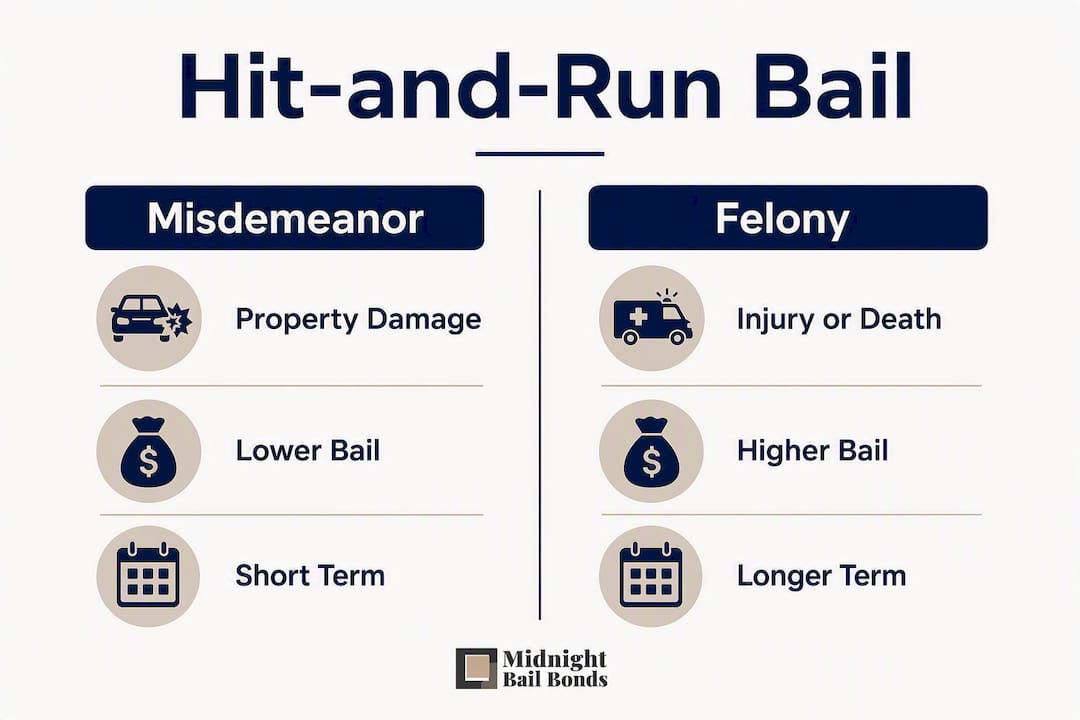
Property damage only (no injuries) is usually charged as a misdemeanor. The moment another person is injured, most states treat it as a felony. If the accident caused serious bodily injury or death, the felony classification becomes more serious and bail rises sharply.
California Vehicle Code Section 20001 draws this line clearly: leaving the scene after an injury or death is a felony, while a property-damage-only departure under Section 20002 is typically a misdemeanor. Other states follow similar logic, though the exact statutory elements and penalties vary. Louisiana, for example, recently enacted legislation directing courts to consider specific factors when setting bail for hit-and-run offenses, reflecting a broader trend toward treating these charges more seriously than standard traffic violations.
When you look up the booking information, note the exact charge code. That code tells the bondsman and any attorney you hire whether you are dealing with a misdemeanor or a felony, which directly affects bail eligibility and the amount.
What bail amounts should you expect for hit-and-run charges?
Bail for a hit-and-run varies widely by state, county, and charge severity. The table below shows representative amounts from published court bail schedules.
| Charge severity | Example bail range | Source |
|---|---|---|
| Property damage only (misdemeanor) | a range starting from several hundred dollars to a few thousand | Carson City Court bail schedule |
| Hit and run with injury | $20,000 is the standard bail amount for hit-and-run with injury in California according to the 2025 Uniform County Bail Schedule | 2025 Uniform County Bail Schedule |
| Hit and run with serious injury or death | $30,000 is the typical bail set for hit-and-run causing serious injury or death per California's 2025 schedule, with some counties setting as high as $40,000 | 2025 Uniform County Bail Schedule / Carson City |
These figures are starting points, not ceilings. Courts often treat hit-and-run more severely than comparably classified traffic offenses because fleeing the scene signals culpability and can worsen harm to victims. A judge can raise bail well above the schedule if the circumstances warrant it.
The factors judges weigh when setting or adjusting bail include:
- Severity of the incident: Injuries, fatalities, and property damage all push bail higher.
- Criminal history: Prior convictions, especially for DUI or previous failure to appear, are significant negatives.
- Flight risk: No fixed address, recent travel, or lack of community ties can lead to higher bail or denial.
- Community ties: Employment, family, and length of residence in the area work in the defendant's favor.
- Additional charges: A hit-and-run combined with DUI, reckless driving, or driving on a suspended license compounds the severity and can dramatically increase bail.
- Ability to pay: Some jurisdictions allow judges to consider financial circumstances, though this is not universal.
County schedules are the baseline. The actual bail set at arraignment can be higher or lower depending on everything above.
How do bail bonds actually work?
A licensed bondsman posts a surety bond to the court on the defendant's behalf. The court gets its guarantee that the defendant will appear; the family pays the bondsman a fee for taking on that risk.
That fee is the bail bond premium, typically set at 10% of the total bail amount by state statute where applicable. On a $20,000 bail for hit-and-run with injury, the premium is $2,000. On a $30,000 bail for serious injury or death, the premium is $3,000. The premium is nonrefundable once the bond is posted, regardless of whether charges are dropped or the defendant is acquitted.
The 10% premium is state-mandated in California and many other states. A bondsman cannot legally charge more or less than the statutory rate in those jurisdictions.
Collateral and cosigners. Some bonds require collateral, particularly for higher bail amounts or defendants with limited community ties. Collateral can be real estate, a vehicle, or other assets. Many bondsmen, including Midnight Bail Bonds, offer no-collateral options in many cases. A cosigner agrees to be financially responsible for the full bond amount if the defendant fails to appear. That is a serious commitment, and cosigners should read the bonding agreement carefully before signing.
Payment options typically include cash, credit card, debit card, Zelle, and financing or payment plans. Payment plans let families spread the premium over time rather than paying it all upfront.
Timeline. After you contact a bondsman and payment is arranged, the bondsman posts the bond with the jail or court. From that point, release processing at the facility can take several hours, sometimes 4–8 hours, depending on staffing, shift changes, and the jail's internal procedures. Posting a bond late at night or on a holiday can push that window further. Plan for it.
How to secure bail quickly: step-by-step
- Confirm the detention. Call the jail directly or use the county's online inmate search. The Orange County Sheriff's inmate information system and San Bernardino County's inmate lookup are examples of the tools available. Most California counties have similar portals.
- Gather the essential information. You need: full legal name, booking number, jail name and address, charge code, bail amount, and date and time of arrest.
- Call a licensed bondsman. Do this as early as possible. Midnight Bail Bonds operates 24/7 and can begin paperwork while you are still pulling together documents.
- Arrange payment. Confirm which payment methods the bondsman accepts and whether a payment plan is available. Have your ID ready.
- Complete the paperwork. The bondsman will walk you through the indemnity agreement and bond application. Read it before signing, especially the cosigner liability section.
- Wait for processing. Once the bond is posted, the jail processes the release. This takes time. Stay in contact with the bondsman for updates.
Information to have ready before you call:
- Defendant's full legal name and date of birth
- Booking number
- Name and address of the jail
- Charge code and bail amount
- Your government-issued photo ID
- Payment method
Pro Tip: If you can confirm the exact bail amount and have an approved payment method ready before you call, the bondsman can move faster. Electronic transfers like Zelle often clear quicker than waiting for a check to process, which can shave time off the overall release window.
Release timing after bond posting depends on the jail's processing cycle. Posting outside of a facility's active release window, such as during a night shift or on a holiday, can add several hours to an already slow process.

Can you get bail reduced or skip posting a bond entirely?
Yes, but it takes time and usually requires an attorney. At arraignment, the defendant or their lawyer can ask the judge to lower bail or grant release on own recognizance (OR release), which means no bond is required. OR release is typically reserved for first-time offenders with strong community ties and low-severity charges.
A bail-reduction motion is another option. An attorney files it before or at arraignment, arguing that the scheduled bail is excessive given the defendant's circumstances. Judges consider the same factors listed earlier: criminal history, flight risk, severity of the charge, and community ties.
When does it make sense to pursue reduction rather than post bond immediately? If the charge is a misdemeanor with no injuries, the defendant has no prior record, and there are strong local ties, a reduction motion at arraignment is worth attempting. For felony charges with injuries, the fastest path to release is usually posting bond now and addressing bail reduction as a secondary strategy.
One practical note: coordinate the attorney and the bondsman early. An attorney can advise whether a reduction motion is realistic while the bondsman prepares to post if the motion fails. Doing both in parallel avoids losing a day waiting for a hearing that does not go as hoped.
What to ask a bondsman and what to bring
Before you commit to a bondsman, ask these questions:
- Are you state-licensed? (Request the license number and verify it with the state's Department of Insurance.)
- What is your fee, and is it the statutory rate?
- Do you offer payment plans or financing?
- Is collateral required for this bond?
- What are the cosigner's exact liabilities if the defendant fails to appear?
- What is the realistic timeline from payment to release?
- Will you coordinate directly with the jail and the attorney?
Documents and information to transmit:
- Your government-issued photo ID
- Defendant's booking number and jail location
- Confirmed bail amount and charge code
- Chosen payment method
- Proof of address or employment if you are cosigning and want to demonstrate community ties
Ask for an itemized breakdown of all fees before signing anything. The premium is fixed by statute in most states, but some bondsmen charge administrative or processing fees on top of it. Know exactly what you are paying.
What happens if someone skips bail?
Skipping bail, meaning failing to appear at a required court date, triggers a cascade of consequences that affect both the defendant and anyone who cosigned the bond.
- Arrest warrant: The court issues a bench warrant immediately upon a missed appearance.
- Additional criminal charges: Failure to appear is itself a criminal offense in most states, adding a new charge on top of the original hit-and-run.
- Bond forfeiture: The court declares the bond forfeited. The bondsman loses the full bail amount to the court.
- Cosigner liability: The cosigner becomes responsible for the full bond amount. The bonding company can pursue collections, file a civil judgment, or seize any collateral pledged.
- Bounty recovery: Many bonding companies employ recovery agents to locate and return the defendant to custody, which can result in additional legal complications.
Cosigners should understand that signing a bond agreement is a financial guarantee, not a formality. If there is any doubt about whether the defendant will appear for all court dates, that needs to be weighed carefully before signing.
How Midnight Bail Bonds helps families in hit-and-run cases
Midnight Bail Bonds provides 24/7 licensed bail bond services across California with fast response and flexible payment options designed for families who need to act quickly.
Service features include:
- Licensed agents available around the clock: No waiting until business hours.
- Bilingual support: English and Spanish assistance for families who need it.
- Flexible payment options: Cash, credit card, debit card, Zelle, and financing plans.
- No-collateral options: Available in many cases, removing a common barrier to posting bond.
- Instant inmate search: Families can confirm booking status and bail information without calling multiple jails. Licensed agents and firms with quick verification tools materially shorten the time families spend locating a detained person.
Midnight Bail Bonds also coordinates directly with the jail and can advise on timing to minimize processing delays. For families navigating arraignment, agents can stay in contact throughout the process so nothing falls through the gaps.
What does hit-and-run bail actually cost in total?
The premium is the largest line item, but it is not always the only one. Here is a realistic picture of the total cost:
The premium is 10% of the bail amount, nonrefundable. On a common bail amount for hit-and-run with injury bail, that is $2,000. On a $30,000 bail, it is $3,000.
Financing fees. If you use a payment plan, the bondsman may charge interest or a financing fee on top of the premium. Ask for the full cost of financing before agreeing to it.
Collateral costs. If collateral is required and you use a third-party collateral service, there may be appraisal or processing fees. Collateral is returned when the case concludes and all court appearances are met.
Attorney fees. If you pursue a bail-reduction motion, attorney fees are separate from the bond premium. A criminal defense attorney's fees vary widely by market and case complexity.
What you do not get back. The premium is gone once the bond is posted. Even if the case is dismissed the next day, the bondsman has earned that fee. Budget for it as a sunk cost from the start.
The total out-of-pocket cost for a $20,000 bail for hit-and-run with injury, using a bondsman with no collateral and no financing, is $2,000. Add financing fees if you use a payment plan, and attorney fees if you pursue reduction. That is the realistic picture.
Key Takeaways
Securing release after a hit-and-run arrest requires confirming the booking, calling a licensed bondsman immediately, and paying the 10% nonrefundable premium to post a surety bond.
| Point | Details |
|---|---|
| Bail ranges by severity | Property damage bail is usually a misdemeanor amount; hit-and-run with injury is typically $20,000; serious injury or death leads to $30,000 or higher bail in most California counties. |
| The 10% premium rule | The bondsman's fee is typically 10% of the total bail amount, nonrefundable once the bond is posted. |
| Release takes hours | Expect 4–8 hours of jail processing after the bond is posted; holidays and night shifts extend that window. |
| Cosigner liability is real | Signing a bond agreement makes you financially responsible for the full bail amount if the defendant misses court. |
| Midnightbail is available now | Midnight Bail Bonds offers 24/7 licensed agents, flexible payment plans, and no-collateral options across California. |
What families should know in the first 24 hours
The first few hours after a hit-and-run arrest feel chaotic, and the instinct is to assume the worst. Most families who call a bondsman quickly discover the process is more manageable than they feared.
What you can realistically expect: once you have the booking number and bail amount, a licensed agent can have a bond posted within an hour or two of receiving payment. The jail's processing time is the variable you cannot control. Four to eight hours from bond posting to release is common. Overnight arrests on weekends sometimes push that to the following morning.
The documentation step is where families lose the most time. Not having the booking number or not knowing which facility is holding the person adds hours. Use the county inmate search tool first, confirm the charge code, and have that information ready before you call. That single step makes everything else faster.
Midnight Bail Bonds is ready when you need help now
When someone you care about is sitting in a California jail on hit-and-run charges, the clock matters. Midnight Bail Bonds offers something most families need most in that moment: a licensed agent who picks up at 2 AM, speaks your language, and can post a bond without requiring collateral in many cases.
The process is straightforward. Call or reach out through midnightbail.com, give the agent the booking number and jail location, and choose a payment method that works for your situation, whether that is cash, card, Zelle, or a financing plan. Agents coordinate directly with the facility to minimize processing delays and keep you updated until your person walks out.
Payment plans mean you do not have to have the full premium in hand before the process starts. Bilingual support means no one gets lost in translation during a stressful call. And 24/7 availability means you are never waiting until Monday morning to get started.
Authoritative sources for verifying bail amounts and local rules
County bail schedules and court resources are the authoritative first stop when confirming a booking's bail amount and charge code. Here is where to look:
- County inmate search portals: Most California counties publish online inmate lookup tools. The Orange County Sheriff's inmate information system and San Bernardino County's portal are two examples. Search by name or booking number.
- County bail schedule PDFs: Published by the superior court in each county, these list bail amounts by charge code. The 2025 Uniform County Bail Schedule covers many California counties. The Riverside Superior Court bail schedule is another example.
- State statutes: California Vehicle Code Section 20001 defines the felony hit-and-run elements. The California Highway Patrol handles many hit-and-run investigations and can confirm charge details.
- Mono County misdemeanor bail schedule: The Mono County bail schedule illustrates how misdemeanor and infraction bail is structured at the county level.
County schedules are starting points. Contact a licensed bondsman or criminal defense attorney to confirm the current amount and any judge-imposed adjustments.
This article provides general information about bail procedures and is not legal advice. Bail rules, amounts, and eligibility vary by state, county, and individual case. Consult a licensed attorney or your local court for guidance specific to your situation.
FAQ
How much does it cost to bail someone out for a hit and run?
The cost depends on the bail amount set by the court. Using a bondsman, you pay a nonrefundable premium of typically 10% of the total bail. For a $20,000 bail for a hit-and-run with injury, that is $2,000 upfront.
What is the minimum sentence for a hit and run?
Sentences vary by state and severity. A misdemeanor property-damage hit-and-run can carry fines and up to one year in county jail in many states; felony charges involving injury or death carry significantly longer potential sentences, sometimes several years in state prison.
What is the best defense for a hit and run?
Common defenses include lack of knowledge that an accident occurred, mistaken identity, or disputing the severity of the incident. An experienced criminal defense attorney can evaluate which arguments apply based on the specific facts and charge code.
What happens if you get caught after a hit and run?
You will face arrest, booking, and a bail hearing. Depending on the severity, charges can range from a misdemeanor to a serious felony. Failing to appear after posting bail adds a separate failure-to-appear charge and triggers bond forfeiture.
Can Midnight Bail Bonds help with hit-and-run arrests in California?
Yes. Midnight Bail Bonds provides 24/7 licensed bail bond services across California, including for hit-and-run charges. Agents are available around the clock, accept multiple payment methods, and offer no-collateral options in many cases.