
The fastest path to getting someone released: find the jail, get the booking number, then either pay cash at the cashier window or call a licensed bail bondsman who can post a surety bond for around 10% of the bail amount. This premium is state-mandated in many states. Everything else follows from those two decisions.
Here is what to have ready before you do anything else:
- Full legal name of the arrested person (exactly as it appears on their ID)
- Date of birth
- Booking number (the single most important item — without it, jail staff may not be able to locate the inmate even if you arrive with cash)
- Jail name and address (city jail, county sheriff's facility, or federal detention center)
- Bail amount, if you already know it
- Your government-issued photo ID and a payment method (cash, credit/debit card, or Zelle where accepted)
Timing reality check: Even after payment clears, release commonly takes several additional hours due to facility processing and paperwork backlogs. Plan for that window.
If you need help right now, Midnight Bail Bonds is available 24/7 across California and can walk you through every step.
Table of Contents
- What information do you need before you go or call?
- How to bail someone out: step-by-step
- Cash bail vs. bail bond: which route makes sense for you?
- How do you find the inmate and the bail amount in your county?
- State and county differences: what varies and where to confirm
- If you cosign a bond: what you're agreeing to
- What are your options if you can't pay bail right now?
- How a licensed bail bonds agent works and how Midnight Bail Bonds can help
- Key Takeaways
- The part most guides skip
- Midnight Bail Bonds is ready to help right now
- Useful sources and where to verify local rules
- FAQ
What information do you need before you go or call?
Showing up unprepared at a jail cashier window is one of the most common reasons families lose hours. The clerk needs specific inmate data, and if any piece is missing, the transaction stalls.
Inmate information the facility will ask for:
- Full legal name (middle name helps if it's a common name)
- Date of birth
- Booking number or arrest number
- Arresting agency (city police, county sheriff, state patrol)
- Jail or detention facility name and location
What you personally need to bring:
- Government-issued photo ID (driver's license, passport, or state ID)
- Payment: cash is universally accepted; many facilities also take credit/debit cards; some accept Zelle or money orders — call ahead to confirm
- If paying online, have the transaction ID and confirmation email ready to show
Some jails require the person posting bail to complete an intake form and present ID before accepting any funds. Skipping this step costs time.
Pro Tip: Call the jail's non-emergency line before you drive over. Confirm cashier window hours, accepted payment methods, and whether they offer an online portal. Jail hours vary widely, and showing up at a closed window at 2 AM means starting over.
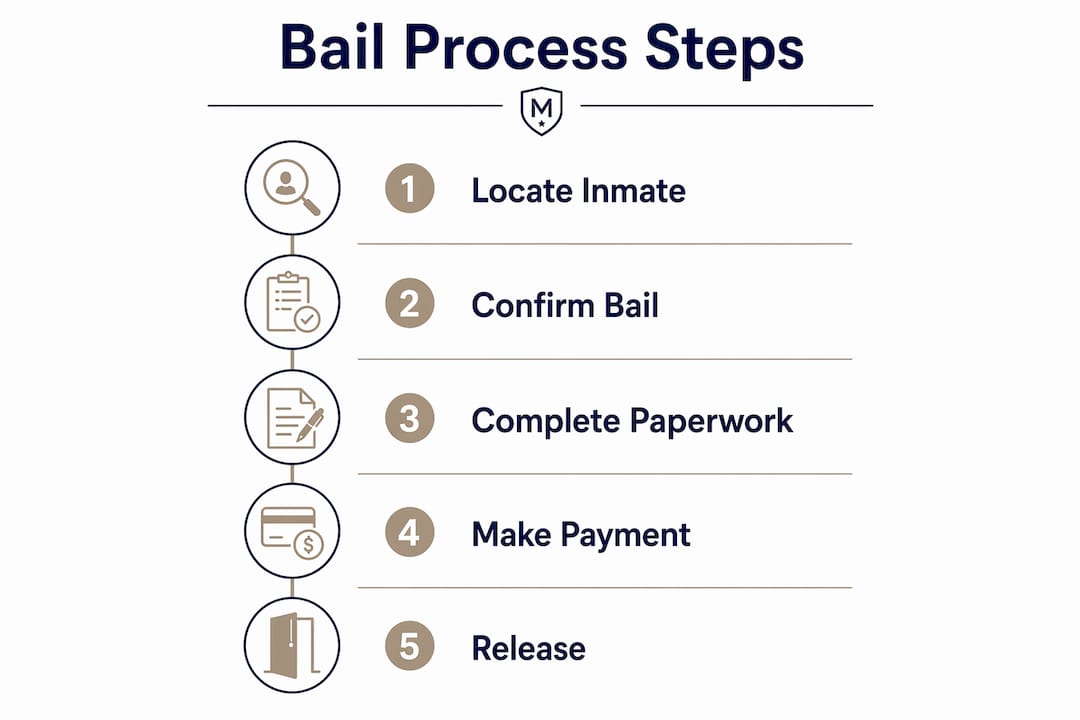
How to bail someone out: step-by-step
Step 1: Locate the inmate and confirm the bail amount
Start with the county sheriff's or jail's official inmate search tool online. Search by full name and date of birth, or by booking number if you have it. If the online search returns no results, call the jail's non-emergency line directly. Posting bail requires the defendant's full legal name, date of birth, jail location, and booking number — confirm all four before you move to payment.

Step 2: Choose your payment route
Three options exist, and the right one depends on the bail amount and your available funds.
- Pay cash in person at the jail cashier window or courthouse clerk's office.
- Use the jail's online portal, if the facility supports it. Not all do.
- Contact a licensed bail bondsman, who posts a surety bond on your behalf in exchange for a non-refundable premium (typically around 10% of the bail amount).
Step 3: Complete the paperwork and keep every receipt
Whether you pay at a window or through an agent, you will sign forms. At the jail, that means an intake form and payment receipt. With a bondsman, you sign an indemnity agreement. Keep copies of everything — the receipt, the transaction ID, and any confirmation number.
Pro Tip: If you pay online, save the transaction ID immediately. That digital record is your only proof of payment if the jail's internal system is slow to update the defendant's status.
Typical processing times by payment method
| Payment Method | Typical Processing Time | Notes |
|---|---|---|
| In-person (jail cashier) | 2 hours or more after payment | Varies by facility staffing and time of day |
| Online portal | 2 hours or more after confirmation | Confirm portal availability first; save transaction ID |
| Licensed bail bondsman | 1 hour or more after paperwork | Agent handles court filing; after-hours service available |
Processing times reflect facility workloads and shift changes, not just transaction speed.
Cash bail vs. bail bond: which route makes sense for you?
The financial difference between these two options is significant, and the wrong choice can tie up money for months.
Cash bail means you pay the full bail amount directly to the court. If the defendant attends every required hearing, that money is refunded after the case closes, minus any court fees. The catch: you need the full amount available right now, and it can take weeks or months to get it back.
A bail bond means a licensed agent posts the full bail on your behalf. You pay a premium — commonly around 10% of the total bail amount, which is state-mandated in many states — and that fee is non-refundable regardless of the outcome. For large bail amounts, this is often the only practical option for families who cannot freeze tens of thousands of dollars.
Quick cost example: $10,000 bail → $1,000 non-refundable premium to a bondsman, versus $10,000 cash to the court (refundable if the defendant appears).
| Cash Bail | Bail Bond | |
|---|---|---|
| Amount paid upfront | Full bail amount | Around 10% premium |
| Refundable? | Yes, if defendant appears | No |
| Collateral required? | No | Sometimes, for large/risky bonds |
| Best for | Small bail amounts, available funds | Large bail amounts, limited cash |
| Speed | Depends on cashier hours | Bondsman can act 24/7 |
When cash makes sense: bail is small (a few hundred dollars), you have the funds liquid, and you want them back after the case.
When a bail bond makes sense: bail is $5,000 or more, the family cannot tie up that cash, or the arrest happened after hours when courts are closed. A surety bond releases the defendant without requiring the full amount upfront, which is why it's the practical route for most families.
How do you find the inmate and the bail amount in your county?
Every county handles inmate records slightly differently, but the search process follows the same basic path.
- Start with the county sheriff's website. Most California counties and many others nationwide have a public inmate search. Enter the full name and date of birth, or the booking number if you have it.
- Try the city or municipal jail's website if the arrest happened in a city rather than a county facility.
- Call the jail's non-emergency line if the online search returns nothing. Use this script: "I'm looking for information on a recently booked individual. Their name is [full name], date of birth [DOB]. Can you confirm their booking number and current bail amount?"
- Check the court clerk's office when the online jail record shows custody status but no bail figure. Bail amounts are set by a judge or a bail schedule, and the court clerk's records are the authoritative source.
Official county jail cashier windows are typically the centralized in-person location for posting bail, but hours vary. Always call before you travel.
State and county differences: what varies and where to confirm
Bail rules are not uniform across the U.S. A few things that commonly differ by state or county:
- Whether private bail bondsmen are permitted. Most states allow them, but a handful (including Illinois, Kentucky, Oregon, and Wisconsin) have abolished commercial bail bonds. In those states, you post cash directly with the court.
- Accepted payment forms. Some facilities accept only cash or cashier's checks in person; others take credit cards or have online portals.
- Online bail payment portals. Availability varies widely. Some large urban jails have them; many smaller county facilities do not.
- Property bonds. Some jurisdictions allow real estate as collateral in lieu of cash, though this process takes longer.
Where to verify rules for your specific county:
- The county jail's official website (look for "bail" or "inmate services")
- The county court clerk's office (for bail schedules and court-set amounts)
- Your state's judiciary website (for statutes governing bail and bondsmen)
- Your state's Department of Insurance or licensing board (to verify a bail agent's license)
To check a bondsman's license, search your state's insurance department website by the agent's name or license number. In California, the Department of Insurance maintains a public license lookup at doi.ca.gov. A licensed agent will have no problem giving you their license number upfront.
Early contact with an attorney can also clarify which release options apply in your jurisdiction and whether a motion to reduce bail is worth pursuing.
If you cosign a bond: what you're agreeing to
Signing as a cosigner (also called an indemnitor) on a bail bond is a legal and financial commitment, not just a formality.
What cosigning actually means: If the defendant fails to appear in court, the court can forfeit the full bail amount. The bondsman then has the right to pursue the cosigner for that entire sum, and may use any collateral pledged in the agreement to recover it.
Typical conditions the defendant must follow after release:
- Appear at every scheduled court date
- Stay within specified geographic boundaries (travel restrictions may apply)
- Comply with any monitoring or check-in requirements set by the court or bondsman
- Avoid re-arrest
If the defendant misses a court date:
- Call your bondsman immediately. Many bondsmen have a short window to locate and surrender the defendant before the bond is fully forfeited.
- The court may issue a bench warrant and set a new hearing.
- The bondsman may pursue a recovery agent (bounty hunter, where legal in your state) to locate the defendant.
Acting fast after a missed appearance is the single most important thing a cosigner can do to limit financial exposure.
What are your options if you can't pay bail right now?
Not everyone can cover bail immediately, and there are legitimate paths forward.
Formal alternatives to consider:
- Request a bail reduction hearing. A defense attorney or public defender can file a motion asking the judge to lower bail based on the defendant's ties to the community, employment, and lack of flight risk. This is worth pursuing for high bail amounts.
- Release on own recognizance (ROR). The judge releases the defendant without bail, based on a promise to appear. Availability depends on the charge, criminal history, and jurisdiction.
- Supervised release or pretrial services. Some counties offer monitoring programs (check-ins, electronic monitoring) as an alternative to cash bail. Eligibility varies by charge and jurisdiction.
Practical immediate steps:
- Call a defense attorney or ask the jail about the public defender's office. An attorney can appear at the arraignment and request ROR or a bail reduction.
- Ask the jail directly about payment plan options or emergency procedures.
- Contact local nonprofits or bail funds in your area — some organizations assist with bail for specific populations or charge types.
- Ask a licensed bondsman about payment plans. Many, including Midnight Bail Bonds, offer flexible financing that lets you cover the premium over time rather than all at once.
How a licensed bail bonds agent works and how Midnight Bail Bonds can help
A licensed bail bondsman posts a surety bond to the court, guaranteeing the defendant's appearance. In exchange, the family or cosigner pays a non-refundable premium customary in many states and may pledge collateral for larger or higher-risk bonds.
What a licensed agent typically needs from you:
- The defendant's full legal name, date of birth, booking number, and jail location
- Your government-issued ID and contact information
- Cosigner information and signature on an indemnity agreement
- Payment of the premium (cash, credit/debit, Zelle, or financing)
- Collateral documentation, if required for the bond size
What sets a good bondsman apart: 24/7 availability, bilingual support, flexible payment plans, and the ability to start the process remotely by phone or online so the paperwork is ready before you arrive.
Midnight Bail Bonds operates 24/7 across California, covering DUI, drug charges, domestic violence, theft, assault, failure to appear, and more. Their agents offer bilingual English/Spanish support, flexible payment plans, and bail without collateral in many cases. They also provide a free instant inmate search so you can confirm booking details before you even pick up the phone.
Key Takeaways
Posting bail comes down to three things: having the right information ready, choosing the payment route that fits your situation, and acting fast.
| Point | Details |
|---|---|
| Booking number is critical | Without the booking number, jail staff may not locate the inmate; get it before anything else. |
| Cash bail is refundable after case closure if the defendant appears; the bondsman premium is not refundable. | |
| Release takes hours after payment | Facility processing adds several hours beyond the transaction; plan for this window. |
| Cosigning carries real financial risk | If the defendant skips court, the cosigner can be pursued for the full bail amount. |
| Midnight Bail Bonds is available 24/7 | Licensed California agents offer flexible payment plans, bilingual support, and free inmate search. |
The part most guides skip
There is a gap between what the bail process looks like on paper and what it feels like at 3 AM when someone you care about is sitting in a holding cell. Most guides walk you through the steps as if you have time to research, compare options, and make calm decisions. You usually don't.
The booking number detail is a good example of where theory and reality diverge. Guides mention it as one item on a checklist. In practice, it's the item. Jail staff work from booking numbers, not names. A common name with no booking number can mean an hour of back-and-forth while the person you're trying to help waits. That's not a minor inconvenience — every hour in custody matters.
The other thing worth saying plainly: cosigning a bond is a serious financial commitment, and the pressure of the moment makes it easy to sign without fully reading what you're agreeing to. A reputable bondsman will explain the indemnity agreement before you sign it. If someone is rushing you past that step, slow down.
Speed matters. So does know what you're signing.
Midnight Bail Bonds is ready to help right now
When bail is set and every hour counts, having a licensed agent on the phone is faster than navigating jail websites alone. Midnight Bail Bonds answers calls 24 hours a day, 7 days a week, across California.
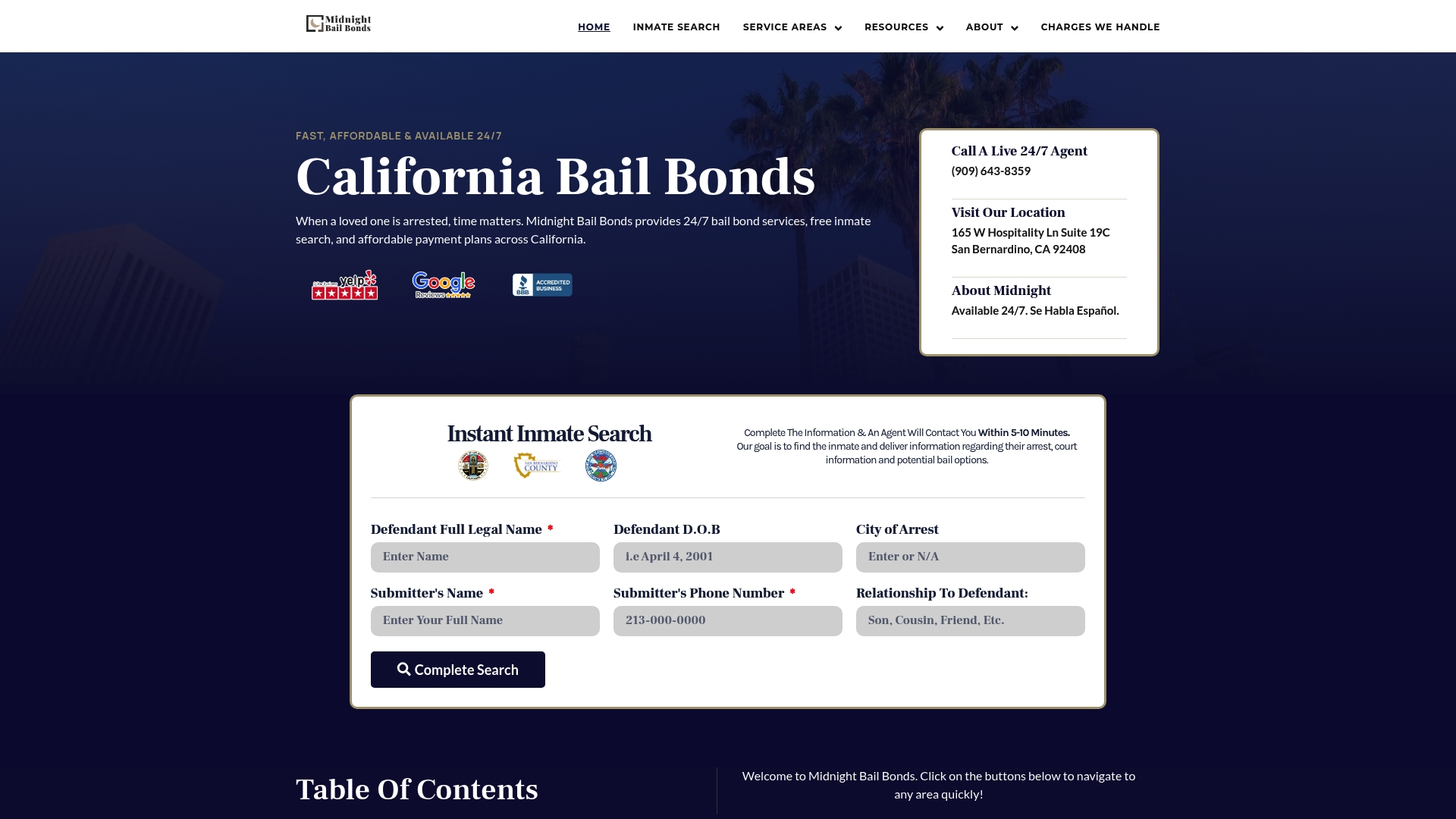
When you call, have the defendant's full name, date of birth, booking number, and jail location ready. Agents will confirm the bail amount, explain your payment options, and begin the bond process immediately. Accepted payments include cash, credit/debit cards, Zelle, and financing plans for families who need to spread the cost. Bilingual English/Spanish support is available. In many cases, bail can be posted without collateral.
Get immediate help from Midnight Bail Bonds — licensed, available now, and ready to get your loved one home.
Useful sources and where to verify local rules
Official and authoritative resources for confirming bail rules, inmate status, and agent licensing in your jurisdiction:
- NYC311 Bail Information — Explains how bail works in New York City, accepted payment methods, and where to post bail. Use it to understand local procedures if the arrest occurred in NYC.
- Delaware Courts: Bail Bonds Q&A — Official state court guidance on bail bond procedures, surety requirements, and what the court expects from bondsmen and cosigners.
- U.S. District Court — Central District of California: Bond Postings — Federal court bond procedures for the Central District of California; relevant if the arrest involves federal charges.
- NYC Inmate Lookup — Official New York City inmate search tool; use it to find booking numbers and facility locations for NYC arrests.
- University of Washington School of Law: What Is Bail? — Academic explainer on how bail works in the U.S. court system, including the difference between cash bail and surety bonds.
For your specific county: search "[county name] inmate search" or "[county name] sheriff inmate lookup" to find the official portal. Verify cashier window hours, accepted payment forms, and online portal availability directly on the county jail's website before traveling.
FAQ
What is the fastest way to bail someone out of jail?
Call a licensed bail bondsman with the defendant's booking number, jail location, and bail amount. A bondsman can begin posting the surety bond immediately, often faster than gathering full cash bail, and is available after hours when court cashier windows are closed.
Can you bail someone out immediately after arrest?
Not always. Bail is typically set at arraignment, which can take at least 24 hours after arrest depending on the jurisdiction and day of the week. Once bail is set and you have the booking number, you can post bail or contact a bondsman right away.
How much does it usually cost to bail someone out?
If you use a bail bondsman, the cost is commonly around 10% of the total bail amount as a non-refundable premium. For example, on a $10,000 bail, you would pay $1,000. If you pay cash bail directly to the court, you pay the full amount but get it back after the case closes, assuming the defendant appears at all hearings.
What information do you need to bail someone out in any state?
You need the defendant's full legal name, date of birth, booking number, and the name and location of the jail. These four items let you pay at a jail cashier, courthouse clerk, or through a licensed bail bondsman.
What happens if the defendant misses a court date after bail is posted?
The court issues a bench warrant and may forfeit the bail. If a bondsman posted the bond, the cosigner becomes liable for the full bail amount. Contact the bondsman immediately — there is often a short window to locate the defendant and request reinstatement before full forfeiture occurs.
This article is general information, not legal advice. Bail rules, fees, and procedures vary by state and county. Confirm current rules with your local court clerk, jail, or a qualified attorney for your specific situation.