

When someone you care about is arrested on robbery charges, the fastest route to release is usually a licensed surety bail bond through a local agent. You pay a nonrefundable premium, commonly about one-tenth of the total bail amount, and the agent posts the full bond with the jail. The other types of bail available are cash bail (pay the full amount yourself), a property bond (secure the bond with real estate), and release on own recognizance (ROR), where the court releases the defendant without payment.
Here is what to do right now:
- Confirm the jail or detention facility and get the defendant's booking number.
- Ask the jail or check online for the exact charge and the bail amount already set.
- If you cannot pay cash in full, call a licensed bail agent immediately. Midnight Bail Bonds operates 24/7 and can start the process while you gather documents.
- Notify a defense attorney as soon as possible, especially if the bail amount seems excessive.
The bail amount for robbery charges varies widely. A first-degree robbery in Marin County, California, carries a presumptive bail of about seventy-five thousand dollars on the county schedule, while Los Angeles County sets first-degree robbery (PC 211) at around one hundred thousand dollars. Armed robbery cases can reach as high as one million dollars in aggravated circumstances. Your first call to a bail agent will clarify the exact figure and what it will cost to get someone home tonight.
Table of Contents
- How judges and bail schedules set bail for robbery charges
- What bail amounts look like for robbery across U.S. jurisdictions
- How to post bail: your four main options explained
- How much bail bonds cost: fees, collateral, and a worked example
- How long does each option take to get someone released?
- When bail can be reduced, denied, or revoked
- The real tradeoffs between paying a bond premium and staying in jail
- What happens after bail is posted: conditions, court dates, and forfeiture
- How to choose a bail bond agent you can actually trust
- Key Takeaways
- What families should actually expect when they call for help
- Midnight Bail Bonds is ready when you need to act fast
- Useful sources for verifying local bail rules and amounts
- FAQ
How judges and bail schedules set bail for robbery charges
Bail for robbery is not pulled from thin air. Most California counties and many states publish felony bail schedules that assign a presumptive dollar amount to each statutory offense. Law enforcement can use that schedule to set bail at booking, before a judge ever sees the case. The San Joaquin County Uniform Bail Schedule lists first-degree robbery at $120,000 as its presumptive amount, for example.
Schedules create a floor, not a ceiling. Judges and magistrates can raise or lower bail at the first appearance or at a formal bail review hearing. The factors they weigh include:
- Severity of the offense — whether a weapon was used, whether victims were injured, and the specific degree of the robbery charge.
- Criminal history — prior felony convictions, prior failures to appear, or open cases in other jurisdictions.
- Flight risk — ties to the community, length of local residence, employment status, and family responsibilities.
- Statutory enhancements — the Marin County felony bail schedule adds $15,000 for firearm use and $25,000 for great bodily injury on top of the base robbery amount.
- Public safety — whether the defendant poses a danger to victims, witnesses, or the broader community.
A judge who finds strong evidence of flight risk or a violent history can push bail well above the schedule amount. The reverse is also true: a clean record and deep community ties give defense counsel real ammunition to argue for a lower number.
Statistic callout: Marin County's schedule sets first-degree robbery at about seventy-five thousand dollars presumptive, but firearm and injury enhancements can add tens of thousands of dollars or more to that baseline in a single case.
What bail amounts look like for robbery across U.S. jurisdictions
Armed robbery bail amounts commonly vary widely in aggravated or statutorily enhanced cases, with unarmed robbery charges often starting lower. The table below shows how the same category of offense produces very different presumptive numbers depending on where the arrest happens.
| Jurisdiction | Offense | Presumptive Bail |
|---|---|---|
| Marin County, CA | Robbery, 1st degree | Approximately $75,000 |
| San Joaquin County, CA | Robbery, 1st degree | $120,000 |
| Los Angeles County, CA | Kidnapping for ransom, robbery, sex offense | — |
| Armed robbery (national range) | Aggravated / enhanced cases | — |
Sources: Marin County Felony Bail Schedule, San Joaquin County Uniform Bail Schedule, Los Angeles County Felony Bail Schedule.
State-by-state variation is real and significant. Louisiana, for instance, makes robbery bail generally available but leaves substantial discretion to the judge, and courts there commonly attach electronic monitoring as a release condition. The practical takeaway: always pull the specific county or parish bail schedule for the jurisdiction where the arrest occurred, because the number on a neighboring county's schedule may be meaningfully different.
How to post bail: your four main options explained
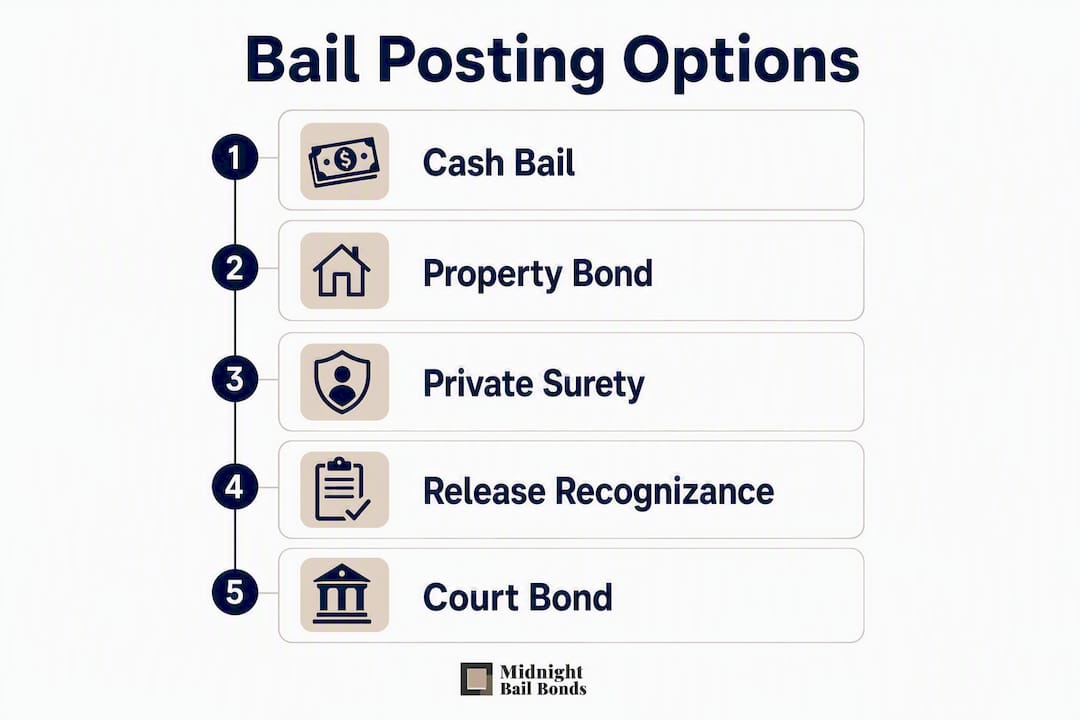
Understanding each posting method helps you pick the one that fits your timeline and finances.
Cash bail means paying the full bail amount directly to the court or jail, in cash or by credit/debit card where accepted. The court holds those funds until the case ends. If the defendant attends every required hearing, the money is returned in full. Cash bail is fast when the funds are available, but a $100,000 bail requires $100,000 in hand.
Property bond lets you pledge real estate or other significant assets as security instead of cash. The bail company or court places a lien on the property, which restricts any sale or refinancing while the case is open. If the defendant fails to appear, the court can move to foreclose on that lien. Property bonds take longer to process because the asset must be appraised and the paperwork approved by a judge.
Private surety bond (bail bond agent) is the option most families use. A licensed agent posts the full bail amount with the jail on your behalf. You pay a nonrefundable premium, commonly around 10% of the total bail, and the agent may require collateral or a cosigner depending on the risk profile. For a $100,000 bail, that means $10,000 out of pocket rather than $100,000. Agents who operate around the clock can coordinate with jail staff and often secure release within hours of posting.
Release on own recognizance (ROR) / supervised pretrial release requires no money at all. The judge releases the defendant based on a finding that they are not a flight risk and do not pose a danger to the community. ROR is uncommon for robbery charges, particularly armed robbery, but it is worth requesting through defense counsel if the defendant has a clean record and strong community ties. Supervised pretrial release may attach conditions like check-ins, travel restrictions, or electronic monitoring.
Some jurisdictions also offer court-financed bonds, where a percentage is paid directly to the court and may be partially refundable at case end, unlike a private bond premium. Availability varies by state.
How much bail bonds cost: fees, collateral, and a worked example
The nonrefundable premium on a private surety bond is the biggest up-front cost most families face. In California and most other states, that premium is set by regulation at around 10% of the total bail amount. You do not get it back when the case ends, regardless of outcome.
| Bail Amount | Cash Required (full bail) | Bond Premium (10%) | Collateral Often Required |
|---|---|---|---|
| $75,000 | $75,000 | $7,500 | Varies by agent |
| $120,000 | $120,000 | $12,000 | Varies by agent |
| — | — | $25,000 | Often required |
| — | — | — | Usually required |
Beyond the premium, watch for these additional costs and conditions:
- Collateral: For high bail amounts, agents may require a lien on real estate or other assets to secure the bond. That lien stays in place until the case concludes.
- Co-signer liability: A co-signer is contractually responsible for the full bond amount if the defendant skips court. This is not a formality.
- Financing and payment plans: Many agents, including Midnight Bail Bonds, offer payment plans so families do not have to produce the entire premium at once.
- Administrative fees: Some agents charge small processing fees on top of the premium. Ask upfront.
- Court-financed bonds: Where available, a portion of the fee paid to the court may be refundable at case end, unlike a private bond premium.
Pro Tip: Get every payment agreement in writing before handing over any money. Ask for a written receipt that itemizes the premium amount, any collateral terms, and the co-signer's obligations. Verbal agreements are nearly impossible to dispute later.
How long does each option take to get someone released?
Speed matters when someone is sitting in a holding cell. Here is how the options typically compare:
-
Cash bail (funds immediately available): Fastest option when you have the money. Once the jail processes payment and clears the paperwork, release can happen within a few hours. No agent coordination required.
-
Private surety bond through a 24/7 agent: Often just as fast as cash bail in practice. Agents who operate around the clock can reach the jail immediately, handle paperwork, and post the bond while you gather documents. Release typically follows within hours of posting, depending on jail processing volume.
-
Court-financed bond: Slower than cash or surety because it requires a court appearance or clerk processing during business hours. Plan for at least a full business day, often longer.
-
Property bond: The slowest standard option. The property must be appraised, documents filed, and a judge must approve the lien. This process can take several days.
-
ROR / supervised pretrial release: Timeline depends entirely on when the judge hears the motion. If defense counsel files quickly and the hearing is scheduled promptly, release can come within a day or two. If the court is backlogged, it may take longer.
One variable that affects every option: booking volume at the jail. A busy county jail on a Friday night processes paperwork more slowly than a quieter facility on a Tuesday afternoon. A bail agent with an established relationship with local jail staff can sometimes navigate that faster than a family acting alone.

When bail can be reduced, denied, or revoked
Bail is not necessarily fixed at the number set at booking. Defense counsel can file a bail review motion asking a judge to lower it, and in some cases the court will grant a significant reduction.
Grounds for a reduction typically include evidence that the current amount is excessive relative to the defendant's financial means, strong community ties (long-term residence, family dependents, steady employment), a clean or minimal criminal history, and weak evidence of flight risk. Bail reduction hearings require documentary proof, so start gathering employment records, lease agreements, and letters from family members or employers as soon as possible.
When bail can be denied entirely: Judges can deny bail when the defendant poses a clear danger to the public, has a history of failing to appear, or faces charges that make them statutorily ineligible for release in that jurisdiction. Armed robbery with aggravating factors, a prior violent record, or an active warrant in another state all increase the likelihood of denial.
Revocation after posting: Once bail is posted, it can still be revoked. New arrests, violations of release conditions, or evidence of witness tampering are common triggers. If bail is revoked, the defendant returns to custody and the premium already paid is not refunded.
Pro Tip: File the bail reduction motion as early as possible. Courts schedule hearings on a first-come basis, and a motion filed the morning after arrest can sometimes be heard within 24–48 hours, before the defendant has spent unnecessary time in custody.
The real tradeoffs between paying a bond premium and staying in jail
Families often hesitate at the nonrefundable 10% premium, and that hesitation is understandable. But the downstream costs of leaving someone in custody frequently exceed the premium itself.
Consider what incarceration during pretrial actually costs:
- Job loss: Many employers will not hold a position through an extended pretrial period. Lost income can dwarf a bond premium within weeks.
- Limited access to counsel: Defendants in custody have far less time with their attorneys, which can affect how well they prepare for hearings and trial.
- Family disruption: A parent in custody cannot care for children, manage household finances, or maintain the stability that often supports a better legal outcome.
- Plea pressure: Research consistently shows that detained defendants are more likely to accept unfavorable plea deals simply to end the uncertainty of pretrial incarceration.
Families often accept the nonrefundable premium because the alternative, remaining incarcerated for weeks or months, carries costs that are harder to see but just as real.
When bail is genuinely unaffordable even with a payment plan, the right moves are: request ROR at the earliest hearing, file a bail reduction motion with supporting documentation, ask the public defender to prioritize a bail hearing, and look into local bail assistance programs or nonprofit pretrial organizations in the county.
Pro Tip: Compile a "community ties packet" before the bail hearing: a letter from the employer confirming the defendant's position, a lease or mortgage document showing local residence, and any documentation of dependent care responsibilities. Judges respond to specifics, not general assertions.
What happens after bail is posted: conditions, court dates, and forfeiture
Posting bail is not the end of the legal process. It is the beginning of a set of obligations that both the defendant and any co-signer must take seriously.
If the defendant misses a court date, the consequences are swift. The court issues a bench warrant, declares the bail forfeited, and the bail agent has a limited window (set by state law) to locate the defendant and return them to custody before the full bond amount is paid to the court. Co-signers are contractually liable for that full amount if the agent cannot recover the defendant in time.
For co-signers, the exposure is real: the bail company can pursue the full bond amount through civil judgment, and any collateral pledged, including real estate, can be seized. Before co-signing, make sure you trust the defendant's commitment to appear and understand exactly what you are agreeing to in writing.
How to choose a bail bond agent you can actually trust
Not every bail agent operates the same way. A few practical steps protect you from bad actors when you are under pressure and moving fast.
Verification checklist:
- Confirm the agent's state license number through your state's Department of Insurance website before signing anything.
- Ask for a written fee agreement that states the premium amount, payment terms, collateral requirements, and co-signer obligations.
- Confirm accepted payment methods upfront. Reputable agents accept cash, credit/debit, and often digital payments like Zelle.
- Ask explicitly whether collateral is required for your bail amount and what form it can take.
- Verify 24/7 availability. An agent who only works business hours is a problem when the arrest happens at 2 AM on a Saturday.
Red flags to walk away from:
- An agent who demands the full bail amount rather than a premium.
- No written receipt or fee agreement offered.
- Refusal to provide a license number or state of licensure.
- Pressure to pay via wire transfer, cryptocurrency, or any untraceable method.
- Vague answers about collateral or co-signer liability.
Documents to have ready when you call:
- Defendant's full legal name and booking number.
- The jail or detention facility name and address.
- The specific charge(s) and the bail amount already set.
- Your photo ID and proof of relationship to the defendant.
- Information about available funds for the premium and any potential collateral.
Key Takeaways
For robbery charges, a licensed surety bail bond through a 24/7 agent is typically the fastest and most accessible release option, costing commonly about one-tenth of the total bail amount as a nonrefundable premium.
| Point | Details |
|---|---|
| Bail is set by schedule and judge | County schedules set presumptive amounts; judges adjust based on weapon use, history, and flight risk. |
| Typical robbery bail ranges widely | First-degree robbery runs about $75,000 in Marin County and $120,000 in San Joaquin County. |
| Bond premium is nonrefundable | A private surety bond costs roughly 10% of bail upfront and is not returned at case end. |
| Bail can be reduced with the right evidence | A bail reduction motion backed by employment records and community ties documentation can lower the amount. |
| Midnightbail offers 24/7 California coverage | Midnight Bail Bonds provides licensed agents, flexible payment plans, and bilingual support for fast release. |
What families should actually expect when they call for help
Speed and honesty are the two things families need most in the hours after a robbery arrest, and they are often the two things that get lost in the chaos. What actually helps is an agent who tells you the real cost upfront, explains exactly what the co-signer is agreeing to, and starts working the jail paperwork while you are still on the phone.
The families who navigate this best are the ones who call early, ask direct questions about fees and collateral before signing anything, and get a defense attorney involved as soon as possible. The bail process and the legal defense process run in parallel. Waiting on one while handling the other costs time the defendant cannot afford.
If the bail amount feels impossibly high, that is not the end of the road. A bail reduction motion, a ROR request, or a payment plan through a licensed agent can all change the math. The worst outcome is leaving someone in custody because the options were not fully explored.
Midnight Bail Bonds is ready when you need to act fast
When bail for a robbery charge runs into six figures, coming up with the full cash amount is not realistic for most families. That is exactly where Midnight Bail Bonds steps in: licensed California agents available 24 hours a day, 7 days a week, who post the full bond for a 10% premium and work directly with jail staff to get your loved one home as quickly as the system allows.
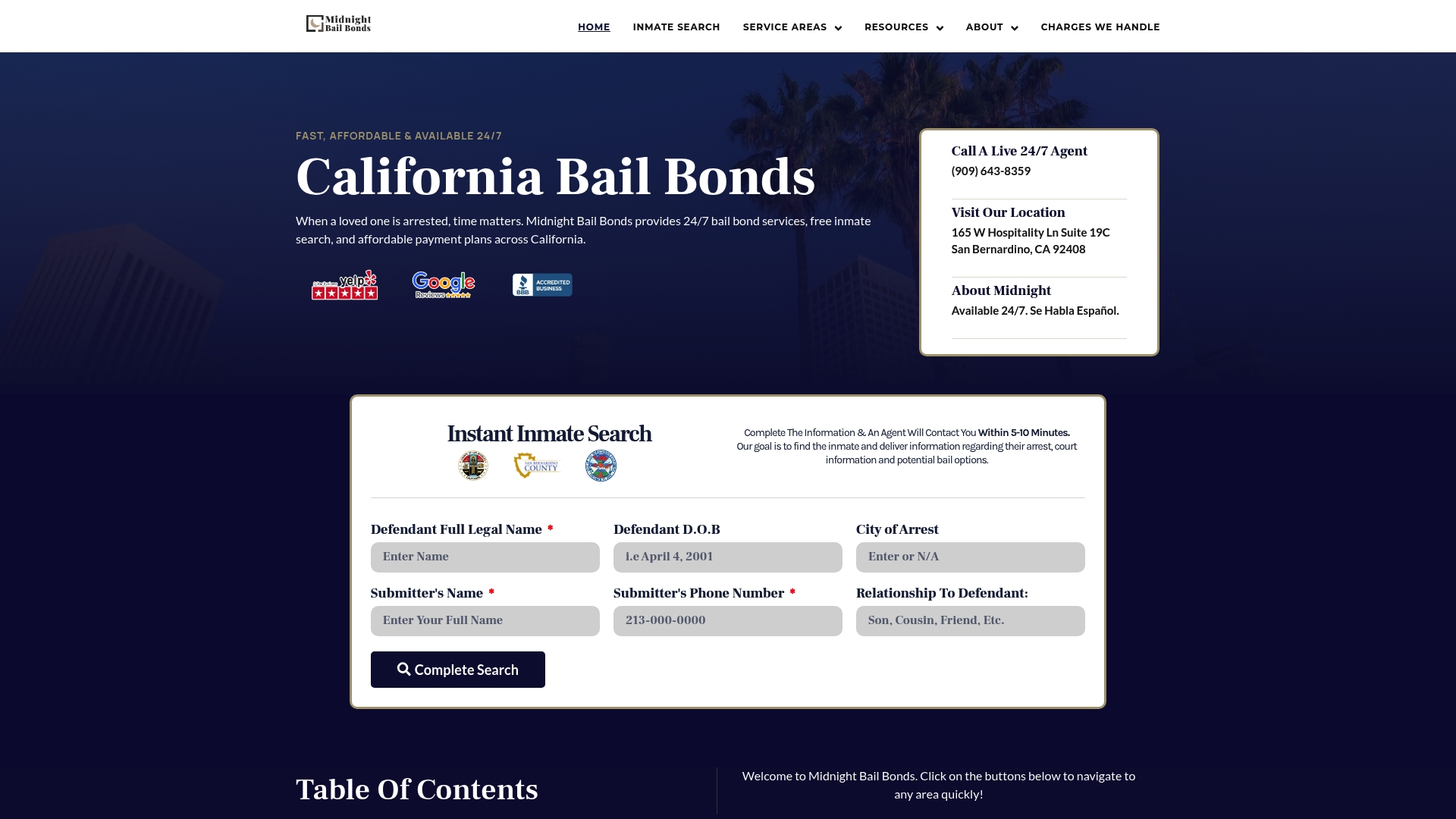
Midnight Bail Bonds accepts cash, credit and debit cards, Zelle, and financing, so the premium does not have to be a single lump-sum payment. Collateral is not required in many cases. Bilingual English/Spanish support is available for every call. If you do not know which facility is holding the defendant, agents can run an instant inmate search to locate them and confirm the bail amount before you commit to anything.
To get started, call or use the online contact form at midnightbail.com. Have the defendant's name, booking number, and the charge ready. An agent will walk you through the fee agreement, explain co-signer obligations clearly, and begin coordinating with the jail immediately.
Useful sources for verifying local bail rules and amounts
Bail schedules, court records, and state statutes are all public. Here is where to look:
- County felony bail schedules: Search your county's superior court website for the current bail schedule. California examples: Marin County Felony Bail Schedule, San Joaquin County Uniform Bail Schedule, and the Los Angeles County Felony Bail Schedule.
- California Penal Code bail statutes: California Penal Code Section 1305 governs bail forfeiture procedures and timelines.
- Legal information resources: — Justia's Criminal Law Center provides plain-language explanations of bail types and procedures applicable across U.S. jurisdictions.
This article is general information, not legal advice. Bail rules, amounts, and procedures vary by jurisdiction. Confirm current rules with your county court, a licensed bail agent, or a qualified criminal defense attorney.
FAQ
What are the four main types of bail for robbery charges?
The four standard options are cash bail, surety bond through a licensed bail agent, property bond, and release on own recognizance (ROR). Court-financed bonds are also available in some jurisdictions.
How much does a bail bond cost for typical robbery charges?
A private surety bond for first-degree robbery, with a bail amount of $75,000 in Marin County, costs $7,500; if bail is $120,000 in San Joaquin County, the bond premium is $12,000. The premium is nonrefundable and does not change based on case outcome.
How long is a sentence for robbery if convicted?
Robbery sentences vary significantly by state, degree, and aggravating factors. First-degree robbery in California carries a state prison term of three, six, or nine years, with enhancements for weapon use or injury adding additional time.
Is it better to stay in jail or bail out before trial?
Bailing out is generally better for case outcomes. Defendants in custody have less access to their attorneys, face more pressure to accept unfavorable plea deals, and risk job loss and family disruption during pretrial detention.
Can bail be reduced for robbery charges?
Yes. Defense counsel can file a bail reduction motion supported by documentation of community ties, employment, and family responsibilities. A judge can lower bail at a formal hearing, sometimes within 24–48 hours of filing.