
Yes, you can receive calls from jail. The inmate places the call outward; you cannot dial in. Calls come through one of three billing methods: collect, prepaid (branded as AdvancePay or AdvanceConnect depending on the vendor), or inmate debit/direct-bill. Your fastest path to a reliable connection is setting up a prepaid account with the facility's contracted vendor before the next call attempt.
Here are the four things to do right now:
- Identify the facility's phone vendor. Check the jail or prison website, or call the facility's inmate services line. Most U.S. facilities contract with one of three major providers: Securus Technologies, GTL/ConnectNetwork (now operating as ViaPath), or ICSolutions.
- Confirm your number is on the inmate's approved list. The inmate must add your phone number to their Personal Allowed Number (PAN) or telephone list before any call can go through.
- Create and fund a prepaid account. Go to the vendor's website, enter your phone number and the inmate's booking number, and add funds. Prepaid accounts work with cell phones; collect calls often do not.
- Test a short call. Once the account is active, have the inmate place a brief call to confirm the connection works before relying on it.
All calls are recorded and monitored except attorney calls. The automated announcement at the start of every call states this.
Pro Tip: Save the facility's inmate services number and the vendor's customer service number in your phone before the first call. If anything breaks, those two contacts resolve most problems faster than any online form.
Key Takeaways
Prepaid accounts are the most reliable way to receive jail calls on a cell phone, and setting one up before the first call attempt prevents the most common connection failures.
| Point | Details |
|---|---|
| Identify the vendor first | Check the facility website or call inmate services to find the contracted provider. |
| Use prepaid, not collect | Collect calls fail on most cell phones; prepaid (AdvancePay/AdvanceConnect) works reliably. |
| Register your own number | The account name must match the phone's registered owner or calls may be rejected. |
| Watch for carrier caps | Monthly billing caps can block collect calls mid-cycle; switch to prepaid to avoid interruptions. |
| Document threats immediately | Note date, time, and content, then contact facility Victim Services, not just the vendor. |
Table of Contents
- What types of calls from jail will you receive?
- How jail calls show up on your caller ID
- Step-by-step: how to start receiving calls from someone in jail
- How to set up and fund your calling account
- Costs, carrier caps, and why calls sometimes stop mid-cycle
- How to block calls, restrict access, and escalate threats
- How to spot scam calls and extortion attempts
- How to find out who called you from jail
- Quick fixes when jail calls fail or drop
- What families should actually prioritize with jail calls
- Sources
- FAQ
What types of calls from jail will you receive?
Understanding the billing model matters because the wrong account type can leave you unable to connect at all, especially on a cell phone.
Collect calls are billed directly to your monthly phone bill. The inmate places the call, an automated system asks you to accept, and the charge appears as a line item on your statement. The catch: many phone companies set monthly billing caps that block further collect calls once the limit is reached. Worse, most cellular carriers do not support collect billing at all, so a collect call to your cell phone will simply fail.
Prepaid collect (AdvancePay/AdvanceConnect) solves the cell-phone problem. You fund an account with the vendor in advance, and charges deduct from that balance each time a call connects. This is the most reliable option for anyone receiving calls on a mobile phone. Michigan DOC confirms that collect calls often cannot be completed to cell phones or commercial numbers, making prepaid the practical default for most families.
Inmate debit accounts are funded by the inmate through commissary deposits. The inmate pays from their own account balance rather than billing you. This works well when the incarcerated person has funds and wants to control call costs independently.
Direct-bill accounts let charges appear on your monthly phone bill without a carrier cap, where offered. Availability depends on the facility and vendor contract.
- Collect: landline-only, billed to your phone bill, subject to carrier caps
- Prepaid collect: cell-phone compatible, deducted from your funded account
- Inmate debit: funded by the inmate via commissary, no action required from you
- Direct-bill: monthly billing, limited availability, check with the vendor
Securus Technologies, GTL/ConnectNetwork, and ICSolutions each support most of these account types, though the specific options at any given facility depend on the contract between that facility and its vendor.
How jail calls show up on your caller ID
Jail calls rarely display the inmate's name. What you see is typically a facility phone number, a vendor gateway number, or a label like "Inmate Call" or "Correctional Facility." The exact number depends on which gateway the vendor routes through for that facility.
Illinois DOC publishes facility-specific caller-ID tables so families can whitelist the correct numbers before the first call. Not every state does this, but it's worth checking your facility's DOC page.
| Caller ID source | What you typically see | Common issue |
|---|---|---|
| Facility phone system | Facility's main or unit number | May trigger spam filter |
| Vendor gateway | Vendor-assigned routing number | Unfamiliar number, often blocked |
| Automated announcement | "Inmate Call" label or similar | Sent to voicemail if unrecognized |
Several things can cause a legitimate jail call to go to voicemail or get blocked outright. Spam filters on Android and iPhone flag unfamiliar numbers aggressively. Call-forwarding and VoIP services are frequently rejected by inmate phone systems, so if your number routes through a VoIP provider, the call may simply not connect.
Pro Tip: Add the facility's gateway number as a contact named "Jail Call" in your phone. On iPhone, enable "Allow Calls From" for that contact. On Android, mark it as a favorite or disable spam filtering for that number. Then test with a short call to confirm it rings through.
Step-by-step: how to start receiving calls from someone in jail
-
Identify the facility's contracted vendor. Visit the jail or prison website and look for "inmate phone" or "telephone services." If nothing is listed, call the facility's main line and ask which phone vendor they use. The answer will be Securus, GTL/ConnectNetwork (ViaPath), or ICSolutions at most U.S. facilities.
-
Confirm your number is on the inmate's approved list. The inmate submits a telephone list, typically capped at around 20 numbers, to facility staff. Indiana DOC limits inmates to approximately 20 approved numbers, and similar limits apply at most facilities. Ask the inmate to confirm your number was added and approved before you set up an account.
-
Create your account with the vendor. Go to the vendor's website or call their customer service line. You'll need: your full legal name, the phone number you want to receive calls on, the inmate's full name, their booking or ID number, and the facility name. TDCJ requires the registered owner of the receiving phone number to match the account name, and many facilities apply the same check. Use your own name and your own phone number.
-
Fund the account. Add money via credit/debit card on the vendor's website, through their IVR phone system, at a kiosk inside the facility, or via money order. Processing times vary; online card payments are usually fastest.
-
Test the connection. Have the inmate place a short call. When the automated announcement plays, press 1 to accept. If the call connects and audio is clear, the account is working. If it fails, check the account balance, confirm the number is registered correctly, and verify the inmate's list was approved.
How to set up and fund your calling account
The setup process is the same across Securus, GTL/ConnectNetwork, and ICSolutions: create an account on the vendor's portal, link your phone number, and add funds. The differences are in the funding options and fee structures.
What you'll need to register:
- Your legal name (must match the phone account owner)
- The phone number to receive calls
- The inmate's full name and booking/ID number
- The facility name and state
Funding methods available at most vendors:
- Online by credit or debit card (fastest, usually processed within minutes)
- IVR phone payment (call the vendor's toll-free number and follow prompts)
- Facility kiosk (cash or card, available during visiting hours)
- Money order mailed to the vendor
- Commissary deposit (for inmate debit accounts, funded at the facility)
Watch for account inactivity rules. Some vendors close accounts or forfeit balances after 90–180 days of no activity. Check the vendor's terms before leaving a large balance sitting unused.
To verify the account is active before relying on it:
- Log in and confirm the balance shows correctly
- Check that your phone number appears as a registered receiving number
- Confirm the inmate's name and facility are listed accurately
- Place a test call and accept it by pressing 1 when prompted
Jail411 recommends prepaid accounts as generally less expensive than collect calls and notes that the vendor is assigned by the facility, so you cannot choose a different carrier.
Costs, carrier caps, and why calls sometimes stop mid-cycle
Jail call costs vary by facility, vendor, and call type. The FCC has set caps on interstate calls, but intrastate rates (calls within the same state) are regulated state by state and can run higher.
Rate context: Jail411 references typical per-minute ranges and FCC interstate caps as a benchmark for expected costs. Check your specific vendor's rate page for the facility you're dealing with, since rates differ by contract.
The most disruptive cost issue is the carrier billing cap on collect calls. ICSolutions warns that phone companies often set monthly caps on how much collect-call billing they'll process. Once that cap is hit, the system blocks further collect calls for the rest of the billing cycle, even if the inmate tries to call and you want to accept.
Pro Tip: If collect calls suddenly stop connecting mid-month, the carrier cap is the most likely cause. Switch to a prepaid account immediately. Fund it online and the inmate can call again within the same day.
How to block calls, restrict access, and escalate threats
You have the right to refuse or permanently block calls from a jail phone system. Here's how each level works:
- Refuse a single call: When the automated announcement plays, simply hang up or press the prompted key to decline. No account or registration needed.
- Set a permanent block via the phone prompt: Some vendor systems offer a block option during the call announcement, often by pressing a specific key (such as "6") and setting a PIN. This blocks future calls from that inmate to your number through that vendor's system.
- Contact vendor support directly: Call the vendor's customer service line and request a permanent block on your number. Provide your phone number and the inmate's name or ID. Processing typically takes 1–3 business days.
- Request a facility-level restriction: Contact the facility's Warden's office or Victim Services unit in writing. Michigan DOC advises contacting local law enforcement and the facility directly if calls are threatening. A formal restriction from the facility carries more weight than a vendor-level block alone.
- Involve law enforcement: If calls contain threats, document everything. Note the date, time, and content of each call. Save any recordings the vendor system generates. File a report with local police and provide that report number to the facility's Victim Services coordinator.
- Unblocking a number: If a block was set in error, call vendor support with your account details and the inmate's information. Expect a review period before the block is lifted.
How to spot scam calls and extortion attempts
Not every call that claims to come from a jail is legitimate. Scammers use spoofed facility numbers to run payment fraud, impersonation schemes, and extortion attempts.
Common patterns to recognize:
- An unsolicited call demanding immediate payment to prevent a loved one's transfer or release delay
- Requests to wire money or load a prepaid card rather than fund through the vendor's official portal
- A caller claiming to be a corrections officer asking for your bank account or card number
- Third-party "savings services" that promise lower per-minute rates if you pay them instead of the vendor
Verification checklist before acting on any call:
- Confirm the inmate's name and booking number against the facility's public inmate roster
- Call the facility's inmate services line directly (using the number from the facility's official website, not a number given by the caller)
- Log into your vendor account and check the transaction history for any unauthorized charges
- Ask the facility whether the inmate actually placed a call at that time
Pro Tip: Never provide bank account details, full card numbers, or wire transfer instructions over an unverified phone call. Fund accounts only through the vendor's official website, their IVR phone system, or the facility kiosk. If a caller insists on another payment method, hang up.
To report fraud: contact the vendor's fraud line, notify the facility's administration, and file a complaint with the FTC at reportfraud.ftc.gov. Keep screenshots of any transaction receipts and note the exact timestamps of suspicious calls.
How to find out who called you from jail
Missed a call and not sure which facility or inmate it came from? Work through these steps:
- Check your call log. Note the exact number and call time. Gateway numbers often follow a pattern tied to a specific vendor or region.
- Cross-check with facility caller-ID tables. Some state DOC pages publish gateway number lists. The Illinois DOC contact page is one example. Search "[state] DOC inmate phone numbers" to find your state's equivalent.
- Call the vendor's customer service line. Provide the number that called you and the timestamp. The vendor can confirm whether that gateway number belongs to their system and which facility it routes from.
- Contact the facility's inmate services line. If you have a name or partial information, ask whether that person is currently housed there and whether they placed a call at that time.
- Use the facility's inmate search tool. Most county jails and state DOC systems have a public inmate locator. Search by name to confirm location and booking number.
- For billing disputes: Gather the call timestamps, the line items on your phone bill or vendor account statement, and any confirmation emails. File a dispute with the vendor first. If unresolved, escalate to your phone carrier or file a complaint with your state's Public Utilities Commission.
Quick fixes when jail calls fail or drop
Run through this checklist before calling vendor support:
- Check your account balance. A zero or low balance is the most common reason calls fail on prepaid accounts.
- Verify your phone number is registered correctly. Log into the vendor portal and confirm the number matches exactly, including area code.
- Confirm the inmate's list is approved. A number submitted but not yet approved by facility staff will not connect.
- Test with a landline. If you're on a cell phone and calls keep failing, try a landline. LegalClarity notes that many inmate systems reject call-forwarding and VoIP numbers, and some cellular configurations cause similar rejections.
- Check calling hours. Facilities restrict phone access to specific hours. Calls attempted outside those windows fail silently.
- Disable call-forwarding. If your number forwards to another line, the inmate's call may be rejected at the vendor level.
If calls connect but drop frequently, ask the inmate to try a different phone unit or a different time of day. Network congestion inside facilities is real. Contact vendor support with the specific call timestamps so they can check their system logs.
When to escalate to the facility: If the vendor confirms no technical issue on their end but calls still fail, contact facility inmate services. Ask them to verify the inmate's telephone list status and whether any facility-level restriction is in place on your number.
What families should actually prioritize with jail calls
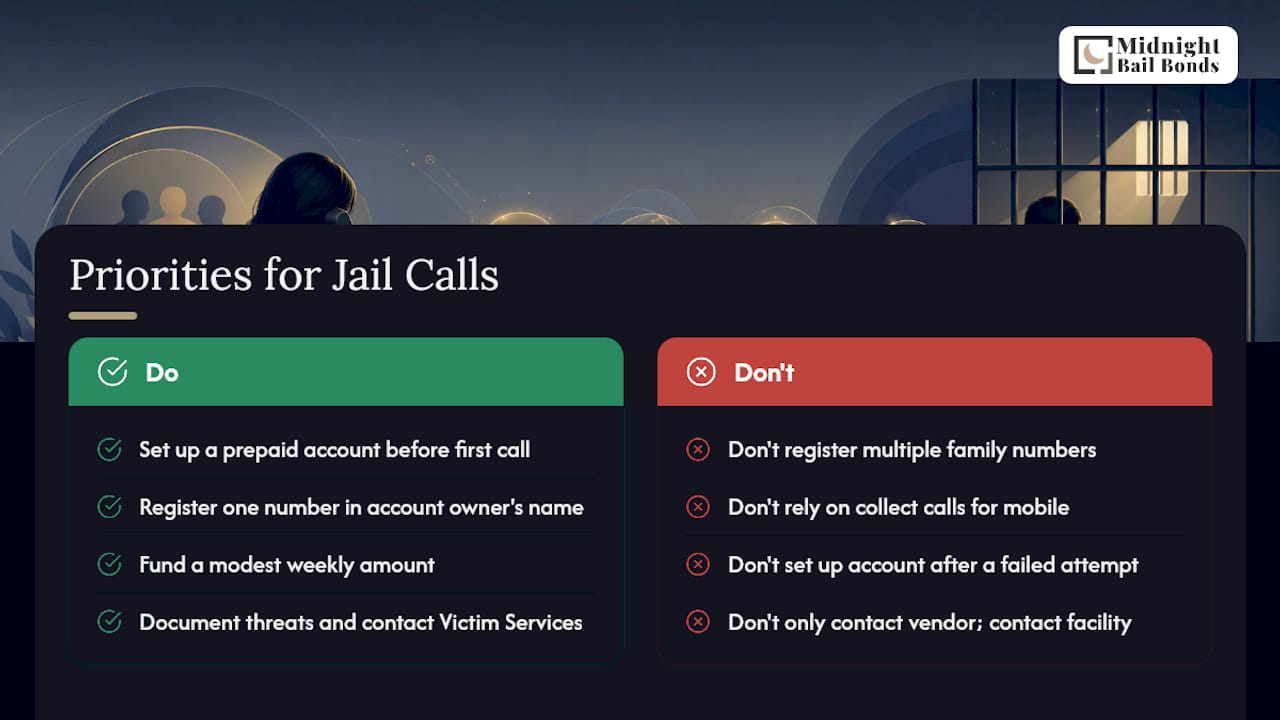
The practical reality is that collect calls are a legacy system. They were designed for landlines, and most families today rely on cell phones. Prepaid accounts are not just cheaper in most cases; they're the only option that reliably works on mobile. Set one up before the first call, not after a failed attempt.
One household policy worth adopting: keep a single registered number in the account owner's name, fund a modest weekly amount to stay ahead of the balance, and resist the urge to register multiple numbers across different family members' accounts. Fragmented accounts create confusion and increase the chance of a number falling off an inmate's approved list.
If you receive a threatening call, document it immediately. Write down the date, time, and what was said. Then contact the facility's Victim Services coordinator, not just the vendor. The vendor can block a number; the facility can restrict the inmate's phone access entirely.
If a loved one's call is the first sign of an arrest and you need to act on release, Midnightbail provides 24/7 bail bond services across California, with bilingual support and a free instant inmate search. The call is often the starting point; what happens next determines how long they stay inside.
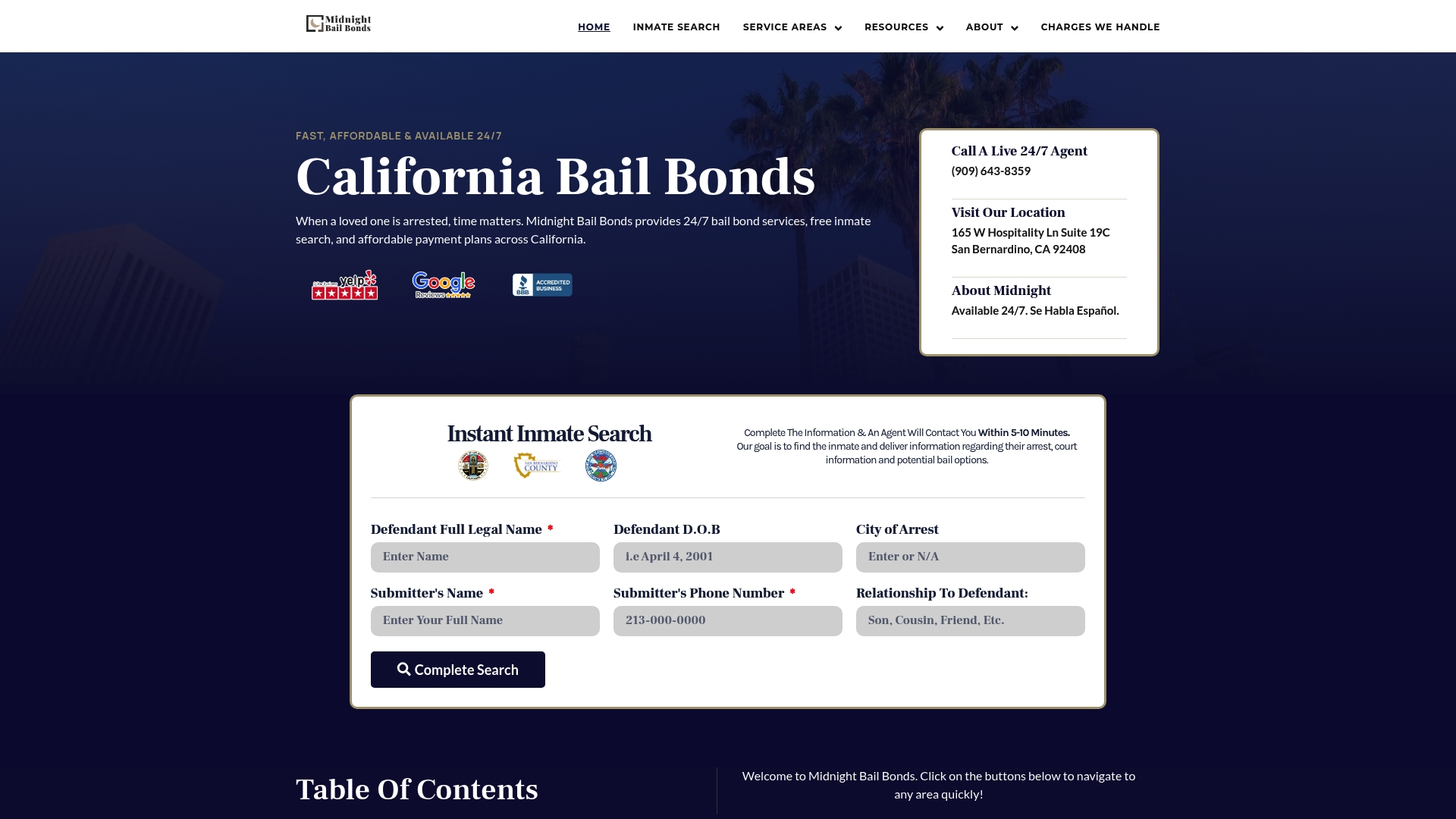
Need help getting someone out after that call? Midnightbail's licensed agents are available 24/7 across California. Whether the arrest is in Orange County, Riverside County, or anywhere else in the state, the team can start the bail bond process immediately. Flexible payment plans, no collateral required in many cases, and Spanish-language support available.
Sources
Before setting up an account or troubleshooting a problem, verify the rules at your specific facility. Rates, caller-ID numbers, and blocking procedures vary by contract.
- IC Solutions > Friends Family Home > Products & Services > Collect Calling
- IDOC: Phone Calls
- Michigan
- How to Call Someone in Jail — Complete Phone Guide | Jail411
- How to Call Inmates in Jail: Setup, Costs, and Rules - LegalClarity
- TDCJ: Offender telephone information
Never transfer money or provide payment details based on instructions from a third-party website. Verify any rate or setup claim against the vendor's official portal or the facility's DOC page directly.
FAQ
Why am I getting calls from a jail?
Someone incarcerated at that facility added your phone number to their approved calling list. Inmates can only place outgoing calls; they cannot receive incoming calls from outside.
What number shows up when someone calls from jail?
You'll typically see a facility phone number or a vendor gateway number, not the inmate's name. Some state DOC pages publish caller-ID tables so you can identify and whitelist the correct number.
How do I receive phone calls from jail?
Create a prepaid account with the facility's contracted vendor (Securus, GTL/ConnectNetwork, or ICSolutions), fund it, and confirm your number is on the inmate's approved list. When the call comes in, press 1 to accept after the automated announcement.
How do I find out who called me from a jail?
Check your call log for the gateway number, then contact the vendor's customer service line with that number and the call timestamp. You can also search the facility's public inmate roster if you have a name.
Can jail calls go to a cell phone?
Collect calls usually cannot connect to cell phones because most cellular carriers don't support collect billing. Prepaid accounts work with cell phones and are the standard workaround.