
A bench warrant in California authorizes law enforcement to arrest you on the spot and bring you before a judge. It is not a future threat. It is active the moment a judge signs it, and it stays active until a court recalls or quashes it. If you suspect one exists, here is what to do right now:
- Verify immediately. Contact the court clerk in the county where your case was filed, or check the county sheriff's official warrant or inmate search page. Do not rely on third-party lookup sites.
- Call a criminal-defense attorney or a licensed bail agent. An attorney can often file a motion to recall the warrant before you are arrested. If arrest is imminent or has already happened, a bail agent can help secure your release.
- Consider voluntary surrender. Showing up to court with counsel is almost always better than being picked up during a traffic stop. Judges respond more favorably to defendants who demonstrate cooperation.
The legal framework governing these warrants includes California Penal Code §978.5, which authorizes issuance and statewide service, and PC §853.8, which sets a 20-day deadline for magistrates after a written promise to appear is broken. The California DMV and the courts are the official institutions to contact for license holds and case status.
Table of Contents
- What is a bench warrant in California?
- Why do California courts issue bench warrants?
- What do the key California statutes actually say?
- What happens when you have an outstanding bench warrant?
- How do you check if you have a bench warrant in California?
- How do you get a bench warrant cleared in California?
- When should you hire an attorney for a bench warrant?
- What happens after arrest on a bench warrant?
- Seven-step checklist if you suspect a bench warrant
- Key Takeaways
- What attorneys and bail agents see most often
- Midnightbail is available 24/7 when custody is on the line
- Official sources and further reading
- FAQ
What is a bench warrant in California?
A bench warrant is issued by a judge, from the bench, in a case that is already open. That is the key distinction from an arrest warrant. An arrest warrant starts a new criminal case, typically after law enforcement presents probable cause to a judge. A bench warrant arises mid-case, when a defendant fails to comply with a court order or misses a required appearance.
Cornell Law's WEX legal dictionary describes bench warrants as judge-issued orders directing law enforcement to bring a named person before the court, typically triggered by non-compliance rather than a new criminal allegation.
| Feature | Bench Warrant | Arrest Warrant |
|---|---|---|
| Who issues it | Judge, on the court's own motion | Judge, based on law enforcement's probable-cause showing |
| When it's used | Existing case: FTA, contempt, probation violation | New criminal investigation or charge |
| New complaint required? | No | Yes |
| Probable cause for new crime? | No | Yes |
| Appears in law enforcement databases? | Yes, statewide | Yes, statewide |
| Typical bail pattern | Set by judge at recall hearing; sometimes "no bail" | Set at arraignment |
Concrete scenarios that produce bench warrants: missing your arraignment date after release on citation, failing to appear at a sentencing hearing, or willfully skipping a court-ordered payment deadline. None of these require a new crime. The court simply issues the warrant to compel your return.
Why do California courts issue bench warrants?
Failure to appear
The most common trigger. Under PC §978.5, a judge may issue a bench warrant any time a defendant who was ordered to appear does not show up. This covers arraignments, pretrial hearings, trial dates, and sentencing. The statute allows the warrant to be served in any California county, not just the one where the case is pending.
A misdemeanor example: you were cited for shoplifting in Sacramento, signed a written promise to appear, and missed the court date. Under PC §853.8, the magistrate must issue a bench warrant within 20 days of that failure to appear. The warrant goes into the state database. A routine traffic stop in Fresno three months later will surface it.
A felony example: you were out on bail for an assault charge in Los Angeles County and missed a pretrial conference. The judge issues a bench warrant, likely with no-bail status, meaning you cannot simply post bond to get out. You will stay in custody until a judge reviews the case.
Failure to pay fines or restitution
Courts can issue bench warrants when defendants ignore payment orders, including fines, restitution to victims, or child support obligations tied to a criminal or family court case. The warrant is not for the underlying offense. It is for contempt of the court's order.
Probation violations
If you are on probation and miss a check-in, fail a drug test, or pick up a new charge, your probation officer can report the violation. The court will typically schedule a hearing, but if you fail to appear at that hearing, a bench warrant follows. Probation-violation warrants often carry higher bail amounts than the original offense.
Contempt of court and other triggers
Penal Code §166 covers contempt of court, which includes willful disobedience of any court order. Missing community service deadlines, failing to complete a court-ordered treatment program, or violating a protective order can all result in a §166 contempt finding and a bench warrant.
What do the key California statutes actually say?
Three Penal Code sections do most of the work in bench-warrant cases. Here is what each one controls in plain terms:
| Statute | What it controls |
|---|---|
| PC §978.5 | Authorizes a judge to issue a bench warrant when a defendant fails to appear as required. The warrant carries the same force as an arrest warrant and can be served in any California county. |
| PC §853.8 | Applies specifically when a person signed a written promise to appear (a citation release) and then failed to show up without posting bail. The magistrate must issue a bench warrant within 20 days of the FTA. |
| PC §166 | Defines contempt of court, including willful disobedience of any lawful court order. A §166 violation can itself be charged as a misdemeanor and is a common basis for bench-warrant issuance. |
| PC §813 et seq. | Governs the general warrant-of-arrest framework, including how complaints and summonses interact with warrant issuance. When a summons is issued and the defendant fails to appear, a bench warrant may follow under this chapter. |
The California Legislative Information page for PC §813 contains the full statutory text for the warrant-of-arrest chapter, which is worth reading if you want to understand how a summons converts to a warrant.
For motions to recall or quash, California Courts Self-Help form CR-302 is a starting point for the paperwork, though an attorney should review any motion before it is filed.
What happens when you have an outstanding bench warrant?
The consequences are immediate and compound over time. According to the San Diego Superior Court, outstanding bench warrants can result in immediate arrest, DMV license holds, additional criminal charges, and forfeiture of any bail already posted.
Arrest at any time, anywhere. Bench warrants are entered into statewide law enforcement databases and remain active indefinitely until a judge recalls or quashes them. A traffic stop, a background check, even a call to 911 from your address can surface the warrant. Officers are not required to warn you. They will detain you on the spot.
No-bail warrants. Some bench warrants, particularly for felonies or repeat failures to appear, are issued with a "no bail" designation. If you are arrested on one of those, you stay in custody until a judge holds a hearing. There is no bond amount to post at the jail window.
DMV consequences. The California DMV can place a hold on your driver's license when court-ordered obligations go unresolved. In some cases, the license is suspended outright. Driving on a suspended license adds a separate charge to an already complicated situation.
Additional criminal charges. Failing to appear on a misdemeanor can itself be charged as a misdemeanor. Failing to appear on a felony can be charged as a felony, carrying its own potential jail or prison time on top of the original case.
Bail forfeiture. If you were out on bail when the warrant issued, that bail is typically forfeited. The court can order the bail bond exonerated, meaning the bonding company loses the posted amount and may pursue the indemnitor for recovery.
Family law and civil matters. An outstanding warrant can affect custody hearings. Judges in family court are aware of criminal warrants, and a parent with an active bench warrant may face adverse credibility findings or temporary custody restrictions.
County practices vary. Los Angeles County, for example, has a high-volume court system where warrant recalls can take weeks to schedule. Smaller counties may move faster, but enforcement intensity also varies. What stays constant is that the warrant is visible statewide from the moment it is issued.
How do you check if you have a bench warrant in California?
-
Use California Courts Self-Help resources. The California Courts Self-Help portal provides guidance on navigating court records and case management, including links to county-specific resources.
-
Check with the DMV if you suspect a license hold. If your license has been suspended or flagged, the California DMV portal is the authoritative source. A hold tied to a court case will show up in your driving record.
Avoid commercial warrant-lookup websites. Many charge a fee and pull from outdated or incomplete databases. They are not connected to the live court or law enforcement systems. An official court clerk or sheriff search is always more reliable.
When you call the court clerk, have ready: your full legal name as it appears on court documents, your date of birth, and the case number or citation number if you have it. If you do not have the case number, the clerk can usually search by name and DOB.
How do you get a bench warrant cleared in California?
The path from warrant to resolution follows a predictable sequence, though the details shift depending on whether the underlying charge is a misdemeanor or a felony.
Verify, then consult counsel. Before doing anything else, confirm the warrant exists and which court issued it. Then call a criminal-defense attorney. This is not optional advice for serious cases. An attorney can often contact the court, review the file, and tell you within hours whether a motion to recall is viable or whether you need to arrange a voluntary surrender.
Motion to quash or recall. The formal legal mechanism is a motion asking the judge to recall the warrant and reset the case for a new hearing. For many misdemeanor cases, an attorney can appear on your behalf without you being present, file the motion, and obtain a recall at the hearing. Felony cases almost always require your in-person appearance. The court will typically set a new hearing date within days to weeks of the motion being filed, depending on the county's calendar.
Voluntary surrender vs. waiting to be arrested. Defense practitioners consistently recommend retaining counsel and appearing voluntarily rather than waiting to be picked up. Judges notice the difference. A defendant who walks in with an attorney, acknowledges the missed appearance, and offers a credible explanation is in a far better position than one who was pulled over at 2 AM and brought in handcuffed.
Possible outcomes at the recall hearing. The judge can recall the warrant and release you on your own recognizance, set a new bail amount, reduce the existing bail, or remand you into custody pending the next hearing. The outcome depends on your history, the seriousness of the underlying charge, and how many times you have failed to appear before.
Costs. Court fees vary by county and case type. If bail is set or reset at the recall hearing, a licensed bail bond agent typically charges the state-mandated non-refundable premium of 10% of the total bail amount. Additional fees vary by agent and payment arrangement.
Pro Tip: Appearing voluntarily with an attorney signals cooperation to the judge. Defense attorneys report that judges often recall first-time warrants for defendants who show up proactively, especially on misdemeanor cases. Being arrested on the warrant, by contrast, gives the judge no reason to extend that benefit of the doubt.
When should you hire an attorney for a bench warrant?
Some situations call for professional legal help immediately. Others give you a narrow window to act on your own. Here is how to tell the difference.
Hire counsel right away if:
- The underlying charge is a felony
- You have prior failures to appear or prior bench warrants on your record
- The warrant may be designated "no bail"
- The case involves DUI, domestic violence, drug charges, or any offense with mandatory minimums
- A child custody or family law matter is running parallel to the criminal case
- You are on probation or parole
What an attorney will actually do:
- File a motion to quash or recall the warrant in the issuing court
- Negotiate a voluntary surrender or an OR (own recognizance) release at the recall hearing
- Appear in court on your behalf for eligible misdemeanor cases, keeping you out of custody
- Negotiate a reduced bail amount if the judge sets one
- Coordinate with a licensed bail agent if custody is unavoidable
Three questions to ask any attorney you are considering:
- How many bench-warrant recall motions have you filed in this specific county?
- What is your fee structure, and does it cover the recall hearing and any follow-up appearances?
- Realistically, how long will this take, and what is the most likely outcome given my record?
An attorney who hedges on all three questions or cannot give you a county-specific answer is not the right fit for a time-sensitive warrant situation.
What happens after arrest on a bench warrant?
If you are arrested before the warrant is recalled, the process moves quickly. Officers will book you into the county jail where you were detained, not necessarily the county where the case originated. Booking typically takes two to six hours, after which you will have a booking number, a listed charge, and a bail amount, unless the warrant was issued as no bail.
Cash bail vs. a bail bond. Posting cash bail means paying the full bail amount directly to the jail. That money is returned at the end of the case, minus court fees, assuming you make all appearances. Most families cannot post the full amount in cash, which is where a licensed bail bond agent comes in. The agent posts a surety bond for the full bail amount in exchange for a non-refundable premium, typically 10% of the bail, paid by the family or the defendant.
Practical steps to arrange release:
- Get the full legal name, date of birth, and booking number of the person in custody
- Identify the jail facility where they are being held (the arresting officer or the jail's public information line can confirm this)
- Contact a licensed bail agent. Midnightbail operates 24/7 across California and can run an instant inmate search to locate the booking and confirm bail status
- Discuss payment options. Midnightbail accepts cash, credit and debit cards, Zelle, and financing, and offers bail without collateral in many cases
- The agent will post the bond, and the jail will process the release, typically within a few hours of the bond being posted
When to call a bail agent vs. an attorney first. If someone is already in custody, call a bail agent immediately to start the release process. The attorney conversation can happen in parallel or shortly after. If the warrant has not yet led to an arrest, call the attorney first. The goal is to avoid custody entirely through a recall motion.
Bilingual support matters in California's diverse communities. Midnightbail offers English and Spanish assistance, which reduces confusion during an already stressful booking process.
For a detailed walkthrough of post-arrest logistics, the battery bail process guide covers the custody-to-release timeline in practical terms.
Seven-step checklist if you suspect a bench warrant
-
Verify the warrant through official channels. Call the court clerk in the county where your case was filed, or check the county sheriff's official warrant search page. Have your full name, date of birth, and case number ready.
-
Call a criminal-defense attorney before doing anything else. Do not walk into a courthouse, call the police, or post anything on social media until you have spoken with counsel.
-
Avoid unnecessary travel, especially out of state. An active bench warrant can complicate border crossings and interstate travel. Stay local until the warrant is resolved.
-
Consider voluntary surrender with counsel present. If the attorney recommends it, arrange a scheduled surrender. This is almost always better than an unplanned arrest.
-
Contact a licensed bail agent if arrest is likely. Give the agent your name, DOB, the county where the case is filed, and the charge if known. They can pre-screen your situation and be ready to post bond quickly.
-
Gather your documents. Collect your case number, any prior court paperwork, and contact information for any witnesses or character references. Your attorney will need these.
-
Attend every scheduled hearing without exception. Once the warrant is recalled and a new date is set, missing it will restart the entire process, likely with a higher bail amount and less judicial patience.
Dos and don'ts:
- Do not ignore the warrant hoping it will expire. It will not.
- Do not rely on friends or unverified online sources to confirm whether a warrant exists.
- Do not drive on a suspended license if the DMV has placed a hold.
Key Takeaways
A California bench warrant stays active indefinitely until a judge recalls it, and voluntary appearance with counsel is the single most effective way to resolve one without custody.
| Point | Details |
|---|---|
| Warrants don't expire | A bench warrant remains in statewide law enforcement databases until a judge recalls or quashes it. |
| Verify through official sources | Contact the court clerk or county sheriff's warrant search page; avoid commercial lookup sites. |
| Core statutes to know | PC §978.5 authorizes issuance; PC §853.8 sets a 20-day FTA deadline; PC §166 covers contempt. |
| Voluntary appearance wins | Appearing with counsel before arrest gives judges a reason to recall the warrant and avoid custody. |
| Midnightbail for fast release | If arrest occurs, Midnightbail's 24/7 licensed agents across California can post bail quickly with flexible payment options. |
What attorneys and bail agents see most often
The cases that resolve cleanly share one thing: the defendant acted fast and brought a lawyer. A first-time misdemeanor FTA, handled within days of the warrant issuing, almost always ends with a recall and a reset court date. The judge sees someone who made a mistake, acknowledged it, and showed up. That is usually enough.
The cases that spiral are the ones where someone waited. A person misses a court date, hears nothing for a few weeks, and convinces themselves it was not a big deal. Then a traffic stop six months later turns into a weekend in jail, a forfeited bail bond, and a new failure-to-appear charge stacked on top of the original case. The original offense might have been a minor misdemeanor. Now it is a multi-hearing ordeal with a public defender stretched thin and a judge who has seen this defendant's name twice for non-appearances.
The contrast between those two outcomes is not luck. It is timing and representation. Judges in California's busier courts, Los Angeles, San Diego, Sacramento, see dozens of warrant recalls every week. A defendant who walks in voluntarily, with counsel, before being arrested is not memorable in a bad way. That is exactly what the system expects cooperation to look like.
One thing families often underestimate: the bail piece and the legal piece are separate problems that need to run simultaneously. If someone is already in custody, the priority is getting them out so they can participate in their own defense. That is where a licensed bail agent earns their fee. The attorney handles the court strategy. The bail agent handles the release. Trying to do one without the other wastes time that matters.
For complicated cases, especially felonies, repeat FTAs, or anything involving probation, hire counsel before taking any other step. For custody situations, call a licensed bail agent the same hour.
Midnightbail is available 24/7 when custody is on the line
When a bench warrant leads to an arrest, the clock starts immediately. Every hour in custody is an hour away from work, family, and the ability to help your own case. Midnightbail's licensed agents are available around the clock, every day, across California, covering charge types from DUI and drug offenses to domestic violence, theft, assault, and failure to appear.
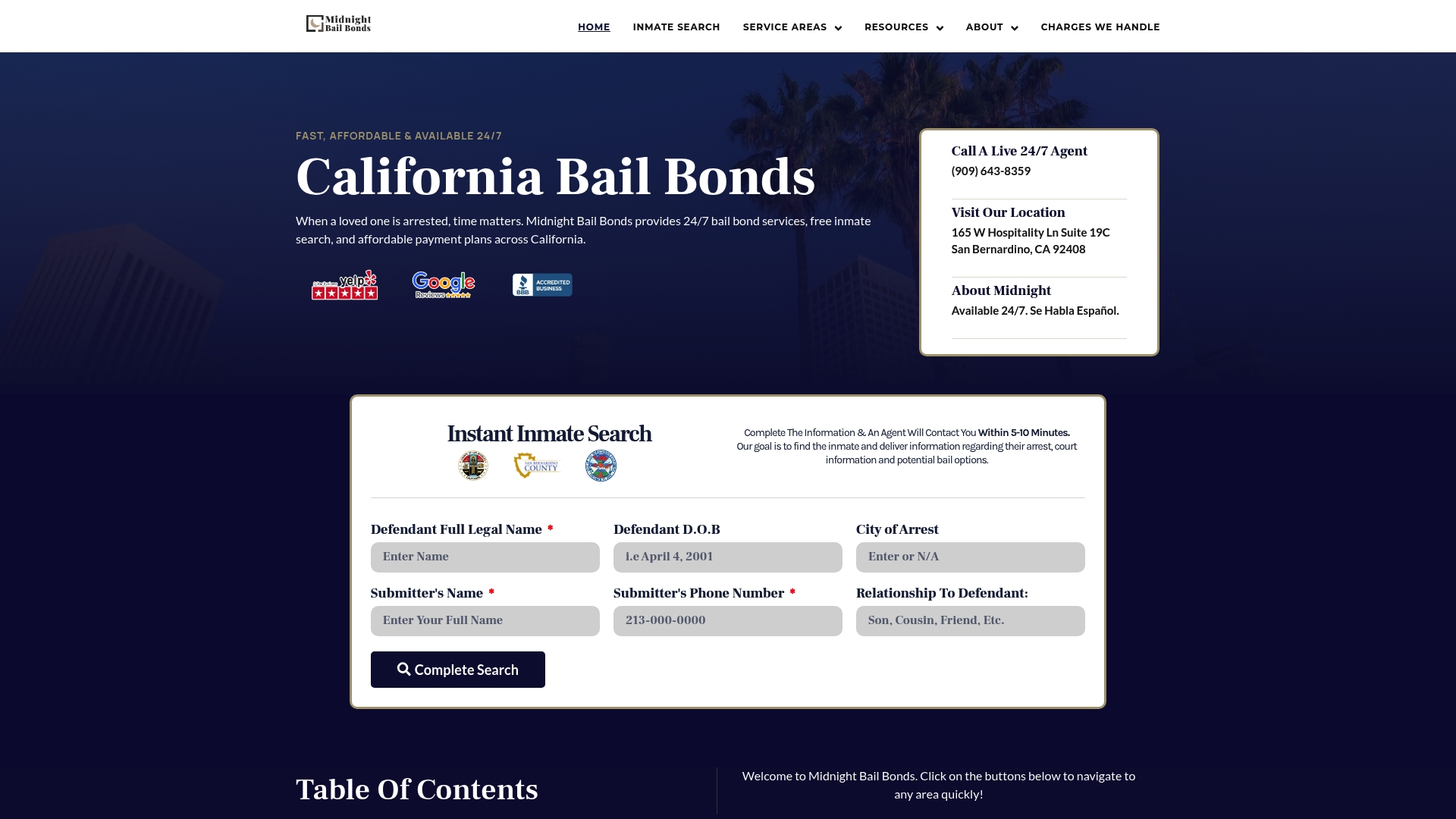
Here is what to have ready when you call: the full legal name of the person in custody, their date of birth, the booking number, the jail facility name, and the charge if known. Midnightbail can run an instant inmate search to locate the booking even if you do not have all the details yet. Payment options include cash, credit and debit cards, Zelle, and financing, and bail without collateral is available in many cases. Bilingual English and Spanish support is available for every call.
Whether you are in Los Angeles County, Orange County, Riverside County, or anywhere else in California, Midnightbail can post the bond and get the release process moving. Call or contact Midnightbail now to get a quote, confirm bail status, and start the release. If the warrant has not yet led to an arrest, speak with a criminal-defense attorney first. If custody has already happened, the bail agent call comes first.
Official sources and further reading
Using official sources matters because commercial warrant-lookup sites pull from outdated databases and may charge fees for information you can get free from the court or sheriff. Start with the source closest to your specific case.
- Warrants | Superior Court of California - County of San Diego
- California Code, Penal Code - PEN § 978.5 | FindLaw
- I have a bench warrant in California. How do I get it recalled? | Shouse Law Group
- Penal Code 978.5 PC - Bench Warrant of Arrest in California | Shouse Law Group
- California Penal Code 853.8 PC – Bench warrants for failure to appear | Shouse Law Group
- California DMV — Official portal
- California Courts Self-Help — CR-302
- Bench warrant — WEX | Cornell Law School
Which source to use first: If you know the county, call that county's superior court clerk directly and use the county sheriff's warrant search page. If you are unsure of the county, start with the California Courts Self-Help portal, which links to county-specific resources. Bring your full legal name, date of birth, and case or citation number to every contact.
FAQ
How serious is a bench warrant in California?
A California bench warrant is immediately serious. It authorizes any law enforcement officer statewide to arrest you on contact, and it remains active until a judge recalls it, with no expiration date.
How long do you stay in jail for a bench warrant?
It depends on the underlying charge and whether the warrant carries a bail amount. With a bail-eligible warrant, a licensed bail agent can often secure release within hours of booking. A no-bail warrant means you stay in custody until a judge holds a hearing, which can take one to several days depending on the county's court schedule.
How do you get rid of a bench warrant in California?
The standard path is to hire a criminal-defense attorney, who files a motion to quash or recall the warrant in the issuing court. For misdemeanors, the attorney can often appear without you present. Felonies typically require your in-person appearance at the recall hearing.
How do you know if you have a bench warrant in California?
Call the court clerk in the county where your case was filed and provide your full name, date of birth, and case number. You can also check the county sheriff's official online warrant or inmate search page. Both are free and pull from live court and law enforcement records.
Can a bench warrant affect my driver's license?
Yes. The California DMV can place a hold on your license or suspend it when court-ordered obligations, including failure-to-appear cases, go unresolved. Resolving the warrant through the court is the first step to lifting a DMV hold.