

If you cosign a bail bond, you legally guarantee the defendant's court appearances and can be held liable for the full bond amount if they fail to appear. That liability can include collateral seizure, collection costs, and lasting credit damage. Before you sign anything, read the indemnity contract line by line and get every fee and collateral term in writing.
TL;DR:
- Cosigners are personally liable for the full bail amount if the defendant skips court, including potential seizure of collateral and legal costs.
- The nonrefundable premium paid to bail agents, typically around 10% of the bond, does not cover any collateral or recovery expenses.
- Qualifications for cosigners generally include age, steady income, valid ID, residence stability, and no disqualifying criminal history.
- Collateral is held only during the case and should be clearly documented, with obligations ending once the court exonerates the bond.
- Asking detailed questions about collateral return, fees, and surrender procedures before signing is essential to avoid unexpected liabilities.
Table of Contents
- What Is a Cosigner for Bail, and How Does the Bond Actually Work?
- What You're Actually Agreeing To: Responsibilities and Worst-Case Risks
- Who Can Be a Cosigner? Qualifications and Paperwork to Bring
- Collateral, Fees, and When Your Liability Actually Ends
- How to Protect Yourself Before You Sign Anything
- How Midnight Bail Bonds Approaches Cosigner Protection
- What the Conventional Bail Advice Gets Wrong
- Get Help Without the Guesswork: How Midnight Bail Bonds Works
- Sources
- FAQ
What Is a Cosigner for Bail, and How Does the Bond Actually Work?
A cosigner, also called an indemnitor, is the person who signs a contract promising to cover the full bail amount if the defendant skips court. The term "indemnitor" is the legal word bail companies use in their paperwork, but most people know the role simply as cosigning for bail.
Here's the mechanic most people miss: the bail agent doesn't pay the court out of pocket. A licensed surety backs the bond, and the agent charges a premium, usually a percentage of the total bail, for taking on that risk. The U.S. Treasury's list of certified surety companies shows just how regulated this backing arrangement is. That's precisely why agents need a cosigner: someone has to personally guarantee the money if the defendant vanishes.
- The surety company backs the full bond amount.
- The bail agent collects a premium as their fee for arranging release.
- The cosigner signs an indemnity agreement making them liable if the defendant doesn't show up in court.
What You're Actually Agreeing To: Responsibilities and Worst-Case Risks
Signing as a cosigner means you're personally on the hook for the full bond, not just the premium, if the defendant fails to appear. That's the single biggest thing people underestimate when weighing bail cosigner requirements against a quick favor for a family member.
Here's how the exposure actually breaks down:
- Full forfeiture risk. If the defendant misses court, the court can forfeit the bond, and the surety comes after the cosigner for the entire amount, not a prorated share.
- Recovery and legal costs on top of the bond. Bail companies can bill cosigners for the cost of tracking down a fugitive defendant, including investigator fees and legal expenses tied to forfeiture, according to a breakdown of cosigner roles and risks.
- The premium is gone no matter what. Whether the case ends in dismissal, conviction, or acquittal, the premium you paid the agent is nonrefundable, generally set around 10% of the bond.
- Credit and asset exposure. Unpaid forfeiture debt can turn into a civil judgment, which opens the door to wage garnishment or a lien on property. Consumer finance guidance on cosigning loans makes a parallel point: cosigning transfers real credit risk onto the person who signs, and bail indemnity works the same way with the added weight of a court case behind it.
Pro Tip: Ask the agent, in writing, exactly what happens to your collateral and credit if the defendant misses even one court date, not just if they disappear entirely.
Who Can Be a Cosigner? Qualifications and Paperwork to Bring
Bail agents don't take just anyone as a cosigner. Most companies apply a fairly consistent set of bail cosigner requirements before they'll let you sign.
Typical qualifying criteria include:
- Being at least 18 years old with a valid, government-issued photo ID.
- Steady, verifiable income or employment, since agents need assurance you can cover the bond if things go wrong.
- A stable residence or reachable local contact information, so the agent can locate you throughout the case.
- No disqualifying criminal history, particularly outstanding warrants or a record of bond forfeiture.
Come prepared with documentation, because agents move fast and paperwork gaps slow everything down. Bring your photo ID, recent proof of income (pay stubs or bank statements work), proof of address like a utility bill, and your Social Security or tax ID if the agent requests it for the contract. A cosigner qualification guide from the bail industry notes that agents weigh these documents against the bond size. Higher bonds often trigger a request for collateral, typically real estate, a vehicle title, or jewelry, especially when the defendant has a thin credit history or prior missed court dates.
Collateral, Fees, and When Your Liability Actually Ends
The premium bail agents charge is an industry-standard fee and it's nonrefundable regardless of how the case turns out. That fee is set by regulation and not negotiable by agents.
Collateral works differently from the premium. If you pledge property, the agent holds a claim on it only as long as the bond is active; forfeiture is what triggers seizure, not a missed premium payment. Once the case resolves, whether through dismissal, a guilty plea, or a completed sentence, the court exonerates the bond and the cosigner's obligation ends. Collateral typically gets released within 30 to 90 days after exoneration, though the exact window depends on how quickly the court processes the paperwork.
There are three real paths off the hook as a cosigner:
- Case resolution and exoneration, the cleanest exit, once the court formally closes the bond.
- Surrender, where you or the agent turn the defendant back in to custody, which can end future liability in some states, though it usually doesn't erase costs already incurred.
- Substitution, replacing yourself with a new cosigner, which requires the agent's approval and a fresh indemnity agreement.
Procedures for surrender and substitution vary by jurisdiction, so ask your specific agent how their state handles it before you assume any of these options is automatic.
How to Protect Yourself Before You Sign Anything
The best defense against cosigner liability is asking hard questions before you put your name on the contract, not after.
- Ask for the total cost breakdown in writing: the premium, any add-on fees, and exactly what triggers additional charges.
- Ask what qualifies as collateral and get the return timeline spelled out, not implied.
- Ask how surrender and substitution work at that specific agency and whether either releases you from costs already billed.
- Ask what happens if the defendant misses one court date versus disappearing entirely, since agencies often treat these differently.
Watch for red flags in the paperwork: open-ended cost language ("additional fees may apply" with no cap), vague collateral descriptions with no appraised value listed, or any verbal promise that isn't also in the signed agreement. A written, itemized fee schedule protects you far more than a friendly conversation with the agent.
Pro Tip: Photograph every document before you sign and after, keep a dated log of every phone call with the agent, and never hand over collateral without a signed receipt describing its condition and value.
If the contract still feels unclear, a short consultation with an attorney before signing costs far less than discovering a forfeiture clause after the fact.
How Midnight Bail Bonds Approaches Cosigner Protection
Licensed agents are available 24/7 across California, which matters because cosigner stress compounds when a family is stuck waiting on a callback at 2 a.m. Faster response means less time for confusion to turn into a bad signature.
Flexible payment plans reduce the pressure to overcommit financially just to get someone released quickly. Midnightbail also offers bail bonds without collateral in many cases, which directly reduces the property-seizure risk that worries most potential cosigners. Bilingual support and an instant inmate search round out a process built to cut down on the guesswork that leads to bad contract decisions.
What the Conventional Bail Advice Gets Wrong
Most bail advice treats cosigning as a binary choice: sign or don't. That framing skips the actual decision point, which is what you negotiate before you sign, not whether you sign at all.
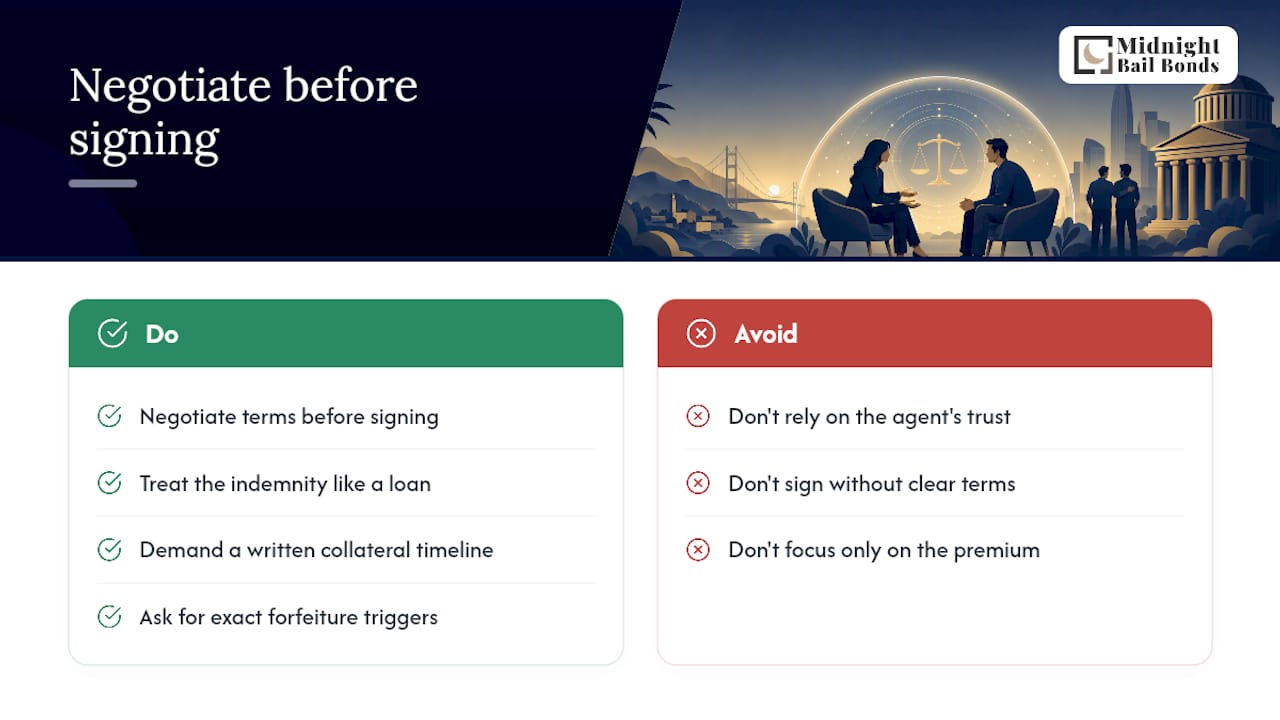
The overrated piece of conventional wisdom is "just trust the agent, they do this every day." Sure, they do it every day, and that's exactly why the contract language favors them by default unless you push back. The underrated move is treating the indemnity agreement like a loan document, because functionally, that's what it is. You wouldn't sign a car loan without knowing the interest rate and default terms. Don't sign a bail contract without knowing exactly what triggers forfeiture and what happens to your collateral.
Prioritize collateral terms over premium cost. Collateral and forfeiture exposure are the open-ended risks that actually ruin people financially. If an agency won't spell out its collateral-return timeline in writing before you sign, that tells you more than any sales pitch about how they'll treat you if things go wrong.
— Jake
Get Help Without the Guesswork: How Midnight Bail Bonds Works
Licensed agents handle bail across California with flexible payment plans and, in many cases, no collateral required at all, which is a significant difference for anyone nervous about cosigning. Instead of pledging a car title or a piece of property to a stranger's contract, you may qualify for a path that skips that risk entirely.
Before you call, have a photo ID ready, proof of your relationship to the defendant, and basic income documentation, since that's what most agents need to move fast. If you already know the booking details, run an instant inmate search first to confirm where they're being held. When you're ready to move, visit Midnight Bail Bonds to start the process or speak with a licensed agent directly about your options, including no-collateral eligibility.
Sources
- Fiscal Service — list of certified surety companies
- What Is a Cosigner for a Bail Bond? Roles & Risks
- Cosigner Guide — Beacon Bail Bonding
This article is general information, not a substitute for advice from a qualified lawyer. Consult a qualified legal professional about your own circumstances before acting on anything here.
FAQ
What Happens if I Cosign for a Bail Bond?
You become legally responsible for the full bail amount if the defendant misses court, and you may also owe recovery or legal costs tied to forfeiture, on top of the nonrefundable premium you already paid.
What Are the Risks of Cosigning a Bail Bond?
The main risks are full bond liability, loss of any pledged collateral, potential civil judgments or liens, and credit damage if the debt goes to collections.
Do You Always Need a Cosigner to Get Bailed Out?
Not always. Some agencies, including Midnightbail in many cases, offer no-collateral bail options that reduce or eliminate the need for a traditional cosigner arrangement, though eligibility depends on the bond amount and defendant's history.
Can Two People Cosign the Same Bail Bond?
Yes, multiple cosigners can share responsibility for one bond, and agents sometimes prefer this since it spreads financial risk, but each cosigner is typically still liable for the full amount, not just a split share.