

Bail conditions in California are court-imposed requirements a defendant must follow to stay out of jail while their case moves through the system. A judge or magistrate sets them at arraignment, and they can range from a dollar amount to a list of behavioral restrictions. Three factors carry the most weight in any bail decision:
- Public safety risk posed by the defendant's release
- Flight risk based on ties to the community, prior failures to appear, and the seriousness of the charge
- Ability to pay, which California Penal Code §1203.25 requires courts to assess individually before setting a cash bail amount
Courts are also required to impose the least restrictive conditions necessary to protect the public and secure the defendant's appearance. That means a judge cannot simply pile on conditions or set a bail amount so high it functions as detention, unless the case meets specific statutory exceptions for serious or violent felonies.
Key Takeaways
California bail conditions are set by a judge under Penal Code §1203.25, which requires individualized assessment of ability to pay and mandates the least restrictive conditions necessary to protect public safety and secure appearance.
| Point | Details |
|---|---|
| Least restrictive conditions required | Courts must choose the minimum conditions that protect public safety and assure appearance under Penal Code §1203.25. |
| Common nonfinancial conditions | Expect stay-away orders, GPS monitoring, travel restrictions, curfew, and drug testing depending on the charge. |
| Surety bond premium is non-refundable | The standard 10% premium paid to a bail agent is not returned regardless of case outcome. |
| Violation consequences are serious | Missing a court date or breaking a condition can trigger arrest, bail forfeiture, and new criminal charges. |
| Midnightbail | Midnightbail offers 24/7 licensed bail agents across California with flexible payment plans and free inmate search. |
Table of Contents
- What bail means in California and the main types of pretrial release
- How bail conditions in California are legally set by judges
- Common nonfinancial bail conditions California courts impose
- How to post bail in California: cash, surety bonds, and property bonds
- What county bail schedules are and how to find yours
- What can happen if someone violates bail conditions in California
- What co-signers and sureties must know before signing
- How long someone can stay on bail and what happens at case closure
- When and how to ask the court to change bail or conditions
- What families get wrong in the first hour after an arrest
- Midnightbail is available 24/7 across California when you need to act fast
- Sources
- FAQ
What bail means in California and the main types of pretrial release
Bail is the mechanism California courts use to release a defendant before trial while giving the court a financial or conditional guarantee they will return. It is not always money. The four main release types are:
Own recognizance (OR) release — The defendant signs a written promise to appear. No money changes hands. Courts grant OR release most often for low-level misdemeanors and defendants with strong community ties and no prior failures to appear.
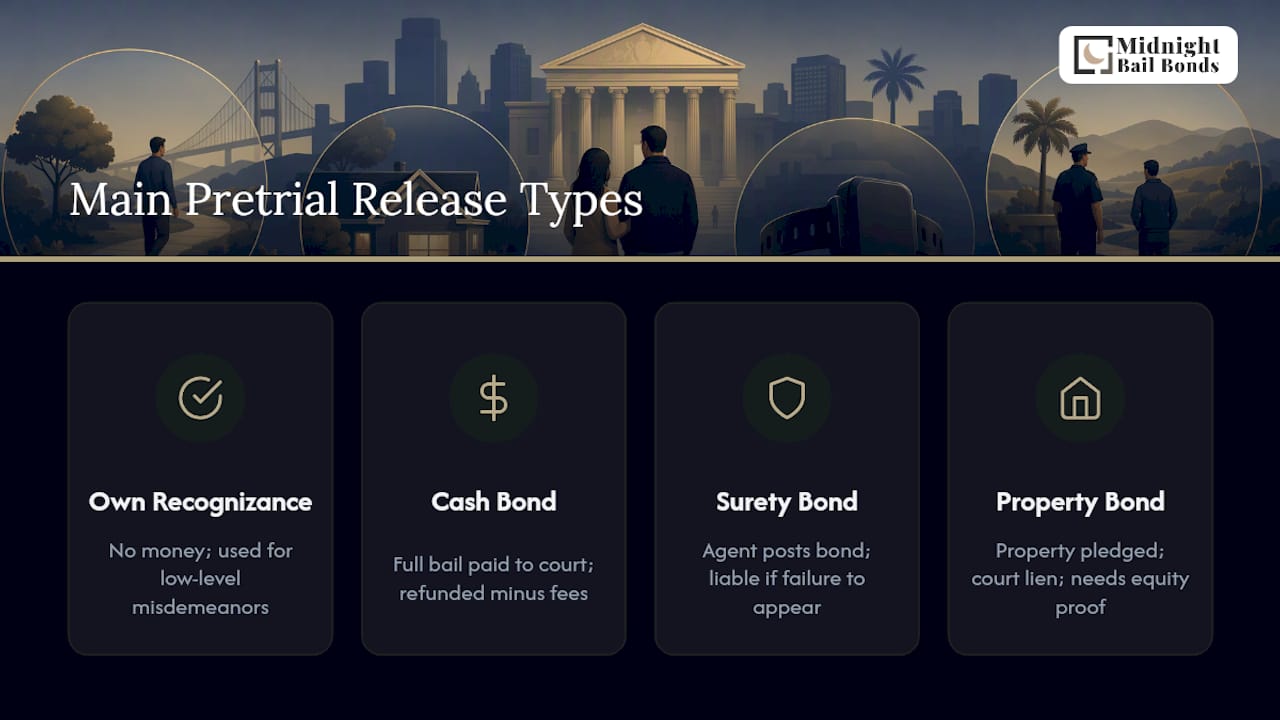
Cash bond — The defendant or a family member deposits the full bail amount directly with the court. If the defendant appears at every hearing, the court refunds the money at case disposition, minus administrative fees.
Surety bond (commercial bail bond) — A licensed bail agent posts the full bail amount on the defendant's behalf. The agent is financially liable if the defendant fails to appear. This is the most common method families use when cash bail is set at amounts they cannot cover outright.
Property bond — Real property is pledged as security for the bail amount. The court records a lien on the property under California Penal Code Sections 1277–1281a, which govern affidavit requirements and lien recordation. Property bonds take longer to process than cash or surety bonds and require documentation showing the property's equity exceeds the bail amount.

Unsecured appearance bond — The defendant promises to pay a set amount only if they fail to appear. No upfront payment is required. Courts use this sparingly, usually for defendants with minimal risk profiles.
How bail conditions in California are legally set by judges
Judges set bail to accomplish two things: assure the defendant's appearance at future hearings and protect public safety. Neither goal alone is sufficient to justify detention. California Penal Code §1203.25 requires an individualized determination, which means the judge cannot simply apply the county bail schedule and move on.
The standard factors a judge weighs include:
- Seriousness of the charge — a felony involving violence or weapons carries more weight than a first-time nonviolent offense
- Criminal history — prior convictions, open cases, and especially prior failures to appear
- Public safety risk — whether release poses a specific danger to an identifiable person or the community
- Flight risk — employment status, length of California residency, family ties, passport status, and travel history
- Community ties — how long the defendant has lived locally, family relationships, and stable housing
- Ability to pay — the court must consider whether the defendant can actually afford the bail amount being set
Statutory callout: Penal Code §1203.25 directs courts to impose "the least restrictive nonmonetary condition or combination of conditions" that will reasonably assure appearance and protect public safety. A bail amount set beyond what a defendant can pay, without individualized justification, risks functioning as de facto detention — something California courts have increasingly scrutinized.
UCLA Law and Berkeley Law research found that California's bail-reform efforts have reduced some wealth-based detention but that significant gaps remain, particularly for defendants who cannot afford even modest bail amounts. Judges retain broad discretion, and for serious or violent felonies, the court may determine that no conditions short of detention will adequately protect public safety.
Common nonfinancial bail conditions California courts impose
When a judge grants release, the bail amount is rarely the only requirement. Nonfinancial conditions are the court's tool for managing risk when money alone is not enough — or when the defendant cannot afford cash bail but release is otherwise appropriate.
Common conditions include:
- Stay-away and no-contact orders — prohibit the defendant from contacting named individuals (victims, witnesses, co-defendants) or entering specific locations
- Geographic and travel restrictions — limit travel to the county or state; surrender of passport is common in federal cases and serious state felonies
- Firearm surrender — required in domestic violence cases under California law and often imposed in any case involving weapons charges
- Curfew or home confinement — the defendant must be at a specified address during set hours, often verified by pretrial services
- Electronic monitoring or GPS — ankle monitors track location in real time; common in domestic violence, gang-related, and high-flight-risk cases
- Drug and alcohol testing or treatment — random testing, SCRAM continuous alcohol monitoring devices, or mandatory enrollment in a treatment program
- Reporting to pretrial services — regular check-ins by phone or in person with a pretrial officer
- Consent-to-search conditions — courts sometimes require defendants to waive Fourth Amendment protections as a condition of release; these conditions have been litigated and may be challenged if imposed broadly without individualized justification
How conditions get tailored to the charge matters. A domestic violence case typically produces a stay-away order combined with GPS monitoring. A DUI arrest often results in an ignition interlock device requirement or SCRAM bracelet. A drug trafficking charge may add mandatory treatment enrollment and random urinalysis. Attorney explainers confirm that judges also sometimes require AA or NA attendance, workplace restrictions, or check-ins with a specific officer depending on the offense profile.
Pro Tip: If you are a family member helping arrange release, ask the jail or your attorney whether any conditions have already been set at the initial appearance. Conditions imposed at booking differ from those a judge may add or modify at arraignment — and knowing the difference saves time and prevents surprises at the courthouse.
How to post bail in California: cash, surety bonds, and property bonds
Getting someone out of jail requires moving quickly and accurately. Here is how the process works in practice:
-
Get the booking information. Call the county jail where the defendant is held and confirm the full legal name, booking number, and the charge. Many jails have automated inmate lookup lines; Midnightbail also offers a free instant inmate search to locate booking details fast.
-
Confirm the bail amount. The jail can tell you whether bail has been set and the amount. If the case is still at initial appearance, the amount may be set from the county bail schedule until a judge reviews it at arraignment.
-
Choose your posting method. Cash bonds go directly to the court or jail cashier. For a surety bond, contact a licensed California bail agent. For a property bond, you will need a title report, equity documentation, and time to record the lien with the court.
-
Pay the premium or deposit. For a commercial bail bond, the non-refundable premium is typically 10% of the total bail amount. For example, a substantial bail amount means a correspondingly substantial premium. Midnightbail accepts cash, credit and debit cards, Zelle, and financing, and offers payment plans for families who need flexibility.
-
Complete the paperwork. The bail agent or court will require a government-issued ID, the defendant's booking information, and a signed indemnity agreement if a cosigner is involved.
-
Wait for release. Processing time varies by jail and shift. County jails in large urban areas like Los Angeles can take several hours; smaller county facilities sometimes process releases faster.
Pro Tip: Bring two forms of ID and have the defendant's full legal name and booking number written down before you call or walk into a bail office. Agents can start paperwork immediately with that information, which cuts processing time significantly. For a step-by-step walkthrough, the guide on how to bail someone out covers the full process.
When the case ends, cash bail is exonerated and refunded by the court, minus administrative fees, typically within 60–90 days of disposition. Surety bond premiums are not refunded regardless of outcome — that fee is the agent's compensation for assuming the financial risk.
What county bail schedules are and how to find yours
Bail schedules are county-level default amounts that law enforcement and courts use at booking before a judge has reviewed the case individually. Every California county is required to maintain one, and each county's schedule reflects local judicial priorities and charge classifications.
At booking, the arresting agency applies the schedule to set an initial bail amount. The defendant can post bail at that amount immediately or wait for arraignment, where a judge may raise, lower, or eliminate the amount based on the individualized factors described above. Schedules are starting points, not final determinations.
Where to find your county's schedule:
- Go to your county's Superior Court website and search for "bail schedule" or "criminal resources"
- The Contra Costa Superior Court felony bail schedule is a clear example of how counties list offenses, Penal Code sections, and default amounts
- San Diego Superior Court publishes both its bail schedule and criminal resources in a single accessible PDF
- County sheriff websites often link directly to the current schedule PDF
How to read a schedule entry:
| Column | What It Shows |
|---|---|
| Offense description | The charge category (e.g., felony assault, residential burglary) |
| Penal Code section | The specific statute the charge falls under |
| Default bail amount | The dollar amount set at booking before judicial review |
| Notes / enhancements | Factors that increase the default (prior convictions, weapon use, victim age) |
Schedules are updated periodically, so always confirm you are reading the current version. If the charge involves enhancements or special allegations, the schedule amount can increase substantially from the base figure.
What can happen if someone violates bail conditions in California
Violating bail conditions is not a minor administrative issue. Depending on the nature of the violation, consequences range from a warning to immediate arrest and new criminal charges.
Possible sanctions include:
- Arrest and revocation hearing — law enforcement can arrest the defendant for a suspected violation; the court then holds a hearing to determine whether release should be revoked
- Bail forfeiture — if the defendant fails to appear, the court may declare the bail forfeited; for surety bonds, the bail agent has a statutory period to locate and return the defendant before the forfeiture becomes final
- Increased bail or detention — after a revocation hearing, the judge may set a higher bail amount or remand the defendant into custody without bail
- New criminal charges — failure to appear is a separate criminal offense under California law; violating a protective order carries its own criminal penalties
- Contempt of court — for certain condition violations, the court may hold the defendant in contempt
NCSL research on pretrial release violations shows that states vary significantly in how they handle forfeiture timelines and whether forfeiture can be set aside. California has specific statutory timelines under Penal Code §1305 governing when forfeiture proceedings begin and how long a surety has to respond. At the federal level, 18 U.S.C. §3148 sets the standard for revocation proceedings, requiring either probable cause of a new crime or clear and convincing evidence of a non-appearance violation before revocation is ordered — a useful analog for understanding the evidentiary bar California courts apply.
If you are accused of a violation, notify your attorney immediately, preserve any evidence that contradicts the allegation (receipts, messages, location data), and attend every scheduled hearing. Missing a revocation hearing almost guarantees remand.
What co-signers and sureties must know before signing
A cosigner on a bail bond is not just a reference. Signing makes you financially liable for the full bail amount if the defendant fails to appear. That is not a formality — it is a binding legal obligation.
Key obligations and risks for cosigners:
- Financial liability up to the bond amount — if the defendant skips court, the bail agent can pursue the cosigner for the full amount, not just the premium already paid
- Potential liens on property — for property bonds, California Penal Code Sections 1277–1281a authorize the court to record a lien against real property pledged as security; that lien stays until the bond is exonerated
- Surety recovery actions — bail agents can hire recovery agents (bounty hunters) to locate and return a defendant who has failed to appear; cosigners may be asked to assist or face civil recovery for costs
- Reimbursement demands — if the agent suffers a loss, they can sue the cosigner for the full forfeited amount
To protect yourself as a cosigner: get a written indemnity agreement that spells out your obligations and any collateral terms, verify the bail agent holds a current California Department of Insurance license, and stay in regular contact with the defendant to monitor court dates. If you have reason to believe the defendant may not appear, you can contact the bail agent to discuss options before a failure to appear occurs.
How long someone can stay on bail and what happens at case closure
There is no fixed maximum length for pretrial release in California. A defendant may remain on bail from arraignment through trial, which can span months or years depending on the complexity of the case, court scheduling, and continuances.
The typical timeline looks like this:
- Arraignment — bail is set or reviewed; conditions are imposed
- Pretrial hearings — motions, discovery, and plea negotiations; defendant must appear at each scheduled date
- Trial or plea — the case resolves by verdict, plea agreement, or dismissal
- Disposition — bail is exonerated when the case ends
At disposition, cash bail is returned to whoever posted it, minus court fees, after the court issues an exoneration order. The timeline for the actual refund check varies by county but typically runs 60–90 days after exoneration. For surety bonds, exoneration releases the bail agent from liability; the premium paid is not returned.
If the defendant fails to appear, Penal Code §1305 triggers forfeiture proceedings. The court enters a summary judgment of forfeiture, and the surety typically has 180 days to locate the defendant and have the forfeiture set aside. After that window closes, the forfeiture becomes final. NCSL's forfeiture research confirms California's statutory framework includes provisions for setting aside forfeiture under specific circumstances, which is why acting quickly through an attorney or bail agent matters the moment a missed appearance occurs.
At case closure, request the exoneration paperwork from the court clerk in writing and follow up if the refund does not arrive within the expected window.
When and how to ask the court to change bail or conditions
Bail conditions are not permanent once set. You can request modification at arraignment or at any point during the case by filing a motion. The key is presenting concrete evidence that less restrictive conditions will still protect public safety and assure appearance.
-
Consult an attorney first. A lawyer familiar with the assigned judge and the county's pretrial practices will know what arguments carry weight and what evidence to gather. Greg Hill & Associates' guide notes that judges often start from the county schedule but will deviate when defense counsel presents credible individualized facts.
-
Gather evidence of community ties and stability. Employment letters, lease agreements, family declarations, and proof of long-term California residency all support a lower bail or less restrictive conditions.
-
Prepare alternative conditions to propose. Courts respond better to a specific proposal than a general request to reduce bail. Offer curfew instead of GPS monitoring, or pretrial supervision check-ins instead of home confinement, if those alternatives address the court's stated concerns.
-
Request a Humphrey-type hearing if ability to pay is the issue. Under the reasoning of In re Humphrey, a California Supreme Court decision, courts cannot set bail at an amount the defendant cannot afford without first considering whether nonmonetary conditions would adequately protect public safety. If the current bail amount is effectively a detention order, this is the legal framework your attorney should invoke.
-
Attend every hearing prepared. Bring all documentation, be on time, and have your attorney address the court's specific concerns directly. Judges notice preparation.
Questions to ask your attorney before the hearing: Can pretrial services provide a supervision recommendation that supports release? What specific conditions would the prosecution accept? Is there a record of the defendant's prior court appearances that demonstrates reliability?
What families get wrong in the first hour after an arrest
The most expensive mistake families make is calling the wrong jail. California has dozens of county jails, city jails, and holding facilities, and a defendant can be transported between them during processing. Calling the right facility with the right booking number is the single fastest way to get accurate bail information.
The second most common mistake is assuming the bail schedule amount is final. It is not. The schedule sets the initial amount at booking, but a judge reviews it at arraignment, which typically happens within 48 hours of arrest. If the charge is serious, the judge may raise the amount significantly. If the defense attorney appears prepared with individualized facts, the amount may drop.
A practical checklist for the first hour:
- Confirm the defendant's full legal name and date of birth
- Call the county jail's inmate information line or use an online inmate locator
- Get the booking number and the charge
- Confirm whether bail has been set and the current amount
- Contact a licensed bail agent if you cannot cover the full cash amount
- Do not sign anything as a cosigner until you have read the indemnity agreement
One thing families underestimate: the cosigner's exposure. Signing a bail bond agreement is not a formality. If the defendant misses a court date, the financial consequences fall on the cosigner first. Understanding that before signing protects everyone involved.
Midnightbail is available 24/7 across California when you need to act fast
When bail is set and every hour in custody matters, having a licensed agent available at 3 AM is not a luxury.
Midnightbail provides 24/7 bail bond services across California, covering all major charge types including DUI, drug offenses, domestic violence, assault, theft, and failure to appear. Agents can run a free inmate search to locate booking details immediately, confirm the bail amount, and begin paperwork without delay. Payment options include cash, credit and debit cards, Zelle, and financing, with flexible payment plans available for families who need them. Bail without collateral is possible in many cases. Bilingual English and Spanish support is available around the clock. To get started, call Midnightbail now or visit Midnightbail to reach a licensed agent and begin the release process tonight.
Sources
- California Penal Code §1203.25
- 18 U.S.C. §3148: Sanctions for violation of a release condition
- FELONY BAIL SCHEDULE - Contra Costa Superior Court
- San Diego Superior Court bail schedule
- Pretrial release violations & bail forfeiture (NCSL)
For official current amounts and local procedures, contact your county Superior Court clerk directly. Online schedules are updated periodically and may not reflect recent judicial council amendments.
This article is general information, not a substitute for advice from a qualified lawyer. Consult a qualified legal professional about your own circumstances before acting on anything here.
FAQ
What are the standard bail rules in California?
California courts must set bail based on public safety, flight risk, charge seriousness, criminal history, and the defendant's individual ability to pay under Penal Code §1203.25. Judges must also impose the least restrictive conditions necessary.
Why do families typically pay only 10% of the bail amount?
The agent assumes financial liability for the full amount if the defendant fails to appear.
What are the most common bail conditions in California?
Stay-away and no-contact orders, travel restrictions, firearm surrender, curfew, electronic monitoring, and drug or alcohol testing are among the most frequently imposed nonfinancial conditions, varying by charge type.
How long can someone remain on bail in California?
There is no fixed maximum. A defendant may stay on bail from arraignment through the end of trial, which can span months or years. Bail is exonerated at case disposition; cash bail is typically refunded within 60–90 days after the court issues an exoneration order.