

In California, a bail forfeiture is a court order declaring that bail is lost because a defendant failed to appear at a required proceeding. The court does not keep the money automatically or permanently. Under California Penal Code §1305, a statutory window opens the moment forfeiture is declared, and what happens inside that window determines whether the bond is vacated or converted into a money judgment.
The deadlines you must know immediately:
- an appearance period from the date of forfeiture declaration during which the forfeiture can be vacated
- a slightly extended appearance period if the court clerk mails notice of forfeiture to the surety or bail agent
- a limited period for the clerk to mail that notice after the court declares forfeiture for bonds over a specified amount
- a defined period for county counsel to seek and enter summary judgment after the appearance period expires without vacatur
If the defendant appears, is surrendered, or is found in custody within the appearance period, the forfeiture can be vacated. Miss those windows, and the court enters a money judgment against the surety for the full bond amount.
Key Takeaways
California bail forfeiture triggers a strict statutory sequence under PC §1305 and §1306, and the 185-day appearance period from the clerk's mailing date is the critical window for vacating forfeiture before summary judgment is entered.
| Point | Details |
|---|---|
| 185-day appearance period | Runs from the clerk's mailing date (for bonds over $400); 180 days if no mailing occurred. |
| 30-day clerk mailing rule | Clerk must mail forfeiture notice to surety and bail agent within 30 days of the court's declaration. |
| 90-day summary judgment window | County counsel must enter summary judgment within 90 days after the appearance period ends, or the right is lost. |
| Grounds to vacate under PC §1305(c) | Defendant appears, is surrendered, is in custody, has a disability, or prosecutor declines extradition. |
| AB 1082 extension motion | Courts may extend the appearance period for good cause — file the motion before the period expires. |
| Midnightbail | Available 24/7 across California for bond posting, surrender coordination, and bilingual support when time is critical. |
Table of Contents
- How California bail forfeiture law works: PC §1305, §1306, and AB 1082
- What happens step by step after a court declares forfeiture
- Grounds that can get a forfeiture vacated under PC §1305(c)
- What happens when forfeiture is not set aside: summary judgment and collection
- Your immediate checklist after receiving a forfeiture notice
- A bail-services perspective on what actually goes wrong
- Midnightbail is available 24/7 when a forfeiture notice arrives
- Sources
- FAQ
How California bail forfeiture law works: PC §1305, §1306, and AB 1082
The entire statutory framework for bail forfeiture in California sits in Penal Code Article 7, sections 1305 through 1308. Two sections carry most of the weight.
PC §1305 governs the declaration of forfeiture and the appearance period. When a defendant fails to appear, the court must declare the undertaking or deposit forfeited. For bonds exceeding $400, the clerk must mail notice of forfeiture to the surety and the bail agent within 30 days of the court's declaration. That mailing is not a courtesy — it is a statutory trigger. When notice is mailed, the appearance period extends from 180 days to 185 days from the date of mailing, giving the surety a fair chance to locate and return the defendant. FindLaw's codification of PEN §1305 reproduces the full statutory text for easy reference.
PC §1306 takes over if the forfeiture is not vacated. The court must enter summary judgment against each bondsman for the bond amount plus costs. That entry must happen within 90 days after the appearance period ends. If county counsel misses that 90-day window, the right to enter summary judgment is lost.
AB 1082 (2015–2016 legislative session) added an important safety valve. Under AB 1082, courts may extend the appearance period on a showing of good cause, giving sureties additional time to locate defendants in complex circumstances. The motion must be filed before the appearance period expires.
The table below maps each deadline to its trigger event.
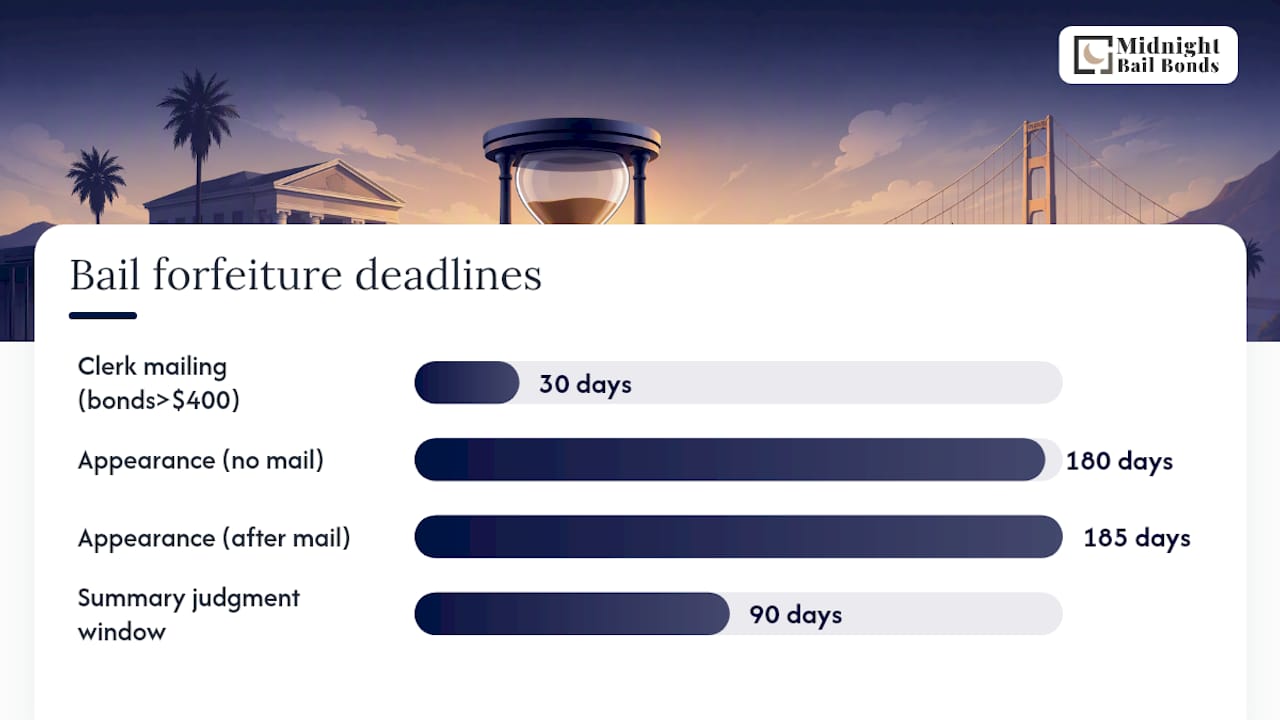
| Statutory Event | Trigger | Deadline |
|---|---|---|
| Court declares forfeiture | Defendant fails to appear | Immediate — same court date |
| Clerk mails notice to surety/agent | Court declaration (bonds over $400) | Within 30 days of declaration |
| Appearance period ends (no mailing) | Date of forfeiture declaration | 180 days from declaration |
| Appearance period ends (mailing) | Date clerk mails notice | 185 days from mailing date |
| Motion to extend time (AB 1082 / PC §1305.4) | Before appearance period expires | Must be filed before period ends |
| Summary judgment entry | Appearance period expires without vacatur | Within 90 days after period ends |
What happens step by step after a court declares forfeiture
The California Department of Insurance flow chart of the bail collection process after forfeiture maps this sequence visually. Here is the operational order:
-
Court declares forfeiture. The judge announces forfeiture on the record when the defendant fails to appear. The clerk enters the declaration in the case file.
-
Clerk mails notice within 30 days. For bonds over $400, the clerk sends written notice of forfeiture to the surety and the bail agent of record. The clerk's certificate of mailing is stamped and placed in the file. This document is critical — it establishes the start date of the 185-day appearance period.
-
Appearance period runs. The surety and bail agent have 180 days from the declaration (or 185 days from the mailing date) to produce the defendant, file a motion to vacate, or arrange surrender.
-
Surety investigates and acts. The bail agent begins locating the defendant. Options include voluntary surrender, arrest by a bail recovery agent, or discovery that the defendant is already in custody elsewhere.
-
Motion to vacate or extend is filed (if applicable). If the defendant is located, surrendered, or a qualifying ground exists, the surety files a motion to vacate forfeiture under PC §1305. If more time is needed, a motion to extend under PC §1305.4 or AB 1082 is filed before the period expires.
-
Court rules on the motion. The court may vacate the forfeiture on terms it finds just. If an assessment is ordered to cover return costs, the surety receives notice and has 30 days to pay.
-
Appearance period expires without vacatur. If no motion succeeds and the defendant does not appear, the appearance period closes.
-
County counsel seeks summary judgment. Within 90 days of the period's expiration, county counsel moves for summary judgment against the surety for the bond amount plus costs.
-
Summary judgment is entered. The court enters judgment. The surety is now liable for the full bond amount as a civil money judgment.
-
Collection and remittance. The county collects on the judgment and remits funds to the county treasurer. A surety that fails to satisfy the judgment may be barred from acting as surety in California courts.
The CDI flow chart also notes the $130 assessment notice that the clerk sends when the court orders an assessment to cover return costs, a routine step that sureties sometimes overlook.
Grounds that can get a forfeiture vacated under PC §1305(c)
Forfeiture is not designed as a penalty. As PC §1305 makes clear, the statute includes multiple mechanisms to restore bonds when the defendant returns or a qualifying circumstance exists. The NCSL's overview of pretrial release violations and bail forfeiture confirms that California's approach, with its 180-day window and vacatur grounds, is among the more structured state frameworks in the country.
Defendant appears voluntarily. If the defendant shows up in court during the appearance period, the court must vacate the forfeiture. No motion is required — the appearance itself triggers vacatur.
Defendant surrendered by surety. The bail agent or surety physically surrenders the defendant to the court or to custody before the period ends. A signed surrender affidavit and booking confirmation are the key documents here.
Defendant in custody in California. If the defendant was arrested and is held in a California county, the surety can file a motion showing the defendant is in custody. The court vacates the forfeiture and the defendant is returned to the original case.
Defendant in custody outside California. Under PC §1305(g), if the defendant is in custody in another jurisdiction, the surety can move to vacate. Public arrest records from that jurisdiction — the kind documented in publicly available charge records — can serve as supporting evidence for this motion.
Permanent or temporary disability. If the defendant is physically unable to appear due to illness, injury, or mental incapacity, the court may vacate forfeiture. Medical records and physician declarations are the standard proof.
Prosecuting agency elects not to extradite. When the defendant is held out of state and the prosecutor decides extradition is not worth pursuing, the court can vacate the forfeiture on that basis.
Reinstatement of bond. In some circumstances, the court may reinstate the original bond rather than require a new one, particularly when the defendant returns and the forfeiture was brief.
Courts have discretion to vacate "on terms that are just." That phrase matters. A court can impose conditions, including an assessment to cover the cost of returning the defendant. If an assessment is ordered, the surety receives a notice and has 30 days to pay before further enforcement steps begin.
One important jurisdictional limit: if the case was dismissed or no complaint was filed within 15 days of arraignment, the court lacks jurisdiction to declare a forfeiture in the first place. Confirming this early can end forfeiture risk entirely.
What happens when forfeiture is not set aside: summary judgment and collection
If the appearance period closes without a successful motion, PC §1306 takes effect. The court enters summary judgment against the surety for the bond amount plus costs. County counsel typically handles this motion, and the 90-day window is firm — courts that miss it lose the right to enter judgment.
One protection worth knowing: penalty assessments are ordinarily not added to the summary judgment amount. The judgment covers the bond and costs, not an inflated penalty stack. That statutory limit is meaningful for sureties facing large bonds.
For cash deposits, the process differs slightly. If the defendant posted cash bail and forfeiture is not vacated, the court orders the deposit paid to the county treasurer after 180 days. The depositor has the same appearance period to seek vacatur, but there is no surety company standing behind the bond.
For surety bonds, the judgment becomes a civil money judgment enforceable against the insurer. A surety that fails to satisfy the judgment can be barred from writing bail in California courts, which is a serious professional consequence for bail agents and their insurers.
Pro Tip: The moment you receive a forfeiture notice, pull the clerk file and check three things: the certificate of mailing (to confirm the mailing date and start your 185-day clock), any date stamps on the forfeiture declaration, and whether a prior extension motion was filed. Missing any of these can cause you to miscalculate your deadline by days or weeks.
Your immediate checklist after receiving a forfeiture notice
Speed is the only thing that separates a vacated forfeiture from a summary judgment. Work through this list in order.
-
Verify the certificate of mailing. Pull the clerk file and confirm the date the clerk mailed notice. That date starts your 185-day clock. If no mailing occurred (bond under $400 or clerk error), your clock runs from the declaration date — 180 days.
-
Calculate your appearance period. Write the end date on a calendar and work backward. Set internal deadlines at 30, 60, and 90 days out so you are never scrambling at the last minute.
-
Check whether the case was dismissed or complaint filed. If no complaint was filed within 15 days of arraignment, or if the case was dismissed before the forfeiture, the court may lack jurisdiction. Confirm with defense counsel immediately.
-
Contact defense counsel and the prosecuting agency. Defense counsel may know the defendant's whereabouts. The prosecutor can confirm whether extradition is being sought, which affects your vacatur strategy.
-
Determine whether the defendant is already in custody. Search jail databases and public arrest records for the defendant's name across California counties and neighboring states. An out-of-county arrest record can be the basis for a PC §1305(g) motion.
-
Arrange surrender if feasible. If the defendant can be located, surrender is the cleanest path to vacatur. Coordinate with a licensed bail recovery agent and document every step — booking confirmation, transport records, and a signed surrender affidavit.
-
File a motion to vacate or extend before the period ends. Do not wait for the last week. File a motion to vacate under PC §1305 as soon as you have supporting evidence. If you need more time, file a motion to extend under PC §1305.4 or AB 1082 while the appearance period is still open.
-
Preserve all supporting documentation. Gather booking and transport records, medical records (for disability claims), arrest reports from other jurisdictions, and any written communications with the prosecuting agency about extradition decisions.
-
Respond to any assessment notice within 30 days. If the court orders an assessment to cover return costs, you will receive a notice. Pay or contest it within 30 days to avoid further enforcement.
-
Seek counsel if the motion is contested. A contested motion to vacate or an extension motion under AB 1082 benefits from an attorney who knows the local court's practices and the specific judge's approach to "good cause."
Pro Tip: Create a one-page "notice response packet" the day you receive a forfeiture notice: a copy of the certificate of mailing, a calculated deadline calendar, a checklist of the PC §1305(c) grounds you are evaluating, and a cover sheet for filing with the court and serving county counsel. Bail agents who do this routinely are far less likely to miss a filing window.
For a practical overview of the bail-out process from the family's side, the steps for coordinating with agents and navigating booking procedures are covered in detail.
A bail-services perspective on what actually goes wrong
The cases that end in summary judgment almost always share the same pattern: someone assumed the deadline was longer than it was, or no one checked the certificate of mailing until it was too late.
The certificate of mailing is the single most overlooked document in the post-forfeiture process. Sureties who calculate their deadline from the declaration date, when the clerk actually mailed notice three weeks later, lose weeks of appearance time they were legally entitled to. Pull that document first, every time.
The second recurring mistake is waiting to file an extension motion. AB 1082 and PC §1305.4 give courts real authority to extend time for good cause, but that motion must be filed before the appearance period expires. Filing the day after the period closes accomplishes nothing. Courts are not sympathetic to sureties who had the statutory tools available and did not use them.
Do not assume a defendant in another state is unreachable. An out-of-county or out-of-state arrest is a statutory ground for vacatur under PC §1305(g). The documentation burden is real — you need custody records and arrest reports — but it is far lighter than satisfying a summary judgment. Move quickly, gather the records, and file.
The law is structured to give sureties a genuine path back. PC §1305 and federal procedural parallels under Rule 46 both reflect the principle that forfeiture is meant to incentivize return, not to punish. Use the statute. File on time. Document everything.
Midnightbail is available 24/7 when a forfeiture notice arrives
When a forfeiture notice lands and the clock is already running, the last thing a family needs is to spend hours finding help. Midnightbail's licensed agents are available around the clock across California, ready to post bonds, coordinate surrender logistics, and walk families through the next steps in English or Spanish.
Flexible payment plans and bail options without collateral in many cases mean families are not blocked by upfront costs at the worst possible moment. Whether the situation involves a missed court date, an FTA warrant, or a bond already declared forfeited, Midnightbail can help assess the situation and move fast. Midnightbail to speak with an agent, or check Huntington Beach bail bond services and Menifee bail bond coverage for local service details.
Sources
The statutes and official guidance below are the primary references for California bail forfeiture law. Verify deadlines and procedural requirements directly from these sources, and consult a licensed California attorney for case-specific advice.
- California Code, PEN 1305
- Flow Chart of Bail Collection Process After Forfeiture (California Department of Insurance)
- Pretrial Release Violations & Bail Forfeiture | NCSL
- Rule 46 — FRCRMP (Forfeiture and setting aside rules) | Cornell Law
- Definition of "bail forfeiture" | Justia
This article is general legal information, not legal advice. Deadlines and procedures vary by county and case type. Confirm current rules with the relevant court clerk or a licensed California attorney.
This article is general information, not a substitute for advice from a qualified lawyer. Consult a qualified legal professional about your own circumstances before acting on anything here.
FAQ
What is a bail forfeiture notice in California?
A bail forfeiture notice is a written notice the court clerk mails to the surety and bail agent within 30 days of a court declaring bail forfeited, typically after a defendant fails to appear. It starts the 185-day appearance period during which the forfeiture can be vacated.
Can a bail forfeiture be reversed in California?
Yes. Under PC §1305, a forfeiture can be vacated if the defendant appears, is surrendered, is found in custody, has a qualifying disability, or the prosecutor declines extradition — all within the 185-day appearance period.
Can you go to jail for not paying bail bonds in California?
Not paying a bail bond premium does not result in jail time for the co-signer, but if a surety fails to satisfy a summary judgment entered under PC §1306, the insurer can be barred from writing bail in California courts, and civil collection action follows.
What is the new bail law in California affecting forfeiture timelines?
AB 1082 (2015–2016) authorized courts to extend the forfeiture appearance period for good cause on a motion filed before the period expires, giving sureties a statutory path to additional time when locating a defendant takes longer than the standard 185-day window allows.
What is the difference between FTA and bail forfeiture?
A failure to appear (FTA) is the defendant's act of missing a required court date. Bail forfeiture is the court's legal response — the formal declaration that the bail is forfeited as a consequence of that FTA. The FTA triggers the forfeiture, but the two are distinct events with different legal effects.