
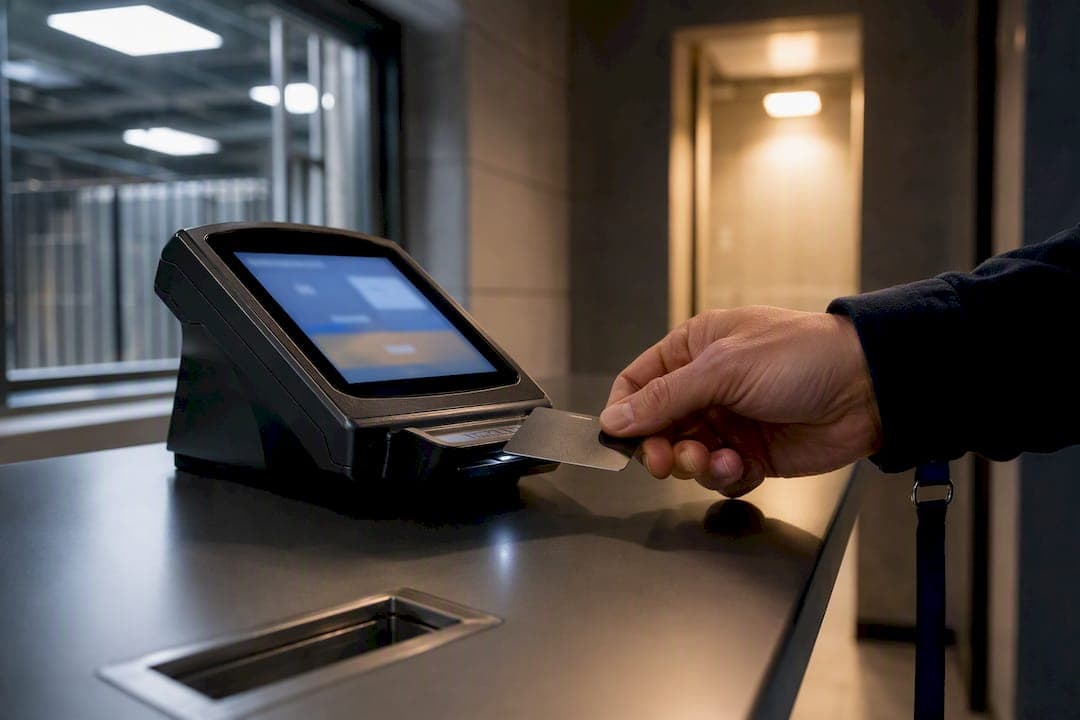
Yes, in most cases, but who you're paying decides whether the swipe goes through. Bail bond agents almost always accept credit cards for their premium. Courts and jails are hit or miss, since some run kiosks or online portals and others still demand cash or a cashier's check. Either way, expect a processing fee and check with your card issuer first, because some of these charges post as cash advances instead of purchases.
TL;DR:
- Credit card payments for bail are accepted by some courts and jails, but acceptance depends on the specific facility's policies and may involve processing fees of 2 to 4 percent.
- Payments made through bondsmen involve a nonrefundable premium typically around 10 percent of the bail amount, which differs from full cash bail that is refunded if the defendant appears in court.
- Always confirm whether your payment will be processed as a purchase or cash advance, as cash advances accrue interest immediately and carry additional fees, increasing the overall cost.
- To avoid unnecessary expenses, call the facility beforehand to verify acceptance methods, transaction limits, fees, and required case information before making any payment.
- Licensed bail bonds agencies like Midnightbail operate 24/7, accept credit cards, and provide clear fee agreements to streamline the bail process efficiently.
Table of Contents
- When Do Courts and Jails Accept Credit Card Bail Payments?
- Bail vs. Bail Bond: Which One Do You Get Back?
- How Do You Actually Pay Bail With a Credit Card?
- What Will a Credit Card Bail Payment Actually Cost You?
- When Should You Skip the Credit Card and Use Something Else?
- What Should You Ask Before You Authorize Any Charge?
- How Midnight Bail Bonds Handles Card Payments
- What You Should Do Right Now
- Get Help Posting Bail Right Now
- Where to Verify Local Bail Payment Rules
- Sources
- FAQ
When Do Courts and Jails Accept Credit Card Bail Payments?
Whether a facility takes plastic depends entirely on the county or state running it. Some jails have moved to kiosk terminals or online payment portals that process Visa and Mastercard directly. Others still require cash, a money order, or a cashier's check at the clerk's window, full stop.
Processing fees are common wherever cards are accepted, typically in the 2 to 4 percent range, and some facilities cap how much can go on a single card transaction.
Before you drive anywhere, get the facility on the phone. Ask these questions:
- Do you accept credit or debit cards for bail, and through what method (portal, kiosk, or window)?
- Is there a maximum amount allowed per card transaction?
- What fee gets added, and is it a flat rate or a percentage?
- Do you need the booking number and the defendant's full legal name to look up the case?
King County's bail payment page is a good example of how counties publish their accepted methods online, and checking your specific county's equivalent page beats guessing.
Bail vs. Bail Bond: Which One Do You Get Back?
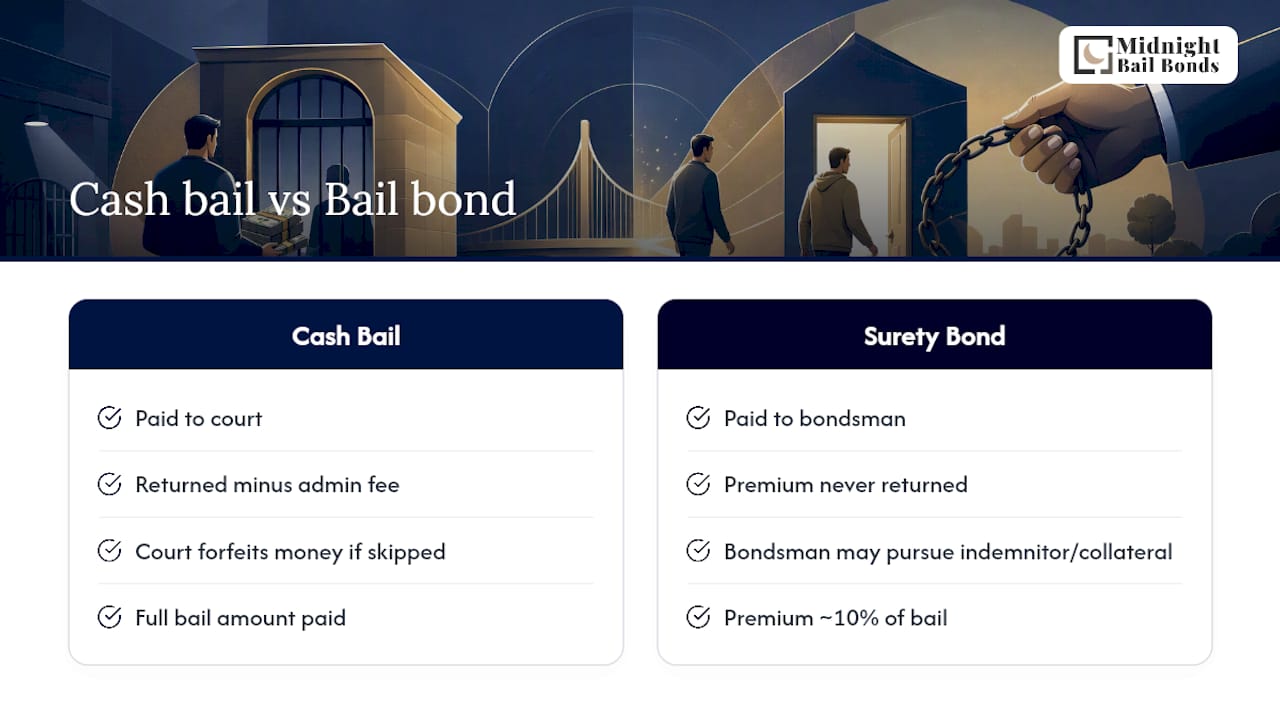
Cash bail and a bail bond premium are not the same transaction, and mixing them up leads to real disappointment later. Cash bail means you pay the court the full bail amount directly. If the defendant shows up to every court date, that money comes back to you, minus whatever administrative fee the court deducts.
A surety bond works differently. A licensed bondsman posts the full bail amount on the defendant's behalf, and you pay the bondsman a premium, commonly around 10 percent of the total bail. That premium is the bondsman's fee for taking on the risk. You never get it back, regardless of what happens in court.
The stakes diverge sharply if the defendant skips a court date. With cash bail, the court simply keeps the money through forfeiture. With a bond, the bondsman can pursue whoever signed as indemnitor and may go after any collateral that was put up to secure the bond.
How Do You Actually Pay Bail With a Credit Card?
Move fast, but move in the right order. Here's the sequence that avoids wasted trips and surprise charges:
- Call the jail or courthouse first and get the booking number, the defendant's full name, and the exact bail amount.
- Ask directly whether cards are accepted and how, then ask about caps and fees before you commit to anything.
- If paying the court, locate the payment portal or kiosk location, and bring photo ID plus your receipt confirmation when you arrive.
- If using a bondsman, provide the defendant's information, review and sign the written fee agreement, and confirm the exact premium amount and expected timeline.
- Get a receipt either way, and if a bondsman posts the bond, confirm the paperwork was filed with the court.
Release processing after payment typically takes two to eight hours depending on the facility's booking volume, so don't expect an instant walkout.
Pro Tip: Call the jail before you call anyone else. Many callers discover the facility requires a cashier's check or has a card limit that makes a full-card payment impossible, and finding that out by phone beats finding it out in person.
What Will a Credit Card Bail Payment Actually Cost You?
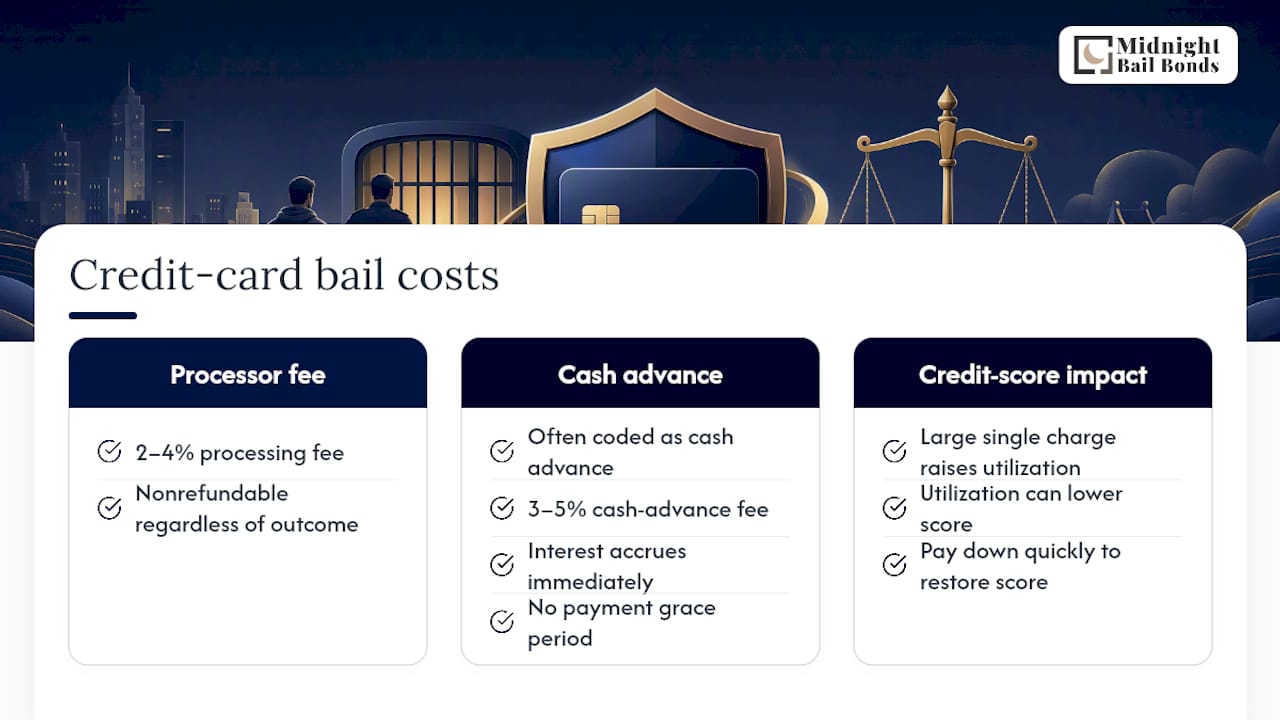
Processing fees are the visible cost, but they're not the only one. Portals and third-party payment processors commonly charge that 2 to 4 percent fee, and it's nonrefundable no matter what happens with the case.
The bigger risk hides in how your card issuer codes the transaction. Bail-related charges sometimes get coded as cash advances rather than purchases, and cash advances carry a different set of rules: interest starts accruing immediately, with no grace period, plus a separate cash-advance fee that often runs 3 to 5 percent on top of whatever the facility or bondsman already charged.
There's also a credit-score angle worth knowing before you charge $2,500 or $10,000 to a card. A large single charge can spike your credit utilization ratio overnight, and that ratio is one of the bigger factors in your score. The dip is usually temporary, but only if you pay the balance down quickly rather than letting it sit.
When Should You Skip the Credit Card and Use Something Else?
A credit card isn't always the smartest move, and knowing the alternatives helps you pick the cheapest, least risky path for your situation.
- Cash bail makes sense if you have the funds available and want that money back once the case resolves, since it avoids both the bondsman premium and any card fees entirely.
- Property bonds, where real estate secures the bail amount, work for larger bail figures but put your property at risk if the defendant fails to appear.
- Payment plans through a bondsman often beat charging a card outright, spreading the premium over weeks instead of hitting your credit limit in one shot.
What Should You Ask Before You Authorize Any Charge?
Get answers in writing before a single dollar moves. These are the exact things to nail down:
- Ask whether the charge will post as a purchase or a cash advance, since that single detail changes the real cost dramatically.
- Ask for the exact fee that will show up on your statement, in dollars, not just a percentage.
- Demand a written fee agreement showing the premium, any additional charges, and the bondsman's license number.
- Get a receipt and proof the bond paperwork was actually filed with the court, including the power-of-attorney or surety filing.
- Keep a contact name and number for follow-up questions or refund and exoneration issues once the case closes.
How Midnight Bail Bonds Handles Card Payments
Licensed bail bond agents accept credit and debit cards around the clock, along with other payment methods. Some cases may qualify for bail bonds without collateral. Bilingual staff typically walk clients through the fee agreement and confirm what the card issuer will see on the statement before any charges are made.
What You Should Do Right Now
If you're on the phone with a jail or standing at a booking desk, here's your short list: get the booking number, confirm whether cards are accepted, ask about fees and coding, and get everything in writing. You don't have to figure this out alone at 2 a.m. Licensed, 24/7 help is available the moment you need it.
— Jake
Get Help Posting Bail Right Now
Midnightbail is the direct alternative to sorting through jail payment portals and hoping a kiosk takes your card. Licensed agents answer calls 24/7, accept credit cards for the bond premium, and often arrange release without requiring collateral upfront.
Have the defendant's full name, the booking number, and your ID ready when you call. A Midnightbail agent will walk you through the written fee agreement, confirm the exact premium, and tell you upfront how the charge will appear on your card statement, no guessing required. If you don't have the booking details yet, the inmate search tool can pull them up in minutes. When you're ready to move, visit the Midnight Bail Bonds page or call the number listed there to start the release process now.
Where to Verify Local Bail Payment Rules
Confirm your facility's exact policy before you commit to a payment method. County court sites like King County's bail payment page and county bail schedule documents such as the San Diego Superior Court bail schedule list accepted methods directly. When in doubt, call the clerk and ask.
This article is general information, not a substitute for advice from a qualified lawyer. Consult a qualified legal professional about your own circumstances before acting on anything here.
Sources
- Can You Pay Bail With a Credit Card? Options and Risks - LegalClarity
- How to Bail Someone Out of Jail: Steps and Costs - LegalClarity
- Bail and bail bondsman - University of Washington Law news
- Pay bail and post bond - King County
FAQ
Can You Use a Credit Card for Bail Bonds?
Yes, licensed bail bond agencies almost always accept credit cards for the premium, though courts and jails vary on whether they take cards directly for cash bail.
How Much Is a $1,000 Bail Bond?
At a common 10 percent premium, a $1,000 bail bond typically costs around $100, and that premium is nonrefundable regardless of the case outcome.
How Much Would I Have to Pay on a $5,000 Bond?
Using the same 10 percent structure, a $5,000 bond usually runs about $500 as the bondsman's premium, separate from any card processing fee.
How Much Does a $25,000 Bail Bond Cost?
At roughly 10 percent, a $25,000 bail bond generally costs around $2,500 in premium, though some agencies offer payment plans to spread that cost out.
Will My Credit Card Company Charge Extra for a Bail Payment?
Possibly. If the transaction gets coded as a cash advance rather than a purchase, you'll face immediate interest and an added 3 to 5 percent cash-advance fee, so confirm the coding with your issuer beforehand.