
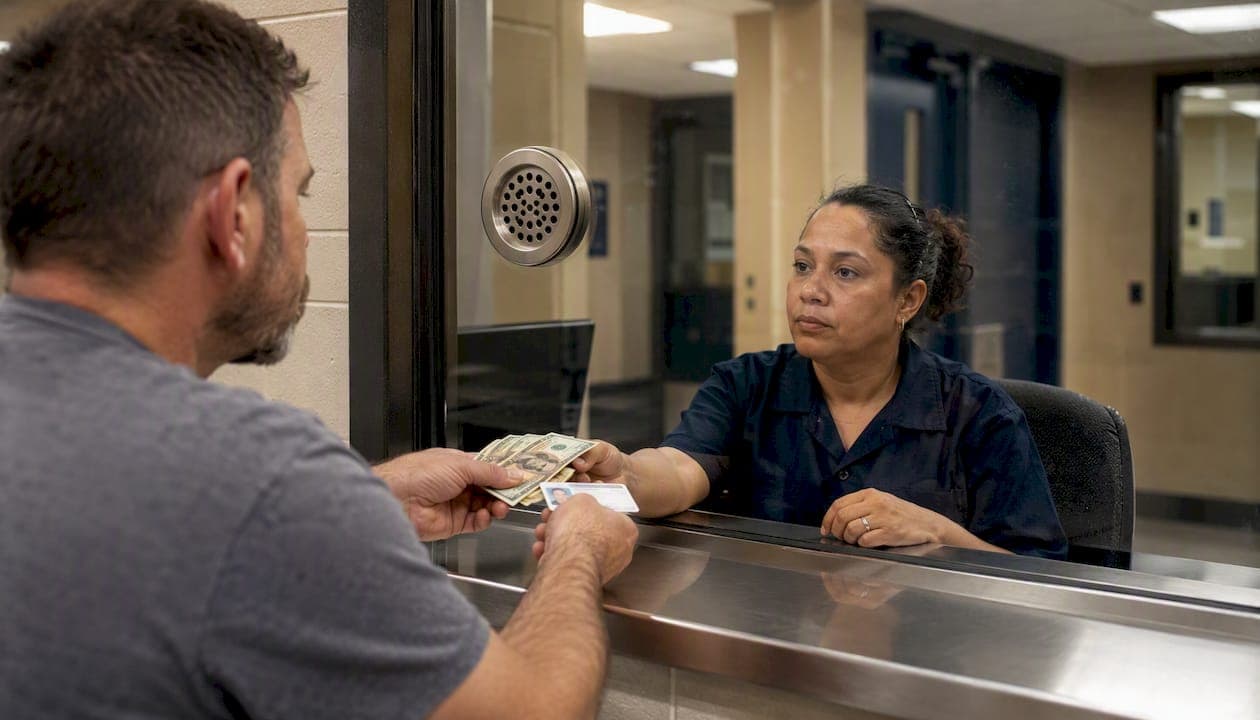
Yes, you can usually bail yourself out of jail — as long as bail has been set and you have access to an accepted form of payment. The catch is that last part. There is no law preventing a defendant from posting their own bail, but booking procedures typically log and hold any cash found on you at arrest, which means the money in your pocket when you were taken in is almost certainly unavailable to you right now.
Here is what to do immediately:
- Find out your bail amount. Ask the booking officer, call the jail's main line, or use an online inmate search if one is available for your facility.
- Confirm accepted payment methods. Not every jail takes cards or Zelle. Some require a cashier's check or money order. Call the jail clerk directly.
- Contact someone on the outside. A family member, friend, or public defender can move faster than you can from inside a cell.
Self-bail is feasible when:
- Bail has been set (either by a bail schedule or a judge)
- You or someone you trust can access the full amount in an accepted form
- The charge does not fall under a category where bail is denied outright (capital offenses, extreme flight risk)
Self-bail is not feasible when:
- Your funds are inventoried as property and unavailable
- The bond amount exceeds what you or your contacts can access quickly
- A judge has denied bail or attached conditions that block immediate release
Key Takeaways
Bailing yourself out is legally permitted in the United States, but the most common barrier is access to accepted funds while in custody — not the law itself.
| Point | Details |
|---|---|
| Self-bail is legal but logistically hard | Booking procedures hold your cash as property; outside help is usually necessary to post bail. |
| Cash bail is refundable | If you appear at all court dates, the full amount comes back after the case resolves, minus administrative fees. |
| A bondsman costs 10% nonrefundable | The premium is gone regardless of outcome, but it requires far less upfront than posting full cash. |
| Alternatives exist if you can't pay | ROR, pretrial services, bail reduction hearings, and charitable bail funds are all options worth requesting. |
| Midnightbail offers 24/7 help in California | Licensed agents post bond the same night, with flexible payment plans and no collateral required in many cases. |
Table of Contents
- How to bail yourself out: a step-by-step checklist
- Understanding bail: who sets it and what types of release exist
- Where and how cash bail is posted: payment methods, locations, and paperwork
- Who can post bail for you: defendants, family, and other options
- Bail bondsman vs. paying cash: costs, speed, and real tradeoffs
- Common obstacles to self-bailing and what to do when you can't pay
- Money matters: refunds, forfeiture, and what happens if you miss court
- State and county differences: a local checklist to act on right now
- What a 24/7 licensed bail agent actually does
- How families actually handle a sudden arrest
- When you need immediate help right now
- Sources
- FAQ
How to bail yourself out: a step-by-step checklist
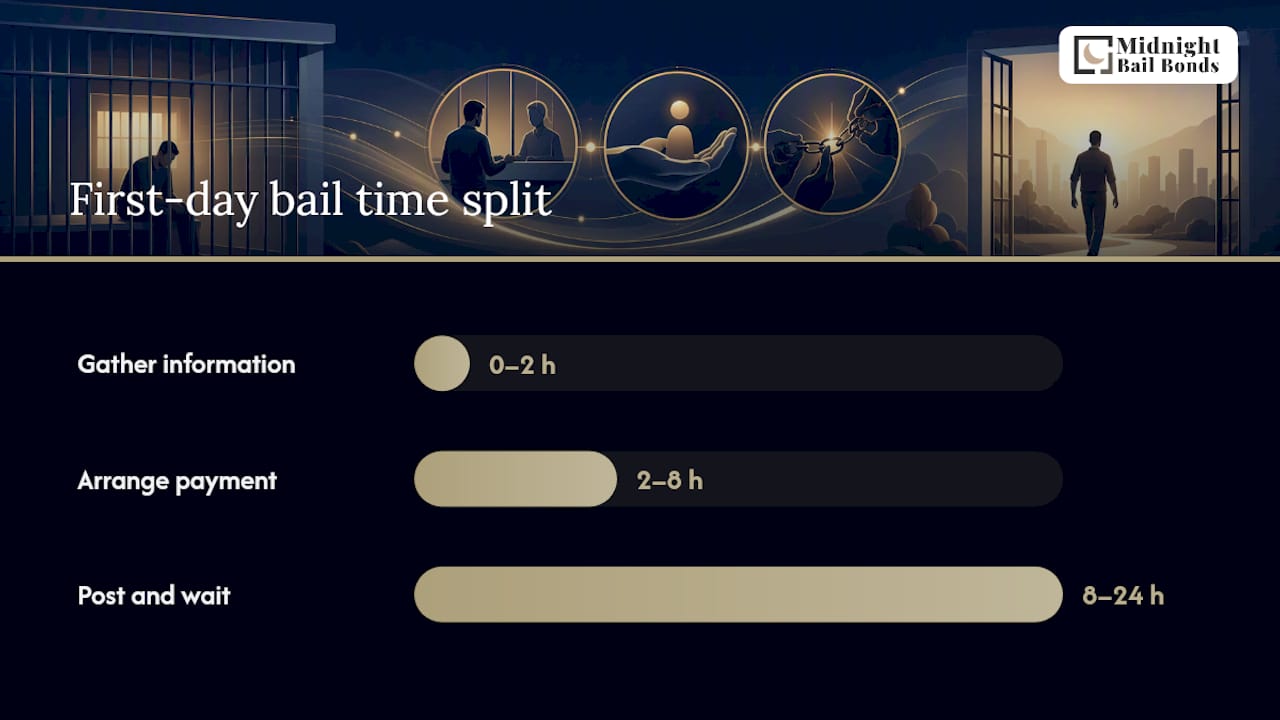
The first two hours after booking matter most. Here is the sequence to follow.
First 0–2 hours: gather information
- Ask the booking officer for your bail amount and case number.
- Request one phone call and use it to reach a trusted contact — not to vent, but to give them your full legal name, date of birth, booking number, the facility name and address, and the bail amount.
- Ask the officer which payment methods the facility accepts. Write it down.
Next 2–8 hours: arrange payment
- Have your contact confirm the bail amount through the jail's inmate search or by calling the jail clerk directly.
- If the amount is manageable, your contact should gather the funds in the accepted form (cash, cashier's check, money order, or card if accepted) and go to the facility's bail window or clerk desk.
- If the amount requires a cashier's check, your contact needs to visit a bank branch during business hours. Most banks issue cashier's checks same-day for account holders.
- If the facility accepts online payments or Zelle, your contact can initiate that remotely. Confirm the portal URL directly with the jail clerk — do not rely on a Google search result that may be outdated.
Next 8–24 hours: post and wait
- Once payment is delivered, processing typically takes several hours depending on facility workload.
- Your contact should keep the receipt. It is the proof of payment and will be needed for a refund after the case resolves.
- If release is delayed past the expected window, your contact should call the jail clerk again to confirm the bond was received and processed.
Pro Tip: When calling the jail, have the booking number ready before you dial. Clerks handle dozens of calls a day; giving them the number immediately cuts the call time in half and reduces the chance of a miscommunication about which inmate you are asking about.
Understanding bail: who sets it and what types of release exist
Bail is the financial guarantee that you will return for your court dates. It is not a fine or a punishment. If you show up as required, the money comes back. The amount and type of release depend on who is making the decision and when.
Who sets bail:
- Police or jail staff can apply a preset bail schedule for common low-level offenses. These schedules let facilities process standard releases without waiting for a judge, which speeds things up considerably for minor charges.
- Pretrial services staff evaluate your case using weighted criteria: the offense, your prior record, ties to the community, employment status, and financial resources. Their recommendation can lead to a bail reduction or a change in conditions through a re-interview program.
- A magistrate or judge sets bail at arraignment for more serious charges or when the bail schedule does not apply. Judges can also deny bail entirely for capital offenses or when a defendant poses a serious flight risk.
Common release types:
- Cash bond: You pay the full bail amount directly to the court or jail. Refundable after the case resolves, minus any administrative fees.
- Surety bond (bail bond): A licensed bondsman pays the full amount on your behalf. You pay the bondsman a nonrefundable premium, typically around 10% of the total.
- Release on own recognizance (ROR): No money changes hands. The court releases you based on your promise to appear. Usually reserved for low-level charges and defendants with strong community ties.
- Unsecured bond: You sign a promise to pay a set amount if you fail to appear, but no money is collected upfront.
Where and how cash bail is posted: payment methods, locations, and paperwork
Knowing the amount is only half the battle. You also need to know where to take the money and what form it has to be in.
Typical posting locations:
- Detention facility clerk or bail window: The most common option. Usually open around the clock at larger facilities, though staffing can slow processing overnight.
- Courthouse bond desk: Used when bail is set by a judge at arraignment. Hours are typically limited to business hours, Monday through Friday.
- Sheriff's office: In some counties, the sheriff's office handles bail for inmates held at county facilities.
Payment methods by jurisdiction:
- Cash (accepted almost universally, but large amounts may require documentation)
- Cashier's check or money order (widely accepted; must be made out to the specific facility)
- Credit or debit card (accepted at some facilities, not all — confirm before assuming)
- Online payment portal or Zelle (available in a growing number of counties but far from universal)
Payment method acceptance varies county by county, and online portals exist in many but not all areas. Always call the specific facility to confirm before your contact makes the trip.
What to bring:
- Government-issued photo ID (driver's license, passport, or state ID)
- The defendant's full legal name, date of birth, and booking number
- The exact bail amount (confirmed with the clerk, not assumed)
- Payment in the accepted form
Processing after payment can still take several hours. A facility with a heavy overnight intake will move slower than one with a light load. Your contact should plan for a wait and not assume release happens the moment payment clears.
| Payment Method | Typically Accepted | Limitations |
|---|---|---|
| Cash | Yes, most facilities | Large amounts may require documentation |
| Cashier's check | Yes, widely | Must be made out to the specific facility |
| Money order | Yes, widely | Amount limits may apply |
| Credit/debit card | Some facilities | Confirm with clerk before traveling |
| Online portal/Zelle | Some counties | Availability is uneven; verify the official portal URL |
Who can post bail for you: defendants, family, and other options
The law does not restrict who can post bail. Texas, for example, permits defendants to post their own cash bond, and most other states follow the same general principle. The practical barriers are what narrow the field.
Who can post bail:
- The defendant: Legally allowed in most jurisdictions, but the in-custody access problem makes this rare without outside help.
- Family or friends: The most common route. They can gather funds, visit the facility, and post payment on your behalf.
- A licensed bail bondsman: Posts the full amount for a nonrefundable fee. Faster in many cases because agents know the facility procedures and paperwork.
- Nonprofit charitable bail organizations: Available in some counties for low-level misdemeanor charges. Funds are limited and eligibility criteria apply.
- Property bond: In some jurisdictions, real estate equity can substitute for cash. The court places a lien on the property. If you miss court, the court can move to collect against it.
Property bonds take longer to process because the court must verify ownership and equity. They are not a same-day option.
Pro Tip: If you own property and want to use it as collateral, gather your deed, a recent mortgage statement, and a current property tax bill before you need them. Courts will ask for all three, and scrambling for documents from custody adds days to the process.
Bail bondsman vs. paying cash: costs, speed, and real tradeoffs
The choice between posting cash and using a bondsman comes down to one question: do you have the full amount available right now?
Cost comparison:
- Cash bail: You pay 100% of the bond amount upfront. If you appear at all required court dates, that money is refundable after the case resolves, minus administrative fees. The money is tied up for the duration of the case, which can be months.
- Surety bond (bondsman): You pay a nonrefundable premium, commonly around 10%, and sometimes put up collateral. That 10% is gone regardless of the outcome. On a $20,000 bond, that is $2,000 you will never see again.
Speed:
A bondsman often moves faster than a family member scrambling to gather cash, because agents know the facility staff, have the paperwork ready, and can post bond at any hour. For a $50,000 bond, finding that much cash overnight is nearly impossible for most families. A bondsman needs only $5,000 (the premium) to get started.
Pros and cons at a glance:
- Cash bail pros: fully refundable, no third-party fee, no ongoing relationship with a bondsman
- Cash bail cons: full amount tied up for months, hard to access quickly for large bonds
- Surety bond pros: lower upfront cost, agent handles logistics, available 24/7
- Surety bond cons: premium is nonrefundable, collateral may be required, bondsman has ongoing interest in your court appearances
For bonds under a few thousand dollars, cash is often the cleaner option if the funds are available. For anything larger, a bondsman is usually the faster, more practical route.
Common obstacles to self-bailing and what to do when you can't pay
The biggest barrier is not the law. It is logistics.
Top practical obstacles:
- Your cash is inventoried. Money found on you at arrest is logged as property and held. You almost certainly cannot use it to post bail without a lengthy release process.
- The amount is too high. A judge may set bail at $50,000 or $100,000 for serious charges. Gathering that in cash overnight is not realistic for most people.
- It's the middle of the night. Banks are closed. Cashier's checks are unavailable. Some jail windows have limited overnight staffing.
- The facility does not accept cards. If your contact shows up with a debit card and the facility only takes cashier's checks, they are making a second trip.
- Bail was denied. For capital offenses or when a judge determines you are a flight risk, no amount of money will secure your release until a hearing.
Alternatives when cash is not available:
- Request release on own recognizance (ROR). Ask your public defender to make this argument at arraignment. It works best for first-time offenders with stable community ties and low-level charges.
- Request a bail reduction hearing. A judge can lower the amount if your attorney argues it is disproportionate to the charge or your financial situation.
- Contact pretrial services. Pretrial staff evaluate weighted criteria and can recommend lower bail or supervised release. Ask about a re-interview.
- Look for a charitable bail organization. In some counties, nonprofits post bail for defendants charged with low-level misdemeanors. Availability is limited and varies by county.
- Call a licensed bail bondsman. A 10% premium is a real cost, but it gets you out when the full amount is out of reach.
- Contact a public defender immediately. They can identify options you may not know exist, including diversion programs or supervised release.
Money matters: refunds, forfeiture, and what happens if you miss court
Cash bail is not a fee. It is a deposit. The distinction matters because it determines whether you get that money back.
When you get your money back:
- You appear at every required court date
- The case resolves by acquittal, dismissal, diversion, or sentencing
- You submit a refund request to the court clerk (some jurisdictions require a formal written request)
- The court deducts any administrative fees or outstanding fines before returning the balance
The refund process is not instant. Depending on the jurisdiction, it can take several weeks to several months after the case closes.
What happens if you miss court:
- The court issues a bench warrant for your arrest
- Your bail is forfeited — the court keeps the full cash amount
- You face an additional charge of failure to appear (FTA), which carries its own penalties
- If a bondsman posted your bail, they have a legal and financial incentive to locate you. In many states, bondsmen can hire recovery agents to find and return you to custody.
If you miss a court date by accident:
- Contact your attorney immediately, before the warrant is executed
- Your attorney can sometimes file a motion to reinstate bail and explain the absence
- Acting fast is the difference between a fixable mistake and a compounded legal problem
Missing court is the single fastest way to turn a manageable situation into a serious one. The bail system is built on the assumption that you will show up. Every part of the forfeiture and warrant process is designed to enforce that assumption.
State and county differences: a local checklist to act on right now
Bail rules are not uniform across the United States. What works in one county may not work in the next. Payment methods, bail schedules, available alternatives, and processing times all vary.
What changes by jurisdiction:
- Whether bail schedules exist for your charge type
- Which payment methods the facility accepts
- Whether charitable bail organizations operate in your county
- Whether pretrial supervision is available as an alternative to cash
- How long processing takes after payment
Your immediate local checklist:
- Search "[county name] inmate search" to find the official jail booking database and confirm the bail amount.
- Call the jail clerk directly to confirm accepted payment methods and the bail window hours.
- Call the court clerk to confirm arraignment date and time if bail was set by a judge.
- Contact the public defender's office for your county. Most have a duty attorney available for arraignments.
- Search "[county name] pretrial services" to find out whether supervised release is an option.
- Search "[county name] charitable bail fund" to check whether a nonprofit bail organization operates locally.
- If using a bondsman, verify their license through your state's Department of Insurance website before paying anything.
How to find local contacts fast:
- The facility's name plus "phone number" in a search engine usually surfaces the main line within the first result
- State judicial branch websites (search "[state] courts official site") list court clerk contacts by county
- The National Association of Pretrial Services Agencies (NAPSA) website lists pretrial programs by state
What a 24/7 licensed bail agent actually does
A bail agent is not just someone who writes a check. They navigate a process that most people encounter for the first time under significant stress, and the speed advantage is real.
What a licensed agent does, step by step:
- Locates the inmate in the jail system using the booking number, full name, and date of birth
- Reviews the charges and confirms the bail amount with the facility
- Prepares the bond paperwork (indemnity agreement, power of attorney for the bond)
- Accepts payment in multiple forms: cash, credit/debit, Zelle, or a payment plan
- Posts the bond directly with the facility, often using established relationships with jail staff to move faster
- Follows up to confirm release and monitors court date compliance
What agents cannot do:
- Post bail when a judge has denied it
- Guarantee a specific release time (facility processing controls that)
- Represent you legally or advise on your case
For a 24/7 bail bond service in California, release after bond posting typically takes a few hours, though overnight processing at high-volume facilities can run longer. The agent's job is to remove every obstacle on their end so the only variable is the facility's own processing queue.
Pro Tip: When you call a bail agent, have four things ready: the defendant's full legal name, date of birth, booking number, and the facility name. An agent with that information can locate the inmate and start paperwork in minutes. Without it, the call turns into a search, and that costs time.
How families actually handle a sudden arrest
The call usually comes late at night. Someone is in custody, the booking number gets relayed in fragments, and the family has about 30 minutes to figure out what to do before the phone call ends.
What typically happens next: someone Googles the jail name, finds the inmate search, confirms the bail amount, and then freezes at the number. A $25,000 bond sounds impossible at midnight. The common mistake at this point is calling the first bail bondsman that appears in the search results without checking whether they are licensed. Another frequent error is wiring money to someone who claims to be a bondsman but asks for payment via gift card or wire transfer to a personal account. Licensed bondsmen do not operate that way.
The smarter move is to write down the booking number before the call ends, confirm the facility address, and then call a licensed agent whose credentials you can verify. Losing the booking number means starting the inmate search from scratch, which adds time when time is the one thing you do not have.
Common mistakes to avoid:
- Sending money to an unverified agent without checking their state license
- Assuming the jail accepts cards without calling first
- Forgetting to get a receipt for any payment made at the facility window
- Missing the arraignment date because no one tracked the court schedule
When you need immediate help right now
Bailing yourself out is possible, but the window between arrest and arraignment moves fast. If the bail amount is beyond what you or your contacts can pull together overnight, or if the facility's payment requirements are creating a logistical wall, a licensed 24/7 bail bond service removes those barriers immediately.
Midnightbail operates around the clock across California, with licensed agents who can locate your inmate record, handle all paperwork, and post bond the same night you call. Bilingual English/Spanish support is available, and in many cases, no collateral is required. Accepted payments include cash, credit/debit, and Zelle.
If you are in Orange County, Los Angeles County, or Riverside County, Midnightbail is available right now to start the process. Call, confirm your booking number and facility, and an agent will take it from there.
Sources
- Bail FAQ — Connecticut Judicial Branch
- Can You Bail Yourself Out of Jail in Texas? How It Works - LegalClarity
- Can You Bail Yourself Out of Jail? - Mainor Wirth
- Can You Bail Yourself Out of Jail? - Florida focus - Catalyst Legal
This article is general information, not a substitute for advice from a qualified lawyer. Consult a qualified legal professional about your own circumstances before acting on anything here.
FAQ
Is it possible to bail yourself out of jail?
Yes. There is no law that prevents a defendant from posting their own bail. The practical barrier is that cash found on you at arrest is typically inventoried and unavailable, so outside help is usually needed.
What does it mean to bail yourself out?
It means paying the court-set bail amount directly, without using a bondsman, to secure your release while your case is pending. If you appear at all required court dates, the money is refunded after the case resolves.
Can you still go to jail after bailing out?
Yes. Bail secures your release pending trial, not a final outcome. If you are convicted, you will be sentenced accordingly. Missing a court date also results in a bench warrant and forfeiture of your bail.
Can you bail yourself out of jail in the U.S. if the amount is too high?
How do you find out your bail amount from inside jail?
Ask the booking officer directly, or have a contact outside call the jail clerk with your full legal name and booking number. Many counties also have online inmate search tools that list the bail amount publicly.