
If someone you love is sitting in a county jail tonight, you need a licensed state or county bail agent, not a federal bail bond. A licensed agent posts a surety bond once you provide the defendant's full name, booking number, and jail location, and release typically happens within hours. The fee is a nonrefundable premium, so verify the agent's license and get the contract terms in writing before you pay anything.
TL;DR:
- A licensed county bail agent posts a surety bond within hours using the defendant's full name, booking number, and jail location, ensuring faster release times.
- Bail amounts vary significantly by county and charge, so calling the jail or court directly yields more accurate figures than relying on generic bail schedules.
- The typical nonrefundable premium for a bail bond is around 10% of the bail amount, payable by cash, card, or installment plans, with collateral at risk if the defendant skips court.
- Federal cases involve different procedures, with release decisions made at detention hearings based on risk rather than fixed bail, often taking several days instead of hours.
- Verify a bail agent’s license beforehand, insist on an itemized contract, and consider bail-review motions if the bail amount seems unreasonable for a quicker, more affordable release.
Table of Contents
- State vs Federal Bail: How the County Process Actually Works
- Steps to Post Bail Tonight: A Family's Checklist
- What Does a Bail Bond Actually Cost?
- How to Check a Bail Agent's License Before You Pay
- How Midnight Bail Bonds Helps When You Need Someone Out Now
- What Separates Federal Cases From County Bail Cases
- How Long Each Process Takes and What Happens at Each Step
- When Federal Bail Applies Instead of State Bail
- Release Conditions: What Changes Between the Two Systems
- After the Bond Is Posted: Court Dates and Forfeiture Risk
- Field-Tested Advice Families Often Skip
- Get Someone Released Tonight: Call Midnight Bail Bonds
- Where to Verify Bail Information and File Complaints
- Sources
- FAQ
State vs Federal Bail: How the County Process Actually Works
A state or county bail bond is a surety bond. The bail agent, backed by a surety insurance company, guarantees the court that the defendant will show up for every hearing. In exchange, the agent charges a premium and the family (or the defendant) signs a contract accepting responsibility if the defendant skips court.
Most county jails set bail using a bail schedule, a preset dollar amount tied to the specific charge. That number is usually available the moment someone is booked, though a judge can adjust it later at a bail hearing. The California Department of Insurance notes that bail schedules are set by individual counties, so the amount for a DUI in one county can look very different from the same charge one county over. That's why calling the actual jail or court where the case is filed matters more than guessing from a generic chart.
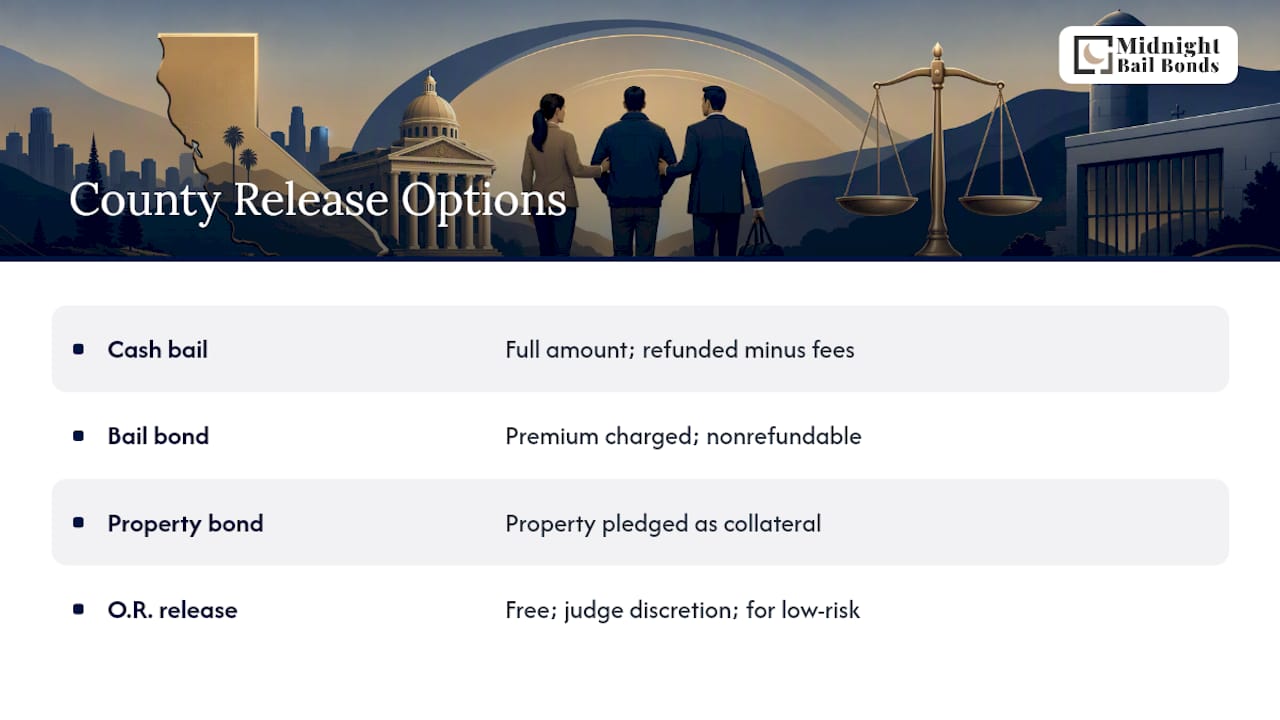
You have three real paths to release: pay the full cash bail directly to the jail, pledge property as collateral through a property bond, or qualify for an own-recognizance (O.R.) release, where the court lets the defendant go on a written promise to appear. Cash bail returns the money once the case closes, minus fees. A bail bond costs less upfront, but the premium never comes back. O.R. release costs nothing but is entirely at the judge's discretion, usually reserved for lower-risk charges and defendants with no history of missed court dates.
Steps to Post Bail Tonight: A Family's Checklist
Speed matters here, and most of the delay in a bail case comes from missing information, not paperwork. Before you dial anyone, get three things confirmed: the defendant's full legal name, their booking number, and the exact jail or facility holding them. A licensed agent needs this to verify the charges and bail amount before quoting you anything real.
Here's the process in order:
- Confirm the details. Full name, booking number, jail location. If you don't have the booking number yet, most county sheriff sites offer an inmate lookup tool.
- Call a licensed bail agent. Give them the information above. They'll check the booking, confirm the bail amount, and quote the premium.
- Review and sign the contract. You'll typically sign as the indemnitor (co-signer), which means you're financially responsible if the defendant misses court. Read this section closely.
- Pay the premium. Once payment clears, the agent prepares the bond paperwork.
- The agent posts the bond at the jail. Processing time depends on the facility, but this step is usually the fastest part of the whole process.
- Release happens. Most releases occur within a few hours of the bond being posted, though bookings, staffing, or an active hold on the defendant can add delays.
Pro Tip: Ask the agent directly whether the jail has flagged any holds (immigration, parole, another agency) before you pay. A hold means bail won't result in release no matter how fast the bond gets posted, and you deserve to know that before you hand over a premium.
If the bail amount looks unreasonably high for the charge, that's worth a conversation with a criminal defense attorney about a bail-review motion rather than paying immediately. Sometimes it's the smarter, cheaper first move.
What Does a Bail Bond Actually Cost?
Bail bond premiums are set by rates the surety company files with the state, and they're nonrefundable no matter what happens to the case afterward. Consumer guidance on California's bail system points to a commonly charged premium around 10% of the total bail amount, meaning a $20,000 bail generally runs about $2,000 in fees. That premium is gone even if the charges are later dropped, since you're paying for the guarantee itself, not a refundable deposit.
Payment usually breaks down like this:
- Cash, in full, at signing
- Credit or debit card
- Zelle or similar instant transfer
- Financing or a payment plan spread across installments
Collateral (a car, a house, jewelry) sometimes secures larger bonds, and if the defendant skips court, that collateral is at risk, along with the co-signer's finances. A CDI bulletin on bail premiums confirms that the entire amount you pay is reported as premium, which means there's no legitimate separate "service fee" layered on top. If an agent tries to charge you extra for something vague, ask for an itemized breakdown in writing. That's a red flag worth walking away from.
How to Check a Bail Agent's License Before You Pay
California law restricts bail bond work to licensed individuals. Under California Insurance Code sections 1800 through 1823, only a licensed agent may solicit, negotiate, or execute a bail undertaking. That license is checkable, and it should take you two minutes.
Before signing anything, confirm:
- The agent's license number through the California Department of Insurance
- The contract lists the surety insurance company's name and contact information
- The premium is itemized, with no vague add on charges
- The agent isn't soliciting you at hours or in a manner the state's bail solicitation rules prohibit
If something feels off, whether it's a missing license number or pressure to sign fast without reading terms, you have the right to contact CDI directly with questions or complaints. A legitimate agent won't discourage that.
How Midnight Bail Bonds Helps When You Need Someone Out Now
Midnightbail runs licensed agents around the clock across California, with an instant inmate search that helps you confirm booking details in minutes instead of waiting on hold with a jail switchboard. That single step often cuts hours off the whole process.
Flexible payment plans and no-collateral bail bond options are available in many cases, which matters if a family doesn't have property to pledge or needs to spread the premium over time. Bilingual support means language isn't a barrier when every hour in custody counts.
When you call, have the defendant's name, booking number, and jail location ready. Agents walk you through the contract, confirm the bail amount, and start posting the bond right away.
What Separates Federal Cases From County Bail Cases
Most families dealing with a jail call are inside the state and county system, where a licensed bail agent handles everything described above. Federal cases work through an entirely different framework, and understanding the split matters if the arrest involves federal charges like large-scale drug trafficking, bank robbery, or interstate fraud.
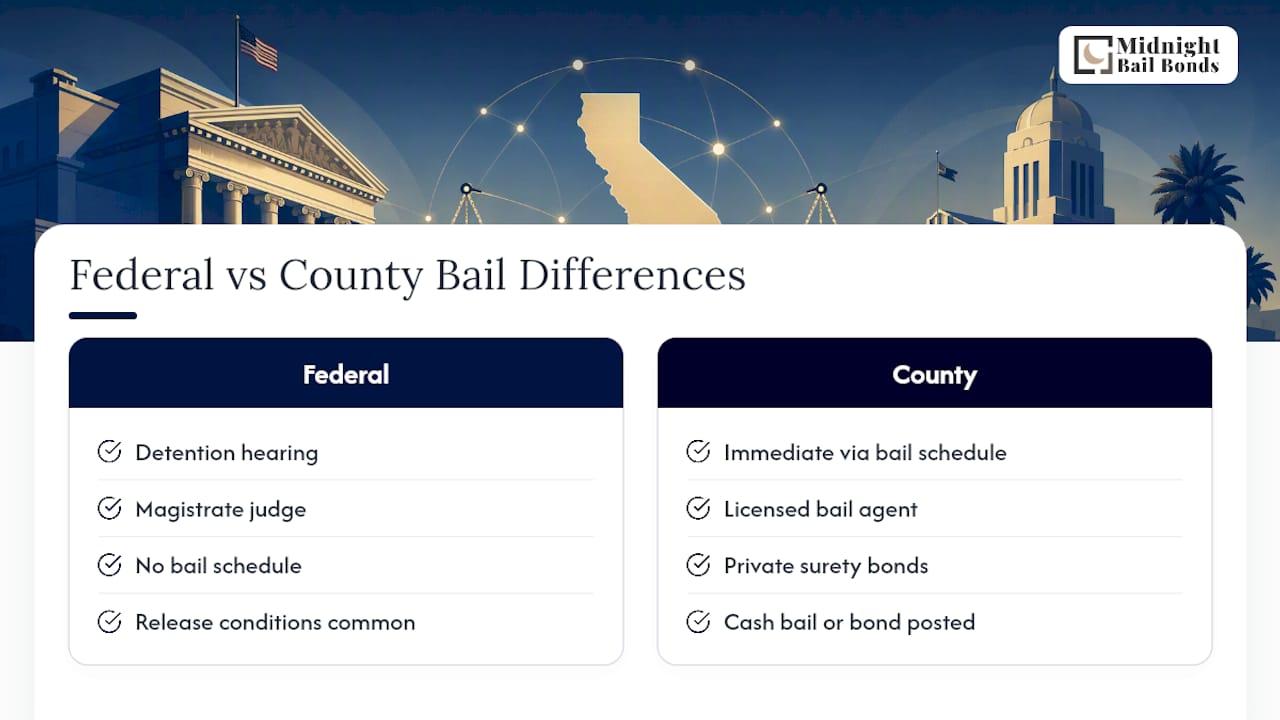
In state and county cases, bail is usually set immediately using a county bail schedule, and a licensed bail agent can post a surety bond within hours without a judge weighing in unless the defendant requests a bail hearing to argue for a lower amount. The system runs on private surety companies and licensed agents regulated by the California Department of Insurance.
Federal cases don't use a bail schedule at all. A federal magistrate judge decides release conditions at a detention hearing, and that hearing considers flight risk and danger to the community under federal law, not a preset dollar figure tied to the charge. Federal courts also lean far more heavily on release conditions instead of straight cash bail: home detention, travel restrictions, surrendering a passport, or third-party custodians who agree to supervise the defendant.
For the vast majority of readers dealing with a county jail booking, a state bail bond through a licensed agent is the relevant path. Federal detention hearings are a narrower, less common process reserved for federal charges.
How Long Each Process Takes and What Happens at Each Step
County bail moves fast because it's built to. Once a bail schedule number exists, a licensed agent can quote a premium, get a contract signed, and post the bond, often within a few hours of the family making that first phone call. The bottleneck is usually paperwork processing at the jail itself, not the bond.
Federal bail, meaning a federal detention hearing, runs on a court calendar instead of a jail clock. After a federal arrest, the defendant typically appears before a magistrate judge within a day or two for an initial appearance. The detention hearing where release conditions get decided can happen at that same appearance or get pushed a few days out if either side requests more time to prepare arguments. There's no bail agent to call and no premium to pay in the traditional sense, since federal release conditions are set by the judge directly rather than purchased through a surety bond.
That timeline difference is the single biggest practical distinction for families. County bail can resolve in an afternoon. A federal detention hearing might take several days to schedule, and the outcome depends on a judge's assessment rather than a fixed dollar amount anyone can simply pay to satisfy.
When Federal Bail Applies Instead of State Bail
Federal bail only enters the picture when federal charges are filed, meaning the case is being prosecuted by federal authorities like the U.S. Attorney's Office rather than a county district attorney. This happens with crimes that cross state lines, involve federal agencies, or violate federal statutes specifically: drug trafficking conspiracies, wire fraud, federal firearms violations, immigration offenses, and crimes committed on federal property.
A single arrest can sometimes trigger both systems if state and federal charges stem from related conduct, though that's less common for the kinds of cases most families call about, like DUI, domestic violence, theft, or state drug possession charges. Those stay firmly in county court, where a bail agent can help immediately.
If you're unsure which system applies, the booking paperwork or the arresting agency will usually make it clear. A county sheriff's booking means state or county charges and a bail schedule amount you can act on right away. A federal detention facility or an arrest involving agencies like the FBI, DEA, or ATF signals federal jurisdiction, where a defense attorney experienced in federal court, not a bail agent, is the right first call.
Release Conditions: What Changes Between the Two Systems
County bail release conditions are usually straightforward: show up to your court dates, don't leave the state without permission, and avoid any specific restrictions tied to the charge, like a protective order in a domestic violence case. Once the bond is posted, the defendant walks out with relatively few ongoing restrictions beyond attending hearings.
Federal release conditions tend to be more layered because a magistrate judge is building them individually rather than pulling from a schedule. Common federal conditions include regular check ins with a pretrial services officer, travel restrictions that can extend beyond the state, surrendering a passport, drug testing, electronic monitoring, or requiring a third party to act as a custodian who reports violations. Federal judges have wide discretion here, and conditions often reflect the specific risk factors of the case rather than a one-size-fits-all standard.
For a family calling about a county jail booking, this distinction mostly matters as context. County release conditions are lighter and more predictable, and a licensed bail agent can explain them clearly at the time the bond is posted, and resources like this guide to bail conditions in California walk through what to expect after release.
After the Bond Is Posted: Court Dates and Forfeiture Risk
Once a county bail bond gets posted and the defendant is released, the case moves forward on the regular court calendar. The defendant must appear at every scheduled hearing. Missing one triggers a bond forfeiture, meaning the court can demand the full bail amount from the surety company, which then comes after the co-signer for that money, plus any collateral pledged. The case resolves through plea, trial, or dismissal, and the bond simply covers the release period until the case closes.
Federal cases follow a similar appearance obligation but with federal court's own calendar and pretrial services oversight monitoring compliance with release conditions along the way. Violating a condition, not just missing a court date, can result in the judge revoking release entirely and ordering the defendant back into custody before the case even reaches trial. That's a meaningfully stricter standard than county bail, where compliance mostly comes down to showing up.
In both systems, the goal of bail or release conditions is the same: guarantee the defendant returns for their hearings without holding them in jail the entire time the case is pending. The mechanics just diverge sharply once you're inside the federal system, where a judge is actively supervising the release rather than a bond simply sitting on file.
Field-Tested Advice Families Often Skip
Verify the agent's license before you pay if you have even a few minutes to spare. It takes less time than filling out the contract. Insist on a written, itemized agreement that names the surety insurer and includes CDI contact information, since a legitimate agent has nothing to hide there.
If the bail number feels excessive for the charge, ask an attorney about a bail-review motion before paying a premium you can't get back. Sometimes the fastest path isn't the first bond quote you get.
— Jake
Get Someone Released Tonight: Call Midnight Bail Bonds
This service provides licensed agents available 24/7 across California, and flexible payment plans mean the premium doesn't have to come out of savings all at once.
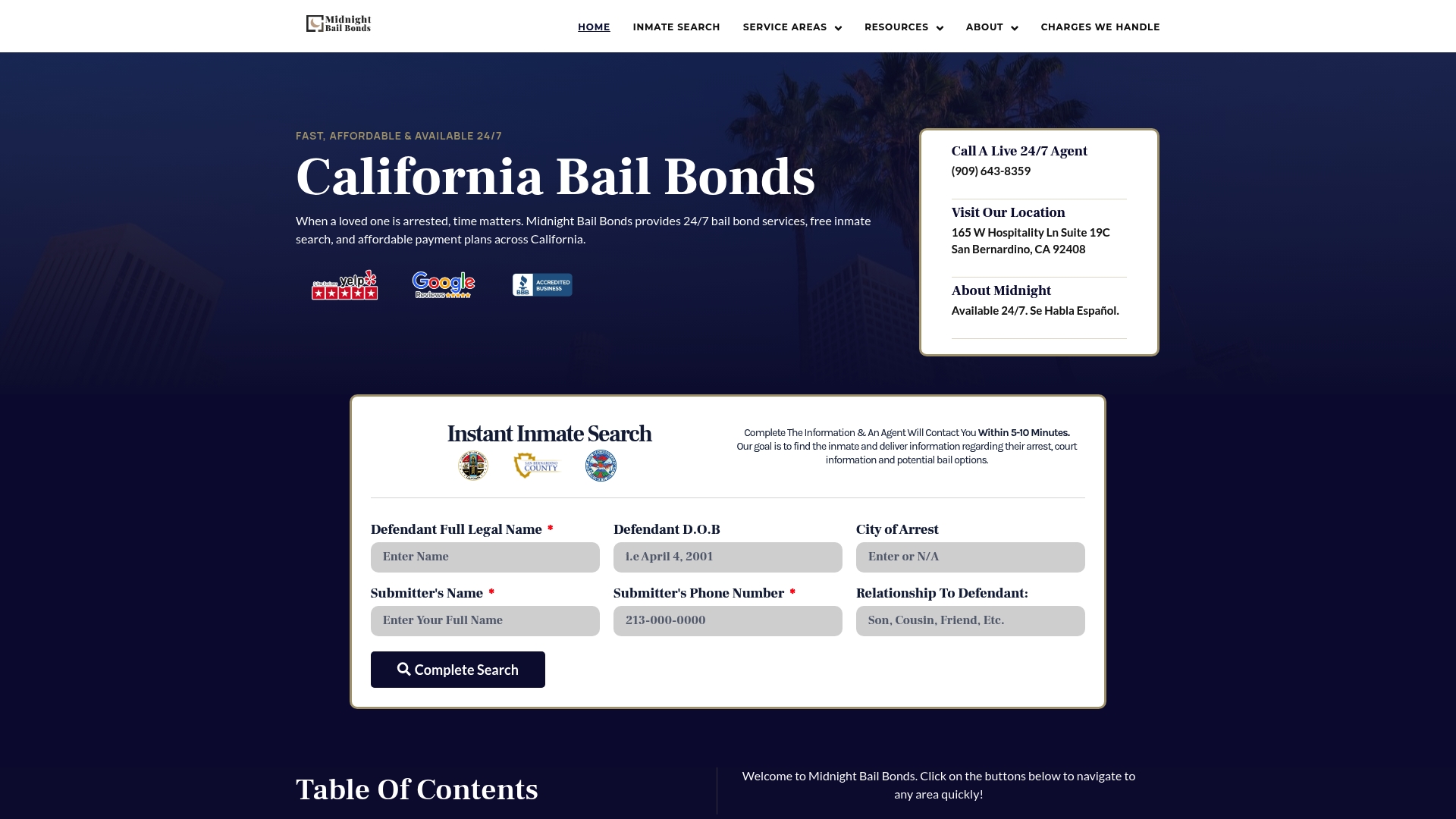
Start with the instant inmate search to confirm the booking number and jail location if you don't have them yet. Bilingual agents walk you through the contract in plain terms, and no-collateral options are available in many cases, so a lack of property doesn't have to stall the process.
Before you call, have three things ready: the defendant's full name, their booking number, and the jail location. Then reach out through Midnight Bail Bonds and an agent will confirm the bail amount, quote the premium, and start the paperwork immediately.
Where to Verify Bail Information and File Complaints
The California Department of Insurance's bail bonds page covers license verification and how to file a consumer complaint against a bail agent.
County-specific posting procedures, including accepted payment methods, are available through San Joaquin County Sheriff's Office bail procedures, one example of how local jails structure the posting process.
The legal basis for agent licensing sits in California Insurance Code sections 1800 to 1823, useful if you want to read the actual statute behind the license requirement.
This article is general information, not a substitute for advice from a qualified lawyer. Consult a qualified legal professional about your own circumstances before acting on anything here.
Sources
- Bail Procedures | San Joaquin County Sheriff's Office
- Bail Bonds | California Department of Insurance
- California Insurance Code — Bail Licenses 1800 - 1823
- How Do Bail Bonds Work? | Power Trial Lawyers Southern California
FAQ
Is "Federal Vs State Bail" the Same as County Bail?
For most families calling about a jail release, the relevant process is state and county bail, handled by a licensed bail agent and a county bail schedule, not the federal detention hearing system.
How Fast Can I Get Someone Out With a Bail Bond?
Once a licensed agent confirms the booking and the contract is signed, release often happens within a few hours, though jail processing times and holds can add delays.
What Information Do I Need Before Calling a Bail Agent?
Have the defendant's full legal name, booking number, and jail location ready, since agents need these to verify the charges and confirm the bail amount before quoting a premium.
Is the Bail Bond Premium Refundable?
No. The premium is a nonrefundable fee for the surety company's guarantee, and it stays nonrefundable even if the charges are later dropped or reduced.
Does the bail bond service offer payment plans or no collateral options?
Yes. Flexible payment plans and no-collateral bail bond options are available in many cases, along with 24/7 licensed agents and bilingual support.