
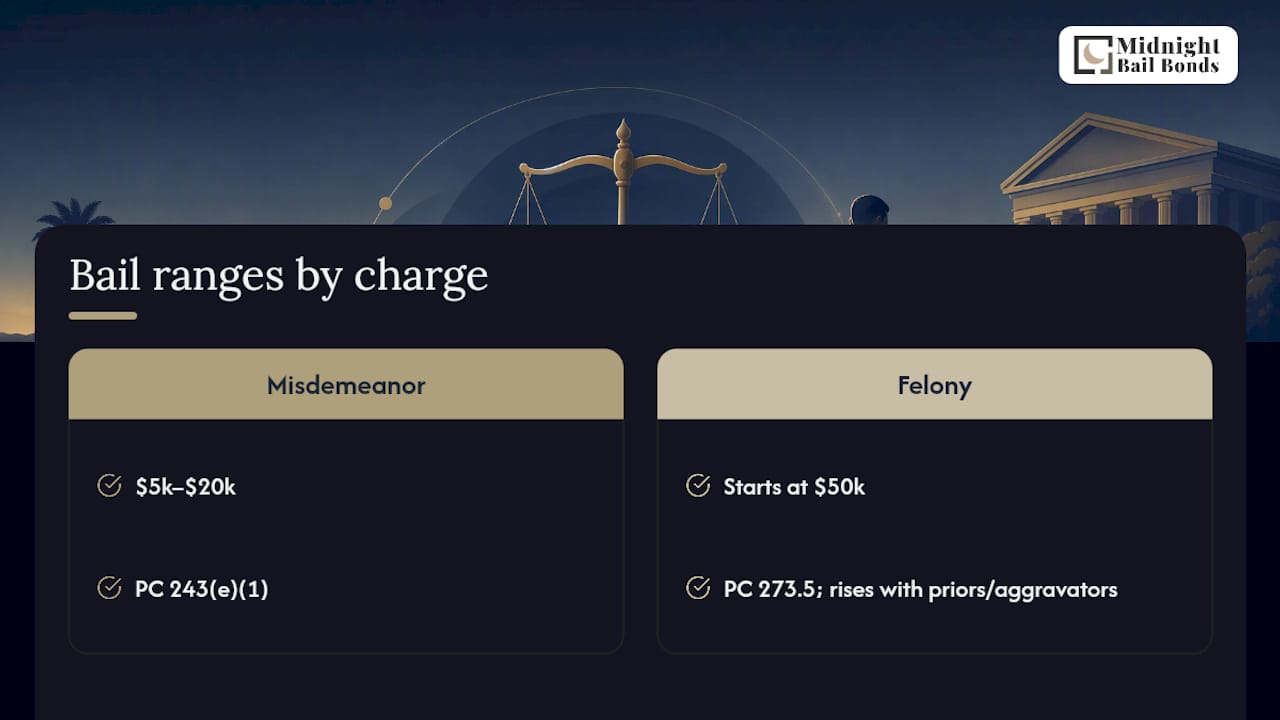
In California, misdemeanor domestic battery under PC 243(e)(1) typically starts at a moderate amount set by county bail schedules, generally in the lower monetary range, while felony corporal injury under PC 273.5 commonly starts at a significantly higher amount, which increases with prior convictions or aggravating factors. County bail schedules set the starting number, but domestic violence arrests often trigger mandatory holds and protective-order conditions that push release later than families expect.
If someone you love was just arrested, here's what to do right now:
- Call the jail's booking line to confirm the exact charge code and listed bail amount.
- Contact a criminal defense attorney before the arraignment, ideally within hours.
- Reach a licensed bail agent to start the paperwork while the hold review is pending.
Key Takeaways
Domestic violence bail in California ranges from roughly $5,000 for a low-level misdemeanor to $50,000 or more for a felony, and the exact figure depends on county schedule, judge discretion, and statutory holds under §1270.1 and §1269c.
| Point | Details |
|---|---|
| Misdemeanor range | PC 243(e)(1) domestic battery typically has a bail amount set by county schedules at a moderate level. |
| Felony baseline | PC 273.5 corporal injury commonly has a higher starting bail amount, which increases with priors or aggravating factors. |
| Mandatory hold possible | Section 1270.1 can require a judge's hearing before release, adding delay beyond payment speed. |
| Protective orders are standard | Expect no-contact terms and firearm surrender attached to nearly every DV release. |
| Fast help available | Midnightbail offers 24/7 licensed agents, bilingual support, and no-collateral bond options across California. |
Table of Contents
- What Is the Bail Amount for Domestic Violence Charges?
- Typical Bail Ranges for Common Domestic Violence Charges
- What Factors Make Judges Raise or Lower Bail?
- Life After Release: Protective Orders and Restrictions
- How Do Bail Bonds Work for Domestic Violence Cases?
- What Should You Do in the Hours After Release?
- Who Handles Bail Bonds for Families in Crisis?
- Where to Verify Bail Rules and Schedules
- A Straight Take on What Actually Matters Here
- Get Help Posting Bail Right Now
- Sources
- FAQ
What Is the Bail Amount for Domestic Violence Charges?
Bail in a domestic violence case moves through two stages, and the gap between them is where most confusion happens. At booking, jail staff assign bail using the county's published schedule, a flat number tied to the charge code with no judge involved yet. That number can change fast once a judge reviews the case at arraignment, and in many domestic violence arrests it changes upward, not down.
Two statutes drive that shift. Penal Code §1270.1 requires an open-court hearing before a judge deviates from the scheduled bail amount in many domestic violence cases, which is exactly why release sometimes stalls for a day or two even when a family has the money ready. Separately, Penal Code §1269c lets a peace officer file a declaration requesting a higher bail than the schedule lists, if the officer believes the scheduled amount will not protect the victim.
Here's the general sequence:
- Arrest and booking, where jail staff apply the county schedule amount.
- A judicial review, often required under §1270.1 before any deviation is finalized.
- Arraignment, usually within 48 hours (excluding weekends and holidays), where the judge can set, raise, or lower bail.
- Release, either on bail, on a bond, or occasionally on the defendant's own recognizance if the judge finds no public safety risk.
"Release on own recognizance" means the person is let out without paying bail, on a written promise to appear in court. Judges use it sparingly in domestic violence cases because of the public safety standard discussed below.
Typical Bail Ranges for Common Domestic Violence Charges
Numbers vary by county, but the pattern across California is consistent enough to plan around. Misdemeanor domestic battery under PC 243(e)(1), the charge that applies when there's no visible injury, typically lands between $5,000 and $20,000. Felony corporal injury to a spouse or cohabitant under PC 273.5 starts much higher.
- PC 243(e)(1) (misdemeanor domestic battery): generally starts at a lower amount based on the county schedule.
- PC 273.5 (felony corporal injury): commonly has a higher starting bail amount that increases with visible injury, weapon use, or prior domestic violence convictions.
- Repeat offenses or violations of an existing protective order: schedules frequently escalate the felony baseline well past $50,000, sometimes into six figures.
The San Diego County Superior Court's published bail schedule reflects this pattern directly, listing misdemeanor domestic battery at a lower bail range and felony corporal injury with a significantly higher starting bail. County-level practitioner guidance from Los Angeles and Orange County schedules shows the same $50,000 felony baseline, which tells you this isn't a San Diego quirk. It's a statewide pattern, though the exact number your family sees will depend on which county jail is holding the case.
There's no single "average" bail figure for domestic violence in California, and anyone quoting one flat number is oversimplifying. Local schedules differ, and judges have real discretion to move off the schedule in either direction once a case reaches arraignment.
What Factors Make Judges Raise or Lower Bail?
Public safety sits at the top of the list. Judges are required to weigh the safety of the alleged victim and the public as the primary consideration when setting bail, which is a higher bar than in many other misdemeanor or felony cases where flight risk alone dominates the analysis.
Beyond that baseline, several specific factors tend to move the number:
- Severity of injuries and whether a weapon was involved.
- Whether children were present during the incident.
- The defendant's criminal history, especially prior domestic violence arrests or convictions.
- Ties to the community, such as steady employment or local family, which cut against flight risk.
- An officer's declaration under §1269c requesting a bail increase because the schedule amount seems insufficient to protect the victim.
Pro Tip: Ask the jail or the defense attorney whether an officer filed a §1269c declaration. If one exists, the number posted at booking may not be the number a judge ultimately sets at arraignment, and you'll want to know that before you commit funds to a bond.
Defense attorneys can push back on all of these at arraignment, arguing for release on lower bail or even OR release, but the prosecution will lean hard on any prior DV history or officer safety concerns to keep bail high.
Life After Release: Protective Orders and Restrictions
Posting bail doesn't end the legal restrictions. Nearly every domestic violence release in California comes with a criminal protective order attached, and violating it can mean immediate re-arrest, even if the original bail was paid in full.
Standard conditions usually include:
- No contact with the alleged victim, directly or through a third party.
- A stay-away order covering the victim's home, workplace, and sometimes children's school.
- Mandatory firearm surrender, which California courts require as a near-automatic condition in domestic violence releases.
- Occasionally GPS monitoring or supervised release, more likely when the alleged injuries were severe or the defendant has prior violations.
Get the exact terms in writing from the court or the defense attorney before the released person goes anywhere near a shared home or shared children. A misunderstanding about what "stay away" covers is one of the most common reasons people get re-arrested within days of release.
How Do Bail Bonds Work for Domestic Violence Cases?
Most families don't have $50,000 in cash sitting around, which is why bail bonds exist. A licensed bail agent posts the full bail amount with the court in exchange for a premium, which is set by state regulation at roughly 10% of the total bail and is non-refundable once the bond is posted.
Here's how the process typically runs:
- Call a licensed bail agent and provide the defendant's booking number and exact charge.
- Complete paperwork and agree on payment, whether that's the 10% premium in full, a payment plan, or, in many cases, a bond arranged without collateral.
- The agent posts the bond with the jail.
- Release follows, though processing time depends on the jail's own paperwork backlog, not just how fast the premium is paid.
Pro Tip: Have the booking number, full legal name, and exact charge code ready before you call an agent. It shaves real time off the paperwork, and in a case with a possible §1270.1 hold, every hour matters.
What Should You Do in the Hours After Release?
The first 24 to 48 hours after release set the tone for everything that follows in the case.
- Get the protective order and every release condition in writing, and read it before the released person goes home.
- Confirm firearm surrender happened and get documentation of it.
- Hire or confirm representation with a criminal defense attorney before the next court date; arraignment timelines move fast.
- If injuries occurred, document them with photos and medical records now, while the details are fresh.
- Keep a written log of any contact attempts, even accidental ones, since courts take documentation seriously if a protective order violation is later disputed.
Skipping any of these steps is how minor missteps turn into new charges layered on top of the original case, learn more about the battery bail process for a full walkthrough.
Who Handles Bail Bonds for Families in Crisis?
Midnightbail works domestic violence cases across California with licensed agents available 24/7, because arrests don't wait for business hours and neither do the mandatory hold reviews under §1270.1. Families dealing with the added complication of an officer's §1269c declaration or a judge-adjusted bail amount need someone who can move the moment the number is finalized, not the next morning.
- Licensed agents on call around the clock, with bilingual English and Spanish support for families who need to move fast in either language.
- Flexible payment plans and bail bond options available without collateral in many cases, plus multiple payment methods including cash, credit, debit, Zelle, and financing.
- A free instant inmate search to confirm booking details before you even make the first call.
Where to Verify Bail Rules and Schedules
Confirm any figure or condition mentioned here directly with primary sources before acting on it.
- California Penal Code §1270.1, governing mandatory hearings before bail deviation.
- California Penal Code §1269c, governing officer declarations for higher bail.
- California Department of Justice OpenJustice portal for broader domestic violence data context.
A Straight Take on What Actually Matters Here
Most articles on this topic hand you a single bail number and call it a day. That's the wrong way to read this system. The number posted at booking is a starting point, not a promise, and treating it as final is how families end up scrambling later when a judge revises it upward at arraignment under §1270.1 or after an officer's §1269c declaration lands on the prosecutor's desk.
The bigger blind spot is what happens after release. Families fixate on the bail figure and forget the protective order that comes with it, then panic when a "harmless" phone call to check in triggers a new arrest. If I had to rank priorities, get the release conditions in writing before you get the money together. A bail agent can move fast once the number is set, but no agent can undo a protective order violation.
Conventional advice treats bail like a transaction. It's better understood as the opening move in a longer process that includes court dates, protective orders, and real legal exposure if any condition gets ignored.
Get Help Posting Bail Right Now
Midnightbail exists for exactly the moment you're in: a domestic violence arrest, a bail number that just got set or is still being reviewed under §1270.1, and a family trying to figure out the fastest legal path to release. Unlike waiting on standard business hours or scrambling to find someone who speaks your language at 2 a.m., Midnightbail runs licensed agents 24/7 with bilingual English and Spanish support, and offers bond options without collateral for families who don't have assets to put up on short notice.
Payment plans and multiple payment methods, including Zelle and financing, mean the 10% premium doesn't have to come out of one lump sum. If your family member is being held in Orange County, Midnightbail's Orange bail bonds page has local jail contacts and agent details specific to that facility. Otherwise, start with Midnightbail's main site and use the free instant inmate search to confirm booking details before you call.
This article is general information, not a substitute for advice from a qualified lawyer. Consult a qualified legal professional about your own circumstances before acting on anything here.
Sources
FAQ
How much is bail for domestic violence charges in California?
Misdemeanor domestic battery under PC 243(e)(1) typically runs $5,000 to $20,000, while felony corporal injury under PC 273.5 commonly starts at $50,000 and rises with prior convictions or aggravating factors, depending on the county schedule.
Is there a most common bail amount for domestic violence cases?
There's no single standard figure because county schedules and judge discretion vary widely, but $50,000 is a frequently cited felony baseline across several large California counties, including Los Angeles and Orange.
What does 10% of a $50,000 bond cost?
A bail bond premium of 10% on a $50,000 bond comes to $5,000, which is the state-regulated, non-refundable fee a licensed agent charges to post the full bail amount with the court.
How much does it cost to bail someone out for an assault-related charge?
Costs scale with the bail amount set for the specific charge, and since a bail bond premium is set at roughly 10%, a misdemeanor bail translates to about 10% of that amount out of pocket through a bond rather than paying the full amount in cash.
Can bail be increased after booking in a domestic violence case?
Yes. An officer can file a declaration under Penal Code §1269c requesting higher bail if the scheduled amount seems insufficient to protect the victim, and a judge can also raise bail at the §1270.1 hearing.