

Most non-aggravated first-offense DUI bail falls between $500 and $5,000, with many counties setting a straightforward bond in the low thousands. If your BAC was below a commonly cited threshold for aggravation, no one was hurt, and there's no prior record, expect the lower end. Your immediate move: confirm the arraignment time with the jail's booking desk and call a bail agent or attorney right away, since acting fast is what actually shortens time in custody.
TL;DR:
- Most non-aggravated DUI bail ranges from $500 to $5,000, with statewide schedules in Florida and regional differences in other states.
- Factors like high BAC, injury, prior offenses, or flight risk can significantly increase bail, often up to $50,000 or more.
- Bail can be posted via recognizance, cash, or bail bonds; fast release depends on having complete arrest and court information ready.
- Arrest conditions such as a BAC threshold or injury may delay release until BAC drops or hours pass, even if bail is paid.
- Hiring a licensed bail agent promptly and providing full defendant details can expedite bail posting and reduce custody time.
Table of Contents
- DUI First Offense Bail: What Different States Actually Charge
- What Pushes DUI Bail Higher or Lower
- How Judges and Bond Schedules Actually Set the Number
- How to Post Bail Fast: Cash, Property, or a Bail Bond
- Arraignment and the First 48 Hours
- Can You Get Bail Reduced or Skip It Entirely?
- A bail agent's quick-priority checklist
- Midnight Bail Bonds: Help With DUI Bail in California, Any Hour
- Sources
- FAQ
DUI First Offense Bail: What Different States Actually Charge
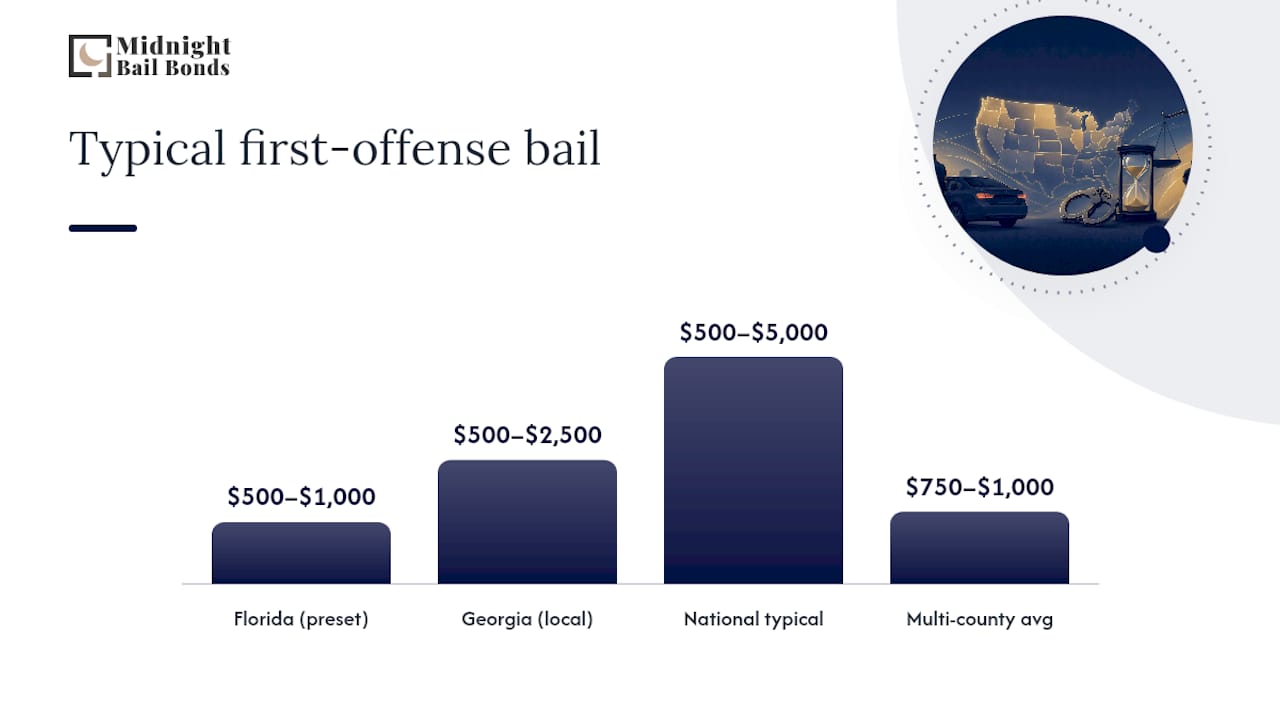
Bail numbers swing hard depending on where the arrest happened, and pretending otherwise does readers a disservice. Most non-aggravated misdemeanor DUI cases land somewhere in the $500 to $5,000 range nationally, but the exact figure depends on the county, the judge, and whether a preset schedule applies at all.
Florida runs on a uniform statewide bond schedule, which means many first-offense DUI charges come with a preset number the jail can use without waiting for a judge. Under AOSC24-126, certain misdemeanor DUI classifications carry standard bonds commonly in the $500 to $1,000 range, though judges can raise that when statutory criteria kick in.
California works differently. There's no single statewide number, so bail depends heavily on county practice. Misdemeanor DUI bail commonly starts in the low thousands according to California DMV data, while felony DUI or cases with serious injury can result in significantly higher bail amounts.
A few more regional patterns worth knowing:
- Georgia: Local guides put typical first-offense bonds around $500 to $2,500 for straightforward misdemeanor cases.
- Texas: Bond amounts vary county by county, often mirroring Georgia's range for a clean first offense with no crash.
- Washington: Courts weigh flight risk and community ties heavily, so a stable local address tends to keep numbers on the lower end.
- Multi-county averages: Some defense firms report initial misdemeanor DUI bonds clustering around $750 to $1,000 in many jurisdictions, which lines up with the broader national pattern.
What Pushes DUI Bail Higher or Lower
Judges don't pull bail numbers out of thin air. They're weighing specific facts against a bond schedule or their own discretion, and the difference between a $750 bond and a $50,000 one usually comes down to a short list of red flags.
What raises bail:
- A BAC at or above a commonly referenced threshold that courts consider serious
- A crash involving injury or death
- A minor passenger in the vehicle at the time of arrest
- Prior DUI convictions on record
- An outstanding warrant or an alleged hit-and-run
What keeps bail lower:
- No prior criminal record
- Steady employment and a documented local address
- Full cooperation during testing and arrest, without added resistance charges
Pro Tip: If you were cooperative during the stop and have no priors, tell your bail agent or attorney immediately. Judges and clerks sometimes have limited discretion, but documented cooperation can matter at a bail review hearing.
Florida's schedule explicitly builds these triggers into law. Under statutory criteria referenced in FindLaw's DUI booking guide, certain aggravating facts require a judge's first-appearance hearing rather than allowing a jail clerk to release someone on the preset bond amount alone.
How Judges and Bond Schedules Actually Set the Number
Bond schedules exist so people don't sit in jail waiting for a judge to become available. Florida's statewide version, laid out in AOSC24-126, assigns preset bond amounts to specific misdemeanor charges, including many first-offense DUI cases.
Judges override that schedule when statutory red flags apply. A crash with injury, a minor in the car, or a prior conviction can trigger a mandatory first-appearance hearing instead of an automatic release. That hearing typically happens within 24 hours of arrest, sometimes sooner.
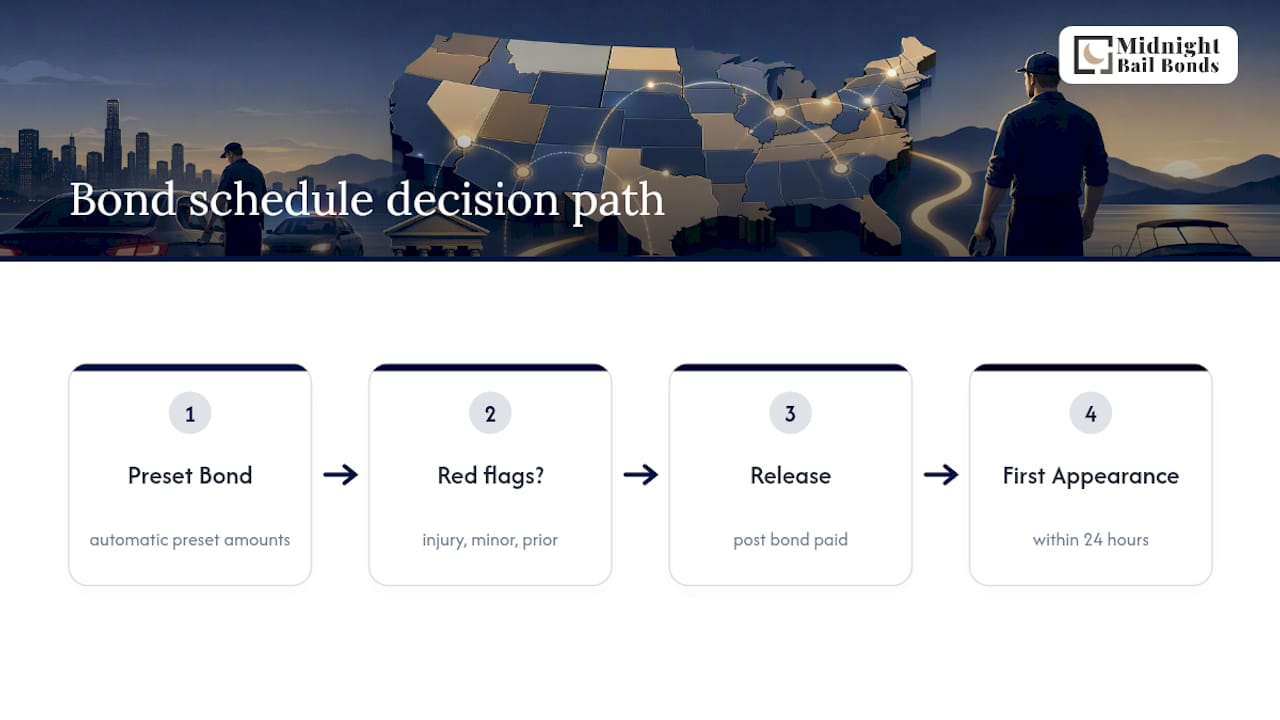
There's another wrinkle specific to DUI: the sober-hold. Many jails, including facilities operating under policies like Orlando's standard bonds and pretrial release procedures, won't release someone until their BAC drops below a certain level or a set number of hours has passed, regardless of whether bail is already posted. That means paying bail fast doesn't always mean walking out fast.
How to Post Bail Fast: Cash, Property, or a Bail Bond
Once bail is set, you generally have three paths to release, and picking the right one saves both time and money.
- Own recognizance (OR) release. No money changes hands. The court releases the defendant on a promise to appear, usually reserved for low-risk, first-time cases with strong community ties.
- Cash bond. You pay the full bail amount directly to the court, refundable later minus fees, assuming all court dates are met.
- Commercial bail bond. A licensed bail agent posts the full amount for a nonrefundable premium, typically 8% to 10% industry-wide, according to FindLaw. Some California options, including 1% bail bonds, lower that upfront cost significantly for qualifying clients.
- Property bond. Rare and slow, involving real estate as collateral instead of cash, and usually not practical for a fast release.
Before you call anyone, have this ready: the defendant's full name and date of birth, the booking number, the jail's location, and the court's arraignment date. Bail agents move faster with complete information.
Pro Tip: Save the jail's booking phone number in your phone before you need it. When it's 2 a.m. and someone you love just got arrested, fumbling for a Google search costs you real minutes.
Arraignment and the First 48 Hours
Arraignment is the first court appearance, and it's often confused with a trial. It isn't. The judge reads the charges, confirms or sets bail, and enters a plea (usually "not guilty" at this stage) while defense counsel gets formally attached to the case.
The judge may also impose release conditions beyond bail itself: travel restrictions, an ignition interlock device (IID), or electronic monitoring, particularly if the arrest involved a high BAC or a prior offense. These conditions matter because violating them, or simply missing a scheduled court date, can lead to bond forfeiture and a new arrest warrant. Write every date down the moment it's given, and set more than one reminder.
Can You Get Bail Reduced or Skip It Entirely?
Defense counsel typically raises this at arraignment or at a separate bail-review hearing, and the request works best when it's backed by paperwork, not just an argument.
Judges respond to concrete proof: steady employment records, documented ties to the local community, a clean record, and a proposed alternative like GPS monitoring or an IID instead of a high cash bond. A cosigner willing to act as surety strengthens the request further.
That said, courts are far less likely to grant relief when the case involves serious injury, a fatality, clear flight risk, or a violent history. A recent case in Napa County, where a judge denied release entirely in a fatal DUI crash, shows how far the numbers can move when prosecutors argue public safety is at stake.
A bail agent's quick-priority checklist
Call a licensed bail agent the moment you have booking details, don't wait to "figure things out" first. Line up a possible co-signer and know your payment options before you call. Ask directly about no-collateral options and bilingual support, since both can speed up processing considerably.
— Jake
Midnight Bail Bonds: Help With DUI Bail in California, Any Hour
If you're staring at a bail number right now and don't know where to start, Midnight Bail Bonds answers calls day and night, every day of the year, with licensed agents ready to walk you through it.
Unlike waiting on a public defender's callback or trying to scrape together a full cash bond, Midnight Bail Bonds offers flexible payment plans and, for qualifying clients, 1% down bail bond options specifically for DUI charges in California. Many cases also qualify for release without collateral, which matters when a family doesn't have property to put up on short notice.
When you call, have the defendant's full name, date of birth, and booking number ready. Agents typically move fast once that information and payment authorization are confirmed. The premium you pay is a state-mandated, nonrefundable fee, standard across California, and Midnight Bail Bonds walks you through the exact cost before you commit to anything.
Start now: call the number on Midnight Bail Bonds' site or begin the online bail process from your phone.
Sources
This guide draws on Florida's bond schedule order, DMV data, FindLaw's procedural explainer, and recent court reporting on bail denial.
This article is general information, not a substitute for advice from a qualified lawyer. Consult a qualified legal professional about your own circumstances before acting on anything here.
- DUI booking, arraignment, and bail - FindLaw
- AOSC24-126 Uniform Statewide Bond Schedule (Florida administrative order)
- California DUI report - DMV
- Napa judge denies release in fatal DUI crash case - Napa Valley Register
- How Much Is a DUI Bond in Georgia? - Law Moffitt
- Orlando arrest/detention policies - standard bonds & pretrial release
FAQ
What Is the Most Common Sentence for a First DUI?
Sentencing varies by state and by the specific facts of the case, so there's no single national number. Courts generally weigh BAC level, whether anyone was injured, and prior record when deciding penalties, separate from the bail amount set right after arrest.
Can a First-Offense DUI Be Dismissed?
Dismissal is possible in certain circumstances, such as a flawed traffic stop, testing errors, or procedural mistakes during arrest, but it depends entirely on the facts of the case and is decided later in the court process, not at the bail stage. An attorney reviewing your specific arrest report is the only reliable way to know if grounds for dismissal exist.
Is Jail Time Mandatory for a First DUI in Florida?
Not always. Florida's uniform bond schedule shows that many first-offense misdemeanor DUI cases are eligible for prompt release on a preset bond, often in the $500 to $1,000 range, rather than extended custody. Jail time as part of sentencing, if any, is decided later and depends on BAC level and other case facts.
How Likely Is Jail Time for a First DUI in Indiana?
Actual sentencing outcomes depend on the specific facts of the arrest and are decided at a later court date, not at bail. What's consistent nationally is that first-offense DUI bail is typically set fast, often within hours, so the person can pursue release before sentencing is ever discussed.
How Much Does a DUI Bail Bond Cost?
Commercial bail bond premiums are typically 8% to 10% of the total bail amount nationwide, according to FindLaw. In California, some clients qualify for 1% down options through Midnight Bail Bonds, which significantly lowers the upfront cost compared to the industry standard.