
Yes, bail is available after most suspended license arrests, though the exact route depends on your state and why the license was suspended in the first place. The fastest options are usually paying cash at the jail, calling a licensed bail bond agent to post a surety bond, or getting cited and released with a promise to appear in court. None of these fix the suspension itself or make the charge disappear.
TL;DR:
- Bail for a simple suspended license stop usually ranges from $500 to $1,500, but higher amounts are common if there are prior offenses or warrants.
- Bail can often be posted via cash, surety bonds, or license deposits, with options like deposit of a driver’s license available in some states.
- Bail amounts and procedures differ widely by state and county, so verifying details with local authorities is essential before attempting release.
- Posting bail only releases the individual from custody; it does not address the license suspension, warrants, or underlying charges.
- Speeding up release is possible by consulting a licensed bail bond agent early, providing necessary details, and choosing flexible payment methods.
Table of Contents
- Suspended License Arrest Bail: How Bail Gets Set
- How Much Does Bail Usually Cost?
- What to Do Right Now to Post Bail
- Bail Doesn't Fix Your License or Your Case
- Author and Company Background
- Why Bail Procedures Differ From State to State
- How Bail Conditions Affect Your Driving and Court Obligations
- Your Rights During a Suspended License Arrest
- The Gap Between Bail Advice and Reality
- If You Need Bail Now, Here's the Fastest Path
- Sources
- FAQ
Suspended License Arrest Bail: How Bail Gets Set
Whether you're looking at a magistrate's bench or a jail intake desk depends entirely on your local system. In many counties, a judge or magistrate sets bail during an initial appearance, sometimes within hours of booking. In others, the arresting agency follows a pre-set bail schedule and skips the judicial step for lower-level offenses.
A few things push the amount up or down every time:
- Why the license was suspended (an administrative lapse reads very differently than a DUI-related suspension)
- Whether you have prior convictions for the same offense
- Any outstanding warrants attached to your name
- Whether the stop involved an accident or injury
- Ties to the community, like a job, family, or fixed address, that suggest you'll show up to court
The path from arrest to release usually looks like this:
- Booking at the jail (fingerprints, photo, personal property logged)
- Initial appearance or bail schedule review
- Bond amount set
- Bond posted (cash, surety, or other accepted method)
- Release, often with paperwork specifying your next court date
Timing varies wildly. Some people are out in a couple of hours; others wait closer to a full day if the jail is backed up or the court doesn't process bail on weekends. One shortcut worth knowing: many suspended license stops end in a citation and release on the spot, called cite-and-release, which skips booking entirely for lower-level, non-DUI cases. Whether that's an option depends on the officer's discretion and your state's rules, according to LegalClarity's breakdown of suspended license consequences.
How Much Does Bail Usually Cost?
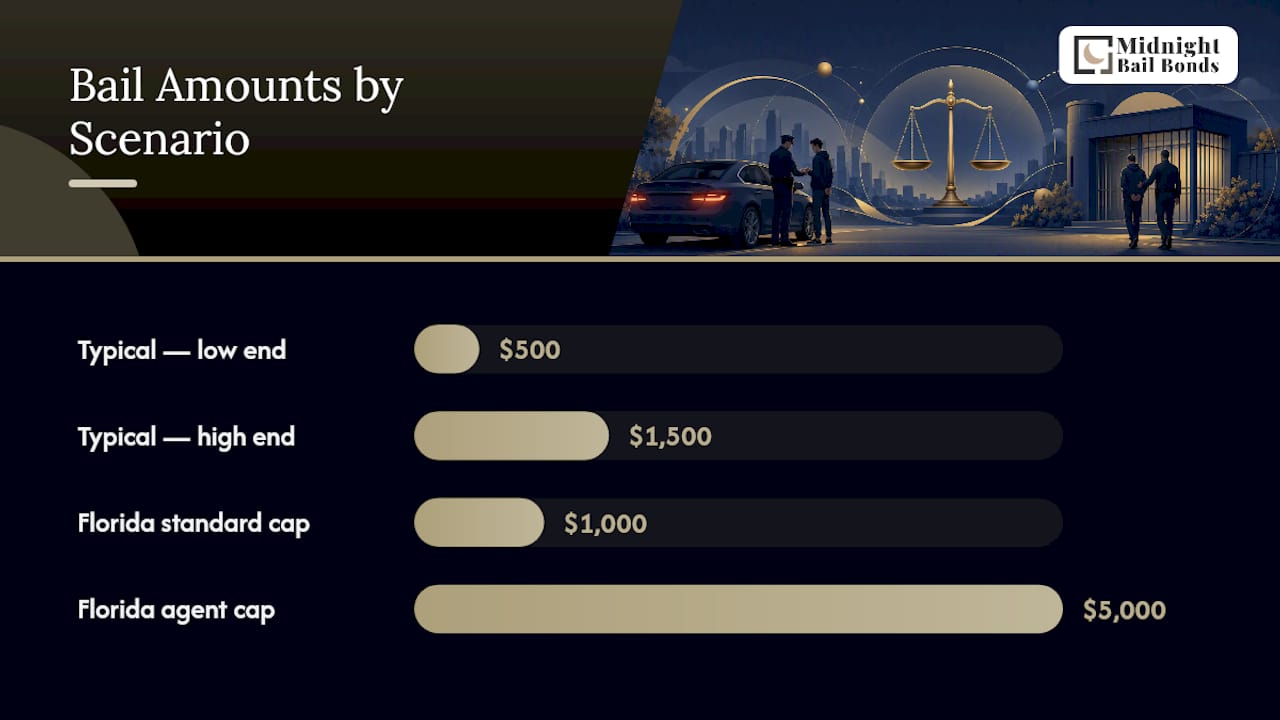
Bail for a straightforward suspended license stop, no DUI, no warrants, no priors, is generally modest and varies widely depending on jurisdiction and case specifics. The number climbs fast once aggravating factors show up.
Bail amounts by scenario:
- First-time administrative suspension, no accident: roughly $500 to $1,500
- Suspension tied to a prior DUI or repeat offense: often several thousand dollars
- Active warrant discovered at the stop: bail can be denied entirely, or set high enough to function as a hold
Florida offers a useful, concrete benchmark here. Under Florida Statute 903.36, guaranteed traffic arrest bond certificates can be accepted as bail for many traffic violations, capped at $1,000. If the certificate is executed by a licensed general lines insurance agent under specific conditions, that cap rises to $5,000. It's a narrow tool built for routine traffic arrests, not a general bail ceiling, and it won't apply if your case involves DUI or other criminal charges layered on top.
Statistic Callout: Florida's guaranteed arrest bond certificate program caps standard traffic bail at $1,000, rising to $5,000 only for bonds executed through a licensed agent under statutory conditions.
Judges can and do deny release outright when someone has an active warrant, a pattern of failing to appear, or a suspension tied to a serious prior offense. Because bail schedules differ by county and even by judge, the only way to know your real number is to check with the specific jail or court clerk handling the case, or have someone check it for you.
What to Do Right Now to Post Bail
Speed matters here, and having the right information ready cuts hours off the process. Before you call anyone, gather this:
- The full legal name of the person arrested
- Their booking or inmate number, if known
- The arresting agency and jail location
- The charge and bond amount, if it's already been set
- A valid photo ID for whoever is posting bail
- Proof of relationship if you're calling on someone else's behalf
From there, you've got three realistic paths.
Cash bond. You pay the full bail amount directly to the jail or court, and you get it back (minus any court fees) once the case resolves. It's straightforward, but tying up $1,500 or more in cash isn't realistic for most families dealing with a surprise arrest.
Surety bond through a bail bond agent. You pay a percentage of the total bail, commonly around 10% as a nonrefundable premium, and the agent posts a bond covering the full amount. Some agencies require collateral, others don't, depending on the case and your relationship with the agent. This is usually the fastest option because a licensed agent can start the paperwork the moment they have your booking details, sometimes before you've even left for the jail.

Cite-and-release or license deposit. Some jurisdictions let you skip a cash bond altogether. Louisiana, for example, permits depositing a driver's license in lieu of security under specific statutory conditions, with its own rules for receipts and how the license gets handled afterward. Not every state offers this, so it's worth asking the arresting agency directly.
Pro Tip: Call a bail bond agent before you arrive at the jail, not after. Agents can often verify the booking and start preparing paperwork remotely once they have the inmate number and arresting agency, shaving real time off the release process.
Bail Doesn't Fix Your License or Your Case
Posting bail gets one thing done: it gets the person out of jail. That's it. It doesn't touch the suspension, and it doesn't make the underlying charge go away.
A few things stay exactly where they were before bail was posted:
- The license suspension itself, which is an administrative matter handled by your state's motor vehicle agency, separate from the criminal case
- Any outstanding warrants, which can keep someone in custody even after bond is posted on the current charge
- The pending court date, which still requires an appearance regardless of how quickly release happened
Once someone is out, the real work starts. Get copies of the booking paperwork, talk to an attorney about the charge, and contact the DMV to find out exactly what reinstatement requires. The Ohio State Bar Association notes that reinstatement can involve fees, program completion, SR-22 insurance filings, or a hearing, and the specifics vary significantly by state.
Author and Company Background
This guide was written by Jake, who covers bail procedures and jail release processes for Midnightbail's editorial team, focusing on making statutory language and court procedure understandable for people dealing with an arrest in real time.
Midnightbail runs licensed agents around the clock across California, backed by an instant inmate search tool that helps families locate booking details fast instead of sitting on hold with a jail switchboard. Flexible payment plans and, in many cases, bail without collateral make the process workable even when cash is tight. Bilingual support means language isn't a barrier at 3 a.m. when someone's already scared and confused.
Call with the booking number and arresting agency ready, and an agent can usually begin the paperwork before you've finished explaining the situation.
Why Bail Procedures Differ From State to State
There's no single national bail system for suspended license arrests, and that catches a lot of people off guard. Each state sets its own bail schedules, and many counties within the same state run their own variations on top of that.
Some states treat a first suspended license offense as a minor infraction with a modest, standardized bond. Others fold it into broader traffic-safety statutes with steeper penalties, especially when the suspension traces back to a DUI. Florida's guaranteed arrest bond certificate system, capped at $1,000 for most traffic bonds, is one example of a state building a dedicated, lower-cost bail mechanism for routine traffic stops. Louisiana's license-deposit option is another, letting someone use their license itself as security instead of cash in specific circumstances.
Whether cite-and-release is even on the table depends on local policy, sometimes down to the individual department's practices. Some agencies default to citing and releasing for administrative suspensions with no aggravating factors. Others book everyone regardless of the reason for suspension.
This inconsistency is exactly why generic advice about "typical bail" only gets you so far. A number that's accurate for a first-time offender in one county might be off by a factor of three for someone facing the same charge two counties over, particularly once priors or warrants enter the picture. Checking directly with the jail, the court clerk, or a bail agent familiar with that specific courthouse beats guessing based on what a friend paid somewhere else.
How Bail Conditions Affect Your Driving and Court Obligations
Getting released on bail almost always comes with conditions attached, and ignoring them creates a second problem on top of the original charge. The most common condition tied to a suspended license case is a strict requirement not to drive until the license is reinstated or a restricted permit is issued. Getting caught driving again while out on bail, even for something as small as running to the pharmacy, can trigger a bail revocation and a return to custody.
Court compliance conditions are just as important. Missing your scheduled court date, even by accident, can result in a warrant for failure to appear stacked on top of the original charge. That combination often means a second arrest with a higher bail amount the second time around, since a missed appearance signals flight risk to whoever sets bail next.
Some jurisdictions add reporting requirements, like checking in with a pretrial services officer, especially if the case involves DUI or repeat offenses. None of these conditions are optional add-ons. They're part of the release agreement, and violating them can undo the entire point of posting bail in the first place: staying out of custody while the case moves through court. Read the release paperwork carefully before walking out the door, and if anything is unclear, ask the bail agent or the court clerk to explain it in plain terms before you leave.
Your Rights During a Suspended License Arrest
You keep your constitutional rights the moment you're arrested, and knowing them changes how the next few hours go. You have the right to remain silent beyond providing basic identifying information, and you have the right to an attorney, including a court-appointed one if you can't afford private counsel.
The initial appearance, sometimes called an arraignment or bail hearing depending on the state, is where a judge or magistrate reviews the charge and sets or confirms bail. You or your attorney can typically argue for a lower bond at this hearing, especially if you can show community ties, steady employment, or no prior records. It's worth showing up prepared rather than assuming the initial bail schedule figure is final.
You also have the right to know the charge against you and the right to a timely hearing rather than indefinite detention while the system sorts out paperwork. If bail is denied outright, which does happen with active warrants or serious aggravating circumstances, you're entitled to a hearing addressing why, and an attorney can push back on that decision.
Exercising these rights doesn't slow down the bail process. If anything, a quick conversation with a lawyer before the initial appearance often results in a more favorable bond, because someone is actively advocating for a lower number instead of letting the default bail schedule stand unchallenged.
The Gap Between Bail Advice and Reality
Most articles on this topic treat bail like a single, predictable number, and that's the biggest disservice done to people searching for this information at 2 a.m. from a parking lot outside a jail. The honest picture is messier: bail for a suspended license depends on your state, your county, your prior record, and sometimes the mood of whoever set the bail schedule that year.
What gets underweighted in most guides is how much a warrant check matters. Plenty of people assume posting bail on the current charge means they walk out. If there's an unrelated warrant sitting in the system, that assumption falls apart fast, and it's a detail worth confirming before anyone shows up with cash in hand.
My honest recommendation: don't spend your first hour trying to guess the bail amount. Spend it confirming the booking number, the exact charge, and whether any holds exist. That information is what actually determines how fast release happens, far more than knowing the statewide average.
— Jake
If You Need Bail Now, Here's the Fastest Path
Reading about bail schedules is useful right up until you're standing outside a California jail at midnight trying to get someone out. That's the exact situation Midnightbail was built to handle. Licensed agents are available 24/7 across California, covering suspended license arrests alongside DUI, drug charges, domestic violence cases, and more.
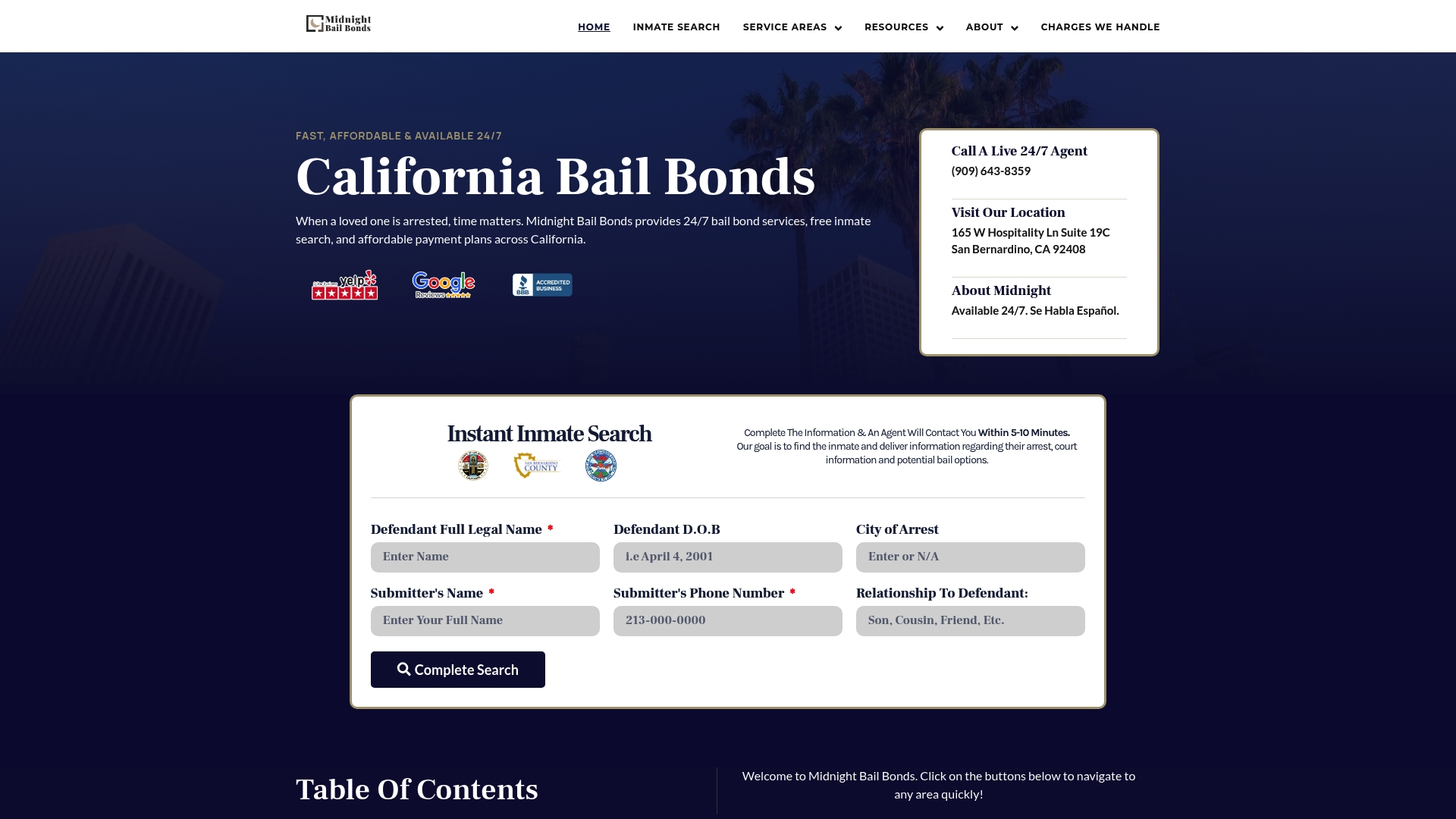
Payment doesn't have to mean scraping together cash on the spot. Midnightbail accepts cash, credit and debit cards, Zelle, and financing, with flexible payment plans that spread out the cost. Collateral isn't always required either, which matters when a family is dealing with an arrest and doesn't have property to put up as security. Bilingual support means the process works the same whether you're more comfortable in English or Spanish.
Start with the instant inmate search to confirm booking details, then call an agent directly to get the bond process moving. If the arrest happened in Orange County, the Orange bail bonds page has local jail information and direct contact details to speed things up further.
Sources
- Florida Senate — Statutes: 903.36 Guaranteed arrest bond certificates as cash bail (2023)
- Louisiana Legislature — statute text on deposit of license in lieu of security (R.S. related provisions)
- Ohio Bar Association — 'My driver's license has been suspended. Now what?' (2026-02-16)
- LegalClarity — 'What Happens If You’re Caught Driving With a Suspended License?'
FAQ
Do You Go to Jail for Driving With a Suspended License in Texas?
Yes, driving on a suspended license in Texas can result in arrest and booking, particularly for repeat offenses or suspensions tied to DUI, though some stops end in a citation rather than a jail stay depending on the officer's discretion and local policy.
Can They Arrest You for a Suspended License in Florida?
Yes, and Florida also offers guaranteed traffic arrest bond certificates capped at $1,000 for many traffic violations, giving some drivers a lower-cost bail option compared to a standard cash bond.
How Do You Avoid Jail Time for Driving on a Suspended License in Pennsylvania?
Avoiding jail time typically depends on the specific circumstances, prior record, and whether an attorney negotiates alternatives like fines or probation instead of incarceration; a lawyer familiar with local courts gives the clearest picture for a specific case.
How Much Is Bail for Driving on a Suspended License in Georgia?
Bail amounts in Georgia vary by county and case specifics, but a straightforward first-offense suspended license charge often falls in the same general range seen nationally, roughly $500 to $1,500, with higher amounts for cases involving DUI or prior offenses. Contacting a licensed bail agent or the local jail directly gives the exact figure for a specific arrest.