
In California, juveniles do not have a guaranteed right to monetary bail. Custody is decided at a detention hearing, usually held within 48 hours of arrest. If your child has been taken into custody, your priority right now is confirming where they're being held, requesting the hearing date, and getting an attorney involved before that hearing happens.
TL;DR:
- Juvenile detention hearings in California generally happen within 48 hours of arrest, with no monetary bail involved unless the case transfers to adult court.
- Courts focus on risks and safety, not payment, making proof of home stability crucial for early release via probation officers or judge orders.
- Transfer to adult court occurs for juveniles 16 or older accused of serious offenses, where bail and formal adult procedures become possible.
- Parents should immediately confirm detention location, request hearing details, and consult a lawyer within the first 24 hours to maximize chances of early release.
- Bail bonds are only relevant when a juvenile’s case moves to adult court; in that scenario, services like Midnightbail offer rapid, around-the-clock assistance.
Table of Contents
- What Happens at a Juvenile Detention Hearing in California?
- Why Doesn't California Give Juveniles Bail Like Adults?
- How Do Juveniles Actually Get Released in California?
- When Does a Juvenile Case Move to Adult Court?
- What Should Parents Do in the First 24 Hours?
- Where Does a Bail Bond Service Fit Into a Juvenile Case?
- The Advice Most Parents Get Wrong
- How Midnightbail Helps When Adult Bail Applies
- Where to Verify These Rules Yourself
- Sources
- FAQ
What Happens at a Juvenile Detention Hearing in California?
A detention hearing is where a judge decides whether your child stays in juvenile hall or goes home while the case moves forward. It's not a bail hearing in the adult sense. There's no bondsman, no set dollar amount, no posting a percentage to walk out the door. The judge is weighing risk, not a monetary transaction.
Timing matters more than most parents realize. Under California's juvenile court process, these hearings must generally happen within 48 hours of arrest, excluding weekends and holidays. That short window exists because the law treats extended detention of a minor as something to avoid unless there's a clear reason for it. Every day that passes without a hearing is a day your child sits in juvenile hall longer than necessary.
Several people typically show up to this hearing:
- The judge, who makes the final custody call
- A probation officer, who usually submits a written recommendation beforehand
- A prosecutor representing the state's interest in the case
- Defense counsel, either private or appointed, arguing for release
- Parents or guardians, who can speak directly to the judge about the home situation
The judge weighs the probation report, the arresting officer's account, and anything your attorney presents about home stability or school enrollment.
Why Doesn't California Give Juveniles Bail Like Adults?
Juvenile delinquency proceedings and adult criminal proceedings run on different logic entirely. Adult bail exists to guarantee someone returns for trial while presuming innocence and preserving liberty in the meantime. Juvenile court was built around a different premise: rehabilitation over punishment, with the state acting more like a guardian than a prosecutor.
That distinction has deep roots. A 1980 survey of juvenile bail practices across all 50 states found most states never extended adult-style monetary bail rights to minors in the first place. Instead, states built systems around release to parents or discretionary court orders.
The policy reasoning holds up today, backed by a few consistent goals:
- Avoid treating a 14-year-old the way you'd treat an adult defendant with resources to post bond
- Keep detention decisions tied to safety and stability, not a family's ability to pay
- Push toward the shortest appropriate stay in custody rather than a fixed release price
International juvenile justice guidance echoes this, recommending that detention of minors be treated as a last resort with prompt review rather than open-ended custody.
How Do Juveniles Actually Get Released in California?
There are three realistic paths out of custody, and they don't all require a judge.
- Probation officer release. Before any hearing even happens, a probation officer can release a juvenile straight to a parent or guardian if they believe it's appropriate. This is often the fastest route out, and it depends heavily on how quickly you can show the officer a stable home situation.
- Judicial release with conditions. If the case reaches the detention hearing, a judge can order release with strings attached — curfews, school attendance checks, drug testing, or regular check ins with probation.
- Continued detention in juvenile hall. Judges reserve this for cases involving serious allegations, prior offenses, or genuine safety concerns, and it's meant to be the exception, not the default.
Pro Tip: Show up to the probation officer conversation with proof of address, school enrollment, and a working phone number. Officers move faster when the home situation is easy to verify.
When Does a Juvenile Case Move to Adult Court?
This is the scenario where monetary bail actually enters the picture. For juveniles age 16 or older accused of serious offenses, prosecutors can request a transfer hearing to move the case into adult criminal court. If the judge grants the transfer, your child is no longer in the juvenile system's rehabilitation framework.
Once a case transfers, the rules change fast:
- Adult booking procedures apply, including fingerprinting and formal charges as an adult
- Monetary bail becomes possible, meaning a bail bond could suddenly be relevant
- Sentencing exposure increases significantly compared to juvenile court outcomes
- Public court records may no longer carry the confidentiality protections juvenile cases typically get
Ask your attorney directly whether transfer is even on the table for your child's charges. Not every serious allegation triggers a transfer hearing, and fighting it early is far easier than fighting it after the fact.
What Should Parents Do in the First 24 Hours?
The first day after an arrest sets the tone for everything that follows. Work through these steps in order:
- Confirm where your child is being held and get the booking number from the facility or arresting agency.
- Ask directly when the detention hearing is scheduled. Staff should give you a date within the 48 hour window.
- Contact a juvenile defense attorney immediately — even before the hearing, counsel can start building the case for release.
- Gather documentation: proof of residence, school records, any medication your child needs, and contact information for responsible adults who can vouch for stability at home.
- Avoid letting your child discuss the case details over recorded jail phone lines. Anything said can surface later.
Pro Tip: Write down the exact time you spoke with each official and what they told you. If the hearing gets delayed past 48 hours, that timeline becomes useful for your attorney.
Where Does a Bail Bond Service Fit Into a Juvenile Case?
Most of what I just walked through has nothing to do with bail bonds, and that's worth saying plainly. If your child is in the standard juvenile system, a bond agent can't do anything for you. The detention hearing, the probation officer's recommendation, your attorney's argument for release, that's the whole game.
Where a service like Midnightbail becomes relevant is the transfer scenario, or any case where your child ends up processed through adult booking. That's when a monetary bail amount gets set, and getting someone home fast starts to depend on how quickly you can post it. Midnightbail runs licensed agents around the clock, offers bilingual support, and provides an instant inmate lookup so families aren't stuck guessing where someone is being held or under what booking number.

The smartest move is running both tracks at once when a transfer is possible: your attorney fights the detention and transfer questions while you have bail resources ready if adult procedures kick in.
The Advice Most Parents Get Wrong
Most articles on this topic hand parents a checklist and stop there. What they miss is the timing pressure that makes checklists useless if you're slow to act. The 48 hour window isn't a suggestion; it's the entire game. Every hour spent confused about where your child is being held, or waiting to call an attorney because you're not sure it's "serious enough" yet, is an hour that doesn't come back.
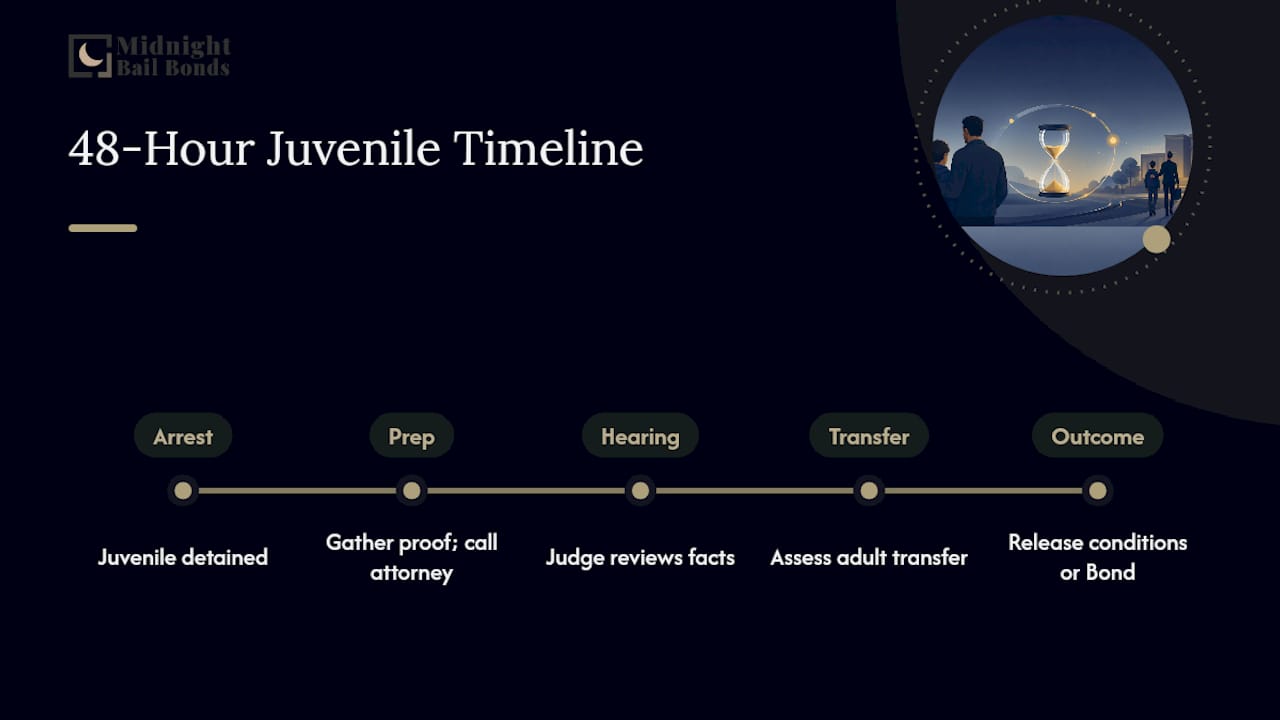
The conventional wisdom also oversells how much control parents have once a hearing starts. You don't get to negotiate a dollar amount and walk your kid out. The judge is weighing home stability, prior record, and the nature of the offense, full stop. Your leverage is entirely in the preparation you do beforehand: proof of address, school records, a defense attorney who's already reviewed the probation report before the judge does.
If I had to tell a parent one thing, it's this: figure out immediately whether transfer to adult court is even a possibility for the charges involved. That single fact determines whether you're fighting for release conditions or preparing to post an actual bond.
— Jake
How Midnightbail Helps When Adult Bail Applies
When a juvenile case moves into adult court, the clock and the paperwork change overnight, and that's exactly the moment Midnightbail's model was built for. Unlike waiting on a public defender's schedule or driving between facilities trying to find out where someone's being held, Midnightbail runs licensed agents 24/7 across California, with bilingual support and a free instant inmate search that tells you the booking number and facility in minutes.

Call as soon as you know a monetary bail amount has been set, whether that's from a transfer to adult court or a separate adult charge in the family. Have the facility name, your child's full legal name, and the booking number ready. Midnightbail accepts cash, credit and debit, Zelle, and financing, and offers bail bond options without collateral in many cases, which matters when families are already stretched thin from legal fees.
Pair that speed with your attorney's work on the underlying case. One gets your family member home. The other protects what happens next. If you're in Orange County, Midnightbail's local Orange bail bonds team can move even faster with area-specific facility knowledge. Reach out now if you need someone home tonight.
Where to Verify These Rules Yourself
Court procedures and juvenile justice rules shift by county and by case, so it's worth confirming details with primary sources rather than relying on secondhand summaries.
- California Courts' self-help guide on juvenile justice covers detention hearing timing and custody procedures directly from the court system.
- The Office of Justice Programs' historical report on juvenile bail explains how states diverged from adult bail models.
- For interstate cases, the Interstate Compact for Juveniles publishes advisory opinions on custody and bail limits across state lines.
This article is general information, not a substitute for advice from a qualified lawyer. Consult a qualified legal professional about your own circumstances before acting on anything here.
Sources
- Juvenile justice court process | California Courts | Self Help Guide
- Bail for Juveniles in the 50 States - Report No 1, March 1980 | Office of Justice Programs
- ICJ advisory opinion: limits on issuance of bail in holding states
FAQ
How much does it cost to bail a juvenile out of custody?
In most California juvenile cases, there's no monetary bail cost at all since release is decided at a detention hearing rather than through a bail payment. Costs only enter the picture if the case transfers to adult court, where bail amounts and bond premiums follow standard adult bail bond pricing.
Why don't juveniles get bail in California?
California's juvenile system is built around rehabilitation rather than the adult framework of guaranteeing court appearance through a financial guarantee, so custody decisions happen at a detention hearing instead of through a bail schedule. Many states have historically followed this same approach, treating release to a parent or guardian as the standard alternative.
How much time can a juvenile actually serve for an offense?
Sentencing length depends heavily on the offense, prior record, and whether the case stays in juvenile court or transfers to adult court, with juvenile court dispositions generally capped by age limits under state law. There's no single fixed sentence, since a probation officer's recommendation and the judge's disposition order both shape the outcome.
What's the most common outcome for a juvenile case in California?
Release to a parent or guardian, sometimes with conditions like probation check ins or curfews, is far more common than continued detention in juvenile hall. Judges reserve extended detention for cases involving serious allegations, prior offenses, or genuine safety concerns.
When would I need to contact a bail bond company for a juvenile case?
You'd need a service like Midnightbail only if your child's case transfers to adult court or if they face separate adult charges, since standard juvenile proceedings don't involve monetary bail. In those situations, 24/7 bail bond services can move faster than waiting on a standard court schedule.