
Call a licensed bail agent right now, give them the inmate's full name, booking number, jail location, and bail amount, and they can post a surety bond to start the release process. That's the fastest path out. Bail agents must be contacted by the arrested person, their attorney, or an adult friend or family member — agents cannot legally reach out to you first, so the call has to come from your side.
Three things to do immediately:
- Call a licensed 24/7 bail agent. Midnightbail has bilingual English/Spanish agents available around the clock and an instant inmate search tool on the site to confirm booking details before you call.
- Gather the basics. Inmate's full legal name, date of birth, booking number, the exact jail facility, and the bail amount if you already know it.
- Arrange payment or a cosigner. The state-mandated premium is typically 10% of the bail amount. Have a credit/debit card, cash, or Zelle ready, or identify a cosigner who can sign the indemnity agreement.
Most families who have everything ready see a bond posted within a few hours of the first call. See the full step-by-step bail process for a detailed checklist.
Key Takeaways
| Point | Details |
|---|---|
| Call immediately | Contact a licensed 24/7 bail agent with the inmate's name, booking number, and jail location. |
| Premium cost | The nonrefundable premium is typically 10% of the total bail amount, set by California law. |
| Cosigner risk | The cosigner is responsible for the full bail amount if the defendant fails to appear in court. |
| Release timeline | Expect 30 minutes to several hours from bond posting to physical release, depending on jail processing. |
| Midnightbail | Provides 24/7 licensed agents, instant inmate search, bilingual support, and flexible payment plans across California. |
Table of Contents
- What happens after you call a bail bondsman?
- How California sets bail amounts and what that means for bond posting
- What does it cost to secure release through a bail bond?
- What information should you have ready before you call?
- What charge types does Midnight Bail Bonds handle?
- What are the cosigner's legal responsibilities?
- How long does release usually take?
- How to contact Midnight Bail Bonds and what to expect on the call
- What is own recognizance release, and how does it differ from a bail bond?
- Who qualifies for own recognizance release?
- How do you request own recognizance release?
- Pros and cons of own recognizance release versus posting bail
- What conditions come with own recognizance release?
- What happens if you violate own recognizance release terms?
- What families actually experience when making that midnight call
- Midnight Bail Bonds is available right now, 24/7 across California
- Sources
- FAQ
What happens after you call a bail bondsman?
The typical bail-bond workflow moves through six stages, and knowing each one helps you avoid the delays that stretch custody time.
- Risk assessment. The agent reviews the charge, bail amount, and the defendant's history. A reputable agent explains cosigner requirements and collateral needs upfront so there are no surprises later.
- Application. You or the cosigner complete a brief indemnity agreement, either in person, by phone, or digitally.
- Payment or collateral arrangement. The premium is collected. Collateral, if required, is documented.
- Bond posting. The agent delivers the surety bond to the jail or court clerk, who enters it into the record.
- Jail paperwork. Jail staff process the release order. This is the most variable step.
- Physical release. The defendant walks out.
Steps 1 through 4 can happen in under an hour when you have everything ready. Step 5 is where most delays occur — shift changes, booking backlogs, and holds all add time.
Pro Tip: Ask the agent what shift the jail's release desk is currently running. Releases processed at the start of a shift tend to move faster than those submitted during the last hour before a handover.
How California sets bail amounts and what that means for bond posting
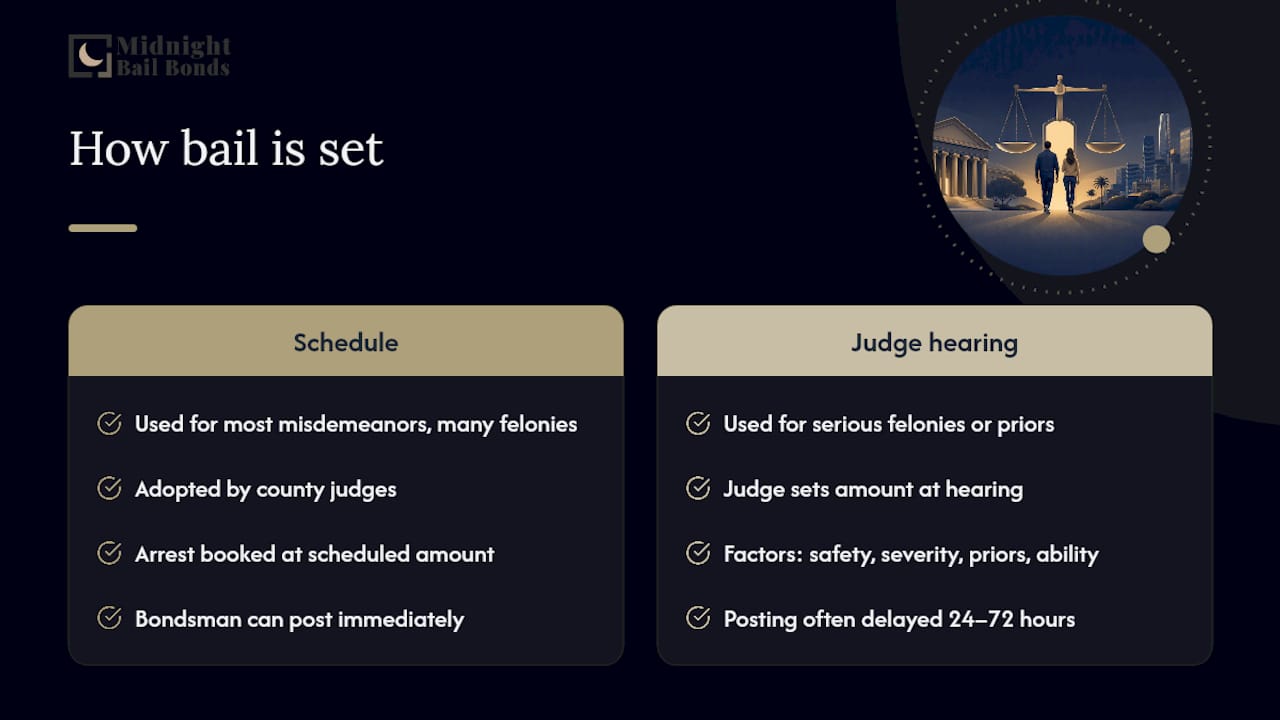
Bail in California is set one of two ways: by the county's published bail schedule or by a judge at a hearing. County bail schedules are adopted by judges in each jurisdiction and assign standard bail amounts by charge type. For most misdemeanors and many felonies, the arresting agency books the defendant at the scheduled amount, which means a bondsman can post immediately without waiting for a court appearance.
When a judge sets bail at a hearing — common for serious felonies or when the defendant has a prior record — the judge weighs public safety, offense severity, criminal history, and ability to pay. That hearing can delay posting by 24 to 72 hours.
Once a court approves a bail undertaking and it is executed and filed, California law requires the magistrate to sign a discharge order. Upon posting bail, the defendant shall be discharged from custody as to the offense on which the bail is posted.
One practical step many families skip: check for government holds (outstanding warrants from other counties or immigration detainers) before initiating the bond. A hold can block release even after a bond is posted, and your agent should flag this during the risk assessment.
What does it cost to secure release through a bail bond?
The short answer: bail bond companies commonly charge a nonrefundable premium of about 10% of the bail amount. For example, on a high bail amount, the premium paid to the agent is not returned even when the defendant appears at every hearing.
| Item | Detail |
|---|---|
| Standard premium | ~10% of total bail amount (state-regulated) |
| Refundable? | No — nonrefundable under California law |
| Renewal premiums | Prohibited since January 1, 2022 |
| Collateral release | After case resolution and bond exoneration |
Accepted payment methods at Midnightbail include cash, credit/debit card, Zelle, and financing plans. No-collateral options are available in many cases.
California law effective January 1, 2022 prohibits any insurer or bail agent from charging more than one premium over the life of a bail contract. Renewal premiums are banned. Violations expose the violator to actual damages plus $3,000 in statutory damages — so if anyone asks you for a second premium on the same bond, that is a legal violation.
Pro Tip: If collateral is required, it is not released until the bail is paid and the bond is exonerated at case resolution — sometimes months later. Ask the agent for a written receipt and keep it.
What information should you have ready before you call?
Speed matters. Having these details ready cuts the application time significantly.
Defendant information:
- Full legal name and date of birth
- Booking number and booking date/time
- Exact jail facility name and city
- Charge(s) and bail amount (if known)
Cosigner (indemnitor) information:
- Government-issued photo ID
- Proof of income or employment (pay stub, bank statement, or employer contact)
- Current address and phone number
- Relationship to the defendant
If collateral is requested, gather property deeds, vehicle titles, or financial account statements. Most documents can be sent digitally — a photo of an ID texted to the agent is usually sufficient to start the application while originals are gathered.
What charge types does Midnight Bail Bonds handle?
Midnightbail posts bonds for most bailable charges, including:
- DUI and alcohol-related offenses
- Drug possession and distribution charges
- Domestic violence charges where bail is permitted by the court
- Theft, burglary, and robbery
- Assault and battery
- Failure to appear
For charge-specific guidance on robbery bail options or battery charges, those pages walk through county-specific processing and typical timelines.
Felony charges sometimes require a judge's bail order before a bond can be posted, which adds time. Domestic violence charges may carry mandatory holds of up to 72 hours regardless of bail status. When a charge falls into a special-processing category, the agent will communicate the next steps and realistic timeline directly.
What are the cosigner's legal responsibilities?
The cosigner — called the indemnitor — takes on real financial and legal exposure. If the defendant fails to appear in court, the cosigner is responsible for the full bail amount, not just the premium already paid.
Typical indemnitor obligations include:
- Paying any additional fees the agent incurs locating the defendant
- Producing the defendant to the court or jail if requested
- Risking loss of any collateral pledged to secure the bond
- Potential civil liability for the full bail amount if the bond is forfeited
If a defendant fails to appear, the bail bond is forfeited and the court issues a bench warrant. The bail agent then has a limited window — typically 180 days in California — to surrender the defendant and have the forfeiture set aside. After that window closes, the cosigner owes the full bail amount.
Do not cosign a bond for someone you are not confident will appear. The emotional pressure in these moments is real, but the financial exposure is equally real.
How long does release usually take?
Realistically, expect 30 minutes to several hours from bond posting to physical release. The bond posting itself, once payment is arranged, can happen in under an hour. The jail processing side is the variable.
Common bottlenecks:
- Shift changes at the jail (releases submitted near the end of a shift often wait for the next)
- Active booking backlogs (busy Friday and Saturday nights)
- Government holds or outstanding warrants that surface during processing
- Felony charges requiring additional paperwork
Midnightbail coordinates directly with local jail staff in areas including Newport Beach, Rialto, Redlands, Long Beach, and Ontario. A 24/7 agent who knows the local facility's procedures can often flag a delay before it becomes a multi-hour wait.
Having the booking number confirmed through the instant inmate search before you call saves 15 to 30 minutes on the intake call alone.
How to contact Midnight Bail Bonds and what to expect on the call
Call Midnightbail's 24/7 line or use the instant inmate search on the website to pull booking details first. When the agent picks up, lead with:
- "I need to post a bail bond for [full name], booked at [jail facility] on [date]."
- Booking number and charge if known.
- Your relationship to the defendant.
- Your preferred payment method.
The agent will confirm the bail amount against the county schedule or court order, run a quick risk assessment, explain cosigner requirements, and send you the application digitally. Once payment is confirmed and the application is signed, the agent moves to post the bond. You will get an estimated release window before the call ends.
What is own recognizance release, and how does it differ from a bail bond?
Own recognizance (OR) release is when a judge releases a defendant from custody without requiring any bail to be posted. The defendant signs a written promise to appear at all future court dates. No money changes hands, no bond is posted, and no bondsman is involved.
A bail bond release works differently. The court holds the bond as a financial guarantee.
The practical difference: OR release is free but entirely at the court's discretion. A bail bond release costs the premium but can happen as soon as the bond is posted, without waiting for a judge's decision.
Who qualifies for own recognizance release?
Judges weigh several factors when deciding whether to grant OR release:
- The severity of the charge (misdemeanors qualify more often than serious felonies)
- The defendant's ties to the community (employment, family, length of residence)
- Prior criminal history and any prior failures to appear
- Whether the defendant poses a public safety risk
- The defendant's ability to pay bail
First-time offenders charged with nonviolent misdemeanors in California have the strongest chance of OR release. Defendants facing violent felonies, those with prior failures to appear, or those with active warrants in other jurisdictions are rarely granted OR release.
How do you request own recognizance release?
The request is made at the arraignment, which is typically the defendant's first court appearance. Defense counsel argues for OR release by presenting evidence of community ties, stable employment, and a clean or limited record. The prosecution argues against it, usually citing public safety or flight risk.
If the judge denies OR release, bail is set and a bondsman can then post a surety bond to secure release. Defendants who cannot afford bail and are denied OR release may also petition the court for a bail reduction hearing.
Pros and cons of own recognizance release versus posting bail
OR release costs nothing upfront and carries no cosigner liability. That's the appeal. The drawbacks are timing and certainty: you cannot arrange OR release yourself, you must wait for a court hearing, and the judge can deny it for any number of reasons.
A bail bond release is faster and more predictable. Once the premium is paid and the bond is posted, release follows by statute.
What conditions come with own recognizance release?
OR release is rarely unconditional. Judges routinely attach requirements such as:
- Regular check-ins with a pretrial services officer
- Travel restrictions (no leaving the county or state)
- Surrender of passport
- No-contact orders (common in domestic violence cases)
- Drug or alcohol testing
- Electronic monitoring
Violating any condition can result in immediate revocation of OR status and a return to custody.
What happens if you violate own recognizance release terms?
A violation triggers a bench warrant for the defendant's arrest. The judge can revoke OR release entirely, set a new bail amount (often higher than the original), or in serious cases, order the defendant held without bail pending trial. A failure to appear on OR release also becomes part of the defendant's record and will be used against them in any future bail or OR hearing.
What families actually experience when making that midnight call
The families who move fastest share one thing: they have the booking number before they dial. Fear and urgency are real, but the paperwork is what controls the clock.
Three things that help in the moment:
- Write down every piece of information the jail gives you at booking, including the exact facility address and the booking officer's name.
- Identify a cosigner before you call the agent — not during the call.
- Keep a copy of every document you sign. The indemnity agreement, the receipt for the premium, and any collateral paperwork will matter if the case drags on.
For release status updates, call the jail's automated booking line directly with the booking number. Agents can also provide status updates as the bond moves through the system.
Midnight Bail Bonds is available right now, 24/7 across California
When someone you care about is in custody and every hour counts, Midnightbail offers something most families need immediately: a licensed agent on the phone at 3 AM who knows the local jail's process and can post a bond the same night.
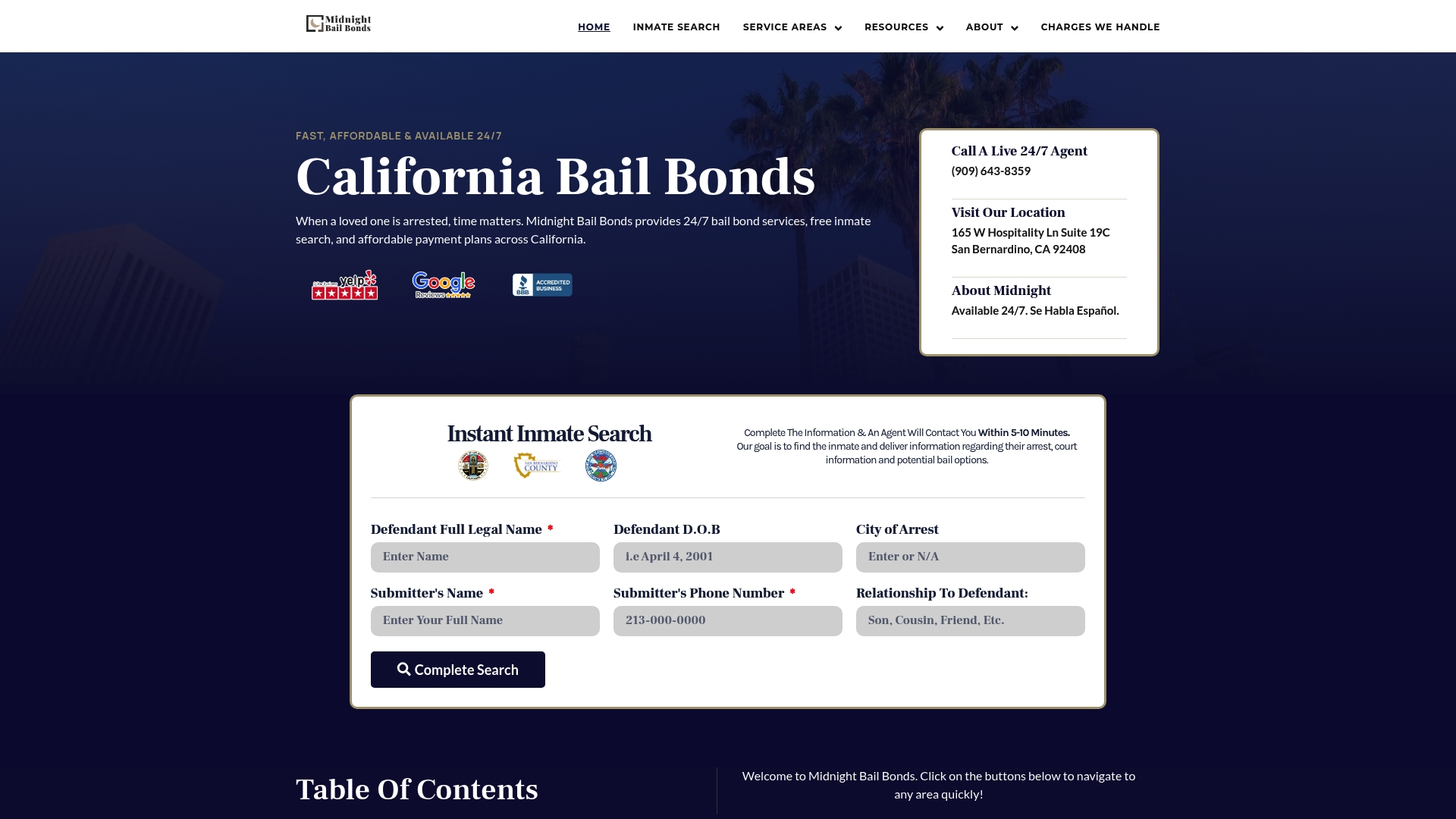
The service covers all major charge types across California. It offers no-collateral options in many cases, flexible payment plans, and bilingual English/Spanish support. Accepted payments include cash, credit/debit card, Zelle, and financing. The state-mandated premium is regulated by the California Department of Insurance, so you will never be charged a renewal premium or a second fee on the same bond.
Use the Midnightbail to confirm booking details, then call to speak with a licensed agent who can start the release process right now.
Sources
- Bail Bonds
- Codes Display Text
- California
- How do bail bonds work? A Legal Guide by Attorneys
- Bail Bonds in California: Costs, Process & Legal Options for Release
For case-specific legal advice, consult a licensed California criminal defense attorney. For immediate bail bond assistance, contact a licensed agent directly.
This article is general information, not a substitute for advice from a qualified lawyer. Consult a qualified legal professional about your own circumstances before acting on anything here.
FAQ
What is the bail bond premium in California?
Can a bail bond be posted before a court hearing?
Yes, for most charges. When bail is set by the county bail schedule, a bondsman can post immediately after booking without waiting for a judge's hearing.
What happens to collateral when the case ends?
Collateral is not released until the bail is fully paid and the bond is exonerated at case resolution, which can take months after the final court date.
How is own recognizance release different from a bail bond?
OR release requires no payment and no bondsman, but it is granted solely at a judge's discretion. A bail bond costs a nonrefundable premium but can be posted as soon as payment is arranged, without waiting for a court hearing.
Does Midnightbail handle domestic violence and felony charges?
Yes. Midnightbail posts bonds for domestic violence charges where bail is permitted by the court, felonies, DUI, drug offenses, and most other bailable charges across California.