

A PC 1275 hold is a statutory bail hold under Penal Code §1275.1 that suspends release until the defense proves, by a preponderance of the evidence, that the bail money was not feloniously obtained. A peace officer, prosecutor, or judge can trigger it at booking or arraignment once probable cause exists. Until that proof is filed, the defendant stays in custody regardless of the bail amount already set.
TL;DR:
- A 1275 hold can be triggered by peace officers, prosecutors, or judges based on probable cause that bail funds derive from felonious activity.
- Defense teams must prove, by a preponderance of the evidence, that the funds are lawful during the hearing, which is a lower standard than beyond a reasonable doubt.
- Strongest evidence includes consistent bank statements, matching tax returns, payroll records, and authenticated transfer records, while altered or inconsistent documents will likely fail.
- If the court does not act within 24 hours after a declaration, the defendant must be released on the original bail amount, with processing typically taking a few hours once the hold is vacated.
- Failing to prove the funds are clean results in the defendant remaining in custody until trial, with potential increased bail, additional charges, or seizure of collateral if tainted funds are traced.
Table of Contents
- What Does Penal Code §1275.1 Actually Say?
- Who Can Place a 1275 Hold, and What Usually Triggers One
- How Does a 1275 Hearing Actually Work?
- What Evidence Actually Convinces a Judge?
- How Long Can Someone Be Held, and When Does Release Happen?
- What Happens if the Defense Can't Prove the Funds Are Clean?
- How to Prepare for a 1275 Hearing: A Step-by-Step Checklist
- How Midnight Bail Bonds Helps Families Facing a 1275 Hold
- The Part Everyone Skips: Preparation Before the Hearing, Not During It
- Need Immediate Help With a 1275 Hold? Here's What to Have Ready
- Sources
- FAQ
What Does Penal Code §1275.1 Actually Say?
The statute is blunt: bail cannot be accepted if any portion of it came from a felony. Not most of it, not the bulk of it. Any portion. That single word does most of the legal heavy lifting in these cases, because it means a defendant with $40,000 in legitimate savings and $2,000 in questionable cash can still get the entire bail package frozen.
The hold requires probable cause first. A judge or magistrate has to find a reasonable basis to believe the money is tainted before the hold takes effect, not just a hunch from a booking officer. Once that finding is made, the defense carries the load of proving otherwise.
Funds that commonly trigger a hold include:
- Cash tied to an active drug sales or trafficking investigation
- Money traced to an embezzlement or fraud scheme
- Transfers that resemble money laundering patterns (multiple small deposits, third-party wires, structuring)
- Proceeds connected to theft, burglary, or robbery charges
Under Penal Code §1275.1, a hold applies specifically when there is probable cause the bail funds themselves were derived from felonious activity, not simply because the underlying charge is a felony.
Who Can Place a 1275 Hold, and What Usually Triggers One
The hold isn't limited to prosecutors. Three types of actors can start the process, and each does it a little differently.
- A peace officer can file the declaration at booking, often based on what turned up during arrest (large cash amounts, packaging materials, financial records).
- A prosecutor can file it later, sometimes after reviewing the case file and spotting a mismatch between the defendant's known income and the bail amount posted.
- A magistrate or judge can order a hold independently at arraignment if the facts on the record raise a red flag.
Common triggers include someone posting a suspiciously large cash bail relative to their reported income, a defendant already under investigation for drug distribution, or a family member wiring bail money through several accounts in a short window. Prosecutors carry civil immunity when filing these declarations, per the framework laid out under §1275.1, which removes a practical disincentive to file one even in borderline cases.
How Does a 1275 Hearing Actually Work?
Once probable cause is established, the mechanics shift almost entirely onto the defense. This is the part most families get wrong. They assume the prosecutor has to keep proving the money is dirty. The opposite is true.
Here's the sequence a hearing typically follows:
- The court confirms probable cause was properly established in the original declaration.
- The burden shifts to the defense, who must now show the funds are clean.
- The defense presents documents, testimony, or affidavits addressing the source of the bail money.
- The judge weighs whether that evidence meets the preponderance standard.
- The judge rules: vacate the hold and accept bail, keep the hold in place, or request additional proof before deciding.
"Preponderance of the evidence" means more likely true than not. It's a far lower bar than "beyond a reasonable doubt," which is the standard for conviction. That distinction is worth repeating to a nervous family member, because it changes what kind of evidence actually matters. You don't need airtight proof. You need the judge to believe your version is more probable than the theory that the money is tainted.
Either side can call witnesses or submit sworn declarations at the hearing, and the defense can request a closed hearing to keep sensitive financial records out of the public record. Judges commonly grant this when asked, even though nothing in the text mandates it.
Pro Tip: File the request for a closed hearing in writing before the hearing date, not verbally at the podium. Judges are far more likely to grant privacy protections when there's a paper record showing you asked properly and early.
What Evidence Actually Convinces a Judge?
Judges hearing a 1275 case are looking for one thing above all else: a clean paper trail showing where the money came from and how it moved. The defense's practical goal is traceability, not just a claim of innocence.
The strongest evidence includes:
- Bank statements covering a full year, showing consistent deposit patterns
- Tax returns matching the income level needed to explain the bail amount
- Payroll records or W-2s confirming steady, legitimate employment
- Loan documents if the money came from a personal or home equity loan
- Authenticated wire transfer records with matching ledger entries on both ends
Weaker but still useful support includes affidavits from employers or family members explaining a gift or loan, and receipts corroborating a sale of property. If collateral is offered instead of cash, the same documentation standard applies: clear title, appraisal records, and a lawful acquisition history.
What sinks a case fast is unsigned statements, documents with obvious alterations, or timelines that don't line up with bank records. One inconsistency is often enough for a judge to ask for more proof rather than rule in your favor. For complex transfers, authenticated electronic records paired with a forensic accountant's affidavit tend to carry more weight than a single bank statement standing alone.
How Long Can Someone Be Held, and When Does Release Happen?
The statute includes a real deadline, not just a vague promise of "prompt" action. If a declaration is filed and the court doesn't act on it within 24 hours, the defendant must be released upon posting the bail already set.
Once a judge vacates the hold, the release process moves fast:
- The court signs off on the bail amount as originally set or modified.
- A bail bond company can post the bond immediately once approved.
- The jail processes release paperwork, typically within a few hours of bond posting.
The gap between "hold vacated" and "actually walking out the door" usually comes down to jail processing speed, not the court. That's where a bondsman coordinating directly with the court clerk saves real time. Read more on how bail conditions interact with holds once a case moves past this stage.
What Happens if the Defense Can't Prove the Funds Are Clean?
Failing to meet the preponderance standard doesn't just mean staying in jail a little longer. It can reshape the entire case.
- The hold remains and the defendant stays in custody until trial or a later hearing.
- Bail can be increased or denied outright if the judge suspects a broader pattern of concealment.
- Presenting falsified or altered documents can result in additional charges layered onto the original case.
- Any collateral offered as security can be seized if it's traced to the same tainted source, creating real exposure for sureties and family members who put up property.
That last point catches people off guard. A grandmother who put her house up as collateral without knowing where the cash actually came from can end up fighting to keep her own property. Details on collateral exposure are covered in California bail forfeiture rules.
How to Prepare for a 1275 Hearing: A Step-by-Step Checklist
Speed matters here more than almost anything else. The moment a hold is filed, the clock on preparation starts, and disorganized paperwork is the single biggest reason hearings drag out.
- Call defense counsel and a licensed bondsman immediately. Both need to know a hold exists before they can act on your behalf.
- Pull one full year of bank statements for every account tied to the bail money, not just the account it came from last.
- Gather payroll records and tax returns that match the income story you're about to tell the court.
- Collect loan documents if any portion of the funds came from a personal loan, home equity line, or family loan.
- Request a closed hearing in writing if the financial records involve sensitive family or business information.
- Line up witness affidavits from employers, lenders, or family members who can corroborate the source of funds.
- Consider forensic accounting for any transfer over roughly $10,000 or involving multiple accounts, since a professional affidavit often carries more weight than raw statements alone.
- Pre-submit authenticated records to the court before the hearing date rather than showing up with a folder of paper on the day.
Pro Tip: Ask your bondsman whether they've handled a 1275 case in the same courthouse before. Some courts have unwritten preferences, like wanting records notarized or wanting the forensic affidavit filed 48 hours ahead, and a bondsman with local experience often knows these quirks before your attorney does.
A bondsman's role here isn't just financing the bond. Once the hold is vacated, they're the ones coordinating directly with the court clerk and the jail to get bond consideration approved and processing moving without extra delay.
How Midnight Bail Bonds Helps Families Facing a 1275 Hold
Licensed agents are available around the clock, every day of the year, to provide support for 1275 hold situations, including in English and Spanish, with flexible payment plans and bail options without collateral in many cases.
When a hold comes up, Bail agents typically ask for the defendant's booking number, the jail location, and available financial paperwork, then work directly with defense counsel to keep the bond ready once a judge vacates the hold. The goal is simple: no wasted hours between "hold lifted" and "released."
The Part Everyone Skips: Preparation Before the Hearing, Not During It
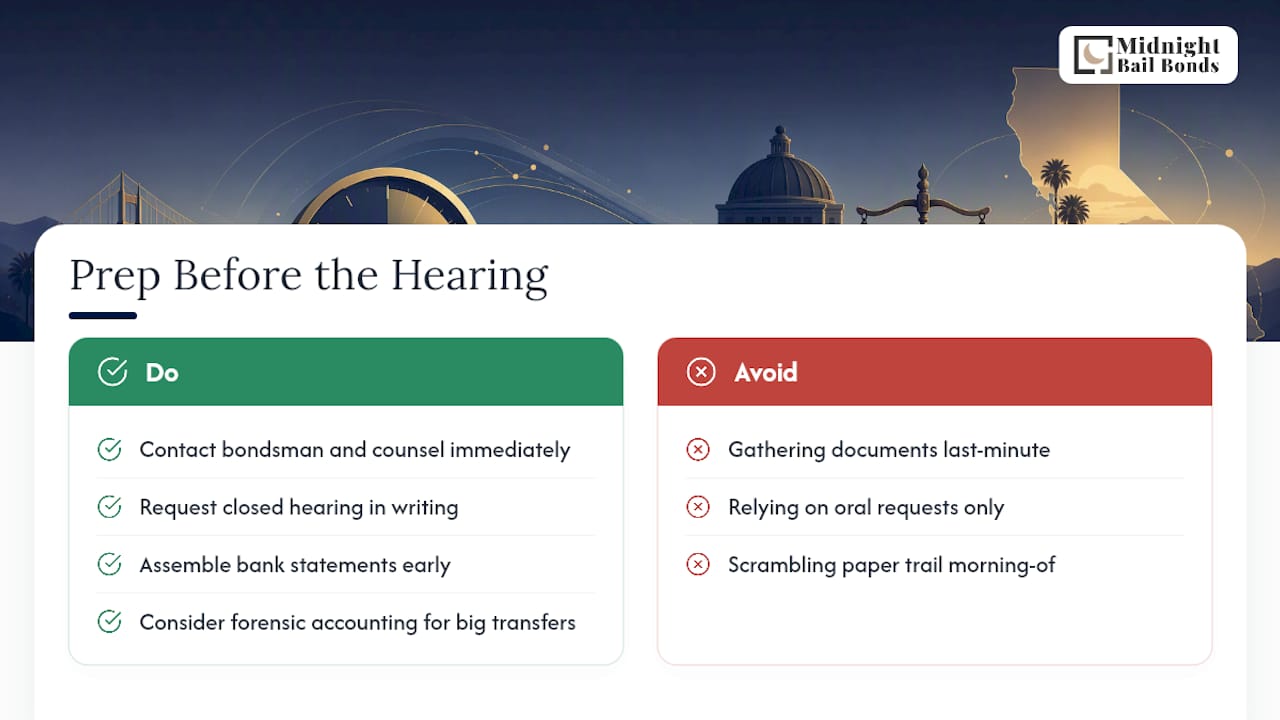
Most explanations of a 1275 hold focus almost entirely on the statute and the burden-shifting mechanics, and that's fine as far as it goes. What gets underplayed is timing. Families usually start gathering bank statements and pay stubs the day before the hearing, sometimes the morning of. That's backward. The judges hearing these cases aren't looking for a dramatic story about where the money came from. They're looking for a boring, consistent paper trail that was clearly assembled with time to spare, not scrambled together overnight.
The conventional advice tells people to "get a lawyer and gather documents." True, but incomplete. The real leverage sits in the sequencing: contacting a bondsman and counsel in the same hour the hold is discovered, requesting a closed hearing in writing before anyone asks verbally, and treating forensic accounting as a real option for any transfer over a few thousand dollars rather than a last resort. Preponderance of the evidence is a low bar. Most defendants clear it. The ones who don't usually failed on organization, not honesty.
— Jake
Need Immediate Help With a 1275 Hold? Here's What to Have Ready
Licensed bail agents provide 24/7 emergency support specifically for 1275 hold situations, so calls at any hour receive prompt response. That matters here more than in a standard bail case, because every hour a hold sits unaddressed is an hour someone stays in custody past when they legally have to.
Before calling, have the jail location, the defendant's full name, and the booking number ready. If any financial paperwork is already on hand, bank statements or pay stubs even in rough form, bringing that along speeds up how fast the bond can move once the hold is vacated. Midnightbail also handles cases without collateral in many situations, which matters for families who don't want to put property on the line while a hearing is pending. Call Midnightbail any time of day to get a licensed agent working on the case immediately.
This article is general information, not a substitute for advice from a qualified lawyer. Consult a qualified legal professional about your own circumstances before acting on anything here.
Sources
Courts scrutinize cash on hand, bank transfers, loan proceeds, and any funds tied to the underlying charge, especially in drug, theft, or fraud cases. The defense must trace the money back to a lawful source using bank records, tax returns, and payroll documentation.
- California Code, Penal Code - PEN § 1275.1
- Penal Code section 1275.1 (public.law paraphrase)
- How to prepare for 1275 hearing and obtain bail | Wallin & Klarich
- What is a PC 1275 hold? | Shouse Law Group
FAQ
What does a PC hold mean in jail?
A PC hold, specifically under Penal Code §1275.1, means the jail cannot release someone on bail until a judge finds the bail money was not obtained through felony activity. It suspends the normal bail process rather than denying it outright.
How long can you be held without bail under a 1275 hold?
If a declaration is filed and the court fails to act within 24 hours, the defendant must be released upon posting the original bail. Beyond that window, custody continues only if the court has properly acted on the hold.
What does California Penal Code §1275.1 say about bail?
The statute bars accepting bail if any portion came from felonious activity, and it shifts the burden to the defense to prove the funds are lawful by a preponderance of the evidence once probable cause is established.
Can a 1275 hold be appealed or challenged after the hearing?
Yes. If the hold remains in place after the hearing, defense counsel can request a new hearing with additional documentation or pursue further legal remedies, since the hold is meant to be temporary rather than a permanent bar to release.