

You have three rights the moment police take you into custody: the right to stay silent, the right to a lawyer, and the right to make phone calls once you're booked. The single best move is to say clearly that you're invoking the first two and save your words for your attorney.
Miranda warnings only have to be read when police start questioning you while you're in custody. That's it. Once you're being interrogated and can't walk away, they're required to tell you about these rights before asking questions meant to get incriminating answers. If you're 17 or younger, Senate Bill 203 adds another layer: you must talk to a lawyer before you can waive Miranda, and that consultation can't be skipped, even if you want to skip it.
- Right to remain silent — say it plainly, don't just go quiet
- Right to an attorney — ask for one immediately, even if you can't afford one yet
- Right to phone calls — you get calls once booking is complete, per Penal Code §851.5
Pro Tip: The words "I want to remain silent" and "I want a lawyer" carry legal weight. Nodding, shrugging, or going quiet without saying so doesn't count as invoking anything in the eyes of most courts.
Key Takeaways
Invoking your right to silence and your right to counsel in clear, exact language is the single most protective action you can take after arrest in California.
| Point | Details |
|---|---|
| Use exact invocation language | Say "I want to remain silent" and "I want a lawyer" clearly; vague wording doesn't count in most courts. |
| Know the 48-hour rule | You must see a magistrate within 48 hours of a warrantless arrest, excluding weekends and holidays, under Penal Code §825. |
| Use your phone calls wisely | Penal Code §851.5 guarantees three completed calls within three hours; use one for an attorney and one for bail arrangements. |
| Minors get extra protection | Under SB 203, anyone 17 or younger must consult a lawyer before interrogation, and that step cannot be waived. |
| Document everything | Note officer names, badge numbers, injuries, and witnesses immediately if you believe your rights were violated. |
This article is general information, not a substitute for advice from a qualified lawyer. Consult a qualified legal professional about your own circumstances before acting on anything here.
Table of Contents
- Understanding Rights After Arrest in California: Miranda and Custody
- What Happens During Booking: Phone Calls and Identification
- Special Rules for Youth Under SB 203
- Arraignment Timelines: The 48-Hour Rule and What Comes Next
- Searches, Seizures, and Excessive Force: Know the Limits
- What to Say and Do in the First Three Hours
- Your Right to Medical Attention After Arrest
- Humane Treatment and Protection From Discrimination in Custody
- How Bail and Release Actually Work
- Notifying Family or Friends After Arrest
- Interrogation Limits: How Long Can Police Question You
- Filing a Complaint Against Police Misconduct
- What the System Doesn't Tell You Fast Enough
- Sources
- FAQ
Understanding Rights After Arrest in California: Miranda and Custody
Miranda rights kick in only when two things happen at once: you're in custody, and officers are interrogating you. Courts define custody as a situation where a reasonable person wouldn't feel free to leave. Interrogation means direct questions or actions designed to get an incriminating response. Small talk during a traffic stop doesn't trigger Miranda. Being handcuffed in the back of a patrol car and asked "where were you at 9 PM" absolutely does.
The standard warnings tell you: you have the right to remain silent, anything you say can be used against you in court, you have the right to an attorney, and one will be appointed if you can't afford one. Each phrase exists for a reason. The first two protect you from self-incrimination. The last two guarantee you don't have to face questioning alone.
Use exact language to invoke these rights. Say "I am invoking my right to remain silent" or "I want an attorney" out loud, clearly, to the officer. Vague statements like "maybe I should talk to someone" don't count as invocation in most California courts, and officers can keep questioning you if your wording is ambiguous.
- Miranda applies to custodial interrogation, not every police encounter
- A public-safety exception lets officers ask limited questions (like "where's the gun") before Miranda if there's an immediate danger
- Officers don't have to read your rights the moment they handcuff you. They only need to read them before interrogation begins
If police question you without Miranda when they should have, the remedy is usually suppression of your statements, not an automatic dismissal of your case, according to LegalClarity's breakdown of California Miranda rules. That distinction surprises a lot of people who assume a Miranda violation means the whole case falls apart. It rarely does.
What Happens During Booking: Phone Calls and Identification
Booking is procedural, not optional, and resisting it only creates new problems. Here's the sequence most California jails follow:
- Officers search you and log your personal property.
- You're photographed and fingerprinted.
- You answer routine identifying questions: name, date of birth, height, weight, address.
- You're assigned a cell or holding area.
Routine booking questions are exempt from Miranda. Answering your name or birth date isn't the same as answering "did you do it," and courts have upheld that distinction repeatedly.
Once booking is complete, Penal Code §851.5 entitles you to at least three completed phone calls within three hours, free of charge within the local calling area. Typical recipients: an attorney, a bail bond agent, and a family member or friend. If staff delay or deny your calls, ask for the denial in writing or note the time, the officer's name, and badge number so your attorney can follow up later.
When you get your call through, keep it short and specific: your full name, the facility you're being held at, and the bail amount if you know it. That's enough for a family member or a bail bonds agent to start working on your release immediately.
Special Rules for Youth Under SB 203
If you're 17 or younger, California law gives you a protection adults don't have. Under SB 203, you must consult with a lawyer before police can question you in custody and before you can waive any Miranda right, and that consultation can't be waived, no matter what you or your parents say.
- Consultation can happen by phone, video call, or in person before questioning starts
- The conversation with counsel is private; officers aren't supposed to listen in
- If police skip this step, a court can exclude any statement made during that interrogation
Parents and guardians should know this rule exists because officers sometimes move fast, and a missed consultation can become the strongest argument your attorney has later. If you're a parent getting a call about a minor in custody, your first question to the facility should be whether SB 203 counsel access has happened yet.
Arraignment Timelines: The 48-Hour Rule and What Comes Next
California law requires that anyone arrested without a warrant be brought before a judge "without unnecessary delay," which courts generally interpret as 48 hours, excluding weekends and holidays, under Penal Code §825. That clock matters because it's one of the few hard deadlines in a process that otherwise feels open ended.
At arraignment, the judge reads the charges against you, explains your rights, appoints a public defender if you qualify, and sets bail along with your next court date. This is often the first moment you'll stand in front of someone with authority to actually change your custody status.
- 48 hours: deadline to appear before a magistrate after a warrantless arrest
- 30 days: speedy-trial deadline if you remain in custody, per Penal Code §1382
- 45 days: speedy-trial deadline if you're out on bail
Waiving time limits can feel harmless in the moment, especially if your attorney needs more preparation. But defense attorneys generally caution against giving up statutory deadlines casually, since prosecutors gain breathing room too. Talk to your lawyer before you agree to any waiver, even if it sounds like a small procedural formality.
Searches, Seizures, and Excessive Force: Know the Limits
Police generally need a warrant to search you, your car, or your phone. There are exceptions: a search incident to arrest, the vehicle exception when there's probable cause, exigent circumstances, and anything in plain view. Your phone is different. Officers typically need a warrant to search its contents even after arrest, regardless of what they can search physically.
You can say "I do not consent to a search" without physically resisting. That phrase preserves your legal objection while keeping the encounter safe. ACLU guidance is direct on this point: refusing consent is not the same as resisting arrest, and physically resisting only adds new charges.
- Ask if you're being detained or free to leave
- Say "I do not consent to a search," then comply if they proceed anyway
- If force seems excessive, don't fight back in the moment. Document everything after
Force is judged by whether it was objectively reasonable given the circumstances, not by how it felt to you afterward. If you believe officers used excessive force, photograph injuries and collect witness names as soon as you safely can.
Pro Tip: Ask for medical documentation of any injury before you're transferred between facilities. Once you're moved, records get harder to track down.
What to Say and Do in the First Three Hours
The words you use in the first minutes matter more than almost anything else that happens before trial. Here's a simple sequence:
- Say "I am invoking my right to remain silent."
- Say "I want a lawyer."
- Comply physically with instructions (don't resist, even if you disagree).
- Note the officer's name and badge number if you can.
- Once at the station, ask for your phone calls as soon as booking wraps up.
- Call someone who can act (family, friend, or a bail bond agent) and give them your name, the facility name, and bail amount if it's set.
Bail bond agents need very little to get started: your full legal name, the jail or facility holding you, and the bail amount from the booking sheet. Most agents can begin paperwork within minutes of that call, which is often the fastest path out of custody while your case moves through the system.
Pro Tip: Save one phone call for your attorney and one for whoever is arranging bail. Trying to combine both into a single three-minute call rarely works well.
Your Right to Medical Attention After Arrest
You have the right to receive medical attention after arrest, and that right doesn't disappear just because you're in custody. If you're injured during the arrest, dealing with a chronic condition, or experiencing withdrawal symptoms, tell the arresting officer and repeat that request at booking.
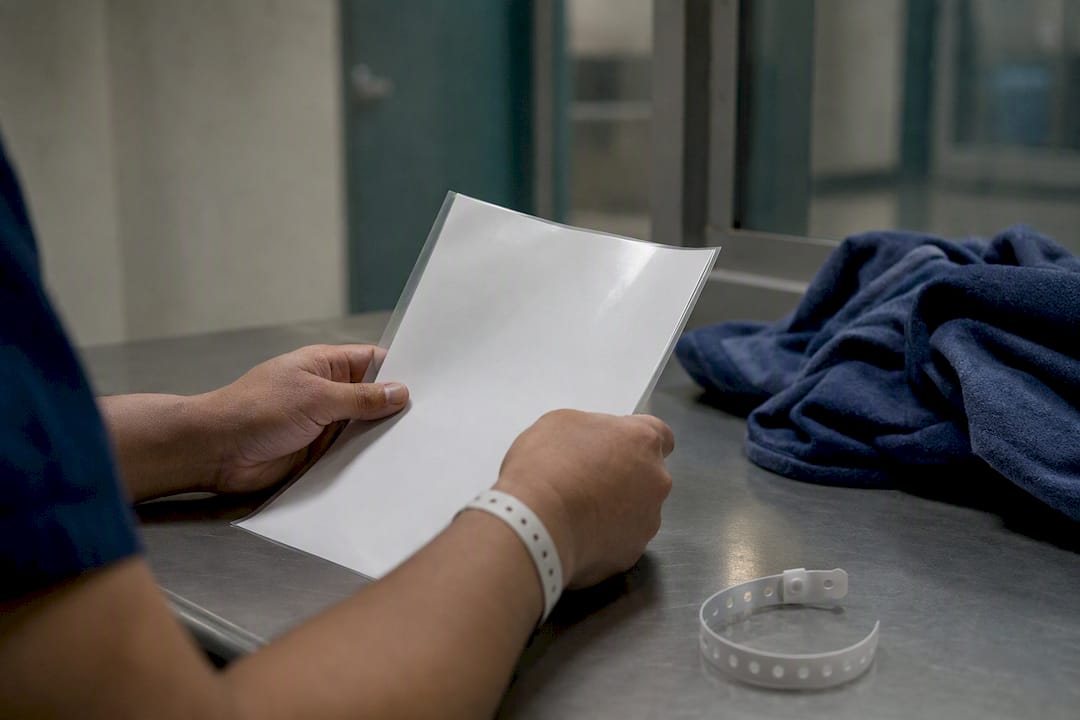
Jail staff are required to respond to medical needs, though "respond" doesn't always mean immediate treatment. Serious injuries and visible bleeding tend to get faster attention than complaints of pain that aren't outwardly visible, which is part of why documenting your condition matters so much.
If you take prescription medication, tell booking staff the name of the medication and your dosage as soon as you can. Facilities often need time to verify prescriptions with a pharmacy, so the earlier you flag it, the less likely you are to miss a dose. Missing doses of psychiatric medication, insulin, or blood pressure medication isn't just uncomfortable. It can become medically dangerous within hours.
If medical staff refuse to treat an obvious injury or ignore repeated requests, note the time, the staff member's name if available, and what you asked for. That record becomes useful if your attorney needs to argue that your treatment in custody was inadequate, particularly in cases where injuries happened during the arrest itself and could support a separate civil claim.
Humane Treatment and Protection From Discrimination in Custody
You're entitled to humane treatment in custody regardless of the charge against you, your immigration status, your race, religion, gender identity, or disability. That means access to food, water, a place to sleep, and freedom from harassment by staff or other detainees that facility staff should be preventing.
Discrimination complaints in custody often center on things like being denied religious accommodations, being misgendered or housed inappropriately relative to gender identity, or being denied disability accommodations like a wheelchair or hearing aid. If any of these happen to you, tell a supervising officer directly and ask that your complaint be logged.
Facilities are also required to provide interpretation for detainees who don't speak English well enough to understand what's happening to them. If you or a family member need Spanish-language support during this process, say so immediately. Bilingual support exists at many stages of this system, from police interviews to bail arrangements, and asking for it isn't a sign of weakness. It's a right.
Keep a mental log (or a written one if you get access to paper) of anything that felt like mistreatment: who was involved, what was said, and when it happened. This becomes the foundation for a complaint later, whether that complaint goes to the facility itself, an oversight board, or your attorney.
How Bail and Release Actually Work
Bail exists to guarantee you'll show up for court, not to punish you before conviction. Once you're booked, the facility typically has a bail schedule that assigns a dollar amount to your specific charge, though a judge can adjust that amount at arraignment based on flight risk, danger to the community, or your criminal history.
You generally have three paths to release: pay the full bail amount in cash, work with a bail bond agent who posts bail on your behalf for a fee (usually 10% of the total bail amount, which is non-refundable), or wait for a judge to consider release on your own recognizance. Own-recognizance release is more common for lower-level, nonviolent charges and depends heavily on your ties to the community and prior record.
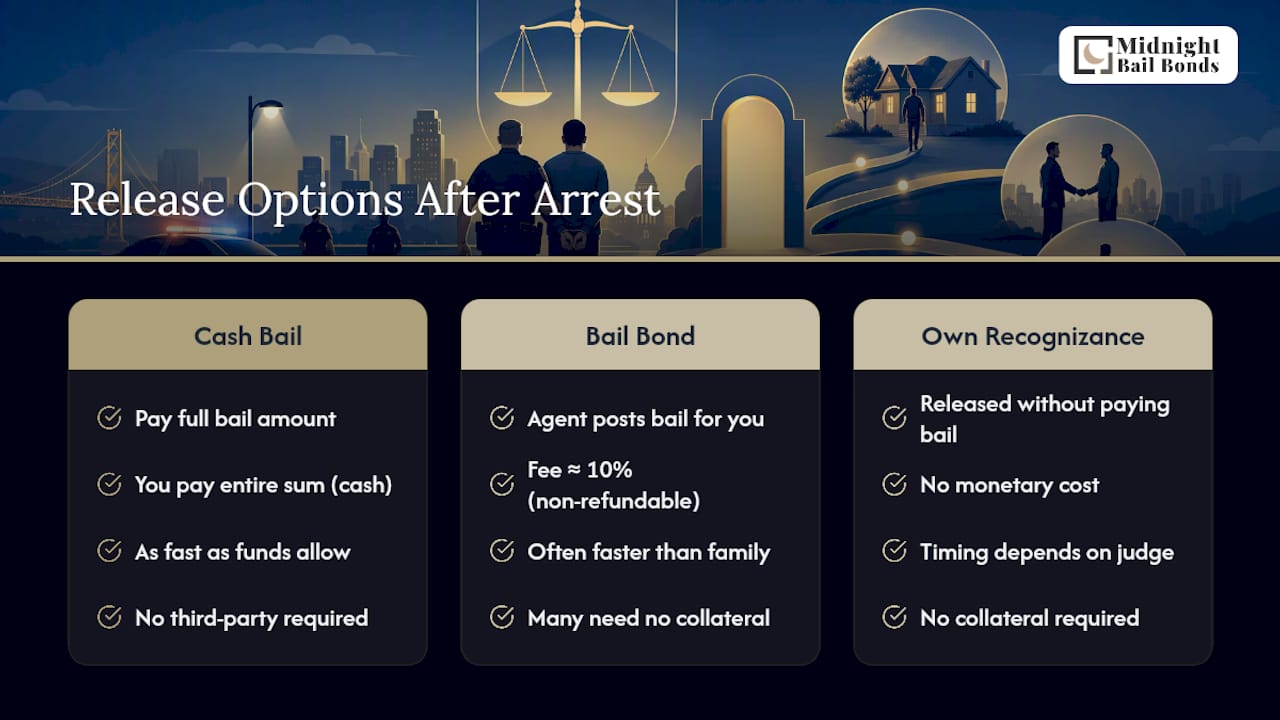
Bail bond agents like Midnightbail can often move faster than family members trying to gather cash, particularly because many arrangements don't require collateral and can be set up with payment plans. That speed matters most in the early hours after arrest, when every hour in custody adds stress for you and your family.
Ask the booking staff directly what your bail amount is and whether it's negotiable at arraignment. If you're not sure, whoever you reach on your first phone call should ask that question on your behalf.
Notifying Family or Friends After Arrest
You have the right to notify a family member or friend after booking, and this isn't a courtesy. It's a statutory function tied to the same phone call rights under Penal Code §851.5 that guarantee attorney and bail bond calls.
If you're the one arrested, use this call efficiently. Give the person your full name as it appears on your booking sheet, the exact facility name, and your booking number if you have it. Ask them to start figuring out bail immediately rather than waiting for more information, since delays often come from confusion about which jail someone is actually being held in.
If you're the one receiving the call, write down everything before you hang up: the facility name, booking number, and bail amount if it's been set. Facilities in different counties, like Adelanto in San Bernardino County or Carson in Los Angeles County, have different intake procedures and visiting hours, so having the exact name matters when you start calling for help.
Minors have additional notification protections. Officers are generally required to notify a parent or guardian when a minor is taken into custody, separate from the SB 203 counsel consultation rule covered earlier.
Interrogation Limits: How Long Can Police Question You
There's no fixed statutory time limit on how long police can question you in California, which surprises a lot of people who expect a hard cutoff. What the law does require is that interrogation stay within constitutional bounds: no coercion, no denial of basic needs like food, water, or bathroom access, and no continued questioning after you've clearly invoked your right to silence or an attorney.
Once you say "I want a lawyer" or "I am invoking my right to remain silent," officers are supposed to stop questioning you on that topic. If they keep pushing, don't argue or explain further. Repeat the same phrase and stay quiet. Courts have found that equivocal or repeated attempts to reason with officers after invocation can be read as reopening the conversation, which is the opposite of what you want.
Extended interrogation without breaks, food, or access to a bathroom can become grounds for challenging the reliability of any statement you made. If you're held for hours without these basics, remember the sequence of events as clearly as you can. Time of arrival, requests you made, and how staff responded all matter if your attorney later argues the conditions affected what you said.
Interrogation conditions and duration matter most when combined with other factors, like age, mental health, or language barriers. If any of those apply to you or someone you love, that information should go to your attorney immediately, since it can affect how a court views the reliability of anything said during questioning.
Filing a Complaint Against Police Misconduct
If you believe your rights were violated during arrest, booking, or interrogation, you have several paths to file a complaint. Most California police departments and sheriff's offices have an internal affairs division that accepts written or in-person complaints about officer conduct.
You can also file complaints with independent oversight bodies where they exist. Many larger counties maintain civilian oversight boards specifically to review police misconduct claims outside the department's own chain of command. The ACLU's Know Your Rights guidance recommends writing down everything you remember as soon as possible: officer names, badge numbers, patrol car numbers, exact time and location, and names of any witnesses.
If your complaint involves excessive force, keep the photographs and medical records mentioned earlier as part of your file. If it involves a Miranda violation or an unlawful search, tell your defense attorney directly. That's often more effective than an administrative complaint alone, since your attorney can raise the issue during pretrial motions and potentially get evidence suppressed.
Complaints can also go to your state's Attorney General's office for patterns of misconduct affecting multiple people, though individual case issues are usually handled faster through your own defense counsel or the department's internal process.
What the System Doesn't Tell You Fast Enough
Most guidance on arrest rights reads like a civics lesson: accurate, but written for someone with time to absorb it calmly. Nobody in a holding cell has that luxury. The gap between knowing you have a right and knowing exactly what words invoke it is where people lose ground, and it's the part conventional advice glosses over.
The conventional wisdom says "stay calm and know your rights." That's not wrong, it's just incomplete. Knowing you have a right to silence doesn't help if you say "I don't think I want to talk right now" instead of a clean invocation. Courts have repeatedly treated vague language as no invocation at all. The exact phrasing matters more than most people realize until it's too late to fix.
If I had to rank priorities for someone in custody right now: invoke clearly, first. Get your phone calls moving, second. Everything else, including bail logistics and complaints about treatment, comes after those two things are locked in. Families waiting on the outside should focus energy on the phone call and the facility name, not on guessing what happens next.
Sources
- California Penal Code §851.5
- The arraignment | California Courts | Self Help Guide
- California DOJ Information Bulletin on SB 203 (2023)
- California Miranda rights: rules, exceptions, and violations | LegalClarity
- Know Your Rights: Police Interactions | ACLU NorCal
FAQ
Can you be handcuffed without being read your rights?
Yes. Handcuffing is a matter of officer safety and doesn't trigger Miranda by itself. Miranda warnings are only required before custodial interrogation begins, not at the moment of physical restraint.
How long does an arrest stay on your record in California?
An arrest record can remain indefinitely unless you petition for a sealing or expungement, and eligibility depends on the outcome of your case and the specific charge. Consult an attorney about sealing options tied to your county's process.
What is a rule 40 arrest?
"Rule 40" isn't a standard term in California criminal procedure. If you encountered this phrase in a specific document or jurisdiction, ask your attorney to clarify what it refers to in your case.
Can a police officer open your car door without permission?
Generally, no, unless an exception applies, such as a search incident to arrest, probable cause under the vehicle exception, or exigent circumstances like an immediate safety threat. Absent one of those, officers typically need consent or a warrant.