

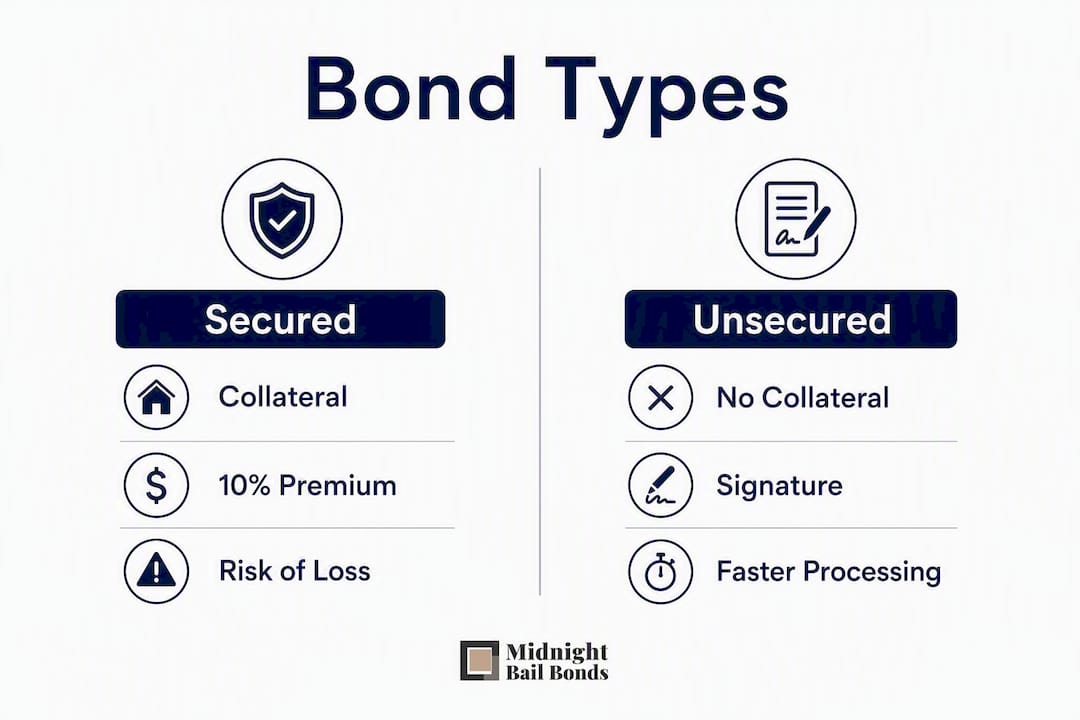
A secured bond requires collateral to guarantee a defendant's release from jail; an unsecured bond does not — it relies on a written promise to appear in court. That single distinction shapes everything: how fast someone gets out, what you risk, and what happens if they miss a court date.
Here is the short version:
- Secured bond: You or a bondsman pledges collateral (cash, property, vehicle title) to the court. A bail bondsman typically charges a state-mandated, non-refundable premium as a portion of the total bail amount.
- Unsecured bond: No collateral changes hands. The defendant signs a promise to appear; if they skip court, they owe the full bond amount.
- Who gets which: Judges grant unsecured bonds for low-level charges and defendants with clean records and strong community ties. Secured bonds are the norm for serious charges, prior failures to appear, or high flight risk.
- Need help right now? Midnightbail has licensed agents available 24/7 across California and can often arrange release without collateral.
Table of Contents
- What is a secured bail bond and how does collateral work?
- How does an unsecured bail bond work?
- How do bail bondsmen handle secured and unsecured bonds?
- Who decides whether a secured or unsecured bond is allowed?
- What happens if the defendant misses a court date?
- How do you choose between a secured and unsecured bond?
- Key Takeaways
- The part most families miss until it is too late
- Midnightbail is available right now, day or night, across California
- Useful sources
- FAQ
What is a secured bail bond and how does collateral work?
A secured bail bond means something of real value is pledged to the court or bondsman to guarantee the defendant shows up. If they do not, that collateral can be seized.
What counts as acceptable collateral
Courts and bondsmen accept several forms of security:
- Cash: The most straightforward option. You pay the full bail amount directly to the court, and it is returned (minus fees) when the case closes.
- Property deeds: Real estate is the most common non-cash collateral. The court or bondsman places a lien on the property. You need sufficient equity — typically the property's equity must cover the full bail amount.
- Vehicle titles: Some bondsmen accept car titles, though this is less common for large bail amounts.
- Promissory agreements: A signed legal promise, sometimes backed by a co-signer, that the full amount will be paid if the defendant absconds.
When you use a bondsman, you pay the 10% premium and the bondsman posts the full bail. The bondsman may or may not require additional collateral from you depending on the bail amount and their assessment of risk.
Pros and cons for the person posting collateral
| Factor | Secured bond (with collateral) |
|---|---|
| Upfront cost | 10% premium (non-refundable) if using a bondsman; full bail if paying cash |
| Asset at risk | Yes — property, cash, or vehicle can be seized if defendant absconds |
| Speed of release | Fast when a bondsman is involved; slower for property-based bonds requiring title verification |
| Collateral recovery | Cash bail returned after case closes; property lien released after case closes |
| Court guarantee | Strongest — court has a tangible asset to enforce |
Recovery of collateral is not always instant. Investopedia notes that even secured positions can involve legal costs, valuation changes, and competing liens that delay or reduce what you get back. Verify equity and title before pledging any property.
Pro Tip: Before pledging real estate, pull a title report to confirm there are no existing liens or co-owner claims. A property with a mortgage and a co-owner can create complications that delay or block recovery of your equity.
How does an unsecured bail bond work?
An unsecured bond releases the defendant without any upfront collateral. Instead, the defendant (and sometimes a co-signer) signs a legal agreement promising to appear at every court date. Fail to appear, and the court can pursue the full bond amount through civil collection.

This type of release goes by several names depending on the jurisdiction: unsecured bond, signature bond, personal recognizance (PR) release, or release on recognizance (ROR). The mechanics differ slightly, but the core feature is the same — no asset is pledged upfront.
When courts typically allow unsecured bonds
Judges and pretrial services weigh several factors before granting this type of release:
- Low-level or nonviolent charges (minor theft, first-time misdemeanors, traffic-related offenses)
- Clean or minimal criminal history with no prior failures to appear
- Strong community ties: steady employment, long-term local residence, family in the area
- Pretrial services recommendation supporting release without financial conditions
- Low assessed flight risk based on the bail schedule or a pretrial risk assessment tool
The absence of collateral does not automatically mean low risk for the defendant. SoFi's explainer on bond types makes the point that security status is only one dimension of overall risk — a defendant's history and ties to the community can matter just as much as whether collateral exists.
For families, the upside is clear: no asset is at risk upfront. The downside is that if the defendant misses court, the court can enter a civil judgment for the full bond amount and pursue collection from the defendant and any co-signers.
Unsecured bonds also tend to move faster through processing once granted, since there is no collateral paperwork to verify. The bottleneck is the judge's decision, not the title search.
How do bail bondsmen handle secured and unsecured bonds?
A bail bondsman's job is to post the full bail amount with the court so the defendant walks out quickly. In exchange, you pay the bondsman a non-refundable premium — in California, that is set by state law at 10% of the total bail amount.
What bondsmen charge and how payment works
The 10% premium is non-negotiable in states with regulated premiums — you cannot shop for a lower rate. What you can negotiate is how you pay it. Midnightbail accepts cash, credit and debit cards, Zelle, and financing, and offers payment plans that let families spread the cost when the full premium is not available upfront.
For a $50,000 bail, that means a $5,000 premium. For a $10,000 bail, it is $1,000. The bondsman covers the rest.
Collateral practices and what happens after the case
Bondsmen decide independently whether to require collateral beyond the premium. For lower bail amounts with a reliable co-signer, many will not. For larger amounts or defendants with a history of failures to appear, they typically require a property lien or other security.
Once the case resolves, the bondsman releases any lien or collateral they hold. The court also releases its hold on any cash bail posted directly. This process can take weeks to months depending on the court's administrative timeline.
Pro Tip: Ask the bondsman three things before signing: (1) Are you licensed in this state? (2) What collateral do you require and under what conditions? (3) What is your process if my family member misses a court date?
Who decides whether a secured or unsecured bond is allowed?
The judge at arraignment makes the final call. In some jurisdictions, a court clerk can set bail according to a published bail schedule for minor charges before arraignment, which means a defendant can be released faster without waiting for a judge. A pretrial services officer or magistrate may also weigh in with a recommendation.
Key factors judges consider
- Severity and nature of the charge
- Prior criminal history and any prior failures to appear
- Assessed flight risk (ties to the community, employment, family)
- Whether the defendant is a danger to the public
- The local bail schedule or statutory guidelines
- Pretrial services report and risk score
The weight given to each factor varies by state and even by county. California, for example, has moved toward risk-based assessments that consider defendant history alongside charge severity. Other states rely more heavily on fixed bail schedules.
Pro Tip: Contact the local court clerk's office or a licensed bondsman before arraignment if possible. Knowing the local bail schedule and the judge's typical stance on unsecured bonds for the specific charge can help you prepare the right information — employment records, proof of residence, family ties — to present at the hearing.
State-by-state variation is real and significant. What qualifies for an unsecured bond in one county may require full collateral in another. Always verify local rules with the court clerk or a licensed agent familiar with that jurisdiction.
What happens if the defendant misses a court date?
Missing a court date triggers consequences fast, and they differ depending on which bond type is in place.
Secured bond consequences
The court issues a bench warrant for the defendant's arrest and declares the bond forfeited. If a bondsman posted the bond, they have a limited window (set by state law) to locate and surrender the defendant before the full bail amount is collected. During that window, bondsmen may engage recovery agents.
If the defendant is not found and surrendered in time, the bondsman must pay the court the full bail amount. They then pursue the indemnitor (the person who co-signed) and any pledged collateral. A lien on real estate can lead to foreclosure proceedings. The SEC's guidance on secured claims illustrates the same principle: a secured creditor has a legal right to the specific pledged asset when the primary obligation is not met.
Unsecured bond consequences
No collateral is seized immediately, but the court enters a civil judgment for the full bond amount against the defendant and any co-signers. That judgment can be collected through wage garnishment, bank levies, or liens placed on property the defendant owns. The financial exposure is the same as a secured bond — the difference is timing and enforcement mechanism.
How do you choose between a secured and unsecured bond?
Start with what the court will actually allow, then work backward to what you can manage.
Decision checklist
- What is the charge? Serious felonies almost always require secured bonds. Minor misdemeanors may qualify for unsecured release.
- What is the defendant's record? Any prior failure to appear makes unsecured release unlikely.
- How urgent is release? A bondsman can often post a secured bond within hours. Unsecured release depends on a judge's decision, which may take longer.
- What assets are available? Cash is the cleanest collateral. Property works but requires equity verification and title review.
- Who is the co-signer? A strong, employed co-signer with no criminal record improves the bondsman's willingness to reduce or waive collateral requirements.
Red flags before pledging collateral
- Property with an existing mortgage and limited equity
- Real estate with co-owners who have not consented
- Collateral whose value is close to the bail amount (no buffer for legal costs or value changes)
- Any asset with existing liens or legal disputes
Finance Dictionary Pro's analysis of lien position makes a point that applies directly here: a first-lien position on property offers far stronger recovery prospects than a subordinate lien. If a bondsman is taking a second position behind a mortgage, their ability to recover — and your ability to get equity back — is weaker than it looks on paper.
When to lean toward an unsecured bond: low-level charge, first offense, defendant has lived locally for years, steady employment, and a pretrial services officer who supports release. When secured is the realistic path: felony charges, any prior FTA, out-of-state ties, or a judge who follows a strict bail schedule.
Key Takeaways
A secured bond requires pledged collateral that can be seized if the defendant absconds; an unsecured bond relies on a signed promise to appear, with civil collection as the enforcement tool if they do not.
| Point | Details |
|---|---|
| Core distinction | Secured bonds require collateral; unsecured bonds require only a promise to appear in court. |
| Typical bondsman fee | State-mandated premium is roughly 10% of total bail — non-refundable regardless of case outcome. |
| Collateral risk | Pledged property or cash can be seized or liened if the defendant misses court; verify equity and title first. |
| Who decides bond type | The judge at arraignment, guided by charge severity, criminal history, flight risk, and local bail schedules. |
| Midnightbail option | Midnightbail offers bail without collateral in many cases, with 24/7 licensed agents and flexible payment plans across California. |
The part most families miss until it is too late
Most people focus on the 10% fee and forget to ask the harder question: what happens to the collateral if something goes wrong? That is where families get hurt.
The secured versus unsecured distinction sounds clean on paper. In practice, the line blurs quickly. A judge may grant an unsecured bond for a charge that looks minor, then revoke it at the next hearing if new information surfaces. A bondsman may accept a property lien without fully explaining that a missed court date starts a clock that can end in foreclosure.
What I see consistently is families pledging property they cannot afford to lose because they did not know unsecured release was even possible for the charge in question. The first call should always be to a licensed bondsman who knows the local court — not to figure out how to post bail, but to find out whether you need to post collateral at all.
The other thing worth saying plainly: defendant history predicts outcomes better than bond type. A defendant with strong community ties and no prior failures to appear is likely to show up whether the bond is secured or not. A defendant with a history of skipping court is a risk regardless of what collateral you pledge. Assess the person, not just the paperwork.
Midnightbail is available right now, day or night, across California
When someone you care about is in custody, the fastest path to release is a licensed bondsman who already knows the local jails and courts. Midnightbail operates 24/7 across California — from Los Angeles County to Orange County, San Bernardino, and Riverside — with agents ready to move the moment you call.
In many cases, Midnightbail can arrange release without requiring collateral from your family. For situations where collateral is needed, the team walks you through exactly what is required and what your rights are if the case resolves in your favor. Payment options include cash, credit and debit cards, Zelle, and financing, so the 10% premium does not have to be a barrier. Bilingual English/Spanish support is available, and the free instant inmate search lets you locate a loved one before you even make the call.
Call Midnightbail now or start an online inquiry at midnightbail.com to speak with a licensed agent and get someone home tonight.
Useful sources
Verify local rules and bond eligibility with these authoritative resources:
- Investopedia: Secured Bond Definition and Risks — covers collateral risk, recovery limitations, and lien considerations
- Finance Dictionary Pro: Secured, Unsecured, and Collateralized Bonds — covers lien position and seniority in collateral claims
- Midnightbail.com — for immediate help arranging bail in California, 24/7
This article is general information, not legal advice. Bail rules vary by state, county, and charge. Confirm current rules with your local court clerk or a licensed bail bondsman before making decisions.
FAQ
What does a $5,000 unsecured bond mean in jail?
A $5,000 unsecured bond means the defendant is released without paying anything upfront, but owes $5,000 to the court if they miss a scheduled court date. No collateral is pledged; the obligation is enforced through civil collection if they fail to appear.
What does a secured bond mean in jail?
A secured bond requires the defendant or a co-signer to pledge collateral — cash, property, or another asset — to guarantee appearance in court. If the defendant absconds, the court can seize or lien that collateral to satisfy the bond amount.
What are the main disadvantages of secured bonds?
The primary risk is losing pledged collateral if the defendant fails to appear. Recovery can be delayed by legal proceedings, competing liens, or property value changes, meaning families may not get full value back even after the case closes.
Why would a judge grant someone an unsecured bond?
Judges grant unsecured bonds when the defendant poses low flight risk — typically first-time or minor charges, strong community ties, steady employment, and no prior failures to appear. A pretrial services recommendation supporting release without financial conditions also weighs heavily in the decision.
Can a bondsman arrange release without collateral?
Yes, in many cases. Bondsmen assess each situation individually; for lower bail amounts with a reliable co-signer, collateral beyond the 10% premium is often not required. Midnightbail specifically offers bail without collateral in many cases across California.