

Most bail agents in California charge a premium equal to 10% of the total bail amount, and that fee is nonrefundable once the bond is posted, even if charges are later dropped. The court sets the bail amount, but licensed bail agents charge a premium rate they've filed with the California Department of Insurance. If a fee looks higher than that filed rate or an agent won't produce a written contract, that's your cue to file a complaint with CDI.
TL;DR:
- The nonrefundable 10% bail bond premium is a fixed rate filed with the California Department of Insurance and cannot legally be lowered or rebated without proper documentation.
- Bail amounts are set by judges or county schedules, while premium rates are regulated separately by private insurers and their agents, leading to a two-number system for release costs.
- If the case is dismissed or charges are dropped before the bond is surrendered, a refund is generally not issued unless the defendant is formally surrendered back into custody beforehand.
- Payment plans and collateral options are common, but the total premium remains the same, and agents must show their filed rate and provide clear, written contracts upfront.
- Consumers should verify licensed agents, demand written documentation of fees, and report any fee violations to the California Department of Insurance for protection against illegal charges.
Table of Contents
- Who Sets Bail and Who Sets the Bail Bond Fees in California
- Typical Bail Bond Rates and How the Premium Gets Calculated
- Refunds, Bail Surrender, and the Narrow Exceptions That Apply
- Collateral, Payment Plans, and Financing: What's Normal and What's Risky
- How to Legally Lower Bail Bond Costs and What to Ask Your Agent
- Your Consumer Rights and How to Report Bail Fee Violations
- A Licensed Bondsman's View on Fair Pricing in California
- Get Clear, Upfront Bail Pricing With Midnightbail
- Sources
- FAQ
Who Sets Bail and Who Sets the Bail Bond Fees in California
Two separate systems control what you'll pay to get someone out of jail, and mixing them up is where a lot of confusion starts. A judge, or a county bail schedule when no judge is immediately available, sets the dollar amount of bail itself. That number is tied to the charge, the county, and sometimes the defendant's prior record. Bail bond fees in California, on the other hand, come from a completely different authority: private insurance companies and their agents, who are required to file their premium rates with the California Department of Insurance under statutory provisions in the California Insurance Code.
A few things follow from that split:
- Courts and county bail schedules decide the bail amount, not the bondsman.
- Sureties (the insurance companies backing bail agents) must file their premium rates with CDI before charging them.
- County-level procedures, detailed on California Courts resources, affect how fast a bail review hearing happens and how local clerks process payments.
- The Penal Code governs how and when bail can be set, modified, or forfeited, while the Insurance Code governs the business side of writing bonds.
That means the price tag on your loved one's release is really two numbers stacked together: a judicial figure you can't negotiate, and a regulated fee percentage that's supposed to be transparent.
Typical Bail Bond Rates and How the Premium Gets Calculated
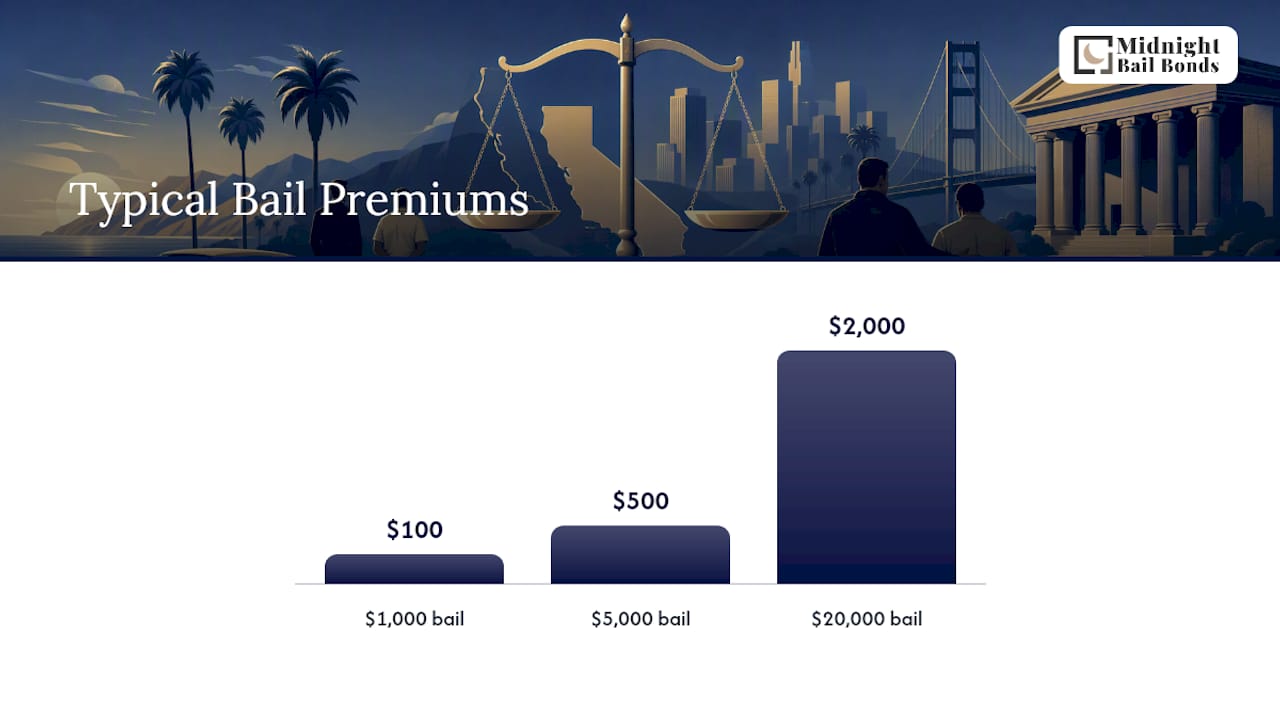
The standard premium across California is 10% of the total bail amount, and in practice it functions as a floor rather than a true negotiating range. Agents rarely go below it, since undercutting a filed rate without proper rebating documentation can violate CDI rules. Here's how that plays out at three common bail amounts:
- $1,000 bail → $100 premium owed to the bondsman.
- $5,000 bail → $500 premium owed to the bondsman.
- $20,000 bail → $2,000 premium owed to the bondsman.
A bail bond calculator can run these numbers instantly for less common bail amounts, but the math itself never changes: take the total bail, multiply by 0.10, and that's the fee.
Statistic Callout: One market-cost aggregator pegs the average bail bond expense in California at $2,025, which lines up with what you'd expect for bail amounts in the $15,000 to $25,000 range once the 10% premium is applied.
The contrast that trips people up is cash bail versus a bond. Post the full bail amount in cash directly with the court, and you get most of it back at the end of the case, minus administrative fees. Pay a bondsman instead, and you're only out 10% upfront, but that 10% is gone for good. The trade is speed and affordability against permanence. Most families don't have $20,000 sitting in a checking account, which is exactly why the bail bond industry exists, but it's worth knowing you're paying for liquidity, not just convenience.
Refunds, Bail Surrender, and the Narrow Exceptions That Apply
Premiums are earned the moment the bond is posted, according to guidance from CDI and legal summaries from Shouse Law. That holds true even if the case gets dismissed the next morning. The fee compensates the surety for taking on the financial risk of guaranteeing the defendant's appearance, not for how long the case lasts.
There's one narrow exception worth knowing:
- Under CCR Title 10 §2090, if the defendant is surrendered back into custody by the bail agent or the indemnitor before the bond is exonerated, a refund is possible, minus administrative costs the surety actually incurred.
- This isn't a general "changed my mind" refund. It applies specifically to a formal surrender process, not to a case dismissal or an early plea deal.
- The practical steps run through the court clerk's office: the surety files a surrender request, the clerk processes it, and any applicable refund gets calculated after administrative costs are deducted.
- Timelines vary by county, so check with the clerk handling the specific case rather than assuming a standard turnaround.
If your case was dismissed and you're wondering why you didn't get anything back, this is why. It also explains why understanding bail forfeiture matters if a defendant misses a court date, since that triggers a completely different set of consequences for the full bail amount.
Collateral, Payment Plans, and Financing: What's Normal and What's Risky
Bail agents often ask for collateral, property, a vehicle title, or cash, to secure larger bonds, because the surety is on the hook for the full bail amount if the defendant skips court. That's standard practice, not a red flag by itself.
Payment methods have gotten more flexible. Expect options like cash, credit or debit cards, Zelle, and structured financing plans that spread the premium over several payments. The premium total doesn't shrink because you're financing it. A payment plan changes when you pay, not how much.
- Ask what happens if a payment is missed. Some contracts allow surrender of the defendant if payments lapse.
- Confirm whether collateral is required for your specific bail amount or if a no-collateral option applies.
- Get the payment schedule in writing before signing anything.
Pro Tip: Before agreeing to financing, ask for the total finance charge in dollars, not just the payment amount. A small monthly number can hide a large add-on over the life of the plan.
How to Legally Lower Bail Bond Costs and What to Ask Your Agent
Rebating, discounting the filed premium rate, is allowed in limited circumstances under California's Proposition 103 framework, but it has real boundaries. An agent can sometimes offer a documented reduction, but they can't simply invent a lower number off the books.
Before signing anything, ask these questions directly:
- What is your CDI-filed rate, and can you show me documentation of it?
- Can I have a written, itemized contract before any money changes hands?
- Are there conditions under which any portion of this fee could be refunded?
- Is there a discount available, and if so, is it documented per Prop 103 rebating rules?
Watch for warning signs. Unexplained "courier fees" or "check-in fees" stacked on top of the filed rate are a common way agents try to inflate costs beyond what's legally on file. So is refusing to hand over a receipt. An agent who won't answer the first question on that list plainly isn't someone you want handling your family's money.
Your Consumer Rights and How to Report Bail Fee Violations
Every bail agent operating in California must carry a valid license, and you can verify that license before handing over a dime. A license lookup confirms the agent is authorized to write bonds in this state and isn't operating outside CDI's regulatory reach.
If something feels off, document it:
- Keep every text message, contract, and receipt tied to the transaction.
- Note the exact amount charged versus the filed rate you were quoted.
- File a complaint directly with the California Department of Insurance, which investigates unlicensed activity and fee violations.
- Loop in the court clerk's office if the issue involves refund timing or surrender paperwork.
Consumers who paid an illegal fee have real recourse. The system only works if people actually use it.
A Licensed Bondsman's View on Fair Pricing in California
Most complaints about bail bond fees don't come from the 10% premium itself. They come from what gets tacked on around it: vague verbal quotes, missing paperwork, or agents who dodge questions about their filed rate. That's the part of this industry that gives the whole business a bad reputation, and it's avoidable.
Licensed agents are often available around the clock, with the expectation to state the filed premium upfront, put it in writing, and answer questions about collateral and payment options before any money changes hands. Flexible payment plans exist because most families don't have a spare $2,000 lying around at 2 a.m., and bail without collateral is available in many cases specifically because not every situation calls for someone to put up their car title.
If you're arranging bail, ask for the CDI-filed rate, a copy of the signed contract, and a receipt for every payment. Any agent worth hiring will hand those over without hesitation.
— Jake
Get Clear, Upfront Bail Pricing With Midnightbail
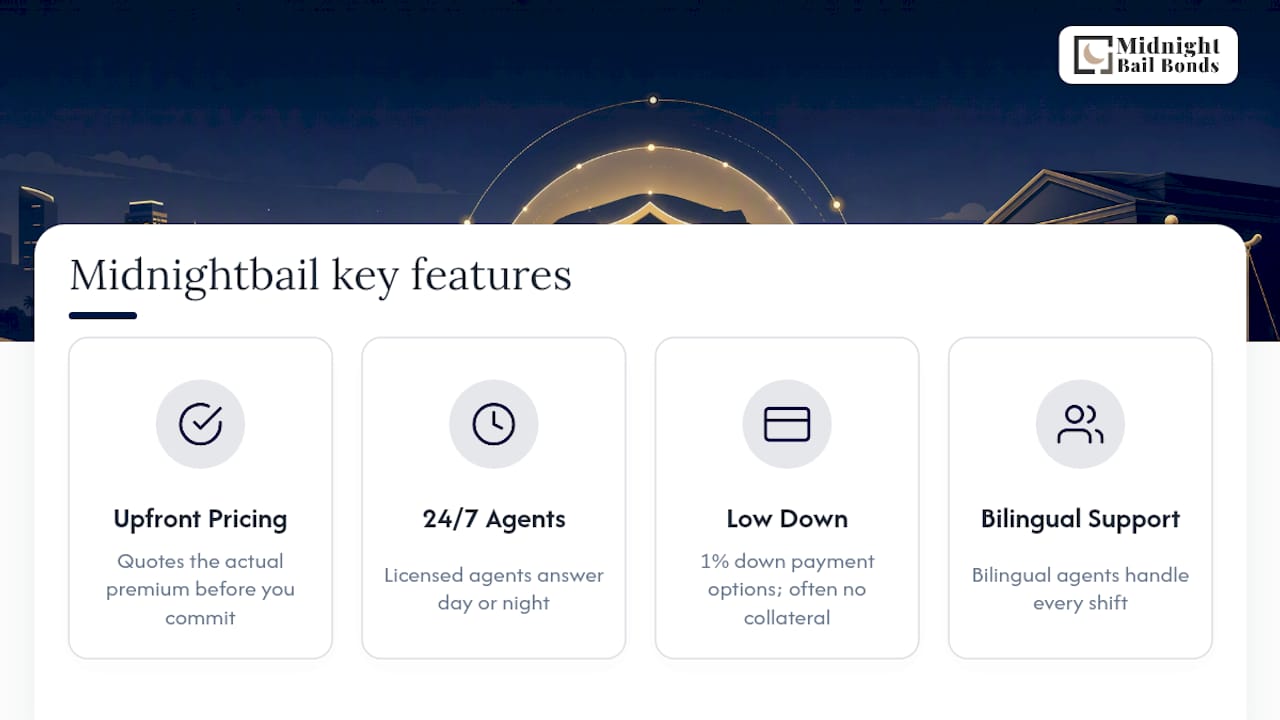
You just read what the law requires: a filed rate, a written contract, and honest disclosure before you pay anything. That's exactly the standard Midnightbail holds itself to, with licensed agents answering calls directly, day or night, and quoting the actual premium before you commit to anything.
Families dealing with an arrest at 3 a.m. don't have time to shop around for hours or decode confusing fee structures. Midnightbail keeps things straightforward: bail bonds for DUI, drug charges, domestic violence, and other common charge types, with 1% down payment options and bail bond services without collateral available in many cases. Bilingual agents handle every shift, so language isn't a barrier when speed matters most.
If someone you care about is in custody right now, visit Midnightbail to start the process, get a clear quote on the exact premium owed, and find out whether a no-collateral option applies to your situation.
This article is general information, not a substitute for advice from a qualified lawyer. Consult a qualified legal professional about your own circumstances before acting on anything here.
Sources
FAQ
Is It Better to Pay Bail or Use a Bail Bond?
Paying the full cash bail directly to the court means you get most of it back when the case ends, minus administrative fees, while a bail bond only costs 10% upfront but that premium is nonrefundable. Cash bail makes sense if you have the full amount available; a bond makes sense when you don't.
Can You Go to Jail for Not Paying a Bail Bondsman in California?
Failing to pay a bail bond premium is a civil debt matter, not a criminal offense, so you generally won't go to jail for it directly. However, missed payments can trigger surrender of the defendant back into custody under the bond contract's terms.
How Much Is Bail on a $1,000 Bond?
At the standard 10% premium, a $1,000 bail amount means a $100 fee paid to the bondsman, and that fee is nonrefundable once the bond is posted.
Is $10,000 a Lot for Bail in California?
Bail amounts vary by charge severity, and the standard premium rate is 10%, so a premium is calculated as 10% of the total bail. It's manageable through a payment plan but still a meaningful cost for most households arranging release quickly.