
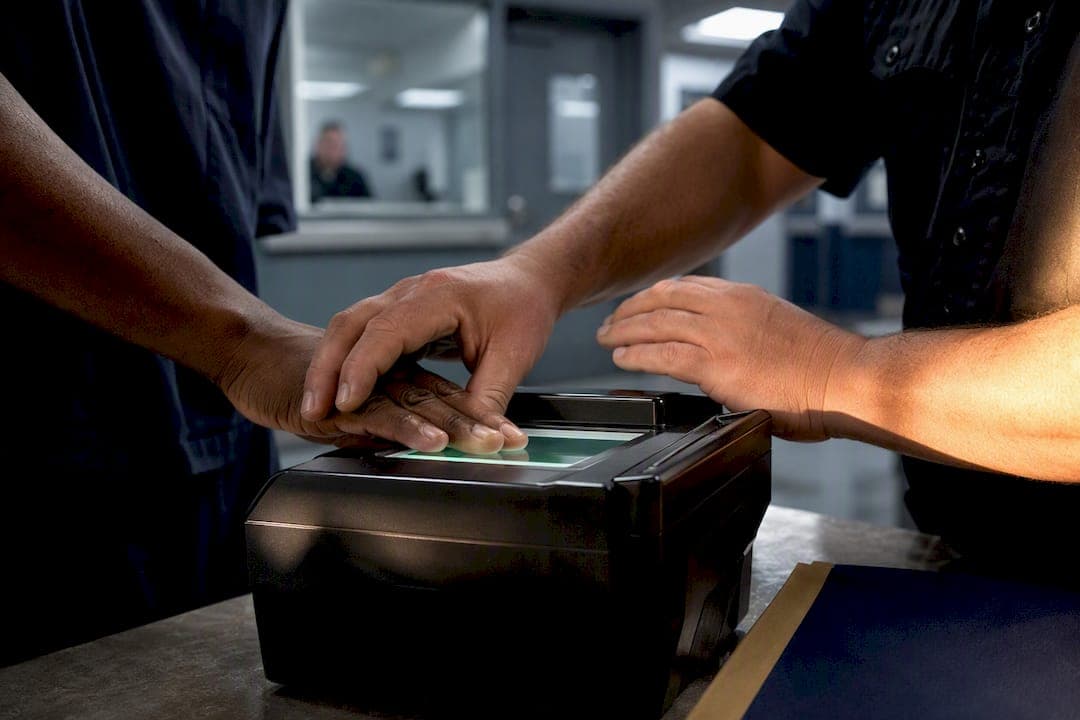
Yes, but it works differently depending on who lacks the ID. Jails identify defendants through fingerprints and booking records, so a missing driver's license rarely blocks release. The person posting bail is a different story: they almost always need a government-issued photo ID to sign the bond contract. Your fastest move is to get the booking number and call a licensed bail agent now.
TL;DR:
- Fingerprints and booking records typically confirm a defendant's identity faster than physical ID, especially for those with prior bookings.
- Bail agents prioritize accurate information from the signer, requiring valid government ID for the co-signer, but may write bonds without one depending on circumstances.
- Missing ID on the defendant usually delays processing, but law enforcement’s verification methods mean the case can still proceed without it.
- The time to release depends more on verifying the signer’s identity and processing the paperwork than on whether the defendant has ID.
- Calling a licensed bail agent immediately with the booking number and a co-signer with ID speeds up the process, even if the defendant lacks ID.
Table of Contents
- What Happens If You Try a Bail Bond Without ID?
- What Information Does the Bail Bond Company Need?
- Who Can Be the Co-Signer, and What Do They Need?
- Why Do Some No-ID Cases Take Longer to Release?
- How Fast Can You Get Someone Released Without ID?
- How Midnight Bail Bonds Handles No-ID Situations
- Is It Legal to Post Bail Without Government ID?
- Do ID Requirements for Bail Bonds Vary by State?
- How Do Agents Verify Identity Without Standard ID?
- What Happens If You Give False Information?
- What's the Right Way to Talk to Jail Officials?
- Our Take: Stop Treating "No ID" as a Dead End
- Need Help Right Now? Start With a Call
- Where to Verify Official Policy
- Sources
- FAQ
What Happens If You Try a Bail Bond Without ID?
Jails don't rely on a wallet card to know who they're holding. Fingerprint matching through the Automated Fingerprint Identification System (AFIS) and cross-checks against prior booking records are the primary tools officers use to confirm a defendant's identity, even when no physical ID turns up at intake.
Name, date of birth, and notes from the arresting agency fill in the rest. A defendant who's been arrested before usually gets identified almost instantly because their prints are already on file. Someone with no criminal history and no ID on them takes longer, since the jail has to lean more heavily on verbal information and any documents family members can provide.
When identity stays genuinely uncertain, the process slows down rather than stopping. Model pretrial release guidance recommends that a magistrate proceed with the initial appearance even without confirmed ID, setting release conditions based on the best information available.
- Fingerprints and AFIS records confirm identity faster for anyone with a prior booking.
- Booking notes (name, DOB, arresting officer's report) often substitute for missing physical ID.
- Uncertain identity can delay the jail booking process and push back the first court appearance.
What Information Does the Bail Bond Company Need?
The agent handling your call cares far more about accuracy than paperwork you don't have. Before you dial anyone, pull together what the jail booking process generates automatically, because it's the fastest path to a quote and a bond.
- The defendant's full legal name and date of birth, exactly as booked, not a nickname.
- The booking number and facility name, which the agent uses to pull charges and bail amount from the jail's system.
- The charges and set bail amount, if a judge has already assigned one; some jurisdictions use bail schedules that set this automatically.
- Your own contact information, since you'll likely be the one signing paperwork and receiving updates.
- A valid government photo ID for whoever signs the bond, since posting a bail bond is a formal legal transaction that requires proof of who's entering the agreement.
- A payment method, since cash, cashier's checks, debit or credit cards, and financing all move at different speeds. Court bail offices frequently require ID plus cash or a cashier's check for anyone posting directly at the courthouse window, and the person who pays is usually the person who gets refunded later, so keep that in mind before handing cash to someone else to deposit.
Missing a piece of this list doesn't necessarily stop you. It just means the agent has to spend extra time verifying it another way, which costs you time you probably don't have.
Who Can Be the Co-Signer, and What Do They Need?
The defendant might get processed with zero ID in their pocket. The co-signer doesn't get that same leeway. Whoever signs the bond is agreeing to be financially and legally responsible if the defendant skips a court date, and that agreement requires a verified identity on paper. Legal guidance is consistent on this point: a government-issued photo ID is typically required to create the surety agreement in the first place.
If there's genuinely no one available with valid ID to co-sign, you're not automatically stuck. Bail agencies can sometimes write a bond without a traditional co-signer, depending on the charge, the bond amount, and how well the agency can verify the defendant's stability and local ties. Collateral, such as a vehicle title or property equity, can also stand in for a co-signer's signature in some underwriting scenarios.
- A co-signer is legally and financially on the hook if the defendant fails to appear.
- No co-signer available? Ask about no-collateral bail bond options or agency underwriting based on verified stability.
- Proof of local ties (a lease, a utility bill, a pay stub) can substitute for some of what a co-signer would otherwise vouch for.
Pro Tip: Pick the most reliable, reachable person you know for the co-signer role, not necessarily the closest relative. Agents move faster with someone who answers calls and has documents ready than with someone who's technically family but hard to reach.
Review the contract protections a co-signer should demand before anyone puts their name on the line. It's a real financial commitment, not a formality.
Why Do Some No-ID Cases Take Longer to Release?
Not every case moves at the same speed, and identity questions are only one variable. A defendant with no prior bookings and no ID takes longer to confirm than one whose fingerprints are already on file, simply because officers have fewer shortcuts.
Immigration holds complicate things further. Guidance on pretrial policy notes that when a detainer is attached to a case, the jail may legally continue holding someone for a limited period even after bond is posted. That's a separate legal track from the bail bond itself, and no bail agent can override it.
Serious charges and high bond amounts add friction too. Bigger bonds usually mean more underwriting steps, sometimes a supervisor's sign off, and occasionally a judge's involvement before the agency finalizes anything.
- Identity verification without prior fingerprints on file adds hours, not minutes.
- Immigration detainers can extend custody beyond when bond is posted.
- High bond amounts or felony-level charges often trigger extra underwriting review.
How Fast Can You Get Someone Released Without ID?
Speed comes down to sequence. Do these in order, and you'll cut out most of the wasted time families lose making calls to the wrong place first.
- Get the booking number and exact jail location. Call the jail's public information line or check an online inmate search if the facility offers one.
- Call a licensed bail agent immediately, ideally one who answers around the clock rather than during business hours only.
- Identify your co-signer now, and if that person doesn't have valid ID handy, start figuring out collateral or an alternative underwriting path before you're on hold with an agent.
- Gather backup documents in case standard photo ID genuinely isn't available: a birth certificate paired with a Social Security card and a recent utility bill can sometimes support identity verification, though acceptance varies by facility and by agency.
- Call the court clerk or sheriff's booking office directly if you're unsure what that specific jurisdiction will accept. Policies differ enough county to county that guessing wastes time.
Pro Tip: Save the jail's booking number the moment you get it. Agents, court clerks, and even the inmate release notification systems some jails use all key off that number, and repeating "I don't have it yet" to three different offices burns real minutes.
How Midnight Bail Bonds Handles No-ID Situations
Midnightbail runs licensed agents around the clock specifically because identity questions and paperwork gaps don't wait for business hours. Bilingual support means language isn't an added barrier on top of an already stressful call, and flexible payment plans mean a missing document doesn't have to translate into a missing bond.
A bail agent with an established relationship at the local jail can pull exact booking details and verify a co-signer's identity electronically, often cutting out the wait that clerks unfamiliar with a case would otherwise need for manual verification.
On your first call, expect an agent to ask for the booking number, the defendant's name and facility, and whoever's signing to have a photo ID ready. In many cases, when underwriting supports it, bonds can be written without requiring separate collateral, which matters most for families who don't have a second option lined up.
Is It Legal to Post Bail Without Government ID?
There's a real legal distinction between the defendant lacking ID and the signer lacking ID, and mixing them up is where families get into trouble. Nothing about a defendant's missing wallet is illegal. Fingerprints and booking records are the legally recognized way jails confirm identity, and courts build their processes around that reality.
The signer's side carries more weight. A bail bond is a binding surety contract, and most jurisdictions require the signer to present valid government-issued ID before the agreement is enforceable. Signing under a false name, or letting someone else use your identity to co-sign, isn't a paperwork shortcut; it's a fraud exposure for everyone involved, including the agent who wrote the bond.
There's also a practical legal risk on the back end. Court bail offices typically tie bail refunds to the identity recorded at deposit, so whoever's name goes on the payment is whoever gets the money back later, assuming the case resolves in a way that triggers a refund. Putting the bond in a stranger's name to work around a missing ID can mean losing access to that refund entirely.
None of this means a no-ID case is a dead end. It means the paperwork has to be accurate, the signer has to be real and verifiable, and shortcuts around identity on the signer's side create liability that outlasts the arrest itself.
Do ID Requirements for Bail Bonds Vary by State?
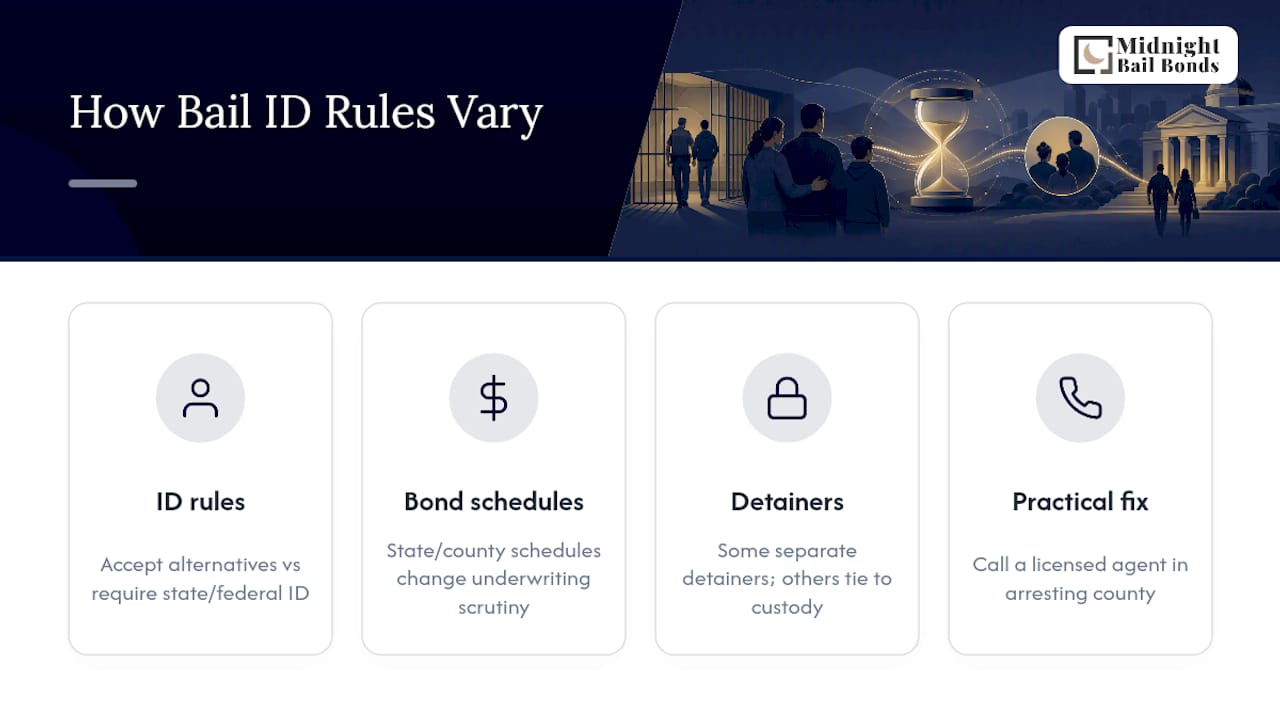
They do, and the variation is bigger than most families expect going in. Some states allow bail agents broad discretion in accepting alternative documentation for a co-signer when a standard photo ID isn't available; others hold a hard line requiring a state-issued or federal ID with no substitutions.
Bond amount schedules differ by state and even by county within the same state, which affects how much underwriting scrutiny a no-ID case triggers. A misdemeanor with a modest bond in one county might move through in an hour, while a similar charge in a stricter jurisdiction could require a supervisor's review before the agency proceeds.
Detainer policy is another area where geography matters. Some counties process bail and any immigration hold as entirely separate tracks, releasing on bond while a detainer plays out on its own timeline; others coordinate the two more tightly, which can extend custody. This is one of the biggest reasons a general internet answer won't fully fit a specific case: the rules genuinely change from one jail to the next.
The practical fix isn't researching every state's statute. It's calling an agent licensed in the state where the arrest happened and asking directly what that county's jail and courts require. A licensed agent working a specific jurisdiction daily knows its quirks better than any generalized checklist can.
How Do Agents Verify Identity Without Standard ID?
Agents aren't limited to a driver's license or passport. When someone shows up without either, a competent agent works through a short list of alternatives before declaring the case a dead end.
Fingerprint-based confirmation through jail records is the first line, and it's usually already done by the time you're on the phone with an agent, since booking happens before bail conversations start. Secondary documents come next: a birth certificate, a Social Security card, a utility bill with a matching address, or even a paystub can combine to support an identity claim when no single document does the job alone.
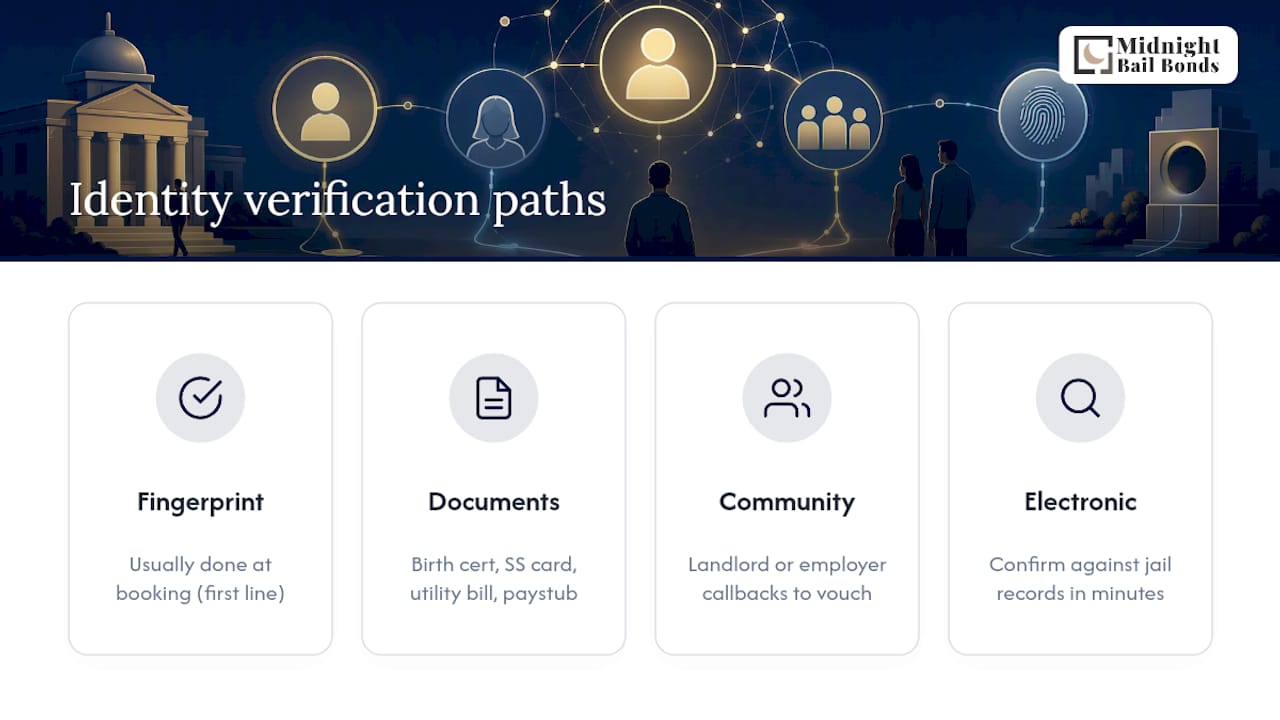
Verified community ties carry real weight too. Model pretrial guidance specifically allows community vouching as one path to satisfying identity concerns when standard documentation is thin. An agent might confirm an address through a landlord, a pay stub through an employer, or a phone number through a callback, stitching together enough verified detail to move forward.
Electronic verification tools speed this up further. Agents with established jail relationships can often confirm a signer's identity against existing records in minutes rather than requiring an in-person visit with a folder of paperwork. That's less about technology being flashy and more about an agent already knowing which door to knock on.
What Happens If You Give False Information?
Getting a detail wrong by accident is a fixable problem. Deliberately giving false information is not, and the consequences land on more than just the person who lied.
A signer who uses a fake name or someone else's identity to co-sign a bond has committed fraud against the bail agency, and agencies do pursue this when discovered, since they're financially exposed for the full bond amount if the defendant disappears. The bond itself can be voided, which puts the defendant right back in custody, often at the worst possible moment.
Providing a false address, false employment information, or an invented emergency contact to strengthen a weak application creates the same exposure. Bail agencies build their underwriting decisions on that information, and discovering it's fabricated after the fact typically triggers immediate bond revocation.
There's a simpler risk too: incomplete information, even without intent to deceive, slows everything down. Guessing at a booking number or approximating a bond amount to sound prepared just means the agent spends the first ten minutes of the call correcting your numbers instead of moving your case forward. Accuracy, even when it means admitting "I don't have that detail yet," beats a confident guess every time.
What's the Right Way to Talk to Jail Officials?
Jail staff field dozens of confused, panicked calls a day, and the ones who get answered fastest tend to lead with specifics instead of a story. Skip the explanation of how the arrest happened. Lead with the booking number if you have it, or the full legal name and approximate arrest time if you don't.
Ask direct, closed-ended questions: "Is [name] currently in custody at this facility?" "What's the booking number?" "Has bail been set, and if so, how much?" Officials generally can't discuss case details beyond confirming custody status and basic booking information, so don't expect a narrative about the charges from the front desk.
If identity confirmation is taking a while, ask specifically what's causing the delay rather than just asking for an update. "Is this a fingerprint match issue or a records issue?" gets you a more useful answer than "how much longer." That distinction tells you whether you're waiting on a system to run a check or waiting on a person to manually verify paperwork, and it changes what you should do next while you wait.
Stay polite and brief. Booking staff aren't the decision makers on bail amounts or release timing, and a frustrated tone slows down a process that's already largely out of their hands.
Our Take: Stop Treating "No ID" as a Dead End
The biggest misconception families walk in with is that a missing driver's license means the case is stuck. It's usually not. Fingerprints and booking records do the heavy lifting on the defendant's side, and courts have long since built processes around exactly this scenario. The real bottleneck almost always sits with the signer, not the defendant, and that's the part conventional advice skips past.
Most guides tell you to "gather your documents" without saying whose documents matter most. Here's the honest priority: find a co-signer with valid ID before you do almost anything else. Everything downstream, the payment method, the collateral question, the timeline, moves faster once that piece is locked in. If no such person exists, don't waste an hour hunting for one; ask the agent directly about underwriting alternatives instead of guessing whether you qualify.
The other overrated piece of advice is worrying about state-by-state statutes in the abstract. County-level jail policy matters more than anything you'll find in a general search, so put your energy into one phone call to someone who works that specific jail, not five hours of research.
— Jake
Need Help Right Now? Start With a Call
If you're reading this from a parking lot outside a jail at 2 a.m., here's what actually moves things forward: call a licensed agent directly, or start the process online if you can't get through by phone right away. Licensed agents are available 24/7 specifically for cases like this, including no-ID situations, DUI holds, and domestic violence charges where timing matters most.
Bilingual agents can walk you through what the specific jail requires, and in many cases you won't need collateral to get a bond written. If you have the booking number and a co-signer with valid ID ready, you're most of the way there already. Start the process through Midnightbail's online bail bonds page if you can't call right now, or reach out through the main Midnightbail site to get connected with an agent immediately. Either path gets a real person working your case within minutes, not hours.
Where to Verify Official Policy
For questions specific to your county, these sources explain the legal framework behind ID requirements and identity verification during pretrial release:
- Model pretrial release policy guidance from the University of North Carolina School of Government, covering identity verification and magistrate discretion.
- First Judicial District of Pennsylvania's Pretrial Services Division, a real-world example of court bail office ID and payment requirements.
- LegalClarity's overview of ID requirements for posting a bail bond as a surety.
This article is general information, not a substitute for advice from a qualified lawyer. Consult a qualified legal professional about your own circumstances before acting on anything here.
Sources
- Do You Need an ID to Bond Someone Out of Jail? - LegalClarity
- Model pretrial release policies — University of North Carolina SOG
- Pretrial Services Division — First Judicial District of Pennsylvania (Bail office procedures)
- Can You Get a Bail Bond Without a Co-Signer - Free At Last Bail Bonds
FAQ
Can You Bail Someone Out Without an ID?
Yes, if you're asking about the defendant. Jails identify people in custody through fingerprints and booking records, not physical ID, so a missing license doesn't block the defendant's processing.
Can a Bail Bondsman Ask for ID?
Yes, and they almost always will, but from the person signing the bond, not necessarily the defendant. Posting a bail bond is a formal legal transaction that requires the signer to prove who they are.
What Do You Need for a Bail Bond?
You'll need the defendant's full name, booking number, jail facility, and bond amount, plus a valid photo ID from whoever signs and a payment method. Agents can walk you through the exact list for your county the moment you call.
Can You Get Out of Jail With No Bond?
In some cases, yes. Model pretrial guidance allows for release on conditions without a monetary bond in certain low-risk situations, though this depends heavily on the charge, the jurisdiction, and the magistrate's discretion at the initial appearance.