
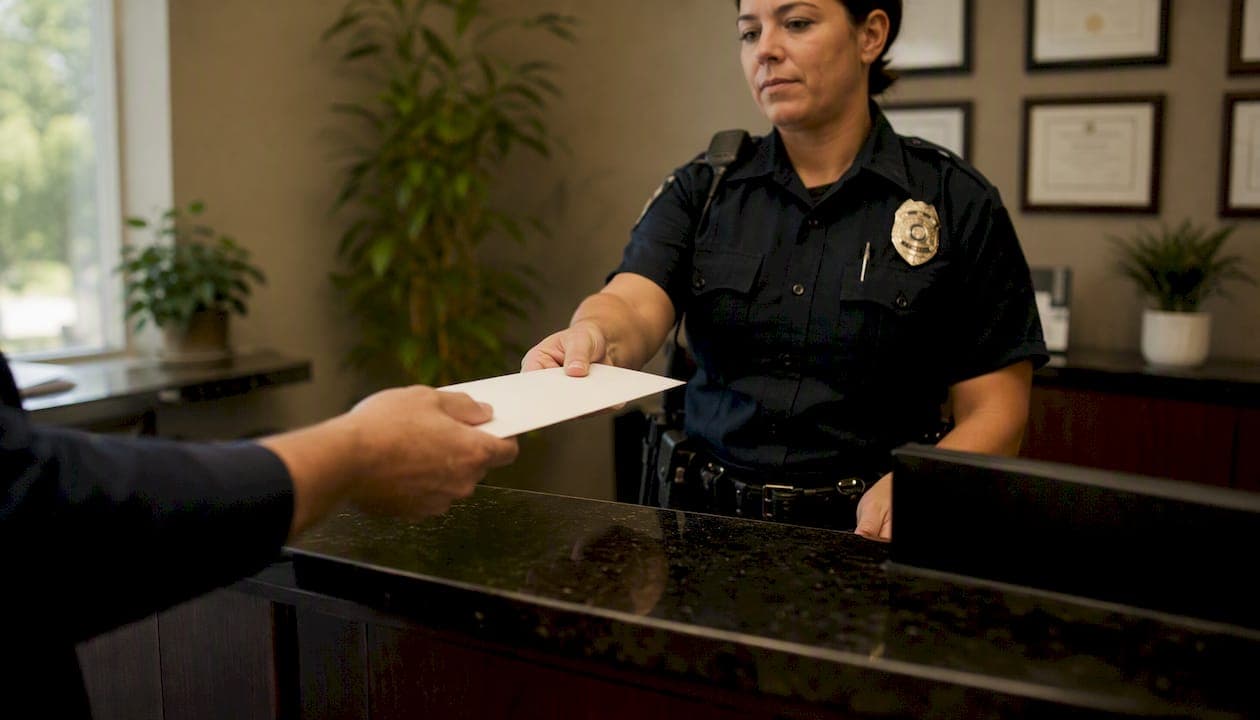
Most people get released between 4 and 12 hours after arrest, once booking is complete and bail is set. That's the realistic middle ground. The best-case scenario, a quiet weekday afternoon with a preset bail schedule, can move quickly. The worst case, such as an arrest late Friday night with a hold attached, can take several days before release.
The single biggest variable isn't the money. It's whether the jail has finished booking and whether a judge or magistrate has to personally set bail before anyone can pay it.
Typical release windows:
- Best case: 30 minutes to 2 hours
- Typical: 4 to 12 hours
- Possible: 24 to 72+ hours
Key Takeaways
Release timing depends less on the bail amount and more on booking speed, statutory magistrate deadlines, and local jail staffing at the moment bond is posted.
| Point | Details |
|---|---|
| Typical range | Most releases happen 4 to 12 hours after arrest, with 30 minutes to 2 hours possible in the best case. |
| Booking comes first | Fingerprints, medical screening, and charge entry must finish before any bond paperwork gets accepted. |
| State limits vary | Texas requires magistration within 48 hours; Colorado requires release within 6 hours of a granted bond, or 24 hours with monitoring. |
| Delays are often operational | Shift changes, property retrieval, and headcounts pause release temporarily without meaning it's denied. |
| Bail agents speed paperwork | Midnightbail's 24/7 licensed agents verify booking, prepare bond documents, and coordinate with jail staff to avoid predictable local slowdowns. |
This article is general information, not a substitute for advice from a qualified lawyer. Consult a qualified legal professional about your own circumstances before acting on anything here.
Table of Contents
- How Long Does Bail Take From Arrest to Release?
- What Has to Happen Before Someone Can Be Released?
- How Do State Bail Laws Change the Timeline?
- Why Is My Release Taking So Long?
- What Should Families Do to Speed Up Release?
- How Do Bail Bond Agents Actually Shorten the Wait?
- Need Bail Fast? Here's How Midnight Bail Bonds Helps
- Sources
- FAQ
How Long Does Bail Take From Arrest to Release?
Release moves through four distinct checkpoints, and each one has its own bottleneck. Understanding them tells you exactly where the clock is stuck.
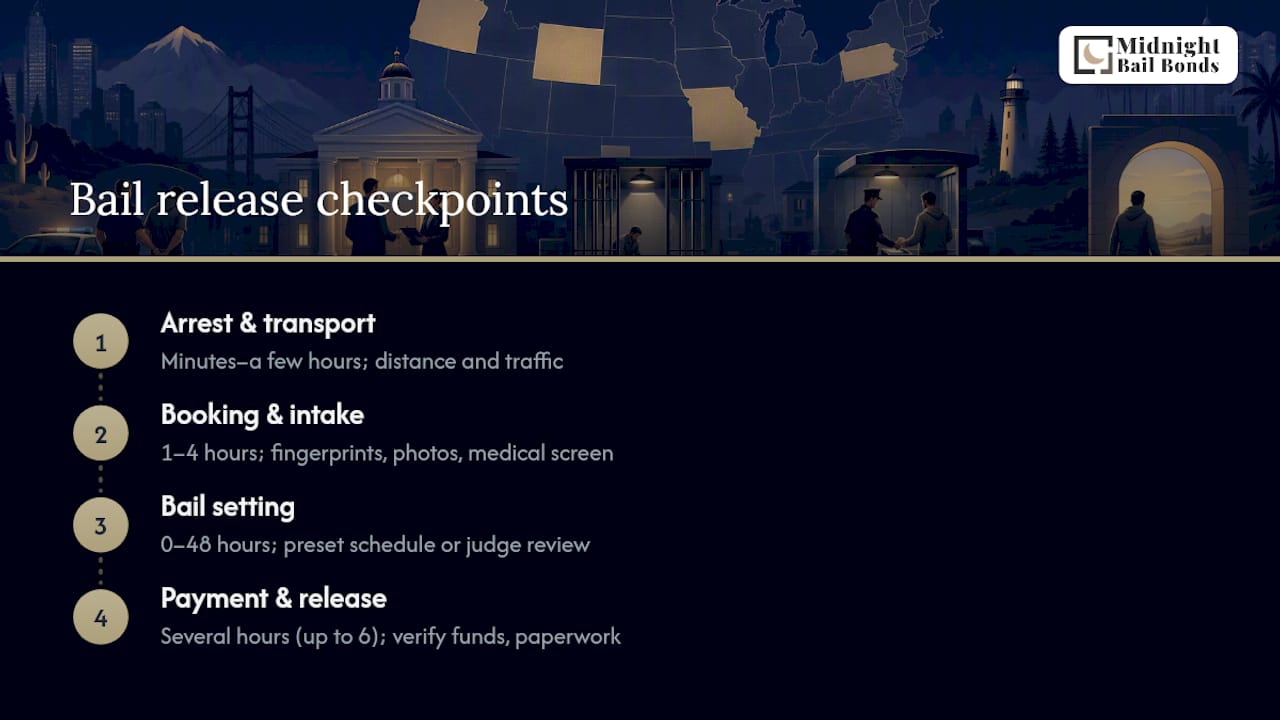
Arrest and transport can take from a brief period up to a couple of hours depending on distance and conditions. The person gets moved from the arrest scene to the booking facility. Distance and traffic matter here more than anything procedural.
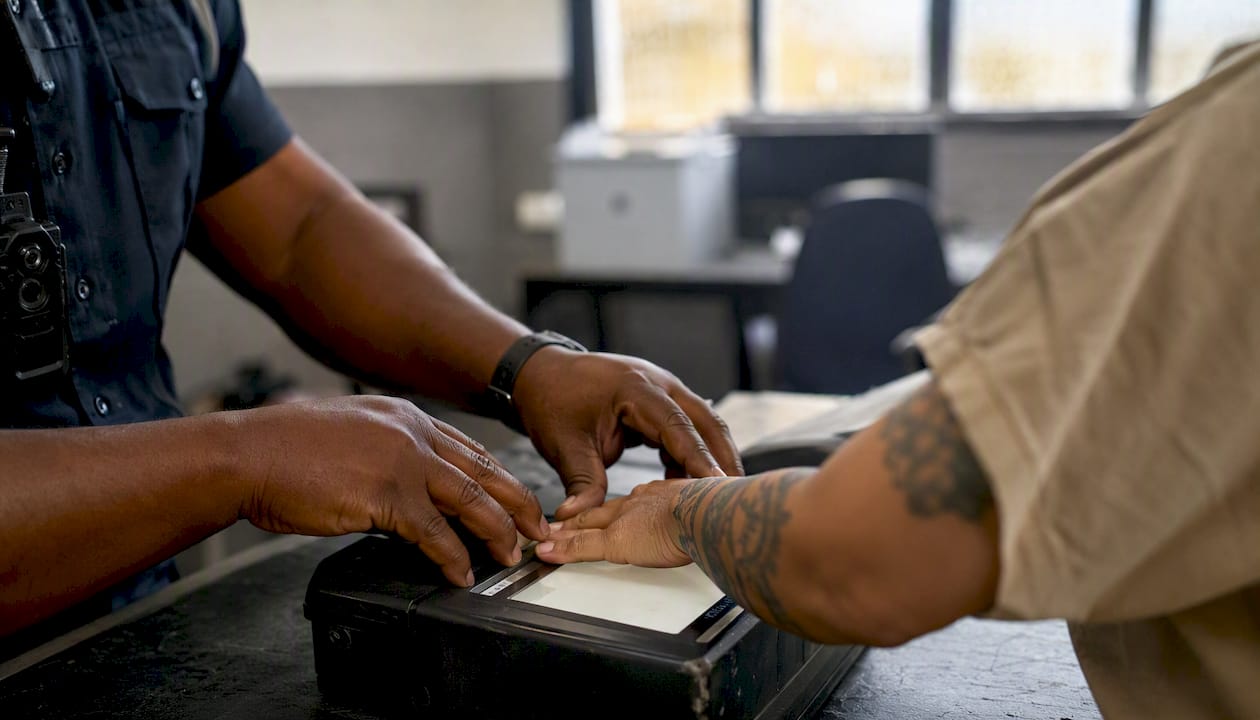
Booking and intake (1 to 4 hours). Fingerprints, photographs, a medical screening, and warrant checks all happen before anyone can even think about paying bail. This step is non-negotiable and it cannot be rushed by a bondsman, a lawyer, or a phone call.
Bail is set (0 to 48 hours). If the charge has a preset bail amount on a county schedule, this happens almost instantly. If a judge or magistrate has to personally review the case, the wait depends entirely on court hours, and Massachusetts guidance on bail-setting shows how much this step varies by jurisdiction.
Payment and release processing can take several hours depending on jail workload. Even after money changes hands, Snohomish County notes release can take up to six hours because staff still have to verify funds, check for other holds, and process paperwork.
Ask the jail these exact questions to locate the delay: "Has booking completed?" "Has bail been set or entered into the system?" "Has the bond been logged as accepted?"
Pro Tip: Call during a shift change (usually early morning or late evening) and expect a longer hold time on the phone, not because staff are ignoring you, but because they're mid-handoff on active cases. Try calling an hour after the shift starts instead.
What Has to Happen Before Someone Can Be Released?
Posting bail doesn't flip a switch. It starts a sequence, and skipping steps isn't possible no matter how fast you move.
- Booking and intake finish first. Fingerprints, a medical screen, and formal charge entry into the county system all have to be complete. No facility will accept bond paperwork before this step closes out.
- Bail gets set. Minor charges often run on a preset bail schedule that a booking officer can apply immediately. Serious charges usually require a magistrate or judge, which means waiting for the next available hearing slot.
- Someone posts the bail. A family member, friend, or the defendant can do this, provided they're not the one in custody. Accepted payment methods generally include cash, a surety bond through a licensed bail agent, and increasingly, credit or electronic payment.
- The jail verifies and processes payment. Staff confirm the funds, check for outstanding warrants or holds, and clear the paperwork.
- Property gets returned and release is finalized. Personal belongings, wallet, phone, and any confiscated items come back before the person actually walks out the door.
The gap between step 3 and step 5 is where most confusion happens. Families assume paying equals release, but jail staff still have internal checks to clear:
- Warrant checks across other counties and states
- Verification the payment cleared
- Confirmation no other agency has a hold
How Do State Bail Laws Change the Timeline?
State statutes set hard ceilings on how long someone can sit in jail before a judge sees them, and those ceilings differ enough to matter.
In Texas, the law requires a magistrate appearance within 48 hours of arrest. For certain warrantless arrests, Texas statutes cap release timelines directly: misdemeanors max out at 24 hours with a $5,000 bail cap, felonies at 48 hours with a $10,000 cap. Those numbers are ceilings, not guarantees. Plenty of people get through faster.
Colorado takes a different approach for people already granted release. Under Colorado Revised Statutes §16-4-102, anyone approved for personal recognizance or cash bond must be released as soon as practical and no later than six hours after arriving at the jail. If a judge orders electronic monitoring, that window can stretch to 24 hours just to get the device fitted properly.
California relies on statutes like Penal Code §1305 to govern bail conditions, but the state leaves a lot of implementation to individual counties. That's why two arrests for the same charge in the same state can play out on completely different timelines. A Los Angeles County felony case moves through a much larger, busier system than a similar arrest in a smaller county with fewer daily bookings.
This is exactly why a statewide answer only gets you halfway. County jail operations, staffing levels, and even which courthouse handles arraignments all shift the real number. Checking your specific county sheriff's page, not just the state statute, is the only way to get a number you can actually plan around.
Why Is My Release Taking So Long?
When bail is posted and hours pass with nothing happening, it's usually one of a handful of issues.
- An outstanding warrant from another case or county surfaced during the standard check
- A hold from immigration, probation, or parole that overrides the posted bail
- A medical issue requiring clearance before release
- An extradition flag if another jurisdiction wants the person held
- A shift change or headcount in progress, which pauses all releases temporarily
- Delays retrieving personal property from a separate storage area
Not every delay means release is being denied. A hold from another agency is a legal block that bail money can't touch. A shift change or headcount is purely operational and resolves on its own within an hour or two. The difference matters, and jail staff can usually tell you which one you're dealing with if you ask directly.
Ask staff specifically: "Is there a hold on this booking, and if so, from which agency?" That question alone usually separates a legal problem from a scheduling one.
What Should Families Do to Speed Up Release?
Getting organized before you make the first call saves real time. Jail staff and bail agents can move faster when you're not fumbling for basic information mid conversation.
- Get the booking number, facility name, and full legal name of the person in custody. Most county jails post this on their inmate lookup pages within an hour or two of booking.
- Confirm the charges and bail amount, if it's already been set. This tells you whether you're dealing with a preset schedule or a magistrate hearing.
- Have valid photo ID ready for whoever is posting bail, since jails and bail agents require this before accepting any payment.
- Decide your payment method in advance. Cash is fastest when accepted, a licensed bail bond agent is usually faster than waiting on a large cash sum, and electronic or credit payment options add flexibility for families under time pressure.
When you call, keep it direct: "I'm calling about [full name], booking number [X], at [facility]. Can you confirm if bail has been set and whether it's been posted yet?" That single question gets you further than a vague inquiry.
Pro Tip: Write down the name of whoever you speak with and the time you called. If you need to follow up an hour later, referencing that conversation gets you a faster answer the second time around.
How Do Bail Bond Agents Actually Shorten the Wait?
A licensed agent handles the paperwork burden that otherwise falls entirely on the family: verifying the booking, preparing bond documents, arranging payment or financing, and coordinating directly with jail records staff so nothing sits in a queue longer than it has to.
What agents cannot do is override a lawful hold or skip a required magistrate hearing. If a judge has to personally set bail, no amount of paperwork speed changes that legal requirement.
- Verifies booking status directly with the facility
- Prepares and files bond paperwork
- Arranges payment plans or financing when cash isn't available
- Works with jail records staff to avoid predictable local slowdowns
Pro Tip: An agent who already works regularly with a specific jail knows its shift patterns and paperwork quirks. That local familiarity often shaves real time off release, especially at facilities with a reputation for slow property returns.
A perspective from inside the bail business
Families almost always underestimate the booking step, not the bail amount. They assume paying fast means release fast, but a jail that hasn't finished intake won't accept payment no matter how quickly you show up. Knowing a facility's specific rhythm, when their shifts change, how their property room runs, cuts real hours off a wait that otherwise feels random.
Need Bail Fast? Here's How Midnight Bail Bonds Helps
Waiting on a preset schedule or a magistrate's calendar is out of anyone's hands, but the paperwork side of release doesn't have to add extra hours to an already stressful day. Midnightbail runs licensed agents around the clock across California, which means someone answers the phone at 3 a.m. exactly the same as at 3 p.m.
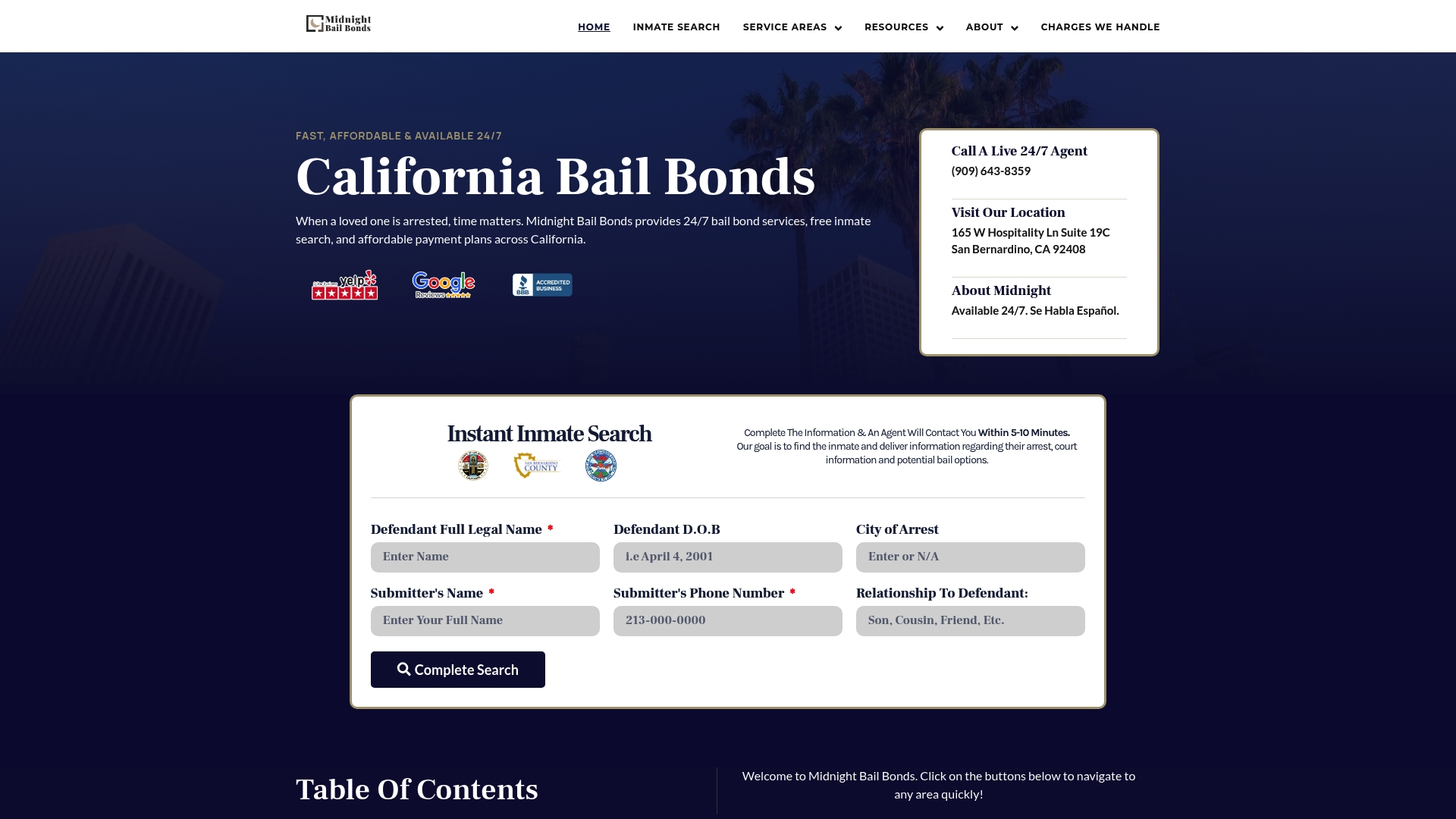
Families get flexible payment plans, bail options without collateral in many cases, and bilingual English and Spanish support so language never slows down an already urgent situation. A free instant inmate search helps you confirm booking status and charges before you even make the first call, which means you walk into the process with the exact information staff need instead of guessing. Whether the case involves a DUI, a domestic violence charge, or something else entirely, an agent familiar with the local jail can move the paperwork side of things as fast as the facility allows.
If someone you care about is in custody right now, contact Midnight Bail Bonds for 24/7 assistance and get the release process moving today.
Sources
- TIDC — Texas arrest/magistration and bail timing (Article 15.17 / Article 17.033)
- Justia — Colorado Revised Statutes §16-4-102
- Snohomish County — Posting bail (release timing guidance)
- Mass
- California Legislative Information — Penal Code §1305
FAQ
How long are people usually out on bail before trial?
Once released, a defendant typically remains free on bail for the entire pretrial period, which can range from a few weeks to well over a year depending on court scheduling and case complexity.
How long does it take to go from arrest to a bail hearing?
If a magistrate hearing is required, it usually happens within 24 to 48 hours of arrest, with Texas law setting a firm 48 hour outer limit.
How long do you stay in jail before you're eligible for bail?
Eligibility often starts as soon as booking finishes, sometimes within an hour or two for minor charges on a preset schedule, though serious charges may require waiting for a magistrate.
Can someone be bailed out immediately after arrest?
Not usually. Booking, including fingerprints and a medical screen, has to be completed first, which typically takes one to four hours before any bond payment can be accepted.
Why is release taking longer than expected after bail was posted?
The most common causes are outstanding holds from another agency, a shift change in progress, or delayed property retrieval, none of which the posted bail amount can resolve on its own.