

Most people arrested for burglary can get bail. Unless a judge orders detention for public safety reasons or a statutory bar applies, pretrial release is available. The fastest thing you can do is call a licensed bail agent, get the arrestee's booking number and jail location, and have a payment method ready.
Here's what to do in the first hour:
- Get the booking number and jail name. You need this before anything else. Without it, no bail agent can act.
- Call a licensed bail agent or criminal defense attorney immediately. Every hour in custody is an hour you can't get back.
- Prepare your ID and payment method (cash, credit/debit card, or Zelle).
- Write down the arrestee's full legal name and date of birth. Agents need this to pull booking data.
For urgent help right now, Midnightbail has licensed agents available 24/7 across California.
Table of Contents
- What does bail mean, and who sets it in the U.S.?
- What types of bail are used in burglary cases?
- How do courts set bail for burglary charges?
- What does burglary bail actually cost?
- What conditions come with bail, and what happens if you violate them?
- How do bail rules vary by state, and where do you find local information?
- Key Takeaways
- Why fast action in a burglary case changes the outcome
- Midnightbail is ready when you need bail posted tonight
- Useful sources and how to verify local rules
- FAQ
What does bail mean, and who sets it in the U.S.?
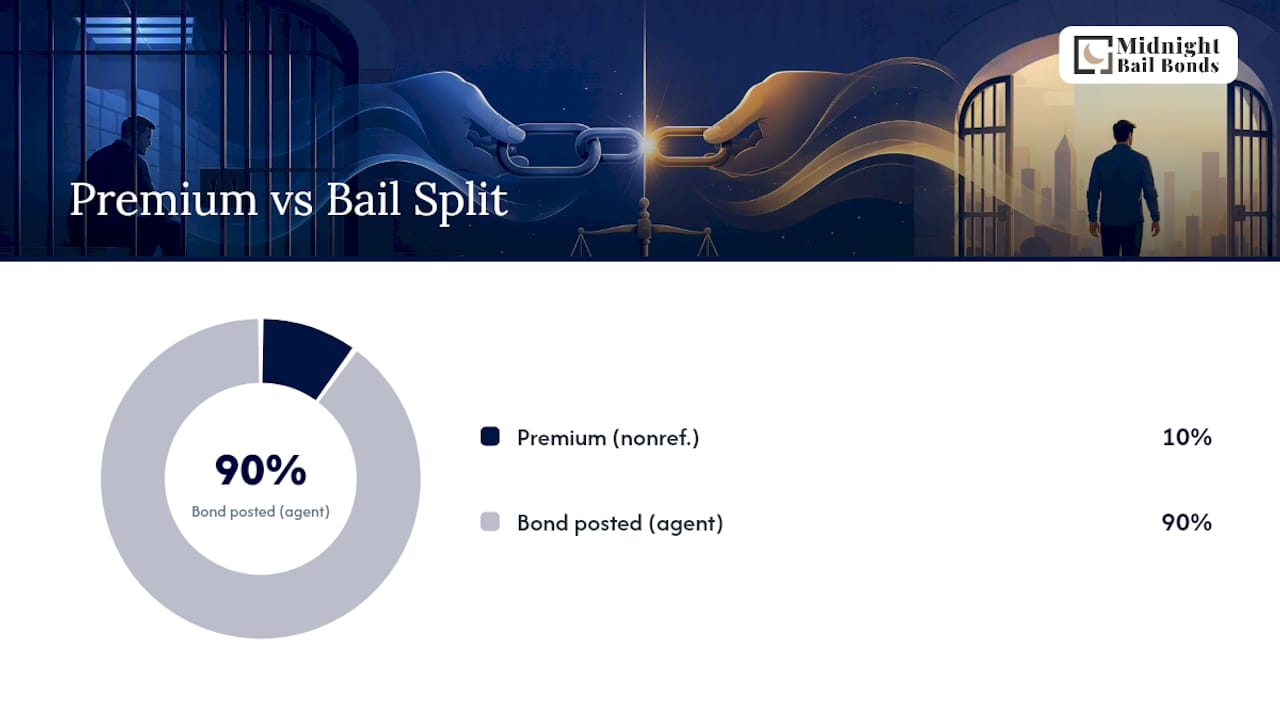
Bail is a financial guarantee that a defendant will appear at all required court dates. Pay it, show up to court, and you get the money back at the end of the case. Fail to appear, and the court keeps it. A bail bond is slightly different: a licensed bondsman pays the court on your behalf in exchange for a nonrefundable fee, commonly about one-tenth of the total bail amount.
Who actually sets the number depends on where you are and when. At booking, many counties use a preset bail schedule that lets a defendant post bail immediately without waiting for a judge. A magistrate or judge then confirms, modifies, or revokes that amount at the first appearance hearing, usually within 24–48 hours of arrest. The judge has wide discretion to go above or below the schedule amount, and they must state their reasons on the record when they do.
State rules vary significantly. Florida, for example, operates under Fla. Stat. §903.011, which mandates a uniform statewide bond schedule but also requires individualized judicial consideration for certain offense categories, including burglary. California counties each maintain their own bail schedules. A handful of states have moved toward eliminating cash bail for lower-level offenses, so the rules in your jurisdiction matter enormously.
In rare circumstances, bail is denied entirely. This happens when a judge finds the defendant poses an extreme flight risk or a serious danger to the community, or when a capital offense is charged.
What types of bail are used in burglary cases?
There are four main options. Each has a different cost structure, speed, and risk profile.
| Type | How it works | Cost | Refundable? | Speed |
|---|---|---|---|---|
| Cash bail | You pay the full bail amount directly to the court | full bail amount | Yes, after case ends | Moderate |
| Surety (bail bond) | A bondsman pays the court; you pay the bondsman a premium | ~10% of bail (nonrefundable) | No | Fast |
| Property bond | Real estate equity secures the bail amount | Court/recording fees | Yes, lien released after case | Slow |
| Release on recognizance (ROR) | No money required; defendant signs a promise to appear | — | N/A | Fastest |
Cash bail means paying the full amount to the court clerk. If bail is set at $50,000, you hand over $50,000. The court returns it when the case concludes, minus any fees, as long as the defendant appeared at every hearing. The catch is obvious: most families don't have $50,000 liquid.
Surety bonds are how most families actually get someone out. A licensed bail bondsman posts the full bail with the court, and you pay the bondsman a premium that is generally around one-tenth of the total bail. That fee is nonrefundable regardless of the case outcome. It's the cost of the service. For a $50,000 bail, that's $5,000 out of pocket. Many agents accept payment plans, credit cards, and Zelle, which makes this the most practical route for most families.
Property bonds use real estate equity as collateral. The court places a lien on the property. This takes time because title searches and court approval are required, sometimes days. It's rarely the fastest option in a burglary case.
ROR means the judge releases the defendant on their written promise to appear. No money changes hands. Judges grant ROR based on low flight risk, no prior record, strong community ties, and the nature of the charge. Residential burglary rarely qualifies for ROR, but commercial burglary with no prior record and strong local ties sometimes does.
Pro Tip: When time is the priority, a surety bond through a licensed agent is almost always the fastest route. Before you sign anything, confirm the agent holds a current state license, accepts your payment method, and can post the bond the same day.
How do courts set bail for burglary charges?
The degree of the charge is the single biggest driver of the bail amount. Residential burglary, especially when someone was home, draws far higher bail than commercial burglary of an unoccupied building. Judges weigh several factors simultaneously:
- Related charges: Burglary often comes with additional charges like assault, vandalism, or possession of burglary tools. Each adds to the total exposure. Understanding whether charges are misdemeanor vs. felony matters here because the degree directly affects which bail schedule applies.
Example bail amounts from California county schedules
California counties publish felony bail schedules that set presumptive amounts. Here are figures from publicly available 2025–2026 schedules:
| Offense | Santa Clara County (2025) | San Joaquin County (2025) | Yuba County (2026) |
|---|---|---|---|
| Burglary, first degree (residential) | $50,000 | Varies by enhancement | Listed in felony schedule |
| Burglary, second degree (commercial) | $20,000 | Listed in uniform schedule | Listed in felony schedule |
The Santa Clara County criminal bail schedule lists first-degree residential burglary at $50,000 and second-degree commercial burglary at $20,000. The San Joaquin County uniform bail schedule follows a similar structure, with magistrates retaining discretion to deviate when circumstances warrant. The Yuba County 2026 felony bail schedule specifies that when bail is set outside the schedule, a noticed hearing is required.
These figures are county-specific and subject to judicial adjustment. A judge can go higher for aggravated circumstances or lower for mitigating ones.
What to have ready before you call
- Full legal name and date of birth of the arrested person
- Booking number and name of the jail facility
- The bail amount (if already set)
- Your ID and payment method
- Contact number where the agent can reach you
Processing times range from a few hours to a full day. Delays happen when there are outstanding warrants from other jurisdictions, immigration holds, or when the jail is processing a high volume of releases. Legal Aid NYC's guidance on bail notes that families should confirm there are no additional holds before assuming release will be immediate.
What does burglary bail actually cost?
The math is straightforward. A bail bondsman charges a premium, typically 10% of the total bail amount. That fee is nonrefundable. It's not a deposit; it's the price of the service.
Example: Bail set at $50,000 for first-degree residential burglary. The bond premium is $5,000. You pay $5,000 to the bondsman, the bondsman posts $50,000 with the court, and the defendant is released. When the case ends, the bondsman gets their $50,000 back from the court. You do not get your $5,000 back.
Payment options vary by agent. Midnightbail accepts cash, credit/debit cards, Zelle, and financing, which means you don't need the full premium in hand to get started. Some agents also offer payment plans for larger premiums, spreading the cost over weeks or months.
Collateral may be required for high bail amounts. An agent might ask for a vehicle title, jewelry, or a deed of trust on real property to secure their exposure. In many cases, especially for lower bail amounts, collateral is not required.
A few things to know about costs:
- State-regulated premiums — In California, the bail bond premium rate is set by the state's Department of Insurance. Agents cannot legally charge less than the regulated rate.
If cash bail was posted and then forfeited because the defendant failed to appear, New York courts' bail remission guidance explains the process for petitioning to recover forfeited bail under certain circumstances. Similar remission procedures exist in other states, so don't assume forfeited cash is permanently gone without checking.
What conditions come with bail, and what happens if you violate them?
Release on bail is not unconditional. The judge attaches conditions at the bail hearing, and violating any of them can land the defendant back in custody faster than the original arrest.
Common conditions for burglary cases include mandatory appearance at all court dates, travel restrictions (often limited to the county or state), no-contact orders with alleged victims or witnesses, electronic monitoring or GPS ankle bracelet, drug and alcohol testing, and regular check-ins with a pretrial services officer.
The consequences of violating bail conditions escalate quickly. Miss a court date and the judge issues a bench warrant immediately. The bondsman is notified and typically has a window (varies by state, often 180 days in California) to surrender the defendant before the full bail is forfeited to the court. If the defendant is found in another state, extradition is possible.
The sequence looks like this: missed court date → bench warrant issued → bond forfeiture notice sent to bondsman → bondsman locates and surrenders defendant or pays the full bail → defendant faces additional charges for failure to appear on top of the original burglary charge.
The best move if you've missed a court date is to contact your attorney and surrender voluntarily before law enforcement finds you. Voluntary surrender is treated more favorably than a fugitive arrest and gives your attorney a chance to explain the circumstances to the judge.
How do bail rules vary by state, and where do you find local information?
No two states handle bail exactly the same way. California uses county-level bail schedules, meaning each county's superior court publishes its own felony and misdemeanor bail schedule. Florida uses a statewide uniform bond schedule under Fla. Stat. §903.011, but requires individualized judicial consideration for burglary and other serious offenses. New York has moved significantly away from cash bail for many offenses, though felony burglary still qualifies for bail in most cases. Texas uses magistrate-set bail with broad judicial discretion and no statewide schedule.
To find the rules in your jurisdiction:
- County bail schedules: — Search "[county name] superior court felony bail schedule" or check the court's official website under criminal forms or local rules.
- Bail agent licensing: — Verify a bail agent's license through your state's Department of Insurance website. In California, this is the California Department of Insurance license lookup.
The New York City Department of Correction's bail posting page is a good example of how official city and county resources explain accepted payment methods and procedures. Most major jurisdictions have similar pages.
Key Takeaways
The burglary bail process moves fast when you know the steps: confirm the booking number, call a licensed bail agent, pay the bond premium, and wait for processing.
| Point | Details |
|---|---|
| Bail is usually available | Most burglary defendants qualify for bail unless a judge orders detention for flight risk or public safety. |
| Bond premium is approximately a tenth | A bail bondsman charges roughly a tenth of the total bail amount as a nonrefundable fee. |
| Degree of charge drives the amount | First-degree residential burglary carries higher bail than second-degree commercial burglary; for example, Santa Clara County's schedule sets higher amounts for first-degree than second-degree burglary. |
| Act within the first 24 hours | Getting the booking number and calling a licensed agent immediately reduces time in custody. |
| Midnightbail is available 24/7 | Licensed agents across California can post bail the same day, with flexible payment options and bilingual support. |
Why fast action in a burglary case changes the outcome
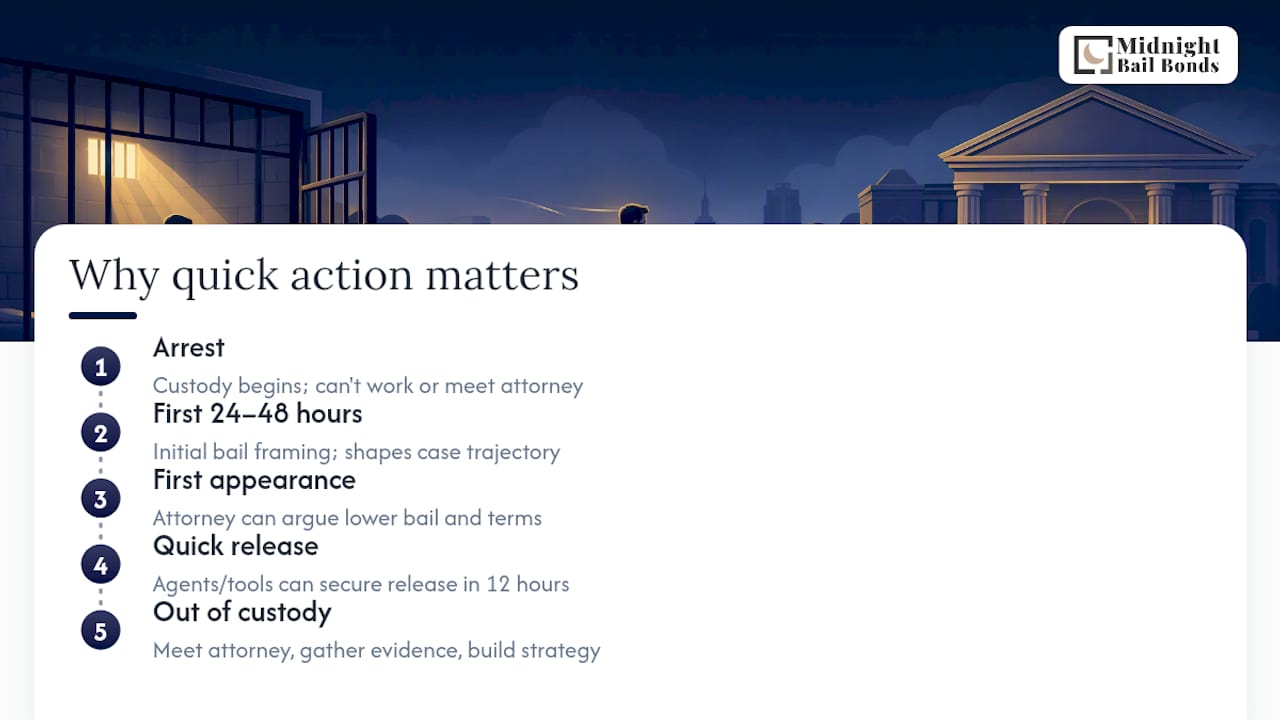
The conventional wisdom is that bail is just about getting out of jail. That framing undersells what's actually at stake. Every extra day a defendant spends in custody before trial is a day they can't work, can't meet with their attorney, and can't gather evidence in their own defense. Defendants who remain in custody through arraignment are statistically more likely to accept plea deals, not because they're guilty, but because the pressure of sitting in a cell while their life falls apart is enormous.
Burglary cases are particularly complicated because they often come with related charges, complaining witnesses, and sometimes co-defendants. That complexity means the defense needs time to build a strategy, and that strategy starts the moment the defendant is out of custody and able to communicate freely with their attorney. A defendant who's been in jail for two weeks before their first real attorney meeting is already behind.
The other thing people underestimate is how much the first 24–48 hours shape the entire case. Bail conditions set at the first appearance can be modified later, but the initial framing matters. An attorney who argues effectively at the first appearance can lock in a lower bail amount and more favorable conditions before the prosecutor has fully organized their case.
The 24/7 availability of licensed agents and instant inmate search tools aren't just conveniences. They're the difference between a defendant who's home in 12 hours and one who's still in a holding cell three days later because their family didn't know where to start.
Midnightbail is ready when you need bail posted tonight
When bail is set and every hour counts, you need an agent who can act immediately, not one you'll reach Monday morning. Midnightbail's licensed agents are available around the clock across California, with flexible payment options including cash, credit/debit cards, Zelle, and financing so you're not stuck waiting to gather the full premium upfront.
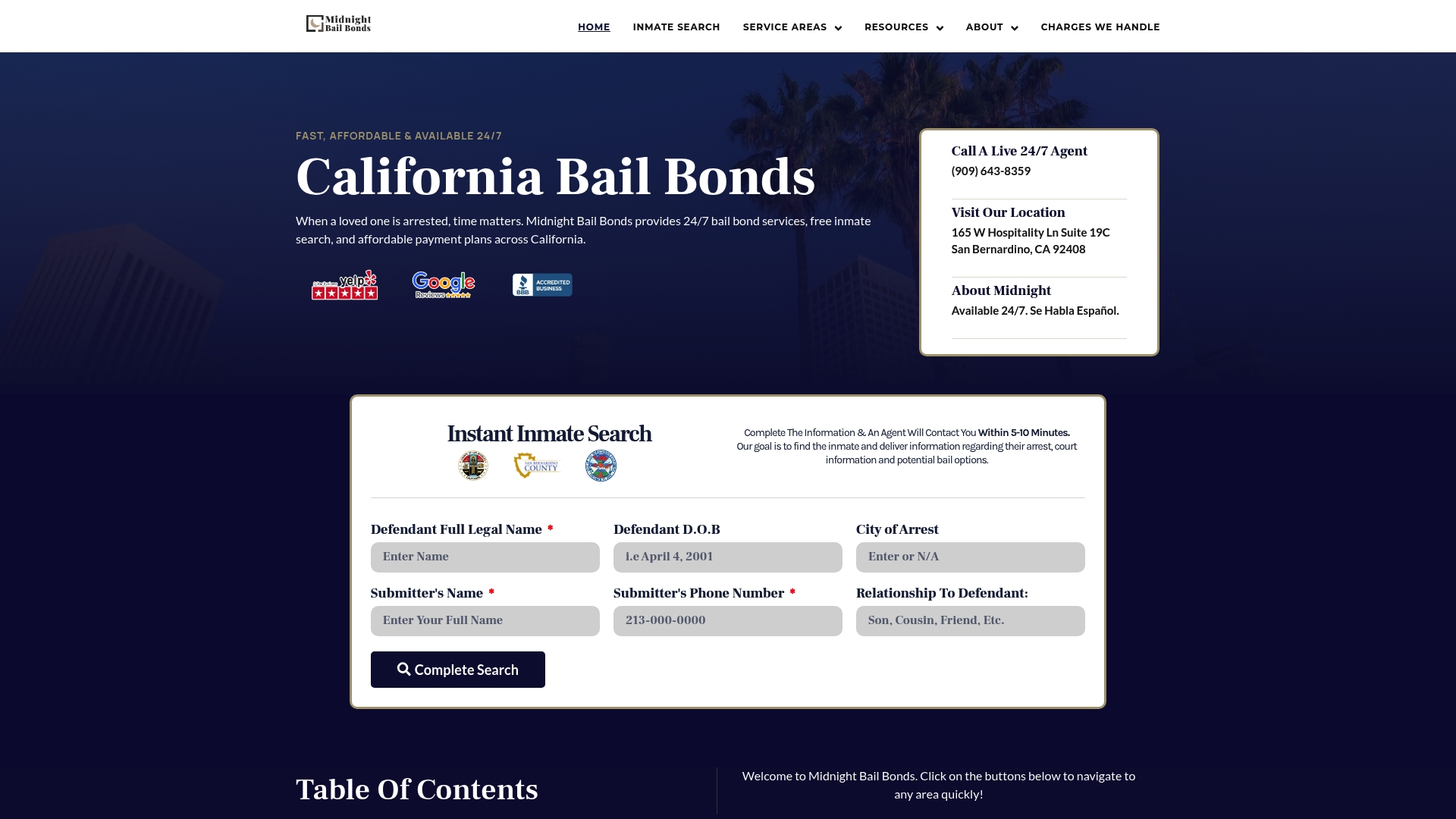
Agents handle the paperwork, contact the jail directly, and post the bond the same day in most cases. Bilingual English/Spanish support means nothing gets lost in translation during a stressful call. The free instant inmate search on the site lets you pull booking numbers and jail locations before you even pick up the phone.
For immediate help, call or visit Midnightbail now. Have the defendant's full name, date of birth, and jail name ready, and an agent will walk you through the rest.
Useful sources and how to verify local rules
Official resources vary by state and county, but the following types of sources give you accurate, current information:
- What is bail, and how does it work in the U.S. court system? — University of Washington School of Law
- Superior Court of California, County of Santa Clara — Criminal bail schedule 2025
- 2025 Uniform County Bail Schedule (revised 10-28-25) — San Joaquin County Courts
- Yuba County Courts — 2026 order: felony bail schedule
- NY Courts — Bail remission guidance
- New York City Department of Correction — Post bail
- What you need to know about bail — Legal Aid NYC
- Florida Statutes — Pretrial release; statewide uniform bond schedule (Fla. Stat. §903.011)
This article provides general information about the bail process in the United States. It is not legal advice. Bail rules, amounts, and procedures vary by state and county. Confirm current rules with your local court, a licensed bail agent, or a qualified criminal defense attorney.
FAQ
Does bail get you out of jail permanently?
No. Bail secures your release until the case is resolved, not permanently. You must appear at every required court date, or the bail is forfeited and a warrant is issued for your arrest.
How much is bail for a burglary charge?
Bail amounts vary widely by state, county, and degree of the offense. Santa Clara County's 2025 bail schedule sets first-degree residential burglary at $50,000 and second-degree commercial burglary at $20,000, though judges can increase or lower these figures based on case circumstances.
What is the minimum punishment for burglary?
Penalties vary by state and degree of the charge. First-degree residential burglary is typically a felony with potential prison time; second-degree commercial burglary may be charged as a felony or misdemeanor depending on the jurisdiction and circumstances.
Can burglary charges be dropped by the victim?
A victim can request that charges be dropped, but the decision belongs to the prosecutor, not the victim. Prosecutors can and do proceed with charges even when a victim asks them not to.
What happens if you miss a court date while out on bail?
The judge issues a bench warrant immediately, and the bail bond is subject to forfeiture. Contact your attorney and surrender voluntarily as quickly as possible to limit the additional legal consequences.