

City jails are run by local police departments and hold people for hours to a few days while they're booked and processed. County jails, run by the sheriff, hold people much longer, often for months while a case moves through court, or for time periods generally associated with misdemeanor sentences. If someone you love got arrested and isn't at the city facility anymore, they've probably been transferred to county custody, and bail posting works differently there.
TL;DR:
- Most transfers from city to county jail happen if the person remains detained beyond 24 to 48 hours, which slows down release processing.
- County jails handle larger volumes and hold inmates for longer periods, resulting in longer paperwork and administrative delays versus city jails.
- Contact the arresting agency first within city limits; if the person isn't listed after a day or two, check the county inmate search for updated custody information.
- Having key details like full name, date of birth, arresting agency, booking number, and bail amount ready can significantly speed up the bail process.
- Bail agents can often start paperwork immediately over the phone, reducing hours of delay caused by transfer and booking volume in county facilities.
Table of Contents
- What Is a City Jail? Who Runs It and What to Expect
- What Is a County Jail? Administration, Capacity, and Pretrial Role
- City Jail vs. County Jail: Key Differences at a Glance
- The Booking, Transfer, and Release Timeline Explained
- What This Means for Families: Where to Look and Who to Call
- A Bail Agent's Perspective on Why Timing Confuses Families
- Get Bail Help Right Now From Midnight Bail Bonds
- Where to Verify This Information
- Sources
- FAQ
What Is a City Jail? Who Runs It and What to Expect
A city jail is a municipal police department's short-term lockup, not a long-term facility. Officers use it to process an arrest, not to house someone indefinitely, and that difference shapes almost everything about how fast things move.
Once someone is brought in, the booking process usually follows the same pattern everywhere:
- Fingerprinting and mugshots
- Recording of personal information and charges
- A records check for warrants or prior history
- Notification of the bail amount, if one is set
Most people don't stay long. A Scottsdale, Arizona legal explainer describes city facilities as short-term holding spots where people are typically released, cited out, or moved to county custody within a day or two. Smaller booking volume at a city lockup tends to mean faster paperwork, which is why posting bail at that stage often gets someone out quicker than waiting for a county transfer.
What Is a County Jail? Administration, Capacity, and Pretrial Role
County jails answer to the county sheriff, not the local police chief, and they carry a heavier operational load. These facilities function as the main holding site for anyone the county intends to keep for more than a night or two.
A few things set them apart:
- They hold pretrial detainees whose cases are still working through court.
- They house people serving short sentences, generally capped around one year, which lines up with the Bureau of Justice Statistics definition separating jails from prisons.
- Some systems are single small buildings; others, like the ones described in the Vera Institute's overview of jail operations, function as sprawling networks holding thousands of people at once.
- That scale brings administrative layers, classification units, medical screening, and court coordination that a city lockup simply doesn't need.
Because county jails process far more people and manage longer stays, release paperwork tends to take longer to clear, especially during busy booking hours.
City Jail vs. County Jail: Key Differences at a Glance
Here's the short version of what separates the two, side by side.
| Feature | City Jail | County Jail |
|---|---|---|
| Run by | City police department | County sheriff |
| Typical stay | Hours to a couple of days | Weeks to months, including short sentences |
| Purpose | Initial processing | Pretrial detention, short sentences |
| Scale | Small, single-site lockup | Often large, multi-unit network |
| Bail process | Usually fast, low volume | Can take hours longer due to volume |
The LASD's own custody division reporting is a good real-world example of just how much administrative machinery a large county system runs compared to a single municipal lockup.
Pro Tip: If you're not sure where someone is being held, start with the city police department that made the arrest. If enough time has passed, roughly 24 to 48 hours in most jurisdictions, check the county sheriff's inmate search next.
The Booking, Transfer, and Release Timeline Explained
Here's roughly how the process unfolds when someone gets arrested and doesn't post bail right away:
- Arrest and initial city booking. Police process the arrest, take fingerprints and photos, and log the charges.
- A decision gets made. The person is either cited out, released on bail at the city level, or held for transfer.
- Transfer to county custody. If the case is serious enough or bail isn't posted quickly, the person moves to the county jail, where the sheriff's department takes over. In practice, this is a common outcome any time someone stays detained past the initial city booking window.
- County booking repeats the process. New records, a new booking number, sometimes a new bail assessment tied to arraignment.
- Court and bail processing. Bond paperwork gets filed, and release timing depends on how backed up that particular jail's booking desk is that day.
County transfers add real time to the process, mostly because of higher volume and more paperwork, not because anyone is being deliberately slow. Our guide on how long bail actually takes breaks down realistic windows by jurisdiction, and our piece on when inmates typically get released covers the booking bottlenecks that cause delays.
What This Means for Families: Where to Look and Who to Call
Knowing which facility someone is in changes your entire next step. Call the arresting agency first; if the arrest happened within city limits, that's usually the city police department, not the sheriff.
If time has passed and the person isn't showing up in the city system, check the county inmate search tool for that jurisdiction. Our own instant inmate search tool pulls booking status so you're not stuck guessing which building someone is sitting in. For a step-by-step walkthrough, our California inmate search guide covers what to enter and how to read the results.
Before you call anyone, whether it's a bail agent or the jail itself, have this ready:
- Full legal name and date of birth
- The arresting agency's name
- Booking number, if you have it
- The charge and bail amount, if listed
A bail agent can move faster with accurate details up front instead of guessing which county or city has the person in custody.
A Bail Agent's Perspective on Why Timing Confuses Families
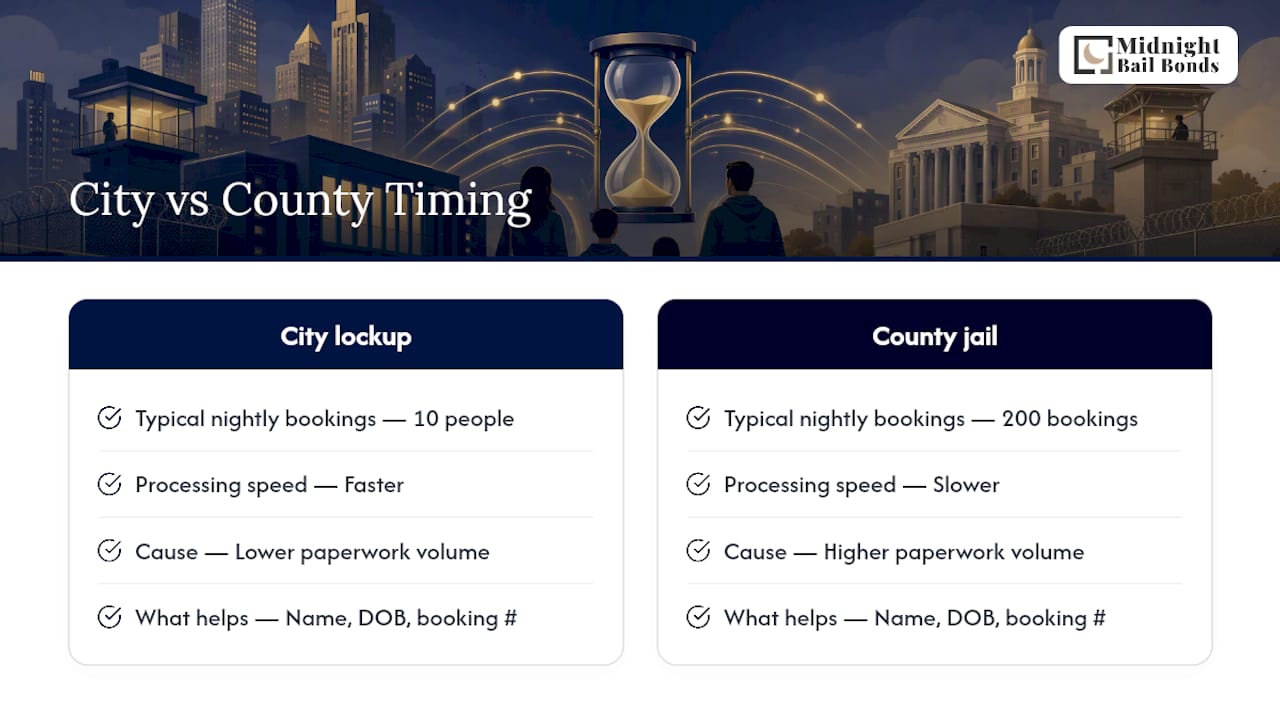
Most of the confusion families feel isn't about the law. It's about paperwork volume. A city lockup with ten people moves faster than a county jail processing two hundred bookings overnight, and that gap in speed has nothing to do with the charge or the person.
Having the right details ready, name, birth date, booking number, cuts real time off the process. Stay calm, make the calls in order, and the timeline usually sorts itself out faster than it feels in the moment.
— Jake
Get Bail Help Right Now From Midnight Bail Bonds
Waiting on a county transfer or a slow booking desk costs real hours a family doesn't have to lose. Licensed bail agents are often available day and night, enabling paperwork to start the moment you call instead of waiting for business hours.
Midnightbail handles bail for DUI, drug charges, domestic violence, theft, and failure to appear cases, and offers no-collateral bail bond options for families who qualify, along with flexible payment plans and bilingual support in English and Spanish. When you call, have the person's full name, date of birth, and the arresting agency ready. That information lets an agent start the paperwork immediately instead of tracking down details first, which is often what separates a same-day release from an overnight wait. Visit Midnight Bail Bonds to start the process now or check current booking status before you call.
Where to Verify This Information
For deeper reading beyond what's covered here:
- The Bureau of Justice Statistics draws the official line between jails and prisons, including sentence-length thresholds.
- The Vera Institute explains how jail systems vary in scale and why that affects operations.
- County sheriff transparency reports, like LASD's custody division data, show real local booking numbers and processing detail.
Sources
- Correctional Institutions | Bureau of Justice Statistics
- What is jail? | Vera Institute
- LASD transparency custody division report (example of municipal vs county administration)
- The Difference Between City Jails, County Jails and Prison. | Scottsdale DUI Lawyer
FAQ
How long can you be held in a county jail?
County jails typically hold people awaiting trial for as long as their case takes, and those serving sentences generally stay up to about one year, per the Bureau of Justice Statistics definition separating jails from prisons.
Why do people go to county jail?
People end up in county jail because they're awaiting trial, denied release, or serving a short sentence, usually after being transferred from a city lockup once it's clear they won't be released quickly.
What's the difference between a city jail and a county jail?
A city jail is run by local police for short-term booking and processing, usually hours to a couple of days, while a county jail is run by the sheriff and holds people for longer pretrial stays or misdemeanor sentences.
What do inmates do all day in county jail?
Daily routines vary by facility, but they generally include scheduled meals, limited recreation time, court appearances or attorney visits, and access to commissary or phone calls, details that differ county by county.
Which is better, city or county jail?
Neither is "better," since they serve different functions. A city jail means a shorter process for minor issues, while a county jail signals a longer stay tied to a pending case or sentence, which usually calls for contacting a bail agent sooner rather than later.