
A domestic-violence no-contact order imposed as a bail condition is a binding court condition that controls whether someone can be released from jail and how they may communicate while the case is pending. It's not a suggestion, and it's not something a bondsman, a family member, or the alleged victim can waive on their own. Once a judge issues it, or it gets written into the bond paperwork at booking, it's enforceable immediately, and it typically stays in effect until the case is resolved or a judge formally changes it.
This distinction trips up a lot of families in the first 24 hours after an arrest. Posting bail gets someone physically out of a cell. It does nothing to loosen the conditions attached to that release. Criminal courts issue these orders under state bail statutes and pretrial release rules, and most jurisdictions train judges using bench-book guidance built specifically around domestic and family violence cases.
Here's what matters most in the first hours after release:
- The order is active the moment it's pronounced in court or signed at booking, not after some grace period.
- Verbal permission from the protected person to make contact does not cancel the order.
- Only a judge can modify or lift the condition, and that takes a formal motion.
Quick fact: In many states, jail staff require the accused to sign an acknowledgment of the no-contact terms before they'll process release, which means the paperwork you sign at the jail window is often your first legal notice of exactly what's prohibited.
Key Takeaways
A no-contact order tied to bail is fully enforceable the moment it's issued and stays active until a judge changes it, regardless of what anyone privately agrees to.
| Point | Details |
|---|---|
| Order controls, not bail | Posting bond gets someone released but never changes or removes the no-contact condition. |
| Indirect contact counts | Third-party messages, social media comments, and tags can trigger a violation just like direct contact. |
| Read the paperwork first | Get the written bail order at release and hand a copy to your attorney immediately. |
| Modification requires a motion | Only a formal court motion, not a private agreement, can narrow or lift the condition. |
| Midnightbail handles release, not conditions | Midnightbail posts bonds 24/7 with flexible payment options but cannot alter court-ordered no-contact terms. |
Table of Contents
- What a Domestic Violence No-Contact Order Actually Prohibits
- How a No-Contact Order Shapes Bail and Release Decisions
- What to Do the Moment You're Released
- How to Ask the Court to Change a No-Contact Condition
- What Happens If You Violate a No-Contact Order
- Why Rules Vary by Jurisdiction and When to Call a Local Lawyer
- What I've Seen Coordinating Releases Under No-Contact Conditions
- How Midnightbail Gets Families Through Release Fast
- Sources
- FAQ
What a Domestic Violence No-Contact Order Actually Prohibits
Most people assume "no contact" just means don't call or show up at the house. The scope is usually much wider than that, and misunderstanding it is how well-meaning defendants end up back in custody.
Direct contact covers the obvious stuff: phone calls, texts, emails, video chats, and in-person visits. But indirect contact catches just as many people off guard. Asking a mutual friend to "check in" on the protected person, commenting on their social media post, or having a relative deliver a message all count as violations in most jurisdictions, even if you never speak to them directly.
Standard bail conditions in domestic violence cases typically prohibit both direct and indirect communication, including electronic contact, with stay-away distances commonly set around 500 feet from the protected person's home, vehicle, or workplace. That 500-foot figure shows up often enough in state statutes that it's worth treating as a rough default, though the actual number in your case depends entirely on what the judge wrote into your order.
Here's what typically falls under the no-contact umbrella:
- Direct communication: calls, texts, emails, in-person contact, video calls.
- Indirect communication: third-party messages, social media comments, tags, or posts referencing the protected person.
- Geographic restrictions: staying away from the protected person's home, workplace, school, or vehicle.
- Incidental overlap: showing up somewhere you know the protected person will be, even without direct interaction.
Pro Tip: If you receive a text, call, or social media message from the protected person, do not respond. Take a screenshot, note the date and time, and send it straight to your attorney. Responding, even to say "I can't talk to you," is itself a violation in most jurisdictions.
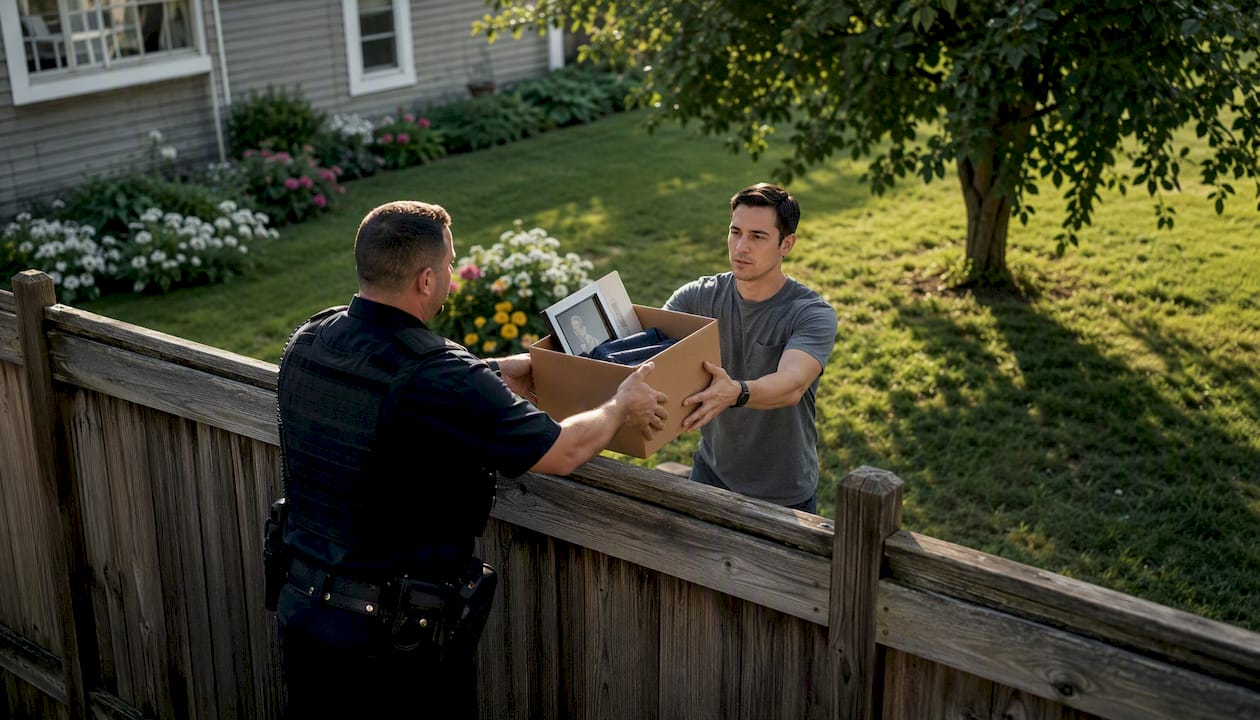
Property retrieval and child access are the two situations most likely to cause an accidental violation. If you need clothes, a car, or your kid's school supplies from a shared address, don't go get them yourself. Ask your attorney about a police-escorted pickup or a court-approved procedure instead.
How a No-Contact Order Shapes Bail and Release Decisions
Judges weigh a handful of factors when setting bail in a domestic violence case: the alleged victim's safety, whether children are involved, the defendant's criminal history, and the perceived risk of reoffending. A no-contact condition is close to automatic in these cases, largely because safety of the complainant and any children drives the release decision more than almost any other factor.
Posting bail through a bondsman doesn't touch these conditions at all. The bond covers the financial guarantee that you'll show up to court. The no-contact term, along with anything else the judge attaches, lives in a separate written order that controls your behavior regardless of how you paid to get out.
Judges often stack additional conditions on top of the no-contact term, especially in cases involving prior incidents or weapons. GPS monitoring, weapons surrender, alcohol or drug abstinence, and supervised release check-ins are all common, and courts favor electronic monitoring with defined exclusion zones when the risk assessment points to a higher-than-average danger level.
Three release outcomes tend to play out differently in practice:
- Release on recognizance: No cash bond required, but the no-contact term is still fully enforceable and often paired with check-in requirements.
- Secured bond: A bondsman posts the bond, the person is released, and the no-contact condition remains untouched.
- Detention pending hearing: Bail is denied or set unusually high, typically when the judge sees a pattern of prior violations or an escalating risk profile.
| Condition | What it restricts | Typical enforcement |
|---|---|---|
| No-contact order | Calls, texts, in-person, third-party, and social media contact | Arrest and bail revocation on violation |
| Stay-away distance | Physical proximity to home, work, or vehicle (often 500 feet) | New charge for violating release conditions |
| GPS monitoring | Movement into excluded zones | Immediate alert to law enforcement, possible detention |
| Weapons surrender | Possession or purchase of firearms | Separate criminal charge, bail revocation |
| Supervised release | Missed check-ins with pretrial services | Bench warrant, bail hearing |
What to Do the Moment You're Released
The single most important step comes before anything else: get a physical or digital copy of the written bail order and read every line. Don't rely on what an officer told you verbally at the jail, and don't rely on what the alleged victim says the order allows.
- Obtain the written bail order from jail staff or the court clerk before leaving the facility.
- Make at least two copies, one for yourself and one to hand your attorney immediately.
- Avoid all contact, direct or indirect, starting the second you're released, not after your first court date.
- Preserve any incoming messages from the protected person and forward them to your lawyer unanswered.
- Route any property retrieval or child-access need through police escort or a court-approved procedure, never on your own.
Family members arranging bail have their own checklist. Coordinate directly with your bail bond agent about paperwork and timing rather than assuming the process is identical to a standard bail case. If you need a police escort to retrieve belongings, call the non-emergency line and ask specifically for a "civil standby" or escorted property retrieval, terms most departments recognize immediately.
A 24/7 bail bond service can move fast on posting a bond and walking a family through the paperwork at the jail, but it has no authority to loosen or interpret court conditions. That distinction matters when a bondsman explains what happens next: they can tell you how the process works, not what the judge will allow.
How to Ask the Court to Change a No-Contact Condition
Modifying a no-contact order requires a formal motion filed with the court, typically by your defense attorney, not an informal request or a note passed to the prosecutor.
- Your attorney files a written motion requesting a specific, narrow change to the condition.
- You attach supporting evidence: proof of a shared lease, a custody arrangement, or a documented emergency.
- The prosecutor reviews the request and may object, especially if the alleged victim's advocate raises safety concerns.
- The judge schedules a hearing, which can take anywhere from days to several weeks depending on court backlog.
- The judge grants, narrows, or denies the request, often issuing a carve-out rather than lifting the order entirely.
Judges tend to grant narrow exceptions more readily than blanket lifts. Supervised child exchanges through a third party, a one-time escorted property pickup, or a documented medical emergency contact all have a track record of approval. Full removal of the order is rare while a case is active, particularly if the charge carries a history of prior incidents.
Private agreements between the defendant and the protected person carry zero legal weight here. Even if the alleged victim tells the court in writing that they want contact restored, only a judge can change a pretrial condition, and prosecutors often push back precisely because they've seen informal reconciliation attempts backfire.
What Happens If You Violate a No-Contact Order
Breaching a no-contact order almost always triggers immediate consequences: a new arrest, revocation of the existing bail, detention pending a new hearing, and often a fresh criminal charge layered on top of the original case. Bail that was already set gets revisited, and judges rarely go easier the second time around.
Prosecutors treat violations seriously because they signal, in the court's eyes, an ongoing risk to the protected person. A single documented violation can be enough for a judge to deny bail entirely on the reopened case, even if the original charge was relatively minor.
If you're accused of violating the order, the response matters as much as the alleged violation itself:
- Do not flee or ignore a summons connected to the alleged violation.
- Contact your attorney immediately, before speaking to police or the alleged victim about what happened.
- Preserve any messages, call logs, or witnesses that show you didn't initiate contact.
- Document the sequence of events in writing while your memory is fresh.
Pro Tip: Screenshot everything, including timestamps, and email the images to yourself or your attorney right away. Phones get lost or reset, but an email thread creates a dated record your defense can point to at a hearing.
Why Rules Vary by Jurisdiction and When to Call a Local Lawyer
No two states handle domestic violence bail identically. Some treat these charges as "show cause" offenses, which flips the presumption toward detention rather than release. Others lean more heavily on electronic monitoring instead of cash bond. Bench-book practices, statutory language, and how aggressively local prosecutors pursue revocations all shift the practical experience of the same basic no-contact condition from one county to the next.
Get local counsel involved quickly if any of these apply to your situation:
- A civil protective order already exists alongside the new criminal no-contact condition.
- You share custody of children with the protected person and need an access plan.
- Your charge is classified as a show-cause offense in your state.
- You're unsure whether electronic monitoring or a stay-away zone applies to your work address.
Bring the written bail order, any prior protective orders, and custody paperwork to your first consultation. A lawyer familiar with your specific courthouse will know how that judge typically handles modification requests, which is information no general guide can give you.
What I've Seen Coordinating Releases Under No-Contact Conditions
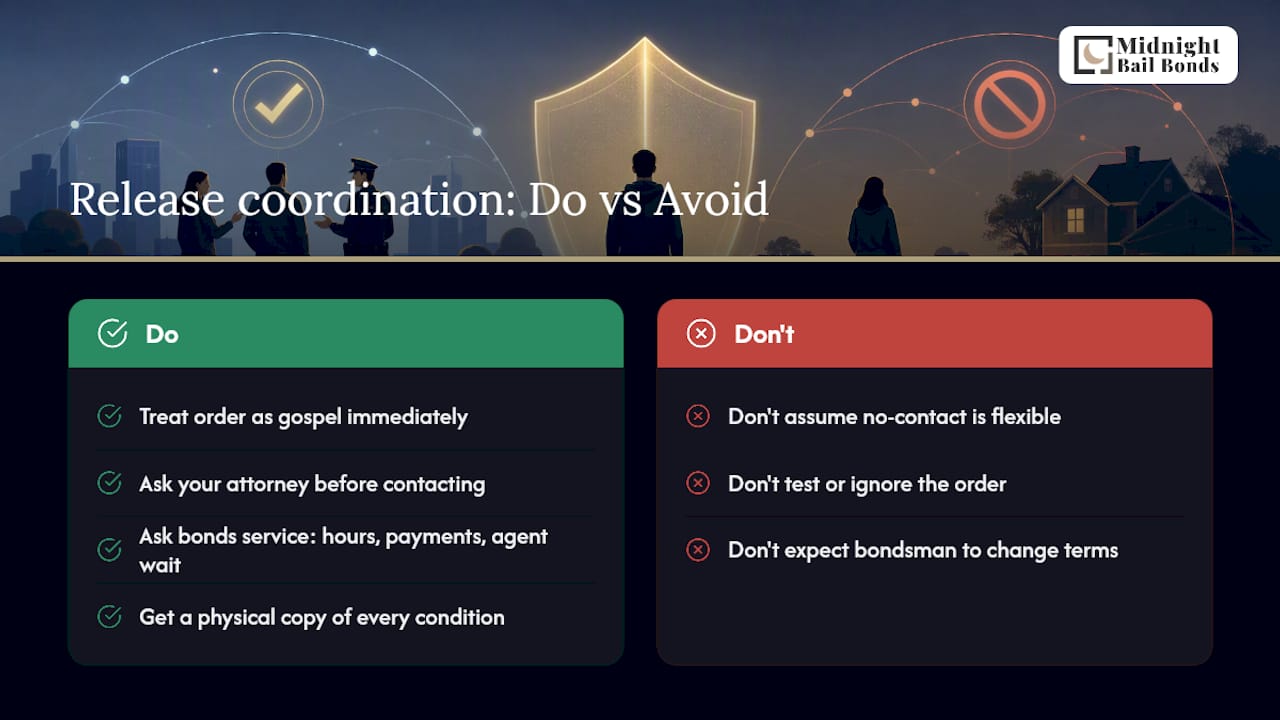
Families calling for bail help in the middle of the night are almost never thinking about the no-contact paperwork. They're thinking about getting someone out of a cell before morning. Our job at that moment is narrow: move fast, get the bond posted, and get the accused walked through the jail's paperwork so they leave with a physical copy of every condition attached to their release.
What I try to make clear on that first call is where our role ends. We can tell a family how long processing usually takes at a specific jail, what payment options exist, and whether an agent will wait on-site while the paperwork gets signed. We cannot tell anyone that a no-contact term is flexible, negotiable, or safe to test. That's a judge's call, made in a courtroom, not a decision a bondsman or a family member gets to make on the drive home.
The families who avoid trouble are the ones who treat the written order as gospel from minute one, and who ask their attorney before assuming anything about what contact is or isn't allowed. When you call a bonds service, ask directly: what are your hours, what payment plans do you offer, and will an agent stay until the paperwork and conditions are fully signed and understood. Those three questions tell you a lot about who you're working with.
How Midnightbail Gets Families Through Release Fast
Midnightbail is the fastest path to getting a loved one out of custody while the court sorts out everything else. We're available 24/7 across California, we offer bilingual English and Spanish support, and in many cases we can arrange bail without requiring collateral, which matters when a family is scrambling at 2 a.m. with limited options.
Flexible payment plans, including cash, credit or debit, Zelle, and financing, mean the premium doesn't have to come from one lump sum. Our licensed agents handle the paperwork at the jail so the process moves as quickly as the facility allows. What we can't do, and won't pretend to do, is change a court-imposed no-contact condition. That written order is the final word on what happens after release, and any change to it goes through a judge, not through us.
If someone you love has been arrested on a domestic violence charge, start with a free instant inmate search to confirm booking details, then call Midnightbail to get the bond process moving right away.
Sources
Rules and procedures vary by state and even by courthouse, so confirm your exact conditions with your attorney or the court clerk handling your case. This article is general information, not legal advice.
This article is general information, not a substitute for advice from a qualified lawyer. Consult a qualified legal professional about your own circumstances before acting on anything here.
FAQ
Does posting bail remove a no-contact order?
No. Posting bail secures release from custody, but the no-contact condition remains fully in effect and can only be changed by a judge.
Can the alleged victim cancel the no-contact order themselves?
No. Only the court can modify or lift the order, even if the protected person requests contact or says they no longer want it in place.
What counts as indirect contact under a no-contact order?
Indirect contact includes asking a third party to pass a message, commenting on social media posts, or any communication routed through someone else on your behalf.
How long does it take to modify a no-contact order?
Timelines vary by court, but a hearing on a modification motion can take anywhere from a few days to several weeks depending on the court's schedule and the request's complexity.
Can Midnightbail change my no-contact conditions?
No. Midnightbail can post bonds quickly and help with release paperwork, but only a judge can modify or remove a no-contact condition tied to a bail order.