
Bail is almost always available for a DUI that caused injury, but expect a far steeper number than a standard DUI arrest. Misdemeanor injury cases often run around $20,000, while felony injury DUIs regularly land between $50,000 and $100,000 or higher, depending on the county and how severe the crash was. If you're arranging release for someone in custody, your first moves should happen at the same time: call a defense attorney and start lining up cash or a licensed bail bond agent.
TL;DR:
- Bail amounts for DUI with injury vary significantly depending on the county and whether the charge is filed as a misdemeanor or felony, with felony injury DUIs often exceeding $50,000.
- Courts consider factors like severity of injury, high blood alcohol content, multiple victims, and prior convictions when setting bail, often increasing the amount beyond standard county schedules.
- Nonfinancial release conditions such as alcohol monitoring, GPS tracking, and travel restrictions are common for injury DUI cases, and violating these can result in bail revocation.
- Filing the charge as a felony or misdemeanor dramatically influences bail amounts and conditions, with felony injury DUIs typically incurring much higher bail and stricter monitoring.
- Prompt coordination with a licensed bail bond agent, providing necessary documents and details upfront, can significantly speed up the release process, especially in high-bail injury DUI cases.
Table of Contents
- DUI With Injury Bail Amounts by County and State
- How Judges Decide Bail in Injury DUI Cases
- What Happens at the Bail Hearing
- How to Post Bail for DUI Charges Involving Injury
- Costs and Fees Tied to DUI Injury Bail
- What to Do Immediately After Release
- Differences in Bail Procedure Between Injury DUI and Standard DUI
- Failing to Appear After Posting Bail in an Injury DUI Case
- How Victim Injury Severity Changes Bail Amount
- Pretrial Services and Monitoring in Injury DUI Cases
- Bail Conditions Specific to Injury DUI Charges
- Injury DUI vs. Non-Injury DUI: The Bail Comparison
- What Actually Speeds Up Release
- How Midnight Bail Bonds Gets You or a Loved One Released
- Sources
- FAQ
DUI With Injury Bail Amounts by County and State
Bail schedules aren't guesswork. Every California county publishes a set list of dollar figures tied to specific charges, and prosecutors and clerks use those numbers as the starting point before a judge ever gets involved.
The charge itself explains why the number jumps. Under California Vehicle Code §23153, driving under the influence causing bodily injury carries 90 days to a year in county jail and a fine between $390 and $1,000 for a first offense, with an added year of exposure for each additional injured victim, up to three years. That statute is the reason courts treat an injury DUI as a fundamentally different animal from a standard DUI stop, and bail schedules reflect it.
County-level numbers show how much local practice varies:
- San Diego County: misdemeanor DUI bail is substantially higher than standard misdemeanor DUIs; felony DUI with injury can be set at very high amounts reflecting case severity.
- Siskiyou County: felony DUI with injury is set at a flat $50,000 under the county's local bail schedule.
- Florida: the 2026 Uniform Statewide Bond Schedule lists a standard bond of just $1,000 for DUI with property damage or injury, though a judge can raise that figure sharply if the facts warrant it.
- National pattern: misdemeanor DUI bail commonly falls in the hundreds to low thousands, while felony and injury cases frequently push into the tens of thousands or beyond.
Notice the gap between Siskiyou's flat $50,000 and Florida's $1,000 baseline. Neither number tells you what you'll actually pay. Florida's schedule is a floor a judge can build on, not a ceiling, and California counties set their felony figures much closer to what they expect the final bail to be. Always pull the actual schedule for the county where the arrest happened rather than assuming one county's number applies statewide.
How Judges Decide Bail in Injury DUI Cases
Judges don't pick a number out of thin air. California court guidance instructs them to consider nonfinancial release conditions first and, if a financial condition is genuinely necessary, to set an amount the defendant can reasonably afford whenever that's consistent with public safety. That "ability to pay" standard is a real legal safeguard, not just a courtesy.
Several facts push bail higher, regardless of the county schedule's baseline:
- Serious or permanent injury to the victim
- A blood alcohol content of 0.15 or above
- A minor passenger in the vehicle at the time of the crash
- Multiple injured victims
- Prior DUI convictions on the record
- Any indication of flight risk or failure to appear in the past
Courts can also lean on nonfinancial tools instead of, or alongside, cash bail: GPS monitoring, SCRAM alcohol-monitoring anklets, and travel restrictions. If a judge decides those measures aren't enough to protect public safety, the law still requires the court to state its reasons for setting high bail or denying it outright, and courts can set provisional bail while more evidence about the injury's severity comes in.
Pro Tip: Bring documented proof of your ties to the community to any bail hearing. Employment letters, lease agreements, and family contact information routinely persuade judges to keep bail closer to the schedule's lower end.
What Happens at the Bail Hearing
Booking and processing typically takes several hours, and most jurisdictions guarantee a first court appearance within 48 hours of arrest, not counting weekends and holidays in some counties.
- Booking: Fingerprints, photographs, and a records check happen first, and this alone can take hours depending on jail volume.
- Initial appearance: The prosecutor presents the case against you, often citing the victim's injuries, your BAC, and any prior DUI history.
- Defense presentation: Your attorney can counter with evidence of community ties, steady employment, or enrollment in a treatment program.
- Bail decision: The judge either confirms the schedule amount, adjusts it up or down, or orders release on nonfinancial conditions.
- Bail review: If the initial number feels unreasonable, your attorney can request a reduction hearing once more facts, like the true extent of the victim's injuries, become clear.
Bring anything that documents where you live, where you work, and who depends on you. That paperwork is what turns a bail review into a real reduction instead of a denied motion.
How to Post Bail for DUI Charges Involving Injury
You have three practical paths once bail is set, and each comes with different speed and cost trade-offs.
- Cash bail: Pay the full amount directly to the county clerk or jail. It's the only option that returns your money (minus court fees) once the case resolves, assuming the defendant meets every court date.
- Commercial bail bond: A licensed bail agent posts the full bail amount in exchange for a nonrefundable premium, typically a percentage of the total bail set by state regulation. Some agencies offer 1% or 2% programs for qualifying clients, which lowers the upfront cash needed compared to a standard premium.
- Collateral and payment plans: Property, vehicles, or other assets can secure a bond when cash on hand is short, and many agencies structure payment plans so families aren't forced to liquidate assets under pressure.
Having a few documents ready, valid ID, proof of employment, and a couple of personal references, speeds up underwriting considerably. Jails move fast once paperwork is complete and slow to a crawl when it isn't.
Pro Tip: Call a licensed agent before you drive to the jail. Agents can often start underwriting over the phone, which shaves real time off the release process once you arrive.
Costs and Fees Tied to DUI Injury Bail
The premium on a commercial bail bond is nonrefundable no matter how the case ends. That's the tradeoff for not tying up the full bail amount in cash. Cash bail works differently: the court returns it once the case concludes, provided the defendant showed up to every hearing, minus any administrative court fees.
The real financial risk shows up if someone skips a court date. Failing to appear triggers bail forfeiture, meaning the court keeps the cash bail entirely, or a bail agent moves to collect on any collateral pledged against a bond.
Beyond bail itself, a DUI injury conviction carries its own separate costs:
- Fines and possible restitution paid directly to the injured victim
- Driver's license suspension through the DMV
- Higher auto insurance premiums for years afterward
- Court-ordered treatment or education program fees
Bail is just the first bill. The fines specified under VC 23153, $390 to $1,000 for a first offense, are separate from bail and separate from any restitution a judge later orders for the victim's medical costs.
What to Do Immediately After Release
Release is a relief, but it's also the start of a compliance period that matters as much as the arrest itself.
- Retain counsel right away and hand over every piece of paperwork from booking, including the police report and any BAC results.
- Follow every release condition to the letter, whether that's a no-contact order, alcohol monitoring, or a travel restriction, and keep your own written record of compliance.
- Handle the DMV side separately from the criminal case. A DUI arrest triggers an administrative license action on its own timeline, and missing that deadline can cost your license regardless of how the criminal case turns out.
- Start gathering records that support a bail reduction or plea negotiation, things like an employment verification letter or proof you've enrolled in a treatment program.
Reviewing what happens after bail is posted in more detail helps you avoid the common mistake of treating release as the end of the process instead of the start of a new one.
Differences in Bail Procedure Between Injury DUI and Standard DUI
A standard first-offense DUI usually moves through the system fast: booking, a bail schedule figure in the hundreds or low thousands, and release within hours. An injury DUI adds steps that slow everything down and raise the stakes at each one.
Prosecutors typically request a higher initial bail figure and come to the first appearance with more supporting material: medical reports on the victim, BAC evidence, and sometimes photos from the scene. Judges scrutinize injury cases more closely because the charge itself, a violation of VC 23153 rather than a simple DUI, already signals a public-safety concern the court has to weigh.
Injury cases are also more likely to trigger conditions beyond bail itself. Standard DUI releases might include a court date reminder and nothing else. Injury cases frequently come with alcohol monitoring, no-contact orders if the victim was a passenger, or restricted driving privileges pending the outcome. The felony/misdemeanor line matters too. Whether the prosecutor files the injury DUI as a felony or a wobbler charged as a misdemeanor changes which bail schedule tier applies and how much leeway a defense attorney has to negotiate a reduction. A misdemeanor injury DUI in most counties still lands closer to the standard DUI end of the schedule; a felony filing pushes it toward the six-figure examples county schedules describe.

Failing to Appear After Posting Bail in an Injury DUI Case
Skipping a court date after posting bail in an injury DUI case triggers consequences that stack on top of the original charge. The court issues a bench warrant almost immediately, and bail gets forfeited: cash bail is gone, and any collateral pledged against a bond becomes collectible by the bail agent.
Prosecutors also treat a missed appearance as evidence of flight risk, which matters enormously if there's a second bail hearing. A judge who set an affordable bail the first time around has little patience for a defendant who didn't show, and the next bail amount, if bail is offered again at all, tends to reflect that. In some cases, a new failure-to-appear charge gets added on top of the DUI injury charge itself, which is its own separate criminal offense in most states.
The injury element makes this worse than a typical missed court date. Prosecutors already framed the case around public safety, given the actual harm to a victim, so a failure to appear reinforces exactly the narrative they were making at the first hearing. Judges reviewing a bail reduction request after a missed date are far less likely to grant one. If a genuine emergency causes someone to miss a court date, contacting the court and defense counsel before the date, not after, is the only way to preserve any credibility with the judge.
How Victim Injury Severity Changes Bail Amount
The single biggest lever in an injury DUI bail decision is how badly the victim was hurt. A minor injury, something treated and released from an emergency room, keeps a case closer to standard felony bail schedule figures. Severe or permanent injury, especially anything involving surgery, long-term disability, or a hospital stay, pushes bail toward the higher end of what a county schedule allows, and often invites a request to exceed the schedule entirely.
Multiple injured victims compound the number further. Because VC 23153 allows a one-year sentencing enhancement per additional injured victim, up to three years, prosecutors use that same multiplying logic when arguing for higher bail. A crash that injured two passengers instead of one is treated as materially more serious at the bail hearing, not just at sentencing.
Injury severity also shapes what conditions come attached to bail, not just the dollar figure. A case involving a victim still hospitalized at the time of the bail hearing is far more likely to draw a no-contact order, tighter monitoring, or a request for detention rather than release altogether. Defense attorneys who can show the injury was less severe than the initial police report suggested, through updated medical records, sometimes succeed in getting bail reduced at a later review hearing once the full medical picture is clear.
Pretrial Services and Monitoring in Injury DUI Cases
Pretrial services exist to give judges an alternative to cash bail when nonfinancial conditions can accomplish the same public-safety goal. In an injury DUI case, that usually means some combination of alcohol monitoring, check-ins with a pretrial officer, and travel restrictions rather than release with no supervision at all.
SCRAM anklets and similar continuous alcohol-monitoring devices have become common conditions in injury cases specifically because they give the court a way to verify sobriety without keeping someone in custody purely over an inability to pay bail. GPS monitoring serves a similar function for cases where flight risk or contact with the victim is the primary concern rather than continued drinking.

Some counties route injury DUI defendants through a formal pretrial risk assessment before the bail hearing even happens, feeding a recommendation to the judge on top of the bail schedule figure. That assessment typically weighs prior record, community ties, and the nature of the current charge, and it can push a judge toward release on nonfinancial conditions even in cases where the schedule suggests a high cash number. Not every county has this infrastructure, so the ability to argue for pretrial supervision instead of straight cash bail depends heavily on local resources. A bail conditions overview walks through what these supervision requirements typically look like once release is granted.
Bail Conditions Specific to Injury DUI Charges
Beyond the dollar amount, injury DUI cases tend to come with a distinct set of conditions attached to release, and they're worth knowing before the hearing so you're not caught off guard.
Alcohol monitoring is the most common one. That can mean a SCRAM anklet, scheduled breathalyzer check-ins, or a full order to abstain from alcohol entirely pending trial. Restricted travel is another frequent condition, sometimes limited to travel for work and court appearances only, and sometimes barring travel outside the county or state altogether. No-contact orders come into play whenever the victim is someone the defendant knows, a passenger, family member, or acquaintance rather than a stranger in another vehicle.
Ignition interlock device requirements show up in some jurisdictions even before conviction, requiring a breath test to start the vehicle. Courts sometimes add mandatory check-ins with a pretrial supervision officer on a weekly or biweekly basis. Each of these conditions layers on top of whatever bail amount gets set, and violating any one of them, even without a new arrest, can trigger a bail revocation hearing and a return to custody. Treat the conditions list with the same seriousness as the bail amount itself; they're not just paperwork.
Injury DUI vs. Non-Injury DUI: The Bail Comparison
Put the two side by side and the pattern is consistent across jurisdictions: injury adds a multiplier, not just a modest bump. A standard first-offense DUI with no injury frequently resolves at bail in the hundreds to low thousands of dollars range nationally. The same fact pattern with an injured victim can push into the tens of thousands, and a felony filing pushes it further still, toward the $50,000 to $100,000 range county schedules describe.
Non-injury DUI cases usually skip the extra scrutiny prosecutors apply once a victim's medical records enter the picture. There's no enhancement calculation, no argument about permanent harm, and typically fewer conditions attached to release beyond a court date reminder. Injury cases invite all of that from the first hearing forward.
The charging decision itself is a fork in the road. Some states allow injury DUIs to be filed as either a misdemeanor or a felony depending on severity, a "wobbler" in California's terminology, and that filing decision alone can move bail by tens of thousands of dollars. Where the injury is minor and the defendant has no prior record, a skilled defense attorney arguing at the first hearing can sometimes keep the charge, and the bail figure, closer to the non-injury end of the spectrum.
What Actually Speeds Up Release
Release timelines depend far more on documentation than most families expect. A bail agent who has the booking number, the jail's name, the defendant's full legal name, and the charge on hand can often start underwriting before you've even left for the jail. Cases that drag tend to have one thing in common: missing paperwork, not a difficult bail amount.
Collateral gets requested less often than people assume, particularly for defendants with steady employment and no history of missed court dates. Bilingual support matters more in injury DUI cases than people expect too, since families are often making financial decisions under real stress and need clear answers in the language they're most comfortable in.
— Jake
How Midnight Bail Bonds Gets You or a Loved One Released
Once you know the bail number, the next question is how fast you can actually get someone out. Midnightbail runs licensed agents around the clock, which means a felony injury DUI bail set at midnight on a Saturday doesn't have to wait until Monday morning. You can start the process online, run an instant inmate search to confirm booking details, and get bilingual support if English isn't the easiest language for this conversation.
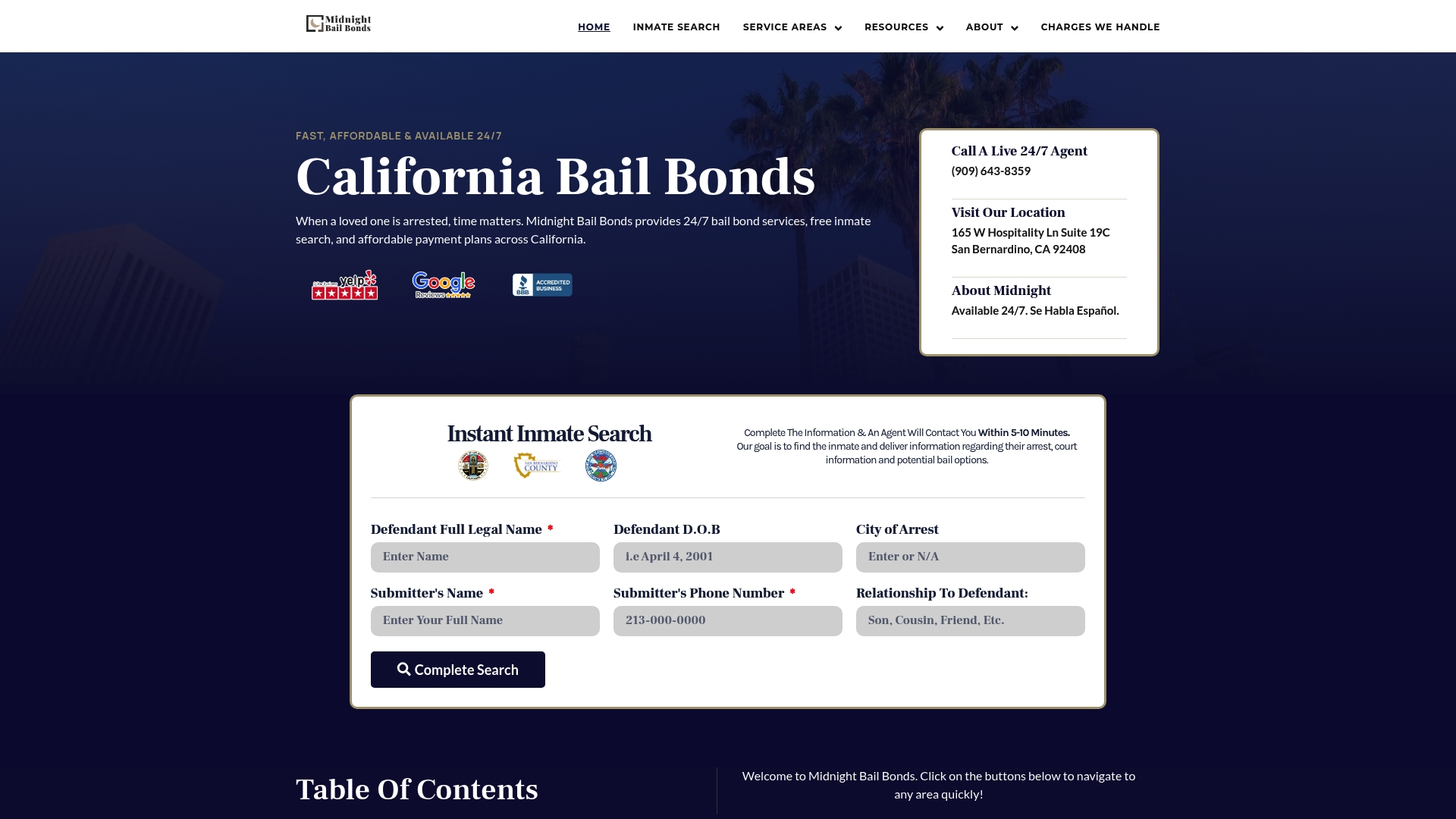
For injury DUI cases specifically, Midnightbail's DUI bail bonds in California service includes 1% and 2% bond programs for qualifying clients, along with flexible payment plans and no-collateral arrangements in many cases, so a high felony bail figure doesn't force a family to liquidate assets on short notice. Before you call, have the booking number, the jail's name, the defendant's full legal name, and the charge ready. That's the information that turns a phone call into a bond agents can start underwriting immediately, rather than a longer back-and-forth that costs hours you don't have.
This article is general information, not a substitute for advice from a qualified lawyer. Consult a qualified legal professional about your own circumstances before acting on anything here.
Sources
- California Vehicle Code §23153
- Siskiyou County local bail schedule (2026)
- Florida DUI bail amounts and Uniform Statewide Bond Schedule (2026)
- California courts: Invitation to comment on pretrial release/detention (CR-104 related material)
FAQ
What Does "DUI With Injury" Mean?
DUI with injury means someone was hurt, even minor injuries count, while the defendant was driving under the influence. Under California Vehicle Code §23153, that turns the offense into a more serious charge with jail time of 90 days to a year and fines between $390 and $1,000 for a first offense, plus added exposure for each additional injured victim.
How Much Is Bail for a DUI in Florida?
Florida's 2026 Uniform Statewide Bond Schedule sets a standard bond of $1,000 for DUI involving property damage or injury, but that's a baseline, not a ceiling. Judges routinely increase it when aggravating factors like a very high BAC or a minor passenger are present.
What Is the Typical Bail Amount for a DUI With Injury in California?
It depends heavily on the county and whether the charge is filed as a misdemeanor or felony. San Diego County examples run around $20,000 for misdemeanor DUI and up to roughly $100,000 for felony injury DUI, while Siskiyou County's schedule sets felony DUI with injury at a flat $50,000.
What Is the Most Common Plea in a DUI Injury Case?
Plea outcomes vary widely by county, prosecutor policy, and the specific facts of each case, so there's no single common plea that applies universally. A defense attorney reviewing the medical records, BAC evidence, and prior record is best positioned to advise on realistic plea options for a specific case.
Can a Bail Bond Company Help With a Felony Injury DUI?
Yes. Contact a licensed agent as soon as bail is set, since felony bonds at higher dollar amounts often take more time to underwrite than a standard misdemeanor bond.