
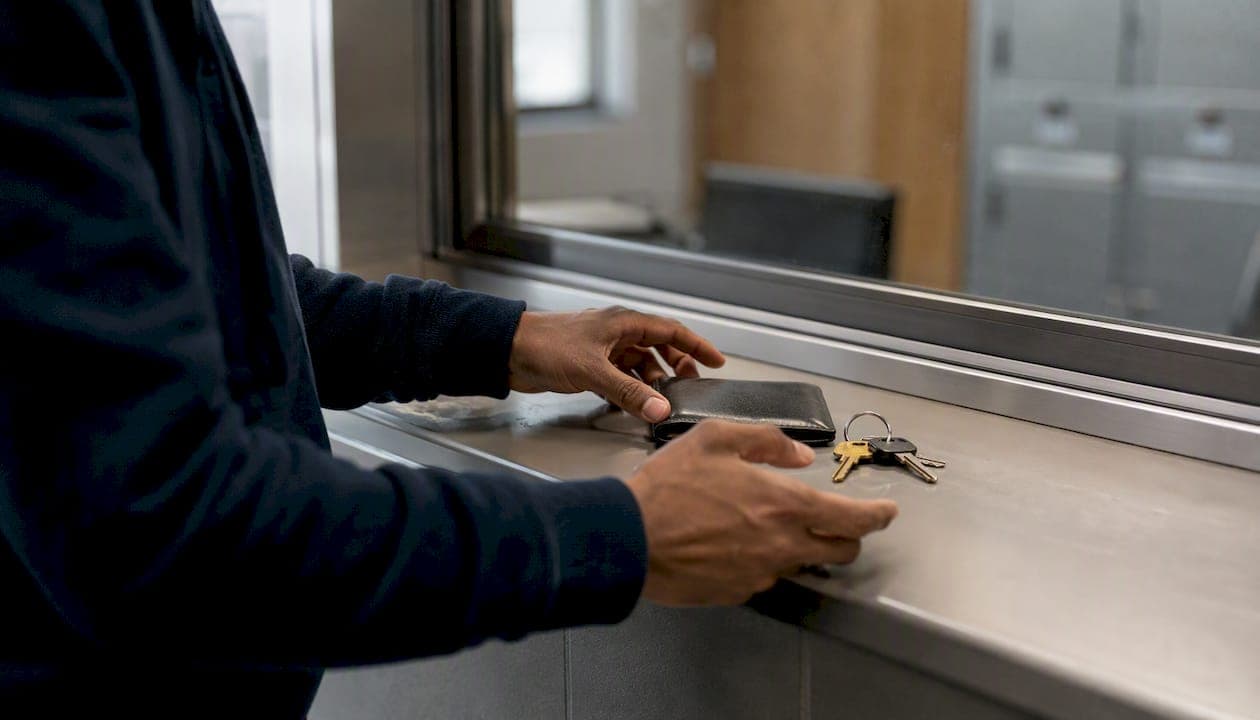
After bail is posted, you are released from custody but the case is not over. Release is conditional. You must follow every court-ordered term, show up at every scheduled hearing, and keep your paperwork. Miss one court date and a warrant goes out the same day.
Here is what to expect immediately:
- You will receive a release order, a bail receipt, and a notice listing your next court date. Keep all of it.
- Jail processing after bail is posted typically takes several hours. Busy urban facilities can take longer due to administrative backlogs.
- If you paid cash bail, a refund is only possible after the case concludes, and some jurisdictions take months to process it.
- If a bail bondsman posted a surety bond, the premium you paid (commonly around 10%) is non-refundable regardless of the outcome.
- Your next court appearance, usually an initial hearing or arraignment, is typically scheduled within 24–48 hours of arrest in most U.S. jurisdictions.
The single most important thing to understand: release on bail is a privilege, not a permanent status. Courts can revoke it at any point if you violate conditions or fail to appear.
Key Takeaways
Release on bail is conditional: you must follow every court-ordered term, appear at every hearing, and keep your paperwork or risk losing your freedom and your bail money before the case is resolved.
| Point | Details |
|---|---|
| Release is conditional | Bail gets you out of custody but does not end the case; every condition in your release order is legally binding from day one. |
| Keep the bail receipt | Courts require the receipt to process cash refunds; losing it triggers an affidavit process that can delay your refund by months. |
| Cash vs. surety bond | Cash bail is refundable after the case ends (minus surcharges); the bondsman's ~10% premium is non-refundable regardless of outcome. |
| Missing court triggers a warrant | A failure to appear results in a bench warrant, bail forfeiture, and a separate criminal charge for bail jumping in most jurisdictions. |
| Midnightbail offers 24/7 help | Licensed agents across California post bonds for all major charge types with flexible payment plans and no-collateral options in many cases. |
Table of Contents
- What happens after bail is posted at the jail?
- What bail conditions do you have to follow after release?
- What court appearances come after release?
- How does bail money work, and when do you get it back?
- How does pretrial supervision work, and can conditions be changed?
- What happens if you miss court or violate bail conditions?
- Why you need an attorney immediately after release
- What to expect from your bail bondsman after release
- Your rights and responsibilities the moment you are released
- How bail conditions are enforced beyond revocation
- What to do if bail money is lost, seized, or claimed by the court
- How bail affects your future legal proceedings and criminal record
- What most people get wrong in the first 48 hours after release
- Midnight Bail Bonds is available 24/7 across California
- Sources
- FAQ
What happens after bail is posted at the jail?
Release does not happen the moment bail is paid. The facility has its own processing sequence, and it takes time.
After bail or a bond is confirmed, staff verify the payment, confirm your identity, complete paperwork, and return your personal property. That sequence alone commonly runs two to four hours. At large county jails or facilities processing multiple releases at once, administrative delays can push that to considerably longer. The City of St. Louis Municipal Courts notes that processing times vary and that municipal systems may take months just to process refund requests for cash bond, which gives you a sense of how slowly the administrative side moves.
Documents to collect before you leave the facility:
- Release order: the official document authorizing your release; keep it.
- Bail receipt: proof of payment, required to claim any refund later.
- Court date notice: lists your next scheduled appearance; confirm the date, time, and courtroom.
- Bond company instructions: if a bondsman posted the bond, they will give you reporting requirements in writing.
- Personal property receipt: signed acknowledgment that your belongings were returned.
Pro Tip: Bring a government-issued ID to the jail when arranging release, and have the booking number and facility name ready. Contacting the jail clerk's window directly, or working through a licensed bondsman who knows the facility's process, is the fastest way to avoid unnecessary delays.
What bail conditions do you have to follow after release?
Bail conditions are court orders, not suggestions. Violating even one can send you back to jail before your case is resolved.
Conditions are listed in your release order and take effect the moment you walk out. Some are standard across most cases; others are specific to the charge or the judge's assessment of risk.
Common standard conditions:
- Appear at all scheduled court dates
- Remain in the jurisdiction (no out-of-state travel without court approval)
- Avoid contact with alleged victims or witnesses
- Refrain from possessing firearms or other weapons
- Submit to drug or alcohol testing if ordered
- Check in with a pretrial services officer on a set schedule
- Surrender your passport if flight risk is a concern
Charge-specific conditions are layered on top. A domestic violence charge almost always carries a no-contact order. A DUI charge may require an ignition interlock device or alcohol monitoring bracelet. Drug charges often add mandatory testing and treatment requirements.
Federal law requires that release orders explicitly state all conditions and the consequences of violating them, and state courts follow the same principle. You cannot claim ignorance of a condition that was written in your release paperwork.
Contacting a protected party even once, even by text, is enough to trigger immediate revocation. Courts treat no-contact orders as zero-tolerance. One message is one violation.
For a closer look at how conditions play out in specific charge types, the trespassing bail guide covers monitoring requirements for common low-level charges.
What court appearances come after release?
The court timeline starts fast. According to the Department of Justice](https://www.justice.gov/usao/justice-101/initial-hearing), defendants are typically brought before a magistrate for an initial hearing either the same day as arrest or the following day. That hearing is where bail and release conditions are formally addressed.
After the initial appearance, the sequence generally looks like this:
- Initial hearing / first appearance: Same day or within 24–48 hours of arrest. Bail is set or confirmed, conditions are stated, and you are informed of the charges.
- Arraignment: You enter a formal plea (guilty, not guilty, or no contest). In many states this happens at the initial hearing; in others it is a separate date within days or weeks.
- Pretrial hearings: Motions, discovery deadlines, and plea negotiations. These can span weeks or months depending on case complexity.
- Trial or plea resolution: The final stage, which may be months away from the arrest date.
What to bring and do before each appearance:
- Confirm the date, time, and courtroom with your attorney at least 48 hours ahead.
- Arrange transportation the day before; do not rely on last-minute plans.
- Bring your release order and any paperwork your attorney requests.
- Dress appropriately for court. First impressions affect how proceedings go.
- Arrive early. Late arrivals can be treated as failures to appear at the judge's discretion.
Pro Tip: Set a phone calendar reminder for every court date the moment you receive your paperwork. Add your attorney's number and the court clerk's number to your contacts the same day.
How does bail money work, and when do you get it back?
The answer depends entirely on how bail was posted.
Cash bond means you or a family member paid the full bail amount directly to the court. That money is held until the case concludes. If you appear at every hearing and the case resolves, the court returns the cash, minus any applicable surcharges. New York City, for example, applies a 3% surcharge on cash bail when a defendant is convicted and typically mails refund checks about eight weeks after bail is exonerated. Other jurisdictions take several months. The St. Louis Municipal Courts note that some municipal systems can take months to process refund requests.
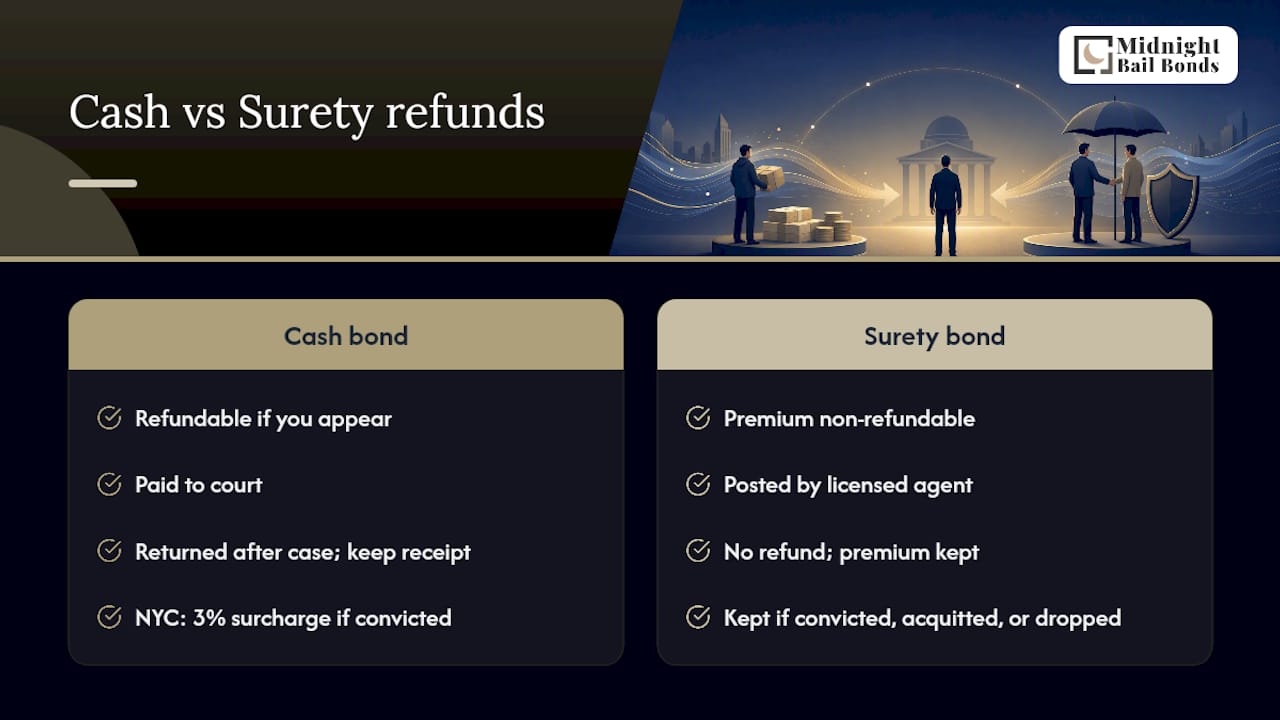
Surety bond (bail bondsman) means a licensed agent posted the full bail amount on your behalf. That premium is non-refundable. The bondsman's fee is how they earn their income; you do not get it back whether you are convicted, acquitted, or charges are dropped.
Keep your bail receipt. New York Courts confirm that the receipt is the primary document required to claim a cash refund. Without it, you may need to file a lost-receipt affidavit, which adds weeks or months to the process.
How does pretrial supervision work, and can conditions be changed?
Many defendants released on bail are assigned to pretrial supervision, a program run by the court or a county pretrial services agency. The level of supervision depends on the judge's risk assessment.
Typical supervision requirements include:
- Regular check-ins by phone or in person with a pretrial officer
- Random drug or alcohol testing
- GPS ankle monitoring for higher-risk cases
- Travel restrictions enforced through passport surrender or check-in protocols
- Employment or school verification
The supervising agency reports compliance directly to the court. If you miss a check-in or test positive, the officer files a report and the judge decides what happens next.
Conditions are not permanent. A judge may adjust, revoke, or amend bail conditions at any time during proceedings if circumstances change. That works in both directions: a judge can add restrictions after a violation, or reduce them if your attorney files a motion showing changed circumstances (a new job, stable housing, completed treatment).
Pro Tip: If a condition is making it impossible to work or care for your family, ask your attorney to file a motion for bond modification as soon as possible. Courts are more receptive when the request is specific, documented, and filed early rather than after a violation has already occurred.
Public records show how quickly post-release supervision violations can result in new charges and custody.
What happens if you miss court or violate bail conditions?
Missing a court date is one of the fastest ways to make a bad situation worse.
The typical enforcement sequence after a failure to appear or a reported violation:
- The court is notified (by the clerk, pretrial officer, or law enforcement).
- A judge issues a bench warrant for your arrest, often the same day.
- The court may order bail forfeiture, meaning the posted cash or the bondsman's liability is declared lost.
- If a bondsman posted the bond, they have a limited window (set by state law) to locate you and return you to custody before they must pay the full bail amount to the court.
- You are arrested on the warrant, brought back before the judge, and bail may be revoked entirely, meaning no release until the case resolves.
Federal law is explicit: failure to appear or comply with conditions can lead to forfeiture, revocation, and additional criminal charges for bail jumping. State laws mirror this framework.
Missing court once does not just risk your bail money. It adds a separate criminal charge for failure to appear, which can carry its own jail time and fines on top of the original case.
Courts actively enforce these orders. If you realize you missed a date or violated a condition, contact your attorney immediately. Do not wait for law enforcement to find you. Voluntary surrender and a prompt motion to the court for mitigation produce better outcomes than a warrant arrest.
Why you need an attorney immediately after release
Release from jail is not the end of the legal process. It is the beginning of the part where preparation matters most.
An attorney's first moves after your release typically include:
- Confirming all court dates and entering appearances with the court
- Reviewing the release order and conditions for any terms that need clarification or modification
- Requesting discovery (police reports, evidence, witness statements) from the prosecution
- Advising you on what to say and not say to law enforcement, co-defendants, and on social media
- Filing motions to modify restrictive conditions if they interfere with work or family obligations
If you cannot afford private counsel, you have the right to a public defender. Request one at your first court appearance. Public defenders carry heavy caseloads, so the earlier you make contact and provide your paperwork, the better.
Pro Tip: Hand your attorney the bail receipt, release order, and bond company paperwork at your first meeting. That documentation speeds up refund claims, helps them track compliance deadlines, and gives them the full picture of your financial obligations from day one.
For charge-specific guidance on what to expect after release, the battery bail process guide walks through the legal sequence families typically face.
What to expect from your bail bondsman after release
If a bondsman posted the bond, the relationship does not end when you walk out of jail.
A licensed bail bond company posts a surety bond with the court, guaranteeing your appearance. In exchange, you paid a non-refundable premium, commonly around 10% of the total bail amount. In many cases, bondsmen also require a co-signer who agrees to be financially responsible if you fail to appear.
What a bondsman must provide and what you should insist on:
- A written receipt for the premium paid
- A copy of the bond contract, including all reporting requirements
- A clear explanation of what triggers a surrender (missed court dates, new arrests, leaving the state)
- Contact information for their office and any after-hours line
Co-signers carry real financial exposure. If you skip court and the bondsman cannot locate you, the co-signer may be liable for the full bail amount. That is not a technicality; courts enforce it.
Pro Tip: Get every communication with your bondsman in writing. Ask upfront about collateral requirements, what happens if you need to travel for work, and exactly which actions trigger a surrender. Surprises in this relationship are always expensive.
Your rights and responsibilities the moment you are released
Walking out of jail, you retain your constitutional rights. The Fourth Amendment still protects you from unreasonable searches. The Fifth Amendment still protects you from self-incrimination. You have the right to counsel at every critical stage of the proceedings.
At the same time, release on bail comes with immediate responsibilities:
- Follow every condition in your release order from the moment you leave the facility. There is no grace period.
- Do not discuss your case with anyone other than your attorney, including family members, friends, or on social media.
- Report any change of address or phone number to your attorney and pretrial officer immediately.
- Avoid any contact with alleged victims or witnesses, even if they initiate contact.
- Do not pick up new charges. A new arrest while on bail almost always triggers revocation.
Pretrial release disrupts housing, employment, and family stability even in short cases. Staying compliant from day one is the most direct way to protect yourself and the people who helped post your bail.
How bail conditions are enforced beyond revocation
Revocation is the most visible consequence of a violation, but it is not the only one.
Courts and pretrial agencies have a range of enforcement tools. A pretrial officer can file a compliance report that triggers a hearing without a full revocation motion. A judge can add conditions, increase the bail amount, or order electronic monitoring as an intermediate step. Law enforcement can arrest you on a bench warrant and hold you without bail pending a revocation hearing.
Beyond the immediate case, a bail violation can affect future proceedings. Judges in subsequent cases review criminal history, and a documented failure to appear or a revocation makes it harder to obtain favorable bail terms in any future arrest. Some jurisdictions treat repeated bail violations as an aggravating factor at sentencing.
Courts do not treat violations as minor administrative matters. A domestic violence protective order violation, for instance, is a separate criminal charge in most states, carrying its own penalties on top of the original case.
What to do if bail money is lost, seized, or claimed by the court
Losing the bail receipt is more serious than most people realize. Courts require it as primary proof of payment. Without it, you typically must file a lost-receipt affidavit, provide identification, and wait for the court to verify the original transaction. That process can delay a refund by weeks or months.
If the court claims or forfeits your cash bail:
- Contact the court clerk immediately to confirm the reason for forfeiture and whether a motion for remission (partial or full return) is available.
- Notify your attorney. A timely motion can sometimes recover forfeited bail, particularly if the failure to appear had a legitimate explanation (medical emergency, documented miscommunication).
- Request a written explanation of any deductions, surcharges, or fines applied before the refund was calculated.
- If the bondsman's surety was forfeited, the bondsman typically has a statutory period to locate you and seek remission. Co-signers should consult an attorney about their liability exposure.
If you believe bail money was improperly seized or applied, a civil attorney can advise on whether a formal claim is viable. Keep copies of every receipt, every court filing, and every communication with the court clerk.
How bail affects your future legal proceedings and criminal record
Bail itself does not appear on a criminal record. The arrest does. The charges do. The outcome of the case does. But how you behave while on bail shapes the trajectory of everything that follows.
Judges and prosecutors notice compliance. A defendant who attended every hearing, followed every condition, and maintained stable employment during the pretrial period is in a meaningfully different position at sentencing than one with a bench warrant history. Defense attorneys use pretrial compliance as a mitigating factor in plea negotiations and at sentencing hearings.
Conversely, a bail violation, particularly a failure to appear, creates a documented record that follows you. Future bail hearings in any case will reference it. Prosecutors cite it when arguing for detention or high bail amounts. Some states have mandatory detention provisions for defendants with prior failures to appear.
The case outcome itself is what ultimately affects your criminal record. A conviction is reported; an acquittal or dismissal is not (though the arrest record may remain unless you seek expungement). The bail process is the bridge between arrest and resolution, and how you navigate it directly affects the options available to you at the end.
What most people get wrong in the first 48 hours after release
The first two days after release are when the most preventable mistakes happen. People lose the receipt. They forget to write down the court date. They send a text to someone they were ordered not to contact. They assume the bondsman will remind them of everything.
None of that is the bondsman's job. None of it is the court's job. It is yours.
The practical list that actually matters:
- Photograph your release order, bail receipt, and court date notice before you leave the facility parking lot.
- Put the court date in your phone calendar with a 48-hour reminder and a same-day reminder.
- Call your attorney within 24 hours of release, not when the next court date is approaching.
- Read every condition in your release order. If you do not understand one, ask your attorney before you accidentally violate it.
- Tell the people in your household what the no-contact and travel conditions are, so they do not inadvertently create a problem.
The defendants who stay out of trouble between arrest and resolution are not the ones with the best lawyers or the lowest bail. They are the ones who treated the release order as a binding contract from day one. That discipline is the difference between a case that resolves in your favor and one that compounds.
Midnight Bail Bonds is available 24/7 across California
When someone you care about is in custody, every hour matters. Midnightbail provides 24/7 bail bond services across California, with licensed agents available around the clock for every charge type, including DUI, drug charges, domestic violence, assault, theft, and failure to appear.

Midnightbail offers flexible payment plans and can arrange bail without collateral in many qualifying cases. Bilingual English/Spanish support is available, and the free instant inmate search tool lets you locate a detained person and get booking information before you even call. Accepted payments include cash, credit/debit, Zelle, and financing.
To get started, have the defendant's full name, booking number, and the name of the facility ready. Then call or reach out through Midnightbail for immediate assistance from a licensed agent who knows the local jail process.
Sources
Official and authoritative resources for jurisdiction-specific rules, court forms, and pretrial office contacts:
- Bail hearing procedures — FindLaw
- Making Bond — City of St. Louis Municipal Courts
- Bail — New York Courts
- Congress
To find your specific court or clerk's office, search "[county name] superior court clerk" or "[city name] jail release procedures." Bring your release order, booking number, and bail receipt to any in-person inquiry.
This article is general information, not a substitute for advice from a qualified lawyer. Consult a qualified legal professional about your own circumstances before acting on anything here.
FAQ
Can you still go to jail after bailing out?
Yes. A judge can revoke bail and order you back into custody at any time if you violate conditions, miss a court date, or face new charges. Bail conditions can be amended or revoked throughout the proceedings.
What happens right after a person gets bail?
The jail processes the release, which typically takes several hours, then returns your property and paperwork. You leave with a release order, a bail receipt, and a notice of your next court date, and your conditions take effect immediately.
How long can you remain on bail before the case resolves?
There is no fixed national limit. Pretrial release can last weeks or months depending on case complexity, court scheduling, and whether continuances are requested. You remain on bail, and subject to all conditions, until the case concludes or bail is revoked.
Is it better to pay cash bail or use a bail bondsman?
Cash bail makes financial sense if you have the full amount available; a bondsman is the practical option when you do not, since Midnightbail and similar licensed agencies offer payment plans and no-collateral arrangements in qualifying cases.