
Bail after a probation violation is not automatic. Whether you or a loved one gets released on bond depends on the type of violation, the judge's read on risk, and the state where the case is happening. Judges weigh several things at once when deciding: whether the violation is technical (a missed check-in, a failed drug test) or tied to a new arrest, how serious the original offense was, the person's track record on supervision, and whether they pose a flight or public-safety risk. Some statutes tilt the scale toward release. California's Penal Code §1203.25, for instance, requires courts to justify holding a probationer rather than releasing them on their own recognizance unless there's clear evidence of risk.
Main factors that decide bail in a probation violation case:
- Technical violation versus new criminal charge
- Severity of the original underlying offense
- Compliance history while on probation
- Flight risk and public-safety concerns
- State-specific statutory rules, some of which allow no-bond holds
Key Takeaways
Bail after a probation violation depends on whether the violation is technical or tied to a new arrest, and acting fast on documentation and legal counsel improves the odds of release.
| Point | Details |
|---|---|
| Bail is not guaranteed | Judges weigh violation type, offense severity, compliance history, and flight risk before deciding. |
| Some states favor release | California's PC §1203.25 requires courts to justify detention absent clear evidence of risk. |
| Others allow no-bond holds | Florida Statute 948.06 gives courts discretion to deny bond, especially for felony probationers. |
| Documentation changes outcomes | Employment proof, housing records, and treatment enrollment strengthen a bond request. |
| Midnightbail speeds the process | Offers 24/7 posting, payment plans, and bail without collateral in many California cases. |
Table of Contents
- Bail For Probation Violation: What Happens Right After the Arrest
- What Judges Actually Weigh Before Setting Bail
- How to Seek Bail Right Now: Steps, Options, and Costs
- How Long Will You Sit in Jail Before a Hearing?
- Conditions and Risks After You're Released on Bond
- What Families Should Expect When They Call a Bail Agent
- Get Bail Moving Fast With Midnightbail
- Statutes and Court Rules Worth Reviewing
- Sources
- FAQ
Bail For Probation Violation: What Happens Right After the Arrest
Probation violations don't always start with a new crime. A probation officer can file a violation report over something as small as a missed appointment, and a judge can issue a warrant based on that report alone. Some warrants specifically say "no bail" or "no bond," meaning the arresting agency can't set a bond amount at booking, no matter how much cash the family has ready.
Once someone is in custody, the case moves through a few predictable stages:
- Booking and initial hold. The jail processes the arrest and checks whether the warrant sets a bond amount or blocks one.
- First appearance. A judge or magistrate reviews the case, usually within a day or two, and decides whether bond is even on the table.
- Probable-cause or preliminary hearing. The court checks whether there's enough evidence to believe a violation actually happened.
- Revocation hearing. This is the full hearing where the judge decides whether probation is revoked, modified, or continued.
Federal cases follow a similar structure. Rule 32.1 of the Federal Rules of Criminal Procedure requires that a person be taken promptly before a magistrate judge, who then applies release or detention standards and confirms the right to counsel before the case moves further. Bond decisions can happen at more than one of these stages, so knowing which hearing you're heading into changes what to prepare.
What Judges Actually Weigh Before Setting Bail
Judges aren't guessing. They're running through a fairly consistent checklist, even if they never say it out loud. Understanding it helps you build a bond request that actually lands.
- Type of violation. A missed curfew check reads very differently than an arrest for a new felony.
- Severity of the original offense. Someone on probation for a nonviolent theft charge faces a different calculation than someone convicted of a violent felony.
- Compliance history. A clean record on probation up to this point works in your favor; repeated violations do not.
- New criminal charges. A violation tied to a fresh arrest almost always raises the bar for release.
- Flight and public-safety risk. Judges look at whether the person is likely to show up to court and whether they pose a danger if released.
- Community and employment ties. Stable housing, a steady job, and family in the area all argue against flight risk.
Florida gives a useful contrast to California's release-favoring approach. Florida Statute 948.06 gives courts broad discretion to issue no-bond warrants for probation violations, especially for felony probationers or anyone facing new felony charges. The same violation can lead to two very different outcomes depending on which state the case sits in.
Pro Tip: Bring documentation, not just promises. Pay stubs, a signed lease, a letter from an employer, or proof of enrollment in a treatment program carry far more weight with a judge than a family member simply vouching for good character.

How to Seek Bail Right Now: Steps, Options, and Costs
Speed matters here. The faster you act, the faster a bond hearing can happen.
- Call an attorney immediately. Even a "no bond" warrant can sometimes be challenged with a motion to set bond, particularly when the violation is technical rather than a new charge.
- Confirm the booking details. Get the exact charge, jail location, and case number. This information is what any attorney or bondsman will ask for first.
- Ask the court directly whether a bond-setting hearing exists. Don't assume none is scheduled just because the initial warrant blocked bail.
- Gather supporting materials before the hearing. Employment verification, a lease or utility bill showing local residence, proof of enrollment in counseling or treatment, and character letters all help.
Once bond is set, you're usually choosing between two payment paths. Cash bail means paying the full amount directly to the court, refundable later if the person makes every appearance. Surety bonds work through a licensed bail agent, who posts the bond for a nonrefundable fee, typically around 10% of the total bail amount, with payment plans often available. Cash bail ties up more money upfront but returns it eventually; a surety bond costs less out of pocket but the fee is gone for good, regardless of the case outcome.
How Long Will You Sit in Jail Before a Hearing?
Detention length depends heavily on which court and state the violation falls under, but a few benchmarks show up across the country.
| Stage | Typical Timing |
|---|---|
| Initial custody review | Often within 24 to 72 hours of arrest |
| First appearance before a judge | Usually within 1 to 2 business days |
| Probable-cause hearing | Shortly after first appearance, timing varies by state |
| Full revocation hearing | Can take days to several weeks depending on court schedule |
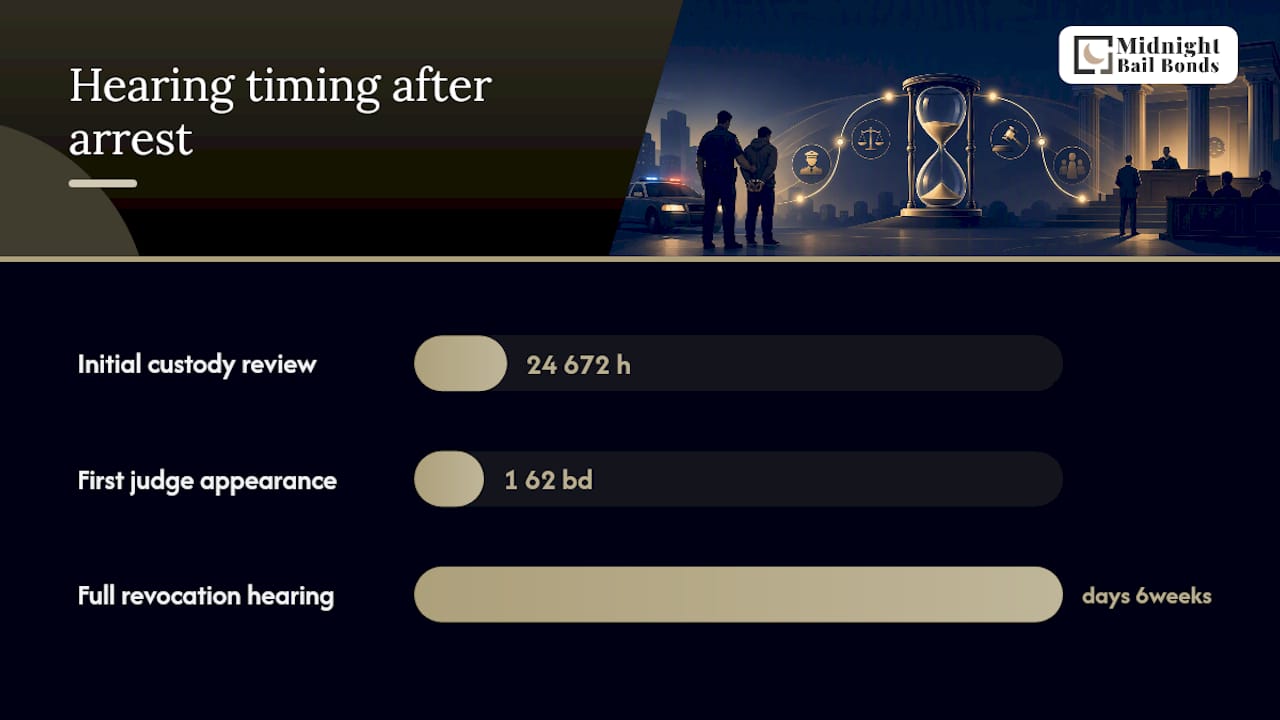
New Hampshire's Rule 30 sets specific deadlines for initial appearance and bail hearings after a probation violation arrest, giving a concrete example of how states build hearing windows into their rules. A new criminal charge attached to the violation almost always extends the timeline, since the court often waits on evidence from the new case before ruling on the underlying violation.
Conditions and Risks After You're Released on Bond
Getting released doesn't mean the case is over. It means the case continues while you're out, and every condition attached to that release matters.
- Standard conditions often include regular check-ins with a probation officer, travel restrictions, and continued compliance with the original probation terms.
- Bond forfeiture happens if the person misses a court date, and the bondsman can pursue the full bond amount plus a bench warrant follows almost immediately.
- Ongoing coordination with the probation officer matters even after release, since a probation officer's recommendation carries real weight at the revocation hearing itself.
Missing court after release on a probation-violation bond is treated more seriously than a first-time failure to appear, since the court already had reason to question compliance once.
What Families Should Expect When They Call a Bail Agent
When a family calls us at Midnightbail after a probation violation arrest, the first thing we do is confirm booking details and whether the warrant allows bond at all. We work day and night, which matters because probation violation arrests rarely happen at convenient hours. Have the booking number, jail location, and your relationship to the defendant ready when you call. Bilingual support and an instant inmate search speed that first step considerably.
We coordinate directly with defense counsel whenever a bond-setting hearing needs to be requested on a no-bond warrant. Timelines still depend on the court and the violation type. No bondsman can override a judge's discretion, but we can make sure nothing on the logistics side slows the process down.
Get Bail Moving Fast With Midnightbail
Waiting on a court-appointed process to slowly work its way through the docket costs time your family may not have. Midnightbail posts bail 24/7 across California, offers flexible payment plans, and in many cases arranges bail without collateral, which matters most when a probation violation hearing gets scheduled with little notice.
Before you call, have the defendant's full name, the jail or facility location, and the booking number ready if you have it. If you don't, our instant inmate search can usually track it down in minutes. From there, we handle the bond paperwork and coordinate timing so the defendant isn't waiting any longer than necessary once a bond amount is set.
If the arrest happened in Orange County, our Orange bail bonds team handles local jail procedures directly, and our Irvine service page covers the Musick Facility specifically. Whatever the location, start with our main bail bonds page to get a licensed agent on the phone right away.
Statutes and Court Rules Worth Reviewing
For anyone digging into the specifics of a case, these are the primary sources courts and attorneys reference directly:
- Florida Statute 948.06 on violation of probation and no-bond warrants
- Federal Rule 32.1 on revocation hearing procedures
- New Hampshire Rule 30 on bail hearing timing
Local county courts and clerk offices often publish their own bonding schedules, so check those directly for jurisdiction-specific numbers.
This article is general information, not a substitute for advice from a qualified lawyer. Consult a qualified legal professional about your own circumstances before acting on anything here.
Sources
- Florida Statute 948.06 — Violation of probation
- Federal Rules — Rule 32.1 (revocation procedures)
- New Hampshire Rule 30 — Probation violation procedures
FAQ
Will I get bail for a probation violation?
It depends on the violation and the state. Technical violations often allow bond, while new-arrest felony violations, especially in states like Florida, can trigger no-bond warrants.
How long do you sit in jail for a probation violation?
Initial custody review typically happens within 24 to 72 hours, with a first appearance following shortly after, though a full revocation hearing can take days to weeks depending on the court's schedule.
How do you fight a probation violation to improve your chances of release?
Hiring an attorney immediately and presenting evidence of employment, stable housing, and treatment enrollment are the strongest ways to argue for bond or a favorable outcome at the revocation hearing.
Does a new criminal charge always mean no bail?
Not always, but it significantly raises the bar. A new charge tied to the violation often extends the timeline and pushes judges toward denying bond, particularly for prior felony convictions.
What's the difference between cash bail and a surety bond?
Cash bail is paid in full and refunded if court dates are met, while a surety bond through a licensed agent like Midnightbail costs a nonrefundable fee, typically around 10% of the bail amount, with payment plans available.