

Most resisting arrest charges start as misdemeanors, and bail typically lands under $1,000. That changes fast the moment prosecutors allege violence, a weapon, or fleeing in a vehicle, which can push the charge into felony territory with a much steeper bond and stricter release terms.
If you're trying to get someone out tonight, here's the short version:
- Confirm the exact charge and booking number through the jail's inmate search before you do anything else.
- Call a licensed bail agent or a criminal defense attorney immediately. Both can move faster than you can alone.
- Have a cosigner ready with ID and proof of income. Most bond paperwork stalls waiting on this step.
Pro Tip: Ask the jail's booking desk or the bail agent whether the charge is listed as a misdemeanor or felony on the docket. That single word changes your entire financial plan for the next 24 hours.
Key Takeaways
Bail for resisting arrest usually starts low as a misdemeanor but escalates sharply once a weapon, injury, or companion felony charge enters the case.
| Point | Details |
|---|---|
| Misdemeanor bail is typically modest | Standalone resisting charges often bring bail under $1,000 in many counties. |
| Escalators change everything | Alleged violence, a weapon, or vehicle evasion can push the charge to felony level with far higher bail. |
| Stacked charges combine into one bond | Companion charges are usually rolled into a single combined bond, not calculated separately. |
| Surety bonds move faster than cash | A bail agent's premium is nonrefundable but typically posts release quicker than waiting on court processing. |
| Midnightbail offers 24/7 posting | Licensed agents handle stacked bonds, collateral-free options, and payment plans across California. |
Table of Contents
- Resisting Arrest Bail Amounts by Charge Level
- How Judges and Magistrates Actually Set the Bond
- Getting Someone Released: Cash, Bonds, and OR
- When Bail Gets Much Higher
- How to Ask for a Lower Bond
- Life After Bail Is Posted
- Midnight Bail Bonds and Resisting Arrest Cases
- The Real Problem With Most Bail Advice on This Topic
- Get Released Fast With Midnightbail
- Sources
- FAQ
Resisting Arrest Bail Amounts by Charge Level
There is no single number here, and anyone who tells you otherwise hasn't looked at more than one county's bail schedule. Bail for resisting arrest depends heavily on where the arrest happened, what the person is accused of doing, and whether other charges rode along with it.
For a standalone misdemeanor resisting charge, bail commonly falls in the low hundreds to just under $1,000. That's the baseline scenario: no weapon, no injury, no vehicle chase, just a person who allegedly pulled away or refused to comply during an arrest. Once the conduct escalates, so does the number. County bail schedules show real variance even within the same state, with some jurisdictions listing resisting-related bail in the low hundreds and others setting it in the thousands depending on the charge classification.
A few things reliably move bail from the low end toward the high end:
- Prior arrests or a criminal record on file.
- Any allegation of physical contact with an officer.
- The presence of a weapon, even if it wasn't used.
- Additional charges filed at the same time (DUI, drug possession, domestic violence).
That last point matters more than people expect. When resisting arrest gets stacked with a second or third charge, courts frequently combine them into one total bond figure rather than treating each charge separately. A $500 resisting charge attached to a $10,000 domestic violence charge doesn't net out to $500. The family ends up responsible for the combined total, and cosigners need to understand that before they sign anything.
How Judges and Magistrates Actually Set the Bond
Bail isn't pulled from a fixed chart in every courtroom. Some counties run on preset bail schedules that assign a dollar figure to each charge automatically at booking. Others put the decision in front of a magistrate or judge who weighs the specifics of the case, sometimes within hours of arrest and sometimes not until a hearing days later.
When discretion is in play, the person setting bail is typically weighing:
- The severity of the alleged offense and whether force or a weapon was involved.
- Criminal history, including prior failures to appear in court.
- Flight risk, meaning ties to the area like a job, family, or a lease.
- Whether the person is seen as a danger to the arresting officer or the public.
- Community ties, such as how long someone has lived locally.
Here's the part that trips up a lot of families: if resisting arrest is filed alongside a more serious charge, the conditions attached to release are usually governed by that more serious charge, not by the resisting count on its own. A defendant facing resisting plus felony assault won't get treated like a simple resisting case just because that's the charge they're asking about. The most serious count in the file sets the tone for GPS monitoring, travel restrictions, and total bond, even if resisting is the charge everyone keeps discussing.
Local practice also shapes the outcome. Two counties in the same state can apply the same statute and land on wildly different numbers, purely because one relies on a rigid schedule and the other leaves it to judicial judgment.
Getting Someone Released: Cash, Bonds, and OR
Once bail is set, families generally have three real paths, and they don't all move at the same speed.
- Cash bail. Pay the full amount directly to the court or jail. It's refundable if the case resolves and the defendant shows up for every hearing, but tying up several thousand dollars in cash isn't realistic for most households on short notice.
- Surety bond through a bail agent. A licensed agent posts the full bond on the defendant's behalf in exchange for a premium, which is a percentage of the total bail amount and is not refundable once the bond is posted. In many cases this route also comes without requiring collateral, and it moves faster than waiting on a court clerk or an OR review board.
- Property bond or OR release. Property bonds pledge real estate as collateral instead of cash, which courts allow less often and which takes longer to process because it requires appraisal and title verification. Own recognizance release, where the defendant is released on a promise to appear, is uncommon once resisting arrest is on the docket, especially if it's paired with another charge.
Pro Tip: If cosigning a bond, ask upfront what happens to your collateral or credit if the defendant misses a court date. That conversation is far easier to have before you sign than after a bench warrant gets issued.
Speed matters here. A cash bail payment can take hours to process depending on jail staffing, while a bail agent who already has the paperwork template ready can often post the bond within an hour of getting the defendant's booking information.
When Bail Gets Much Higher
Certain facts turn a routine resisting charge into something far more expensive to bond out of. State laws vary on exactly where the line sits, but a few patterns show up almost everywhere.
- Alleged assault on an officer. Any claim of striking, shoving, or injuring an officer during the arrest typically reclassifies the case as a felony, with bail moving from hundreds into the thousands or tens of thousands.
- Weapon involvement. Brandishing or using a weapon, even without contact, is treated as an aggravating factor in most jurisdictions and usually adds a felony enhancement.
- Evading in a vehicle. Fleeing police in a car is often charged as a separate, more serious offense than resisting on foot, and the combined bond reflects both charges.
- Stacked charges from the same incident. DUI, drug possession, or domestic violence filed alongside resisting adds to the total bond rather than replacing it.
When any of these apply, expect more than a bigger number attached to the case. Courts frequently add GPS monitoring, no-contact orders with the arresting agency or alleged victim, travel bans outside the county or state, and in some cases a requirement for multiple cosigners on the bond. A defense attorney who has handled these enhancement scenarios before can tell you within minutes whether your case fits this pattern or the simpler misdemeanor track.
How to Ask for a Lower Bond
Bail set at booking isn't final. Every jurisdiction has a mechanism for revisiting it, and the timeline usually moves faster than people assume.
- File a motion for bail reduction, typically through the defense attorney, which triggers a hearing in front of a judge, often within a few days of the initial bail being set.
- Bring proof of stability, meaning employment records, a stable address, family obligations, or enrollment in a treatment program if relevant to the case.
- Address the record honestly. A clean history or the absence of prior failures to appear carries real weight with a judge deciding whether to lower the amount.
Pro Tip: Attorneys who regularly appear in front of the same judges know which arguments actually move the needle in that courtroom. That local knowledge often matters more than the strength of the argument on paper.
Companion charges sometimes get negotiated down or dismissed as part of the same process, especially when the underlying offense is where prosecutors have their real leverage. A defense attorney weighing a plea on the primary charge will often use the resisting count as part of that negotiation.
Life After Bail Is Posted
Getting released is not the end of the obligations. Courts attach conditions, and violating them creates a second legal problem on top of the original charge.
Typical conditions include:
- No contact with the arresting officer or any alleged victim in a companion charge.
- Regular check-ins with a pretrial services officer.
- Surrendering a passport if flight risk was a concern at the hearing.
- Staying within a defined geographic area.
Missing a court date or breaking a condition typically triggers bond forfeiture, a new arrest warrant, and sometimes an additional criminal charge for failure to appear. That's a serious financial hit on top of a legal one.
It's worth understanding the money mechanics clearly: cash bail is refundable if the case runs its course and every hearing is attended, while a bail bond premium is not. The typical premium runs 10 to 20 percent of the total bond, and that percentage is the cost of the service, not a deposit. Families sometimes assume they'll get that money back once the case closes. They won't.

Midnight Bail Bonds and Resisting Arrest Cases
Getting someone out fast starts with knowing exactly where they're being held and what they're charged with. Midnightbail's instant inmate search gives families that information immediately, without waiting on hold with a jail switchboard at 2 a.m.
From there, licensed agents work directly with booking staff to post bond on resisting arrest charges, including cases stacked with a second or third offense. A few things families consistently ask about:
- Agents are available 24/7, since arrests don't happen on a business-hours schedule.
- Many bonds are arranged without requiring collateral, which matters when a family needs to move quickly.
- Flexible payment plans mean the premium doesn't have to be paid in one lump sum.
- Bilingual support handles cases where the cosigner is more comfortable communicating in Spanish.
When a resisting charge comes with a companion offense, Midnightbail coordinates the paperwork for both bonds at once rather than making a family go through the process twice.
The Real Problem With Most Bail Advice on This Topic
Most articles on resisting arrest bail treat it like a single number you can look up, and that's the wrong frame entirely. The honest answer is that two people arrested for the exact same conduct in neighboring counties can face bonds that differ by a factor of ten, purely because one county runs on a fixed schedule and the other leaves it to a judge's discretion that morning.
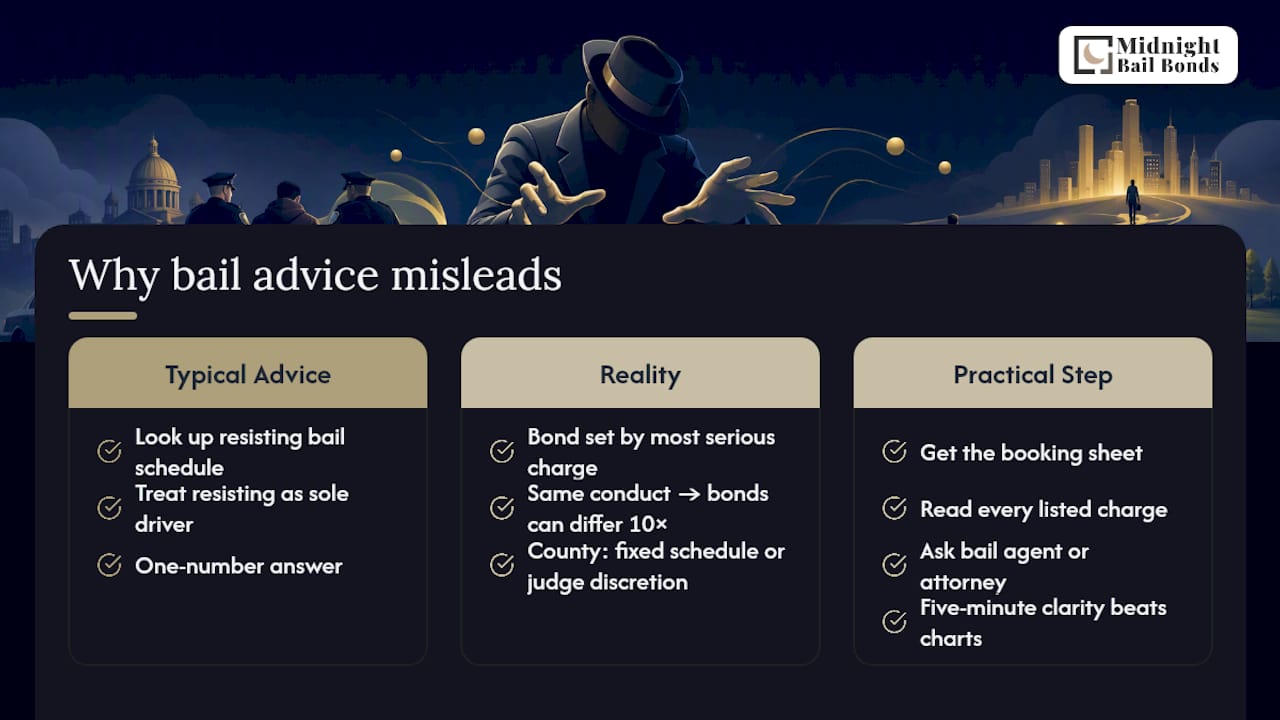
The conventional advice, "just find out the bail schedule for resisting arrest," undersells how much the companion charge matters. Families fixate on the resisting count because that's the charge they understand, while the actual bond is being driven by whatever more serious offense got filed alongside it. If you only research the resisting charge, you'll misjudge your total financial exposure almost every time.
What actually helps: get the booking sheet, read every charge listed, and ask a bail agent or attorney to explain which one is setting the terms. That five-minute step tells you more than any general bail chart ever will.
— Jake
Get Released Fast With Midnightbail
Court-appointed schedules and county bail offices move on their own timeline, and that timeline rarely matches a family's need to get someone out tonight. Midnightbail is built around that gap: licensed agents answer around the clock, many bonds require no collateral, and payment plans spread the premium out instead of demanding it all upfront.

If your case involves resisting arrest stacked with another charge, Midnightbail can coordinate both bonds through one process instead of forcing you to handle them separately. Bilingual agents are available for families more comfortable working in Spanish, and the same instant inmate search used earlier to confirm booking details connects directly to agents who can start paperwork immediately. Readers in Orange County can start with the Orange County bail bonds page to see local response details, or go straight to Midnightbail's main page to get a bond started now.
This article is general information, not a substitute for advice from a qualified lawyer. Consult a qualified legal professional about your own circumstances before acting on anything here.
Sources
- Release on one’s own recognizance — Cornell Law School Wex
- What to Expect in a Resisting Arrest Case — Dean Phillips Law
- Resisting arrest — FindLaw
- New Jersey bail schedule — Middlesex County Criminal Law
FAQ
Can You Be Charged With Just Resisting Arrest?
Yes, resisting arrest can stand as a standalone misdemeanor charge with no other offense attached, and bail in that scenario is typically on the lower end of local schedules.
What Happens if You Can't Post Bail?
The defendant remains in custody until the case resolves, a bail reduction is granted, or someone arranges payment through cash, a surety bond, or another approved method.
How Long Does Resisting Arrest Stay on Your Record?
That depends entirely on state law and whether the case ends in conviction, dismissal, or a plea deal, so checking your state's specific expungement rules is the only reliable way to know.
Is It Better to Pay Cash Bail or Use a Bond?
Cash bail is refundable if all court dates are met, but it ties up the full amount; a surety bond through an agent like Midnightbail costs a nonrefundable premium but typically gets someone released faster and without needing the full sum upfront.