

Whether you can travel on bail comes down to one document: your release order. Some conditions allow county travel freely, others restrict you to the state, and many require written court approval before you cross a border, domestic or international. Before booking anything, read your paperwork, call your attorney or pretrial officer, and confirm with your bondsman. If your passport was surrendered, treat that as an automatic block on international travel until a judge says otherwise.
TL;DR:
- Travel restrictions depend on your specific court order, ranging from local county limits to strict international bans, often requiring written approval for crossing borders.
- Federal pretrial services can approve routine domestic trips quickly, but international or high-risk travel usually needs judicial approval, which can take weeks.
- A bondsman’s role is limited to explaining conditions and coordinating approvals; they cannot override court orders or revoke passport restrictions.
- Traveling without documented permission risks revoking your bond, arrest warrants, and financial penalties, especially if GPS or travel records show unauthorized departures.
- Always obtain written consent from both your attorney and the court before booking nonrefundable travel to avoid violations and legal complications.
Table of Contents
- What Travel Restrictions Usually Look Like on Bail
- Where to Find Travel Terms in Your Paperwork
- How to Get Permission: Federal, State, and Bondsman Routes
- Building a Travel Request Judges Actually Approve
- What to Do When You Need to Travel on Short Notice
- What Happens If You Travel Without Permission
- What a Bail Bondsman Can (and Can't) Do About Travel
- What I Tell Clients Who Ask About Traveling on Bail
- How Midnightbail Can Help You Coordinate Travel Logistics on Bail
- Sources
- FAQ
What Travel Restrictions Usually Look Like on Bail
Bail conditions come in layers, and the wording matters more than most people realize. A release order that says you must "remain within the county" means exactly that. A different order might use "within the state" or name a specific judicial district. Read the clause literally. Courts don't leave much room for interpretation, and a bondsman or judge will not accept "I thought it meant something looser" as a defense.
The most common travel-related conditions include:
- County restrictions: you can move within your home county but need permission to leave it.
- State restrictions: broader movement is allowed, but crossing state lines requires prior approval.
- Passport surrender or explicit international travel bans: these appear in cases involving flight risk, prior international ties, or serious charges.
- No restriction stated: less common, but possible in low-level cases with strong community ties.
Courts impose these limits for two overlapping reasons: reducing flight risk and preserving the court's ability to enforce future appearances. Federal cases tend to route travel decisions through pretrial services first, with judges stepping in only for higher-risk requests. State courts, by contrast, usually require a direct motion to the judge for anything beyond routine local movement. Leaving without checking which system governs your case is how travel out of state on bond turns into a violation instead of a simple trip.
Where to Find Travel Terms in Your Paperwork
Your travel conditions aren't always in one tidy paragraph. They're scattered across several documents, and each one carries different weight.
- The release order or conditions of release. This is the primary legal document. It states, in the court's own language, what movement is and isn't allowed.
- The bond contract with your bail agent. Separate from the court order, this can include its own travel provisions, and violating it can trigger consequences even if the court itself hasn't objected.
- Pretrial services paperwork. In federal cases, this document often spells out reporting requirements and travel approval procedures administered by an officer rather than a judge.
Watch for specific phrasing. "Travel restricted to [county name]" is absolute. "May request travel with prior notice" means you need to ask, not assume. "Passport surrendered pending trial" means international travel is off the table until a judge orders otherwise.
Call your attorney first. They can translate legal phrasing into plain terms and tell you whether a request is even worth filing. Then call your pretrial officer or bondsman, because bail bond contracts often include separate travel provisions that a court order alone won't override. Get every answer in writing. A verbal "should be fine" from anyone involved is not protection if something goes wrong.
How to Get Permission: Federal, State, and Bondsman Routes
The path to lawful travel while on bail splits three ways, and mixing them up wastes time you may not have.
Federal cases often move fastest for routine trips. Pretrial services officers can approve everyday travel without involving a judge at all. Longer trips, international travel, or anything flagged as higher risk gets escalated for judicial review, which slows the timeline considerably.
State cases almost always require a formal step. That typically means:
- Filing a motion to modify bond conditions with the court that set your release terms.
- In some jurisdictions, a request routed through local police for what's sometimes called police bail, depending on how your release was structured.
- Waiting for a judge to review dates, destination, and your stated reason before ruling.
Bondsman approval runs on a separate track entirely. Even with a judge's blessing, your bond contract may still require your surety's written sign-off. Bondsmen carry contractual remedies independent of the court process, meaning they can act on a breach of their agreement even when the judge never objected. Skipping this step is one of the more common ways people get blindsided.
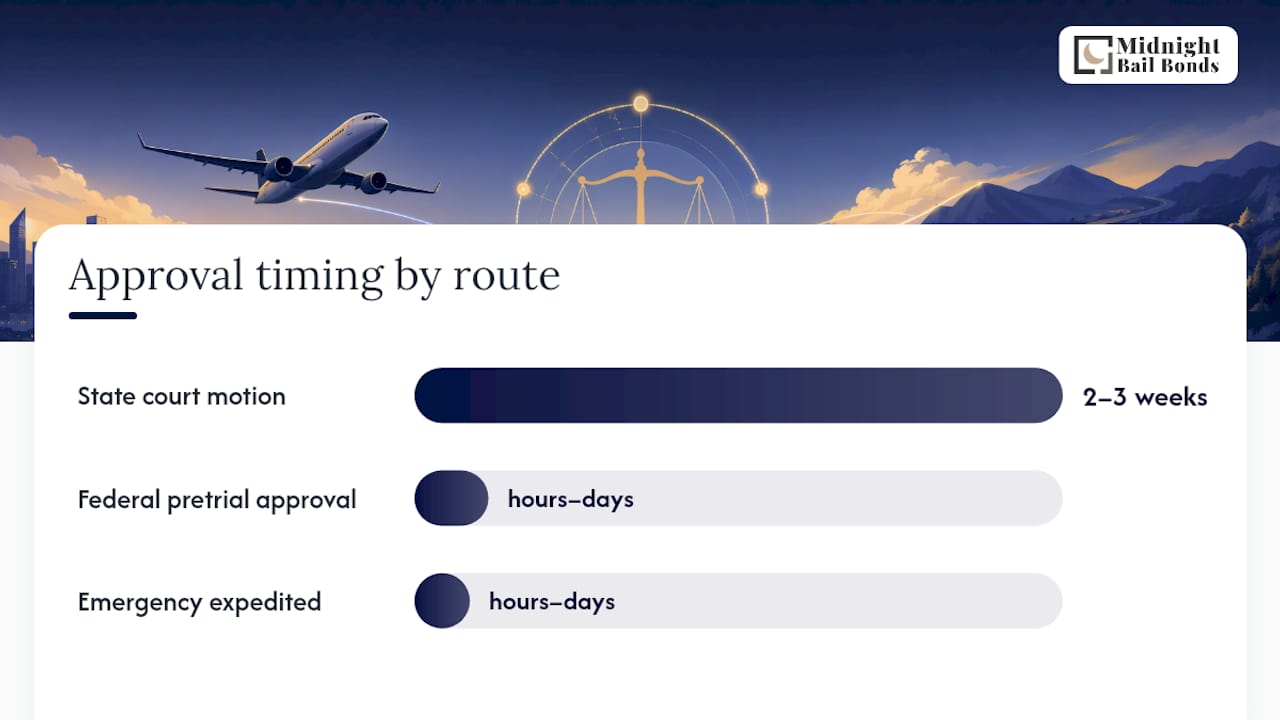
Timing matters. Build in two to three weeks lead time for a state court motion, since judges want to review documentation and, in some courts, hold a brief hearing. Federal pretrial approvals can move faster for routine requests. Genuine emergencies have expedited paths, but "expedited" still means hours or days, not minutes.
Building a Travel Request Judges Actually Approve
A vague request gets a vague answer, usually no. A specific one, with documentation attached, gives the judge or pretrial officer something concrete to say yes to.
Include these elements every time:
- Your case number and the exact conditions you're asking to modify.
- Precise travel dates, destination, and stated purpose (work trip, medical appointment, family emergency).
- A phone number or address where you can be reached the entire time you're away.
- Your attorney's contact information, so the court can verify details quickly.
- Proof of intent to return, such as round-trip airline tickets or a hotel reservation with a checkout date.
Attach supporting documents where possible: an employer letter confirming a work trip, medical records, a funeral notice, a detailed itinerary, or proof of local ties like a lease or a family member's address. Attaching employer letters, medical records, or funeral notices measurably improves approval odds, according to guidance courts commonly follow.
Judges are also more receptive when you offer mitigations upfront: additional check-ins, GPS monitoring, or a temporary increase in surety.
Pro Tip: Draft your request like a business memo, not a plea. Dates, destination, reason, evidence, done. Judges respond to clarity, not emotion.
What to Do When You Need to Travel on Short Notice
Emergencies don't wait for a three-week court calendar, and courts generally understand that. What they expect is documentation, not just urgency.
The moment you know you need to travel unexpectedly:
- Call your attorney first, then your pretrial officer or bondsman, in that order.
- Gather proof of the emergency immediately: hospital records, a death certificate, a funeral home notice.
- Ask your attorney to request an emergency hearing or an expedited written order rather than relying on a phone call.
Who can actually move fast varies. In federal cases, pretrial services can sometimes grant expedited temporary approval without a full hearing. State cases usually still need a judge's signature, though many courts fast-track genuine emergencies when the prosecutor doesn't object. Local judicial discretion plays a real role here, and how readily a court grants travel permission often depends on your prior compliance and ties to the community.
Never treat a verbal "go ahead" as final. A supervising officer or bondsman's spoken assurance can evaporate the moment something goes sideways, and you'll have no paper trail to point to. Get the confirmation in writing, even if it's a short email, before you leave.
What Happens If You Travel Without Permission
The risks scale up fast once you leave without documented approval, and courts don't treat this as a minor paperwork lapse.
- Bond revocation and arrest. Unauthorized travel is grounds for the court to revoke your release entirely, and a warrant can follow.
- Financial forfeiture. Leaving the jurisdiction without permission can trigger forfeiture of bail or leave a co-signer financially liable for the full bond amount.
- Harder future terms. A violation on record makes every future bail request tougher, with stricter conditions and higher amounts.
Evidence of unauthorized travel isn't hard to produce anymore. GPS monitoring data, credit card records, and flight manifests are routinely used in revocation hearings, and they leave little room for argument once submitted. International attempts carry an added layer of risk: passport surrender or an explicit no-leaving-the-country condition can result in detention at the border itself, not just a court sanction after the fact.
What a Bail Bondsman Can (and Can't) Do About Travel
A bondsman's role in travel logistics is real, but limited, and it's worth knowing exactly where that line sits.
What a bondsman can typically do:
- Explain the travel clauses buried in your bond contract in plain language.
- Coordinate with your attorney and pretrial services to make sure paperwork lines up before you file anything.
- In some cases, agree to post additional surety or adjust bond terms if a modification is granted.
Midnightbail offers 24/7 availability, flexible payment plans, no-collateral options in many cases, and bilingual English and Spanish support, along with a free instant inmate search tool. These are practical resources if you're coordinating a release or trying to sort out bond terms quickly.
What no bondsman can do: override a judge's written travel ban or lift a passport-surrender order. Only the court that set those conditions can change them, and any bondsman who tells you otherwise is giving you bad information.
What I Tell Clients Who Ask About Traveling on Bail
Never book anything nonrefundable until you're holding written permission from the court, and written confirmation from your bondsman if your contract requires it. That single rule prevents most of the trouble I see.
My workflow is always the same order: check the paperwork first, call the attorney and pretrial officer next, gather documents, file the motion, then wait for the signed order before making a single reservation. Skipping a step to save time is how people end up detained at an airport instead of on a plane.
Pro Tip: Keep a physical folder with your release order, any modification approvals, and your attorney's contact information. Bring it every time you travel, even domestically.
— Jake
How Midnightbail Can Help You Coordinate Travel Logistics on Bail
Midnightbail won't change a judge's order, but it can take a lot of the friction out of everything around it. If you're trying to sort out bond terms, confirm a contract clause, or move fast because a family emergency just came up, having a bondsman available at 2 a.m. instead of waiting for business hours makes a real difference.

Midnightbail posts bail across California 24/7, offers flexible payment plans, and provides no-collateral options in many cases, so a family in crisis isn't stuck choosing between raising cash fast and doing this the right way. Bilingual support means language isn't a barrier when every hour in custody counts. What Midnightbail can't do is override a written court order or a passport-surrender condition. Those decisions belong to the judge, and any travel request tied to your case still needs to go through your attorney and the court. If you need help sorting out a bond, checking a contract clause, or locating someone in custody before you make travel plans, call Midnightbail any time, day or night.
This article is general information, not a substitute for advice from a qualified lawyer. Consult a qualified legal professional about your own circumstances before acting on anything here.
Sources
- Can You Travel Out of State on Bond? Rules & Restrictions - LegalClarity
- Can You Leave the State if You Are Out on Bail? – Catalyst Legal
- Can I go abroad on bail? | Holborn Adams
FAQ
Can I travel if I'm out on bail?
It depends entirely on your release order. Some conditions allow local or statewide movement freely, while others require written court or bondsman approval before you travel anywhere outside a set boundary.
Do airports know if you're on bail?
There's no universal real-time bail status feed that airports check automatically, but if a passport has been surrendered or a court has issued a travel ban, border and airline authorities can be notified and block travel at that point.
What can you not do while on bail?
Beyond travel limits, most bail conditions restrict contact with alleged victims or witnesses, require regular check-ins with pretrial services, and can bar new arrests or weapon possession. Exact restrictions vary by case and jurisdiction.
What's the longest you can be on bail?
There's no fixed universal limit. Bail conditions typically remain in effect until the case resolves through trial, plea, or dismissal, which can take anywhere from weeks to well over a year depending on the court's caseload and the complexity of the charges.