
If you think you have an outstanding warrant, call the issuing court clerk or a criminal defense attorney today. Do not wait for a traffic stop to find out. Warrants do not expire, and the longer one sits active, the less control you have over how and when police find it.
Here's the priority order:
- Verify the warrant through the court clerk's office or an online docket search.
- Talk to an attorney about a voluntary surrender or a motion to quash before any arrest happens.
- Weigh your bail options: cash, a bail bond, or release on your own recognizance.
- If bail is involved, contact a licensed bail agent to arrange funds or a bond in advance.
Pro Tip: Resolving a warrant through a lawyer or a court's quash calendar almost always beats waiting to get picked up. It puts the timing in your hands instead of a patrol officer's.
Key Takeaways
Resolving a warrant quickly through the court clerk, an attorney, or a licensed bail agent almost always beats the uncertainty of waiting to be arrested.
| Point | Details |
|---|---|
| Verify before acting | Confirm warrant details with the court clerk or county docket before deciding on surrender or bail. |
| Bail is nonrefundable at 10% | Bail bonds typically cost about 10% of the bail amount, and that premium is never returned. |
| Quashing isn't case closure | A quashed warrant cancels the arrest order but the underlying charge still needs resolution. |
| Rules vary by state and county | California's Penal Code 978.5 shows how bench-warrant rules differ from one jurisdiction to the next. |
| Midnightbail offers 24/7 support | Midnightbail provides around-the-clock warrant checks, bond posting, and bilingual assistance across California. |
This article is general information, not a substitute for advice from a qualified lawyer. Consult a qualified legal professional about your own circumstances before acting on anything here.
Table of Contents
- What a Warrant Is and How It Differs From Bail
- How Bail Works Once a Warrant Involves You
- How Judges Set Bail and When There's No Bail at All
- Warrant Bail Bonds: How They Work in Practice
- How to Check for an Outstanding Warrant
- Steps to Resolve a Warrant Before an Arrest
- What Happens if You're Arrested on a Warrant
- Bail and Warrant Rules Change Depending on the State
- What a Bail Bondsman Actually Does and How to Pick One
- Your Legal Rights When a Warrant or Bail Is on the Table
- A Bail Agent's Practical Perspective on Resolving Warrants Quickly
- How a Licensed Bail Agent Can Help You Right Now
- Sources
- FAQ
What a Warrant Is and How It Differs From Bail
A warrant is a judge's signed order authorizing law enforcement to arrest a specific person. Courts issue them for missed court dates, unpaid fines, probation violations, or new criminal charges backed by probable cause. Once signed, a warrant stays active indefinitely. Nothing about it expires on its own.
Two types show up constantly in warrant and bail cases:
- Bench warrants: issued by a judge, usually for failing to appear (FTA) in court or ignoring a court order.
- Arrest warrants: issued based on probable cause tied to a new criminal allegation, often after police or prosecutors present evidence to a judge.
The practical difference matters less than the shared risk. Either type means officers can detain you during a routine stop, a traffic accident, or even a background check for a job.
A warrant does not go away by ignoring it. It waits, sometimes for years, until an officer runs your name.
How Bail Works Once a Warrant Involves You
Bail exists to guarantee you show up to court, not to punish you before a trial. Courts accept several forms of payment, and knowing the options ahead of time saves hours once a warrant surfaces.
Common ways to post bail include:
- Full cash bail, paid directly to the court and refunded (minus fees) if you appear as required.
- Certified funds or a cashier's check, which many courthouses require instead of credit cards.
- A bail bond through a licensed bondsman, who posts the full amount for a nonrefundable premium.
- A property bond, using real estate as collateral instead of cash.
- Release on your own recognizance (ROR), which requires no financial deposit at all.
The 10% standard: bail bonds typically cost around 10% of the total bail amount, and that premium is nonrefundable regardless of the case outcome.
Some courts also run administrative programs or payment plans that soften the upfront cost. But skip a court date after posting bail, and the court forfeits it, then issues a fresh warrant on top of the original problem.
Pro Tip: Ask the clerk whether the courthouse accepts certified funds only. Several municipal courts, including those noted in Huntsville's own bail guidance, won't take a personal check or credit card at the window.
How Judges Set Bail and When There's No Bail at All
Judges don't pull bail amounts out of thin air. They weigh the charge, your record, your ties to the community, and whether missing court looked willful or unavoidable. A missed hearing because of a documented medical emergency reads very differently than skipping town.
Factors that typically shape a bail decision include:
- Severity of the underlying charge (misdemeanor versus felony)
- Flight risk and prior failures to appear
- Criminal history and any active probation
- Community and family ties
- Public safety concerns tied to the original offense
- Local bail schedules that set baseline amounts by charge
In some cases, judges set no bail at all, holding the person until a hearing determines whether any conditions could ensure appearance and public safety. California offers a clear statutory example: Penal Code 978.5 lists specific situations where a bench warrant can issue for failure to appear, and gives judges room to set bail, recall the warrant, or order detention depending on the circumstances.
Bail amounts vary wildly by county and state. The same missed court date can mean a $500 bond in one jurisdiction and thousands in another.
Warrant Bail Bonds: How They Work in Practice
A warrant bond, sometimes called a bench-warrant bond, differs from a standard bond in one key way: it's posted before an arrest happens, often to clear the warrant proactively rather than to bail someone out of custody after booking.
Here's how the process typically unfolds:
- You or your attorney confirm the warrant's exact details, including the case number and bail amount, with the court clerk.
- A licensed bail agent reviews the warrant and quotes the bond premium.
- The bondsman posts the bond once the fee is paid, sometimes before you ever set foot in jail.
- The court marks the warrant satisfied and schedules a new court date.
Pricing note: the premium runs about 10% of the bail amount, same as a standard bond, though some warrant cases carry additional processing fees or collateral requirements depending on the bail size and the agency's policy.
Pro Tip: An experienced bondsman can often coordinate a voluntary surrender with the court so custody lasts hours instead of days. That coordination is worth more than the premium itself when timing is tight.
How to Check for an Outstanding Warrant
Don't guess. Confirm it through official channels before making any decisions about surrender or bail.
- Call the clerk of the court most likely to have issued it. Have your full legal name and date of birth ready.
- Search your county's online court docket, which many counties publish for free.
- Check the sheriff's or jail's official inmate search page for active bookings tied to your name.
- If you're unsure which court has jurisdiction, check municipal, county, and state records, or ask an attorney to run a broader check.
Pro Tip: Skip the third-party "warrant lookup" sites that ask for a credit card. They pull outdated data and often charge for information the court clerk gives you free.
Steps to Resolve a Warrant Before an Arrest
Once you've confirmed a warrant exists, you have real options, some far less disruptive than others.
- Verify every detail: case number, court, and bail amount.
- Consult a criminal defense attorney about your specific situation.
- Ask whether the court has a quash calendar or amnesty program that lets you resolve minor warrants without physical arrest.
- If advised, arrange a voluntary surrender at a time you control.
- Line up bail funds or a bond in advance so release isn't delayed.
- Bring identification and documentation of any emergency that caused the missed court date.
Each path carries tradeoffs:
- An attorney-filed motion to quash lowers your arrest risk, and for minor misdemeanors, a lawyer can sometimes appear on your behalf without you physically showing up.
- Voluntary surrender puts you in control of timing, though it still usually means a short stay in custody.
- Paying bail outright gets you released fastest but ties up your cash until the case resolves.
- Using a bondsman lowers the upfront cost through a smaller premium, though that premium is never refunded.
One caution worth repeating: quashing a warrant only cancels the arrest order. It doesn't resolve the underlying charge, fines, or compliance requirements. You'll still need to show up and deal with the original case.
What Happens if You're Arrested on a Warrant
If police pick you up on an active warrant, expect booking first: photographs, fingerprints, and a records check. How long you sit in custody afterward depends heavily on timing, the local jail's schedule, and whether it's a weekend or holiday.
- Booking includes photos, fingerprints, and a warrant confirmation against the court's records.
- Initial custody can run anywhere from a few hours to a couple of days before your first court appearance, generally bound by rules requiring a probable-cause hearing within about 48 hours.
- A bail hearing may follow immediately or get scheduled separately, depending on the jurisdiction and charge.
Bring or arrange the following in advance if you can: identification, an attorney's contact information, and someone ready to post bail or contact a bondsman on your behalf. If your original warrant stemmed from a missed court date, documentation of the reason (a hospital record, a flight cancellation) can influence how a judge handles bail on return.
Pro Tip: A judge can order no bail in some cases, or revoke bail you already posted once, if the failure to appear looks willful. Forfeiture procedures kick in fast once a second FTA happens.
Bail and Warrant Rules Change Depending on the State
There is no single national playbook for warrants and bail. Every state, and often every county within that state, sets its own bail schedules, quash procedures, and rules for how bench warrants get cleared.
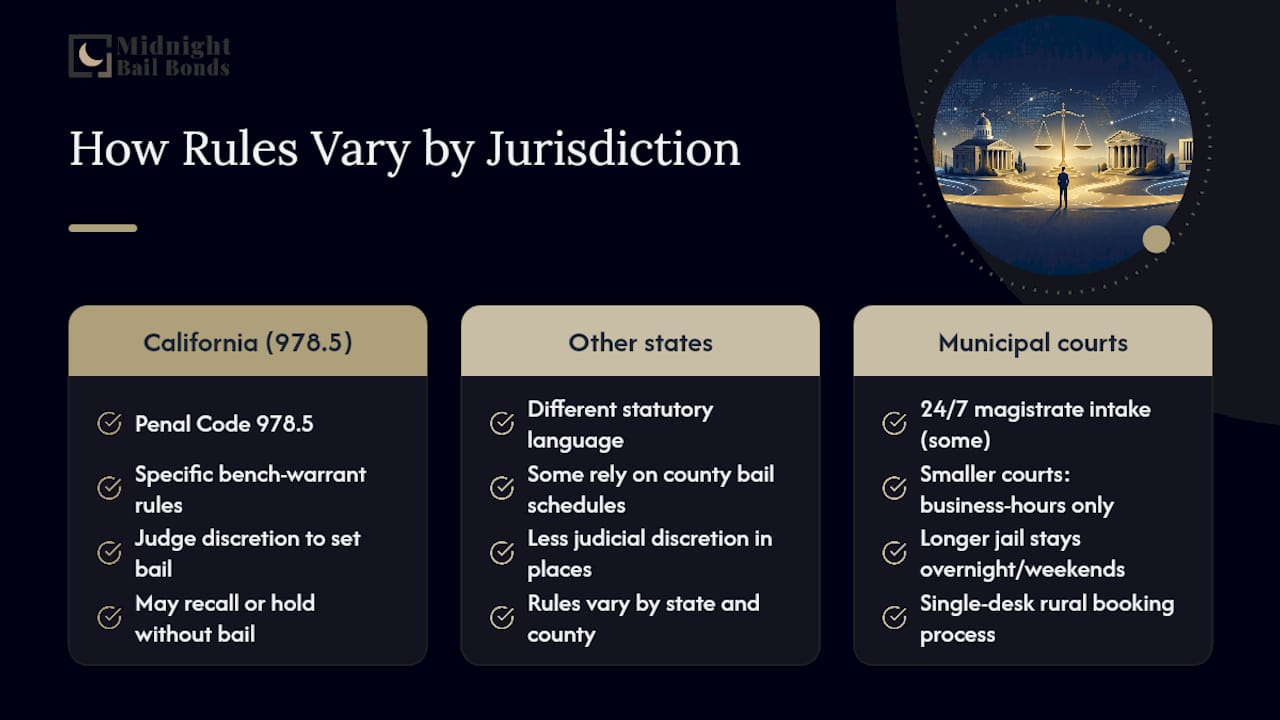
California's Penal Code 978.5 spells out specific circumstances for issuing a bench warrant, and gives judges discretion to set bail, recall the warrant, or hold someone without bail depending on the case. Other states handle the same failure-to-appear scenario through entirely different statutory language, and some rely more heavily on standardized county bail schedules rather than judicial discretion on a case-by-case basis.
Municipal courts add another layer of variation. Some, like those described in Huntsville's own municipal court procedures, operate 24/7 magistrate intake for bail processing, while smaller jurisdictions may only process bail during business hours, forcing a longer jail stay for anyone arrested overnight or on a weekend.
This is exactly why calling the specific issuing court matters more than reading a generic guide. A warrant from a Los Angeles County courthouse follows different local logistics than one from a small county courthouse two hours away, and the jail pickup process at facilities like those covered in our Los Angeles bail bonds or Orange County bail bonds guides looks nothing like a rural county's single-desk booking process. If you're dealing with a warrant tied to a specific charge type, like a battery or trespassing case, the local court's habits around bail amounts and quash calendars will shape your options as much as the charge itself.
What a Bail Bondsman Actually Does and How to Pick One
That premium is the bondsman's fee for taking on the financial risk of guaranteeing your appearance. If you skip court, the bondsman is on the hook for the full bail, which is why bonding companies often require collateral or a cosigner for larger amounts.
Contrary to a common assumption, bondsmen don't have some secret pipeline into warrant databases. They pull the same public court dockets, jail rosters, and sheriff records that anyone can access directly. What they bring instead is speed and familiarity: they know which clerk's window handles warrant bonds, how a specific courthouse likes paperwork filed, and how to move a voluntary surrender along faster than someone navigating the system alone.

When choosing a bondsman, look for a few concrete things. Confirm the license is current in your state. Ask whether they require collateral, since many warrant cases can be handled without it depending on the charge and your ties to the area. And ask about availability: a warrant doesn't wait for business hours, and neither should the person helping you clear it.
Your Legal Rights When a Warrant or Bail Is on the Table
You keep every core constitutional protection through a warrant arrest and a bail hearing, and knowing them changes how you handle the process.
You have the right to an attorney, whether retained or appointed, at every stage that touches your liberty, including a bail hearing. You have the right to know the charge behind the warrant, and the right to a prompt hearing rather than indefinite detention. Federal standards make clear that detention is meant to be the exception, not the default, reserved for cases where no combination of conditions or bail would protect public safety or guarantee your return to court.
You also have the right to request a bail reduction. If your circumstances change, new employment, a documented medical emergency that caused the original missed court date, or stronger community ties than the court initially knew about, your attorney can file a motion asking the judge to reconsider the amount. Judges take documented proof of an emergency seriously when deciding whether to recall a warrant or lower bail on return.
None of these rights activate automatically. You have to assert them, usually through an attorney, at the hearing where they matter.
A Bail Agent's Practical Perspective on Resolving Warrants Quickly
In practice, clearing a warrant fast comes down to verification and coordination: confirming the warrant with the court, then working with the clerk to schedule a voluntary surrender instead of leaving it to chance. Speed matters, but so does documentation. Bilingual support and true 24/7 availability aren't extras. When a family calls at 2 a.m. because someone just found out about a warrant during a background check, having someone answer in their language, immediately, is often the difference between a controlled surrender and a panicked mistake.
How a Licensed Bail Agent Can Help You Right Now
Reading about warrants and bail is one thing. Standing in a jail parking lot at midnight wondering what to do next is another. That's where a licensed 24/7 bail agent earns their keep, not just posting bonds, but walking you through warrant verification, voluntary surrender coordination, and the paperwork that turns a scary situation into a manageable one.
Midnightbail provides warrant checks, bond posting, and bilingual support around the clock across California, with an instant inmate search so you're not guessing whether someone's already in custody. Many cases move forward without collateral, which matters when a warrant surfaces unexpectedly and there's no time to gather paperwork.
If you're facing a warrant right now, or a loved one is already in custody, start with Midnightbail's 24/7 service line for immediate help arranging bail or coordinating a voluntary surrender.
Sources
- Bail — Cornell Law School Legal Information Institute
- Bail and Pretrial Release: Federal Law Overview — Congressional Research Service
- Penal Code 978.5 PC - Bench warrant of arrest in California — Shouse Law Group
- Warrant and Bail Information - City of Huntsville
- Warrant / Bail | Aberdeen Township, NJ
FAQ
Can You Get Bail if You Have a Warrant?
Yes, most warrants carry a bail amount set by the judge, and you can post it through cash, a bond, or property to secure release, though some serious cases carry no-bail warrants.
How Long Do You Stay in Jail for a Warrant?
Custody time after a warrant arrest typically ranges from a few hours to a couple of days, generally bound by a rule requiring a probable-cause hearing within about 48 hours.
Can You Bail Yourself Out on a Warrant?
Yes, you can pay your own bail directly to the court using cash or certified funds, or arrange a bond through a licensed bail agent like Midnightbail if you don't have the full amount available.
Can a Bail Bondsman Tell if You Have a Warrant?
A bondsman checks the same public court dockets and jail rosters that anyone can access, so they can confirm a warrant's existence quickly, but they have no special database access beyond those public records.