

A new arrest while you're out on bail almost always triggers immediate custody and a motion to revoke your release, and it can put your posted bond at risk of forfeiture. Judges treat a second arrest as proof that the original release conditions failed, so the response is often swift and unforgiving. Call a criminal defense attorney the moment you learn about the new charge or warrant. Coordinated action in the first 24 hours frequently determines whether you go back to jail for weeks or get a modified bond within days.
TL;DR:
- Most arrests while on bail trigger immediate custody and a high likelihood of bond forfeiture unless a skilled attorney intervenes quickly.
- Violations such as missed check-ins, failed drug tests, or GPS alerts can lead to swift revocation motions even without new charges.
- Federal law presumes detention once probable cause exists for a new felony, making release unlikely after a second arrest.
- Revocation hearings have lower proof standards and often result in detention or modified conditions, heavily influenced by the violation's severity.
- Prompt legal action and prepared co-signers are crucial to minimize custody time and financial losses after a second arrest.
Table of Contents
- What Happens Right After You're Arrested While on Bail?
- Legal Consequences: Revocation, Bail Forfeiture, and New Charges
- The Revocation Hearing and Legal Standards of Proof
- How Judges Decide Outcomes and Possible Court Orders
- What to Do Immediately After a New Arrest on Bail
- Impact on Current Trial or Case Proceedings and Potential Delays
- Rights of the Defendant Upon Re-Arrest While on Bail
- Differences in Procedures by Jurisdiction or State
- Alternatives to Detention After a Second Arrest
- Effect on Co-Defendants or Related Cases
- Practitioner Perspective: How Bail Agents and Defense Lawyers Respond
- How Midnight Bail Bonds Can Help Right Now
- Sources
- FAQ
What Happens Right After You're Arrested While on Bail?
The moment law enforcement books you on new charges, your existing case gets flagged. Pretrial services or the prosecutor's office typically files a motion to revoke your release within days, sometimes hours, and a judge can issue a violation warrant tied to your original case even before the new charge is arraigned.
Booking works differently when you already have an open bond. The intake officer notes your pretrial status, and that flag often changes how the jail handles you. Some facilities deny a new bond outright until the original judge rules on the revocation motion, meaning you could sit in custody on both cases simultaneously while the courts sort out jurisdiction.
Violations surface through several channels, and not all of them involve a dramatic re-arrest:
- A missed check-in with a pretrial officer or bail agent can trigger a bench warrant even without a new crime.
- Failed drug or alcohol tests reported by supervision programs often prompt an immediate violation filing.
- GPS monitoring data showing you left an approved zone gets flagged automatically in many county systems.
- A police report naming you as a suspect, even before formal charges, can reach the original court through routine record checks.
- A victim or witness contacting the court directly, common in domestic violence cases, can accelerate the process outside normal channels.
The speed of this process catches most people off guard. You might not even know a revocation motion has been filed until you're sitting in a holding cell wondering why your original bond doesn't seem to matter anymore. It does still exist. It's just frozen while the court decides what to do with it.
Legal Consequences: Revocation, Bail Forfeiture, and New Charges
Not every violation gets treated the same way. Courts draw a real line between technical violations, like a missed curfew or a late check-in, and substantive violations, meaning a new arrest on separate charges. Technical violations often result in a warning or modified conditions. A new arrest, especially a felony, is a different category entirely.
Federal law spells this out directly. Under 18 U.S.C. § 3148, probable cause that you committed a felony while on release creates a rebuttable presumption against continued release, meaning the burden shifts to you to prove detention isn't warranted. That's a meaningful legal hurdle, not a formality.
Bail forfeiture is the financial side of this equation, and it hits harder than most people expect. If the court forfeits your posted bond, the money or property backing it can be lost outright, and a bail bond company that posted on your behalf can pursue whoever co-signed for the full bond amount, not just the premium. Courts sometimes set aside forfeiture if the defendant is surrendered or justice otherwise warrants relief, but that outcome depends heavily on timing and legal strategy, not luck.
State penalty enhancements add another layer. California, for example, imposes additional prison time under state law when a defendant commits a new felony while released on bail or their own recognizance, on top of whatever sentence the new charge carries. Other states apply similar enhancements, and nearly every state treats failure to appear as a distinct crime, separate from whatever underlying charge sent you to court in the first place.
Quick reference: violation type and typical exposure
| Violation type | Typical court response | Financial risk |
|---|---|---|
| Missed check-in or curfew | Warning, added conditions | Usually none |
| Failed drug/alcohol test | Modified bond, stricter monitoring | Possible partial forfeiture |
| New misdemeanor arrest | Revocation hearing, possible new bond | Forfeiture risk on original bond |
| New felony arrest | Presumption against release (federal); detention likely | High forfeiture risk plus new bond needed |
The Revocation Hearing and Legal Standards of Proof
A revocation hearing isn't a retrial of your original case, and it's not a trial on the new charge either. It exists for one narrow purpose: deciding whether you violated your release conditions and whether continued release still makes sense.
The evidence bar here is lower than what prosecutors need for a conviction. In federal court, probable cause alone on a new felony is enough to flip the presumption against you. For other violations, judges often apply a clear and convincing evidence standard, and some state systems use a preponderance standard instead, meaning the judge just has to find it more likely than not that you broke the rules.
Judges rely on a mix of evidence at these hearings, and it rarely requires a full-blown trial's worth of proof:
- Arrest reports from the new incident, often summarized rather than fully litigated.
- Drug or alcohol test results from pretrial supervision.
- GPS or electronic monitoring logs showing location history.
- Statements from victims, witnesses, or arresting officers.
- Reports from pretrial services officers documenting prior compliance or noncompliance.
Because the standard is lower and the hearing moves fast, defendants sometimes lose release before they've even had a chance to fully understand the new charge against them. That's exactly why waiting to see how things unfold on their own is rarely the right move.
How Judges Decide Outcomes and Possible Court Orders
Judges facing a revocation motion generally have three paths available, and which one they choose depends heavily on the facts in front of them.
- Reinstate the original bond. This happens when the violation is minor, isolated, or explainable, and the defendant has otherwise complied with every condition.
- Modify the conditions. The judge raises the bail amount, adds electronic monitoring, imposes a curfew, or requires more frequent check-ins, often paired with a stern warning.
- Revoke release entirely. The defendant is detained pending trial on both the original and new charges, with no bond available until a later hearing, if one is granted at all.
Judges weigh flight risk, danger to the community, the seriousness of the new allegation, criminal history, and community ties, similar to the weighted release criteria pretrial services use when setting bail the first time around. A defendant with strong community roots and a minor technical violation gets treated very differently from someone facing a new violent felony with a prior record.
The practical fallout compounds quickly. Extended custody means missed work, strained finances, and sometimes consecutive sentencing exposure if convicted on both matters. Posting a second bond, if one is even offered, usually costs more than the first.
Pro Tip: Ask your attorney to request a specific revocation hearing date rather than letting it sit on the docket. Judges often have discretion on scheduling, and a faster hearing date limits how long you sit in custody before anyone even argues your side.
What to Do Immediately After a New Arrest on Bail
The first hour after a bail violation surfaces matters more than almost any other point in the process. Call a defense attorney before you do anything else, and have your original bond paperwork, pretrial officer's contact information, and a written timeline of the new incident ready to hand over.
Voluntary surrender is worth serious consideration if a warrant has been issued but you haven't yet been picked up. Turning yourself in, coordinated through your attorney, tends to present far better at a revocation hearing than getting swept up unexpectedly, and it can avoid the chaos of a surprise arrest at work or home. An attorney can also file a motion to quash the warrant or request a reasonable bail amount before you're even back in custody.
Financing a new bond after a violation gets complicated fast:
- Some bail bond companies decline to post a second bond for the same defendant, viewing repeat arrests as elevated risk.
- Others will post again but require a higher nonrefundable premium, additional collateral, or a new co-signer with stronger financial standing.
- Co-signers face real exposure if forfeiture occurs on the first bond. This financial risk remains even if a second bond is posted.
Resources like the California bail forfeiture breakdown walk through exactly how sureties and defendants are affected when a bond gets forfeited, which is worth reading before you sign anything new.
Pro Tip: If a bondsman hesitates to post a second bond, ask directly what would change their answer, more collateral, a stronger co-signer, or proof of a scheduled hearing date. Specific answers are more useful than a flat no.
Impact on Current Trial or Case Proceedings and Potential Delays
A new arrest rarely stays contained to itself. Once a revocation motion is filed, your original case often slows down while the court sorts out your custody status first. Pretrial motions, plea negotiations, and even scheduled hearings on the first case can get pushed back weeks or months.
Prosecutors sometimes use the new arrest as leverage in plea discussions on the original charge, framing it as evidence of ongoing risk. Defense attorneys have to divide attention between two active matters instead of one, which stretches out preparation time on both.
If you're detained pending the revocation hearing, you also lose the practical advantages of being out on release, like meeting with counsel in person on your own schedule, gathering evidence, or lining up witnesses. Speedy trial clocks don't always stop just because a new charge appeared, so deadlines on the original case can keep ticking while you're stuck resolving the new one. That mismatch is one of the most overlooked consequences of a second arrest, and it's a major reason attorneys push to resolve the revocation question fast rather than let it drag.
Rights of the Defendant Upon Re-Arrest While on Bail
You keep your core constitutional protections even after a new arrest complicates your bail status. The right to counsel applies at the revocation hearing, not just the new criminal proceeding, and if you can't afford a lawyer, the court must appoint one for that hearing too.
You're entitled to notice of the specific violation alleged against you and a chance to respond before the judge rules, though the timeline for that notice can be tight. You also retain the right to present evidence and call witnesses at the revocation hearing itself, even though the standard of proof is lower than at trial. That means you can challenge a failed drug test result, dispute GPS data, or offer context a police report left out.
Importantly, the new criminal charge itself still carries the full presumption of innocence and requires proof beyond a reasonable doubt at any eventual trial. A revocation hearing decides your custody status, not your guilt. Losing that hearing doesn't mean you've lost the underlying case, though it does mean you'll likely be fighting it from inside a jail cell instead of at home.
Differences in Procedures by Jurisdiction or State
Federal and state systems handle re-arrest differently, and even state-to-state variation is significant. Federal cases follow 18 U.S.C. § 3148 uniformly, with its rebuttable presumption against release for new felonies. State systems don't share one standard.
Some states criminalize almost every release condition violation as a separate offense. Others limit that treatment to failure to appear specifically, while handling other violations through civil contempt or administrative sanctions rather than new criminal charges. California's felony-while-on-bail enhancement is one example of a state going further than federal law in a specific direction, adding sentencing exposure that doesn't exist everywhere.
Local court culture matters just as much as the written statute. Some counties move revocation hearings within 48 hours; others let them sit for a week or more depending on docket load. Pretrial services structures vary too, some counties have dedicated supervision officers monitoring compliance closely, while others rely mostly on self-reporting until something goes wrong. If you're facing this situation, don't assume what happened to someone else in a different state, or even a different county, tells you what to expect in yours. Ask your attorney about local practice specifically.
Alternatives to Detention After a Second Arrest
Detention isn't always the only outcome, even after a new arrest. Judges have real alternatives available, and a good attorney will push for them before accepting detention as inevitable.
Modified bail with stricter conditions is the most common middle ground: a higher cash amount, mandatory check-ins, or a requirement that a responsible third party supervise compliance. Electronic monitoring, commonly called an ankle bracelet, lets a defendant remain out of custody while giving the court real-time location data, often paired with a strict curfew or home confinement schedule.
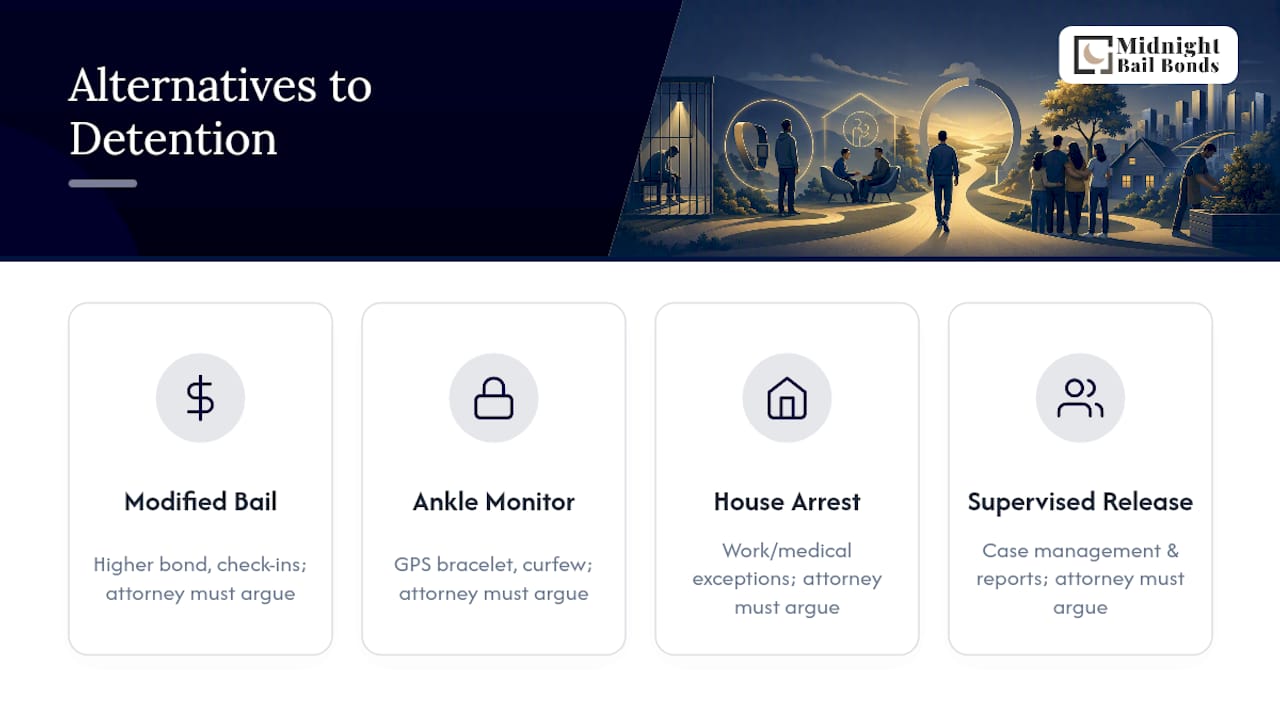
House arrest, sometimes structured through a formal home detention program, allows work release or medical appointments as scheduled exceptions while otherwise confining the defendant to their residence. Some jurisdictions also offer supervised release programs, sometimes run by pretrial services agencies, that add case management and regular reporting requirements without full incarceration.
None of these alternatives get granted automatically. They require an attorney to actively argue for them at the revocation hearing, usually backed by evidence of community ties, employment, or a credible explanation for what happened. A defendant who shows up with a plan, and someone willing to vouch for them, tends to fare better than one who shows up with nothing but an apology.
Effect on Co-Defendants or Related Cases
A new arrest doesn't stay isolated when other people share your case. If you have co-defendants, your violation can raise questions about their reliability too, even when they've done nothing wrong themselves. Prosecutors sometimes use one defendant's re-arrest to argue for stricter conditions across the entire group, particularly in conspiracy or gang-related charges where the court views the defendants as connected.
Co-signers and sureties face the most direct fallout. If your bond gets forfeited, whoever put up the money or property is on the hook, and that person's other financial obligations, a mortgage, a car loan, don't pause while the court sorts out your situation. Family members who co-signed sometimes don't fully grasp this exposure until forfeiture proceedings actually start.
Related civil matters can be affected as well. Restraining orders, custody proceedings, or immigration status reviews tied to the original case often get revisited once a new arrest enters the picture, since many of those proceedings treat pretrial conduct as relevant evidence of risk. If you have co-defendants or family members with financial exposure through a cosigned bond, tell your attorney about those connections early. It shapes how the defense strategy gets built.
Practitioner Perspective: How Bail Agents and Defense Lawyers Respond
Bondsmen see repeat arrests as a red flag, plain and simple. Most will still work with you, but expect a higher premium, added collateral, or a stronger co-signer requirement before they post again, and some decline second bonds outright in higher-risk cases. That's not punishment. It's math. They're on the hook for the full bond if you disappear or get detained.
What actually shortens custody time is speed, specifically an attorney and a bail agent moving in parallel instead of waiting on each other. Attorneys who call ahead to coordinate a bond amount before the hearing consistently get better outcomes than those who show up cold. My honest read after looking at how these cases play out: families often want to focus on getting someone out first and worry about defense strategy later. That instinct is usually backward. A quick conversation with counsel about what triggered the new arrest often determines whether release is even realistic, and skipping that step wastes time you don't have.
— Jake
How Midnight Bail Bonds Can Help Right Now
If you're staring down a new bond amount after a second arrest, waiting until business hours isn't an option, and it shouldn't have to be. Licensed agents often are available around the clock in many areas, with flexible payment plans and no-collateral options available in some cases, so a family scrambling to respond to a revocation hearing isn't also scrambling to find cash on short notice. Bilingual support in English and Spanish can help prevent language barriers from delaying a process where every hour in custody counts.

Before you call, have the basics ready: the inmate's full name, the booking facility, and the bail amount if it's already been set. If you don't have that information yet, the instant inmate search tool pulls booking details in minutes so you're not stuck waiting on hold with a jail switchboard. For cases involving probation violations tied to a new arrest, the probation violation bail bonds page breaks down how that process typically unfolds in California. When you're ready to move, Midnight Bail Bonds is available now to walk through your specific situation and start the release process the same night you call.
Sources
For federal cases, read 18 U.S.C. § 3148 directly rather than relying on a summary. For state-level variation, the NCSL pretrial release database is a solid starting point, and your local pretrial services office can confirm county-specific procedures your attorney may not mention upfront.
This article is general information, not a substitute for advice from a qualified lawyer. Consult a qualified legal professional about your own circumstances before acting on anything here.
- 18 U.S.C. § 3148 – Sanctions for violation of a release condition (U.S. Code)
- Pretrial release violations & bail forfeiture (NCSL)
- What happens if you violate your bond conditions? - LegalClarity
- Arrested while out on bond in Texas: what happens now - Hindieh Law
FAQ
What Happens if You Get Arrested Again While on Bail?
You'll typically face immediate booking on the new charge, a possible violation warrant tied to your original case, and a revocation hearing where a judge decides whether to reinstate, modify, or revoke your existing bond.
What Happens if You Bail Someone Out and They Get Re-Arrested?
The person who posted the bond, whether a family member or a bail bond company, can face forfeiture of the full bond amount if the court revokes release and doesn't set aside the forfeiture. Co-signers should contact the bonding company immediately to understand their specific exposure.
What Can't You Do While Out on Bail?
Standard conditions usually bar committing any new crime, leaving the jurisdiction without permission, contacting certain individuals in cases like domestic violence, missing scheduled check-ins, and failing required drug or alcohol tests. Exact restrictions depend on your specific release order.
What's the Longest You Can Be on Bail?
There's no single national limit. Pretrial release can last as long as a case remains active, sometimes months or longer, though speedy trial rules in most jurisdictions set outer boundaries on how long a case can drag on before trial must begin.