
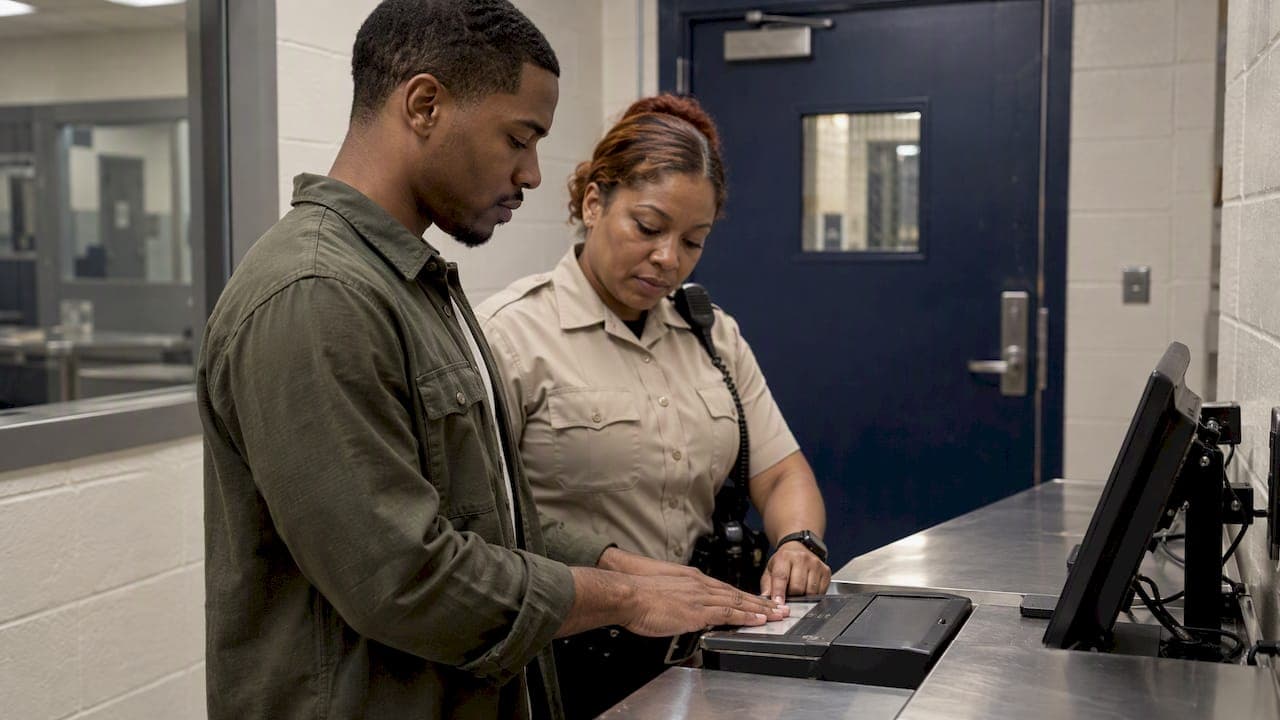
Booking is the jail's administrative check-in after an arrest. Arraignment is the first court hearing, where a judge tells the defendant the charges and asks for a plea. Booking always comes first, and bail is usually decided at or before arraignment. That is why the gap between the two steps is when a family can do the most.
TL;DR
- Booking is police and jail processing: identity, fingerprints, photo, charges recorded. No judge is involved.
- Arraignment is a court hearing: charges are read, rights explained, a plea is requested, and release or bail is addressed if the person is still in custody.
- Booking happens right after arrest. Arraignment follows within days for someone held in jail, or weeks later if the person is released with a citation.
- Families can arrange a bail bond once booking is complete and a bail amount exists, without waiting for the court date.
- Missing an arraignment can lead to a failure-to-appear problem, so the date matters as much as the release.
Table of Contents
- Booking vs. arraignment at a glance
- What happens during booking
- What happens at an arraignment
- How long between booking and arraignment
- Where bail fits in
- What families can do at each step
- Common mix-ups
- Perspective: why the gap matters
- Getting someone out before arraignment
- FAQ
- Sources
Booking vs. arraignment at a glance
The two steps are often mixed up because both feel like "the part where they process my loved one." They are different in who runs them, what they accomplish, and what a family can do during each.
| Booking | Arraignment | |
|---|---|---|
| What it is | Administrative jail and police processing | Formal court proceeding before a judge |
| Who runs it | Arresting agency and jail staff | Judge, prosecutor, defense lawyer |
| When | Right after arrest, usually within hours | Usually the first court date in the case |
| What happens | Personal data recorded, fingerprints, mug shot, charges entered | Charges read, rights explained, plea asked, release decided |
| Is a plea entered? | No | Yes (guilty, not guilty, or no contest) |
| Can bail be posted? | Often, once a bail amount is set | Bail or release is decided here if not already set |
FindLaw describes the split plainly: booking is a non-judicial police function, while arraignment is a court proceeding overseen by a judge that starts the legal case against the defendant.
What happens during booking
After an arrest, the person is taken to a station or jail to be processed. According to the U.S. Department of Justice's COPS Office, booking records the person's name and personal details, takes a mug shot and fingerprints, and enters the charges.
In practice, booking usually also includes a search and inventory of belongings, a health and safety screening, and a check for warrants. Procedures vary by agency and facility, so timing is never identical from one jail to the next.
Phone calls during booking
People being booked are typically allowed to make a phone call, often to an attorney or a family member. If you get that call, stay calm and write down three things: the full legal name, the jail or station holding the person, and the booking number if they have one. The person should avoid discussing the facts of the case on a jail phone.
How long booking takes
There is no single national figure. Many families find it takes several hours, and busy nights or weekends run longer. Our checklist on the jail booking process explains what the wait looks like and what to prepare while it happens.
If someone is held and never booked, the legal system has a safeguard. An attorney can ask a judge for a writ of habeas corpus, which directs the police to bring the person before the court so a judge can decide whether the detention is lawful.
Release without staying in jail
Not everyone booked stays in custody. A person may be released with a citation or a summons to appear, and then the first court appearance can come one to two months later, according to LawHelpMN. That example is from Minnesota, so check the local timeline where the arrest happened.
What happens at an arraignment
An arraignment is usually the first court date in a criminal case. The California Courts Self-Help Guide explains that the defendant learns the charges and their rights, including the right to a lawyer, and is asked to enter a plea such as guilty, not guilty, or no contest.
The same guide adds that the court appoints a lawyer if one is needed, and sets the next court dates. Federal rules follow the same pattern: Rule 10 requires arraignment in open court, with the indictment or information read to the defendant and a plea requested.
What an arraignment is not
It is not a trial. No evidence is weighed and no one decides guilt. Most defendants enter a not guilty plea at this stage, which keeps every option open while the lawyer reviews the case. Your defense lawyer can explain the right plea strategy for your situation.
It is also separate from a probable-cause determination. The Michigan Supreme Court's bench materials say a probable-cause determination confirms the legal justification for the arrest, while an arraignment is about notifying the defendant of the charges and entering a plea. In some places the terms get blurred, and some courts call early hearings "initial appearances," so read the paperwork for the exact label.
Why a prompt arraignment matters
The same Michigan materials explain the purpose: prompt arraignment is meant to advise the arrestee of their rights and the charges, help guard against rights violations, and allow the person's right to liberty on bail to be determined.
How long between booking and arraignment
For someone who stays in custody, the clock is short. In California, Penal Code section 825 requires that a defendant be taken before a magistrate without unnecessary delay and within 48 hours of arrest, excluding Sundays and holidays, with an extension if the court is not in session when that time runs out.
Local practice adds detail. San Diego County's Public Defender explains that a person taken into custody and not released must see a judge within 72 hours, counted as three court days, with weekends, court holidays, and mandatory closure days not counted. A Friday night arrest can therefore mean a first court date on Tuesday or later.

These rules differ by state and county, and the clock may start at arrest or at booking depending on local rules. The jail or the court clerk can tell you the actual date.
A typical timeline
- Arrest. Police take the person into custody.
- Booking. Processing at the jail, usually within hours.
- Bail amount set or release decided. Many jurisdictions use a bail schedule that sets an amount based on the charge. Some people are cited and released.
- Arraignment. The first court appearance, within days for people in custody.
- Next hearings. Pretrial dates, possible plea negotiations, and trial if the case goes that far.
Where bail fits in
Bail is the piece families care about most, and it connects both steps. The amount often exists right after booking, and the court can revisit it at arraignment.
At arraignment, if the defendant is still in jail, the judge decides whether they stay in jail or are released, including on their own recognizance, under supervision, or on bail. Judges weigh factors such as the type of crime, public safety, and whether the person is likely to miss court, according to the same California guide.
Sometimes both things happen in one hearing. FindLaw notes that bail hearings can be combined with the arraignment, so the judge handles the plea and the custody decision together. Factors at a bail hearing can include the seriousness of the alleged crime, criminal history, financial resources, community ties, and appearance and safety risk.
If the judge's decision looks wrong, some states allow a challenge. In Massachusetts, for example, an appeal of a bail decision may sometimes be heard the same day in Superior Court. That is state specific, so ask the defense lawyer what applies locally.
We cover the courtroom side in more depth in our guide to the bail hearing process, and what judges can attach to release in conditions of release in California.
Do not wait for arraignment if bail is already set
A common mistake is assuming nothing can happen until the judge speaks. If a bail amount already exists after booking, a bail bond can be arranged then, and the person may walk out well before the court date. If you wait, your loved one may spend those days in a cell for no reason other than not knowing the option was open.
The cost structure is simple. In California, the bond premium is typically 10% of the total bail amount, and it is non-refundable. Our bail bond calculator page lets you see the figure for a specific bail amount.
What families can do at each step
During booking
- Confirm which jail or station holds the person and get the booking number.
- Use the jail's public inmate search to check whether booking is complete and what the bail amount is. We offer a free instant inmate search for exactly this.
- Do not bring cash to the station unless staff tell you to. Do not discuss the case on recorded lines.
- Read our three immediate steps after an arrest so nothing gets missed in the first hours.
Between booking and arraignment
- Retain a private defense lawyer, who can represent the defendant or prepare for the arraignment, or ask about a court-appointed one. Family members can help by hiring private counsel.
- Gather what a judge may ask about: employment, address, family ties, and time in the community. These are bail factors.
- Ask about the court date and write it down. The date, courtroom, and time matter as much as the release.
- Review the person's rights after arrest in California.
At arraignment
- The defendant should attend, or have the lawyer attend where the court allows, and should arrive early.
- If cost is a concern, Massachusetts explains that a defendant can speak privately with the duty lawyer about a bail hearing regardless of financial status. Other states have their own public defender systems.
- Listen for the next court dates and any release conditions. Missing a date after release can cause new problems, as we describe in arrested while on bail.
Common mix-ups
"Booking means they are charged." Not quite. Booking records the arrest and the charges the arresting agency lists. The prosecutor decides which charges are formally filed, and the arraignment is where those are read.

"Arraignment is when bail is first possible." Not always. Bail may be available right after booking under a schedule. Arraignment is where a judge can set, change, or deny release.
"A not guilty plea means the person claims to be innocent." It means the person is not giving up the right to contest the case. The lawyer explains what that looks like in context.
"An arraignment and a preliminary hearing are the same." They are separate. A preliminary arraignment typically comes first, then a hearing about whether the case has enough evidence to proceed, though terms differ by state.
Perspective: why the gap matters
We talk to families during the stretch between booking and arraignment more than any other time. They usually believe the clock stops until a judge speaks, and it does not. Every night in custody is a night away from work, kids, and a lawyer's office.
Our licensed agents answer calls directly at any hour, give a clear cost up front, and write many bonds without collateral. We have local offices and direct working relationships with jails and courts, and we offer bilingual English and Spanish support on every shift, because a family in crisis should not have to explain things twice.
Our advice is simple: find out where your person is held, find out whether bail is set, and call. We will explain the process, the 10% premium, and the court date you still have to make.
Jake
Getting someone out before arraignment
If your loved one has been booked and bail is set, we can start right away. Midnight Bail Bonds provides 24/7 bail bond services across California, with flexible payment plans and no-collateral options in many cases. You can pay by cash, credit or debit card, Zelle, or financing. Our 24-hour bail bonds page explains how a call works, and you can start from your phone with online bail bonds.
Facing a DUI? See our page on DUI bail bonds in California. For county-specific help, we cover San Diego County and Orange County around the clock.
FAQ
Does booking happen before arraignment?
Yes, always. Booking is the jail processing that follows an arrest, and arraignment is the later court hearing. Someone released with a citation may be booked briefly and then wait weeks for the arraignment.
Is an arraignment the same as a bail hearing?
No, but they can happen together. Arraignment is about the charges and plea, while a bail hearing is about release and its terms. Some courts combine both in one proceeding, and bail may already be set from a schedule before either.
Can I post bail before the arraignment?
Often yes, if a bail amount has been set after booking. A bond can be arranged without waiting for the judge, and the release comes with a court date to attend. If a judge later changes the amount or conditions, the arrangement can be adjusted, so tell your agent the outcome of each hearing.
What happens if someone misses their arraignment?
A missed court date can lead to a warrant and trouble for the bond. The defendant should contact their lawyer and the court right away rather than waiting. Our agents can explain how a missed date affects a bond if you call us.
How soon after arrest is the arraignment?
It depends on the state and on custody. In California, someone held must be taken before a magistrate within 48 hours, excluding Sundays and holidays. Released defendants may wait weeks.
Sources
- TAP and the Arrest, Booking, and Disposition Cycle (U.S. DOJ COPS Office)
- The arraignment (California Courts Self-Help Guide)
- Rule 10. Arraignment (Federal Rules of Criminal Procedure, Cornell Law School)
- The Arrest Process (FindLaw)
- Police Booking Procedure (FindLaw)
- Right to a Prompt Arraignment (Michigan Courts)
- Criminal Case Process (San Diego County Public Defender)
- I got arrested. What happens now? (LawHelpMN)
- Your arraignment or first appearance in court (Mass.gov)
- Penal Code 825 PC: Arraignments and Attorney Visits