
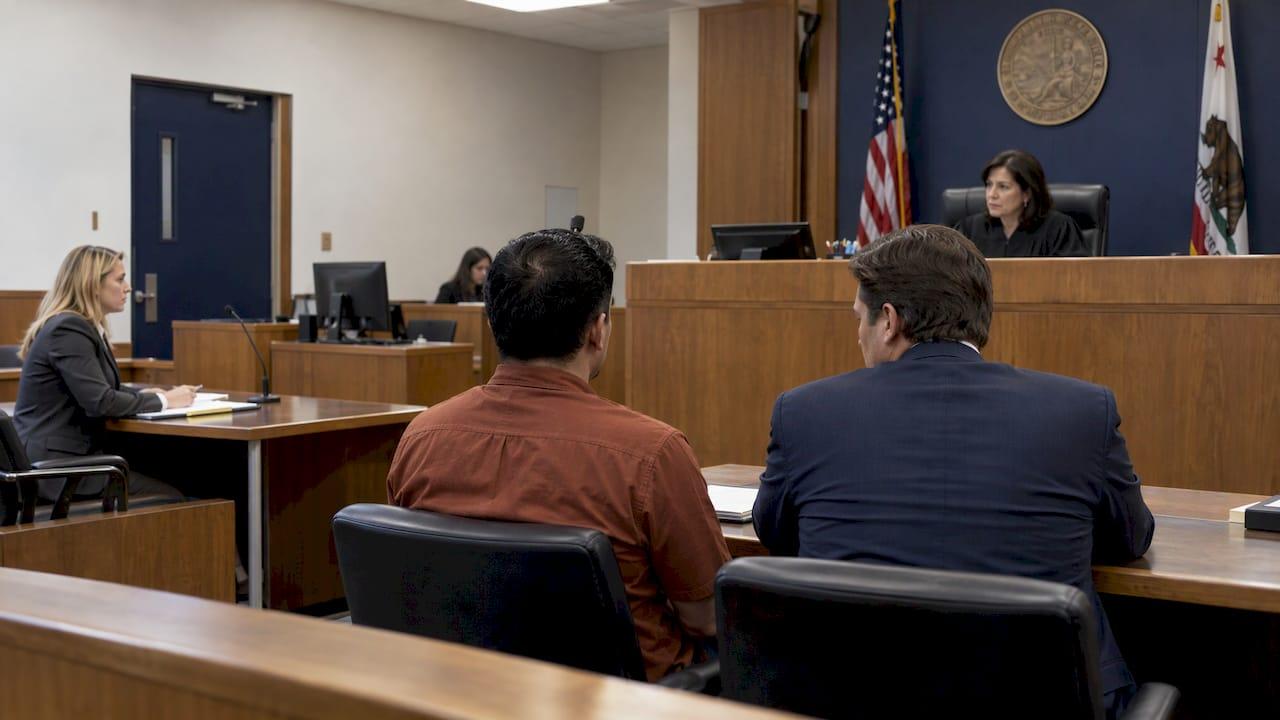
In California, bail is set by one of two things: the county bail schedule or a judge. Before a first court appearance, the amount comes from the arrest warrant or, if there is no warrant, the schedule for that county. After the first appearance, a judge decides, and the judge can go higher, go lower, or release the person without bail. This guide walks through each step so you know what number to expect and what can change it.
TL;DR
- Before the first court appearance, bail is the amount on the warrant or, with no warrant, the county bail schedule amount.
- After the first appearance, a judge sets bail and weighs the seriousness of the charge, criminal record, public and victim safety, and the chance the person will return to court.
- Judges can raise or lower the schedule amount, and California courts must consider what a person can afford.
- A bail bond premium is typically 10% of the full bail and is not refunded. Cash bail paid to the court is returned when the case ends, minus any fees.
- If someone you love was just arrested, you can start the process with us at any hour.
Table of Contents
- Who sets bail in California?
- How the county bail schedule works
- What a judge weighs when setting bail
- Serious charges need a hearing before any change
- Ability to pay: what the courts now require
- Can the bail amount change?
- Perspective from our desk
- Release options once bail is set
- Does bail money come back?
- What to do in the first hours
- Need bail posted now?
- FAQ
- Sources
Who sets bail in California
The answer depends on timing. California Penal Code section 1269b says that if a defendant has already appeared before a judge, bail is the amount the judge fixed at that appearance. If that appearance has not happened yet, bail is the amount in the arrest warrant. If no warrant was issued, it is the amount in the uniform countywide bail schedule.
The California Courts overview of pretrial procedure describes the same sequence: the warrant or county schedule first, then a judge after the defendant appears in court.

This is why two people arrested for the same offense can face different numbers. One may be booked on a schedule amount at 2 a.m. The other may see a judge the next court day and hear a different figure.
Three stages in plain terms
- Arrest with a warrant. The judge who signed the warrant already wrote the bail amount on it. Jail staff use that number.
- Arrest without a warrant. Jail staff look up the charge in the county schedule and book the person at that amount.
- First court appearance. A judge or magistrate reviews the case, and the schedule amount no longer controls.
How the county bail schedule works
Every county has its own schedule. The Penal Code makes it the duty of superior court judges in each county to prepare, adopt and annually revise a uniform countywide schedule for bailable felonies and for misdemeanors and infractions, other than Vehicle Code infractions.
A schedule is a list that matches each offense to a dollar figure. The purpose, as the Santa Clara County 2026 schedule puts it, is to fix an amount at which a person arrested without a warrant can be released before appearing in court. If the person was arrested on a warrant, bail is the warrant amount instead.
Because each county writes its own, figures differ across the state. If you want the real number for a specific charge, read that county's current schedule, which is posted on the superior court's website. The Orange County uniform bail schedule and the Stanislaus County schedule are both public examples, and both say that after the first appearance the judge has discretion to set an amount above or below the schedule.
Most charges are built from a statute number, such as a drug possession or domestic violence code section. If you know the code section, you can often find the schedule line quickly. We have written about what families commonly see for drug possession bail amounts and for PC 273.5 bail if your situation matches.
What a judge weighs when setting bail
Once a judge is involved, the schedule is a starting point and not a rule. The San Francisco Superior Court's bail fact sheet explains that the California Constitution requires judges to consider five things:
- the seriousness of the charged crime
- the defendant's previous criminal record
- whether the defendant is a risk to the community
- the safety of the victim
- whether the defendant is likely to appear at the next court date
The California Attorney General's office adds that public safety and victim safety are the primary considerations when a judge sets, reduces or denies bail.
The American Bar Association describes the same logic nationally: judges weigh flight risk, the type of crime, dangerousness and community safety. They may also release someone on their own recognizance, which means no money is paid, often when the person has a steady job or roots in the community.
Felony versus misdemeanor
Seriousness drives the number more than anything else. Nolo reports that as a general rule, felony bail can run 5 to 10 times the bail for misdemeanors, and that many judges follow standard practices tied to the seriousness of the charge. Judges can raise or lower the standard amount or waive bail altogether.
Cases where bail may be denied
Not every charge is bailable. FindLaw notes that in certain serious cases, such as capital crimes, violent offenses and sex offenses, a defendant may not be entitled to bail. If a loved one faces a charge like this, a licensed bail agent or the defense attorney can tell you whether bail is available in that case.
Serious charges need a hearing before any change
California adds a safeguard for the most serious arrests. Under Penal Code section 1270.1, before a person arrested for a serious felony, a violent felony or certain other listed offenses can be released on an amount higher or lower than the schedule, or on own recognizance, a hearing must take place in open court.
The prosecutor and defense attorney must get two court days of written notice and a chance to be heard. If the person has no lawyer, the court appoints one for that purpose only. The Orange County schedule repeats the practical effect: for these offenses, the schedule amount stands until that hearing.
For families, this means a violent or serious felony arrest rarely produces a quick change. Plan around the schedule amount first, then expect the hearing to be the moment the number can move.
Ability to pay: what the courts now require
California has changed how judges think about the affordability of bail. In In re Humphrey (2021), the state Supreme Court held that jailing someone solely because they cannot afford bail is unconstitutional. When a money condition is still needed, the court must consider the person's ability to pay and cannot effectively detain them only because they lack the money.
The same decision says that when no option other than refusing release can protect the state's interests, a court must first find by clear and convincing evidence that no lesser condition would be enough.
The San Francisco fact sheet summarizes the practical test: the judge looks at the ability to post the amount, the seriousness of the offense and the criminal record, and only when less restrictive options would not work can detention or an unaffordable amount be ordered. Nolo adds that the California Supreme Court has since ruled, in In re Kowalczyk (2026), that in bailable cases bail must be reasonably attainable for the defendant.
In practice, a defense attorney can raise income, family obligations and work history at the hearing. Judges may also consider nonmonetary conditions such as electronic monitoring or supervision. For more on those, see our guide to bail conditions in California.
Can the bail amount change?
Yes. The California Courts overview explains the options. Before arraignment, the defendant, an attorney, a friend or a family member can ask for lower bail or release on own recognizance. Law enforcement can ask for higher bail if the schedule amount would not ensure appearance or would not protect a domestic violence victim or family member.
After arraignment, changing bail that has already been posted requires good cause, such as changed circumstances or newly discovered facts. Automatic review has to happen within five days of the original bail order, according to the same overview.

Own recognizance release is also a real path for lower-level cases. Penal Code section 1270 says a defendant arraigned on a misdemeanor complaint is entitled to release on own recognizance unless the court finds on the record that release would compromise public safety or would not reasonably assure appearance.
Perspective from our desk
Most families call us before anyone has seen a judge. They have a number from the jail, usually the schedule amount, and they are afraid it is final. It often is not, but the hours between arrest and first appearance still matter, because every hour in custody costs a job shift, childcare or peace of mind.
Our view is simple: you should not have to solve the whole legal puzzle at midnight. Understand which stage you are in, get the number, and decide whether posting a bond now makes sense or whether waiting for a judge could be better. We answer calls directly at any hour with licensed agents, explain costs upfront, and write many bonds without collateral, so the amount does not have to be a wall between your family and release.
If the amount is reduced at the first appearance, the bond can be written at the new figure. If it is not, a payment plan can make the schedule amount manageable. Either way, get a clear answer on cost before you commit.
Jake
Release options once bail is set
After the amount is fixed, there are four common ways out. The bail bond option is the one families most often use when the full amount is too much to put up in cash.
| Option | What you pay | Do you get it back? |
|---|---|---|
| Cash bail | The full amount to the court or jail | Returned when the case ends, usually minus fees |
| Surety bond through a licensed agent | A premium, which is 10% of the bail with us | No, the premium is a fee for the service |
| Own recognizance | Nothing; a written promise to appear | Not applicable |
| Conditional release | Nothing, or a smaller amount, plus conditions | Not applicable |
On a bond, the agent guarantees the full bail to the court, and the family pays the premium. Our premium is 10% of the total bail amount. Because the premium is the fee for the guarantee, it is not returned when the case ends.
If you are still comparing price points, our pages on affordable bail bonds and no collateral bail bonds explain what is available and when.
Does bail money come back?
It depends on how it was paid. The American Bar Association explains that bail is not a fine or punishment. Its purpose is to make sure the defendant appears for trial and pretrial hearings, and it is returned when the trial is over, in some states minus a processing fee.
So cash paid straight to the court comes back at the end of the case, whatever the verdict, though fees may be deducted. A bond premium does not come back, because it paid for a service. Either way, the best way to protect your money is to make sure the person attends every court date. Our guide to what happens after bail covers check-ins, court dates and what to do if one is missed.
What to do in the first hours
- Find the booking details. You need the full name, date of birth and the jail. A free inmate search can show the charge and bail amount.
- Learn the charge and the code section. This tells you which line of the county schedule applies.
- Ask whether a warrant exists. A warrant amount replaces the schedule.
- Decide whether to post now or wait for the judge. For lower-level cases, own recognizance release at the first appearance is possible. For serious charges, expect a hearing.
- Plan how you will pay. Cash, a bond with a premium, or a bond with a payment plan are the usual routes.
If a family member is held on a 1275 hold, the rules about how bail funds are handled are different, and our 1275 hold bail bonds page explains what applies.
Need bail posted now?
If you already have a bail amount and need your loved one home, we can help at any hour. Our licensed agents answer calls directly, offer English and Spanish support, accept cash, credit and debit cards, Zelle and financing, and write many bonds without collateral. Our premium is 10% of the total bail, and we can explain payment plans before you commit.
Start with our 24-hour bail bonds page, or begin the paperwork from your phone with online bail bonds.
FAQ
Who sets bail in California?
Before a first court appearance, bail is the amount on the arrest warrant or, if there is no warrant, the county bail schedule. After the first appearance, a judge or magistrate sets it. The judge can follow the schedule, go higher or lower, or release the person on their own recognizance.
Is bail the same in every county?
No. Each county's superior court judges adopt and revise their own schedule, so the same offense can carry different amounts in different counties. The court's website posts the current schedule, and a licensed bail agent can look up the number for a specific booking.
Can a judge lower bail because someone cannot afford it?
Yes. Under In re Humphrey, California courts must consider ability to pay when a money condition is used and cannot effectively jail someone only because they are poor. A defense attorney can raise income and family circumstances at the hearing, and the judge may use nonmonetary conditions instead.
Do I get my money back if I use a bail bond?
No, not the premium. The premium is a fee for the service and is not refunded, even if the charges are dropped. Cash bail paid directly to the court is a different case: it is returned when the case ends, minus any fees the court deducts.
Sources
- California Penal Code section 1269b
- California Penal Code section 1270.1
- California Penal Code section 1270
- Pretrial Law and Procedure: an Overview, California Courts
- Bail fact sheet, San Francisco Superior Court
- Bail, California Department of Justice Office of the Attorney General
- 2026 Criminal Bail Schedule, Santa Clara County Superior Court
- Bail Schedule, Stanislaus County Superior Court
- Uniform Bail Schedule, Orange County Superior Court
- In re Humphrey, Supreme Court of California
- How Bail Is Set: What Judges Consider, Nolo
- How Courts Work: Bail, American Bar Association
- Bail Hearing Procedures, FindLaw