

Call a licensed bail bond agent now and post a surety bond, not a legal motion to reduce bail. That's the fastest path to release for most families. Expect a non-refundable premium, usually about 10% of the total bail, and ask upfront about payment plans or no-collateral options. Keep the inmate's name, booking number, jail facility, and bail amount ready before you dial.
TL;DR:
- Posting a bail bond with a licensed agent is the fastest way to secure release, often within hours, while legal efforts to lower bail can take days or weeks.
- The non-refundable premium in California is usually around 10% of the bail, and a small down payment of 10% to 40% can start the process without needing the full amount.
- Collateral involves real estate, vehicles, or valuables and is returned once the case is resolved, but appraisals and titles may add time and cost.
- Timing and jail processing volume heavily influence release speed, with busy facilities or overnight hours delaying actual release even after bond posting.
- Verify the agent’s license, request a written quote, and avoid pressure tactics to prevent issues during the stressful release process.
Table of Contents
- Step-by-Step Checklist For the First 1 to 4 Hours
- Payment Options: Premium, Payment Plans, and Collateral
- Collateral: What It Means and the Co-Signer's Risk
- Documents, Payments, and Realistic Timelines
- Quick Vetting Checklist and Red Flags to Avoid
- Legal Criteria for Requesting a Lower Bail Amount
- Working With a Lawyer vs Representing Yourself
- How Long It Takes and How Often It Works
- What Happens to Payment Terms if the Amount Changes
- Two Separate Tracks: Bond Posting vs Court Action
- A Direct Note From Midnight Bail Bonds
- Call a Licensed Agent Tonight, Not Tomorrow
- Sources
- FAQ
Step-by-Step Checklist For the First 1 to 4 Hours
The first few hours after an arrest set the pace for everything that follows. Move through these steps in order, and you'll likely have your family member home before the night is over.
- Confirm the bail amount and location. Use the county's public inmate lookup or an agent's instant inmate search to find the booking number, facility, and bail figure. This step alone saves agents from guessing, which slows everything down.
- Call a 24/7 licensed agent. Have the inmate's full legal name, date of birth, booking number, and the jail's name ready. The agent will also ask for your name, relationship to the defendant, and a callback number.
- Discuss the premium and payment structure. Ask directly: is a payment plan available, and does this bond qualify for a no-collateral arrangement? Down payments often range from around 10% to 40% of the premium, and bond posting frequently starts as soon as the down payment and signed agreement are in.
- Sign the bond paperwork. This is usually done electronically or by fax/email if you're not near the office, which matters if you're coordinating from work or another city.
- Track the release. Agents typically notify jail staff once the bond posts, and the facility processes release from there. Ask your agent for a rough time estimate based on that specific jail's current booking volume.
Facilities vary widely on speed. A county jail running a light shift might release someone in under an hour after the bond posts; a busy metro facility on a Friday night could take considerably longer.
Payment Options: Premium, Payment Plans, and Collateral
The single most common confusion families have is mixing up the premium with collateral. They are not the same thing, and understanding the difference protects your wallet.
The premium is the fee you pay the bail agent for the service of posting bond. It's non-refundable, full stop, regardless of how the case turns out. Collateral, by contrast, is a security deposit against the bond amount. It gets returned once the court obligations are satisfied and the bond is exonerated.
In California, that premium is typically set at 10% of the bail amount, and rates are filed with and regulated by the state insurance department.
Here's what a payment plan usually looks like in practice:
- Down payment: often 10% to 40% of the premium, not the full bail amount
- Repayment window: commonly spread across several months, with installment schedules set by the agency
- Financing fees: some agencies charge none; others build a small fee into the plan, so ask directly
- Collateral waivers: agencies may skip collateral entirely for smaller bonds or when a co-signer has strong income and community ties
Statistic Callout: A down payment covering just 10% to 40% of the premium is often enough to get the paperwork moving, meaning a family doesn't need the full premium in hand to start the release process.
Collateral: What It Means and the Co-Signer's Risk
Collateral is a security interest, not a fee. If the defendant skips court, the bondsman has legal grounds to seize whatever was pledged, which is why this section matters more than most people realize before they sign anything.
Common forms of collateral include:
- Real estate, which usually requires a title check and sometimes a formal appraisal
- Vehicles, often verified against the title and current market value
- Jewelry or other high-value items, occasionally requiring independent appraisal
Appraisals and title checks take time and sometimes carry their own fees, so ask about those costs before agreeing to pledge property. Collateral is generally returned once the case resolves and the bond is exonerated, but the exact timeline and any recording fees should be spelled out in writing.
Pro Tip: Ask for an itemized quote before you sign anything. A transparent itemized quote reveals appraisal or filing fees upfront instead of surprising you weeks later.
Protect yourself as a co-signer by keeping every receipt, getting the collateral terms in writing, and tracking the defendant's court dates yourself rather than relying on someone else to remind you.
Documents, Payments, and Realistic Timelines
Have a valid photo ID ready, and bring proof of income if you're negotiating a payment plan. If collateral is involved, bring the relevant documents (title, deed, or appraisal paperwork) too.
- Cash, credit or debit cards, Zelle, and financing are all common ways to pay
- Electronic payments tend to process faster than cash drop-offs or checks that need to clear
- Once the bond posts, release often happens within a few hours, though this depends heavily on the specific jail's booking volume and shift staffing
- Confirm the facility's processing hours directly. Some jails slow down overnight or during shift changes, regardless of how fast your agent works
Quick Vetting Checklist and Red Flags to Avoid
Not every agent operates the same way, and a few minutes of vetting can save you from a bad experience during an already stressful night.
- Verify the license. Every legitimate agent should be licensed through the state insurance department or equivalent regulatory body. Ask for the license number if it's not posted.
- Request a written, itemized quote. A legitimate agency puts the premium, any financing fees, and collateral terms in writing before you sign anything.
- Watch for pressure tactics. High-pressure signing, vague fee structures, or refusal to hand over written terms are all warning signs.
- Ignore anyone who promises to change the court-set bail amount. That's not something a bail agent controls, and any agent who claims otherwise isn't being straight with you.
Pro Tip: Reach out to the agency proactively if you're worried about affording an installment. Agencies handled proactively are generally far more willing to adjust payment terms than they are once a payment is already missed.
Legal Criteria for Requesting a Lower Bail Amount
Courts don't lower bail on request alone. A judge needs a specific legal basis before adjusting the amount a defendant already faces.
The most common grounds include a change in circumstances since the initial bail was set: new employment, a stable address, community ties, or evidence that the original amount was set without full information about the defendant's ability to pay. Judges also weigh flight risk and public safety, so a defendant with strong ties to the area and no history of missing court dates has a stronger case than someone with neither.
Some jurisdictions also allow arguments based on the severity of the charge relative to the bail figure, or evidence that the bail schedule used was disproportionate to the individual's financial situation. A first-time, non-violent offense with an unusually high bail amount is the kind of scenario where this argument tends to carry weight.
None of this changes what happens at the jail door tonight, though. While a legal argument for a lower amount works through the court's calendar over days or weeks, the bail bond premium and payment structure determine how fast someone actually walks out. The two tracks run in parallel, not as substitutes for each other.
Working With a Lawyer vs Representing Yourself
A criminal defense attorney is generally the stronger path for pursuing a lower bail amount, mainly because judges expect a formal argument supported by evidence: employment records, character references, ties to the community, or proof of a stable home address.
Self-representation is legally allowed, but it puts the burden entirely on the defendant or family member to gather that evidence, format the request properly, and argue it before a judge who hears dozens of similar arguments every week. Most public defender offices can also file this kind of request on a client's behalf if private counsel isn't affordable.
Either way, this process runs separately from arranging a bail bond. Families who need someone released tonight typically move forward with a bail bond immediately, then pursue the legal argument for a lower amount afterward, if it's still worth pursuing once the person is already out.
How Long It Takes and How Often It Works
Timelines vary by county and by how backed up the local court calendar is. A request tied to an already-scheduled hearing might get addressed in days; a standalone request filed outside that schedule can take considerably longer, sometimes weeks, before a judge even reviews it.
Outcomes depend heavily on the strength of the evidence presented and the judge's read on flight risk. A defendant with a clean record, stable housing, and no prior missed court dates has a meaningfully better shot than someone with a spotty history, but no formal request comes with a guaranteed result.
This is exactly why most families don't wait on that process to secure release. Posting a bail bond takes hours, not days, and it's the more reliable route when someone needs out now.

What Happens to Payment Terms if the Amount Changes
If a bail amount does get lowered later, it directly affects the numbers tied to any bond already posted. A smaller bail figure means a smaller premium base going forward and potentially a lower amount of collateral required to secure it.
Timing matters here. If the bond was already posted at the original, higher amount before any change came through, the existing agreement and premium already paid generally stand, since the premium is a service fee for posting the bond, not a deposit tied to the final bail figure. Some agencies will work with families to adjust remaining payment plan installments if the bond terms get renegotiated, but that's a conversation to have directly with the agent, not an automatic outcome.
This is another reason proactive communication with your agent pays off. An agency that knows a legal reduction is in progress can plan around it instead of enforcing rigid terms that no longer reflect the situation.
Two Separate Tracks: Bond Posting vs Court Action
These are genuinely two different processes, and mixing them up costs families time when it matters most. Posting a bail bond is a financial transaction between you, a licensed agent, and the court, resolved in hours. Pursuing a lower bail amount is a legal proceeding, resolved on the court's calendar, sometimes over weeks.
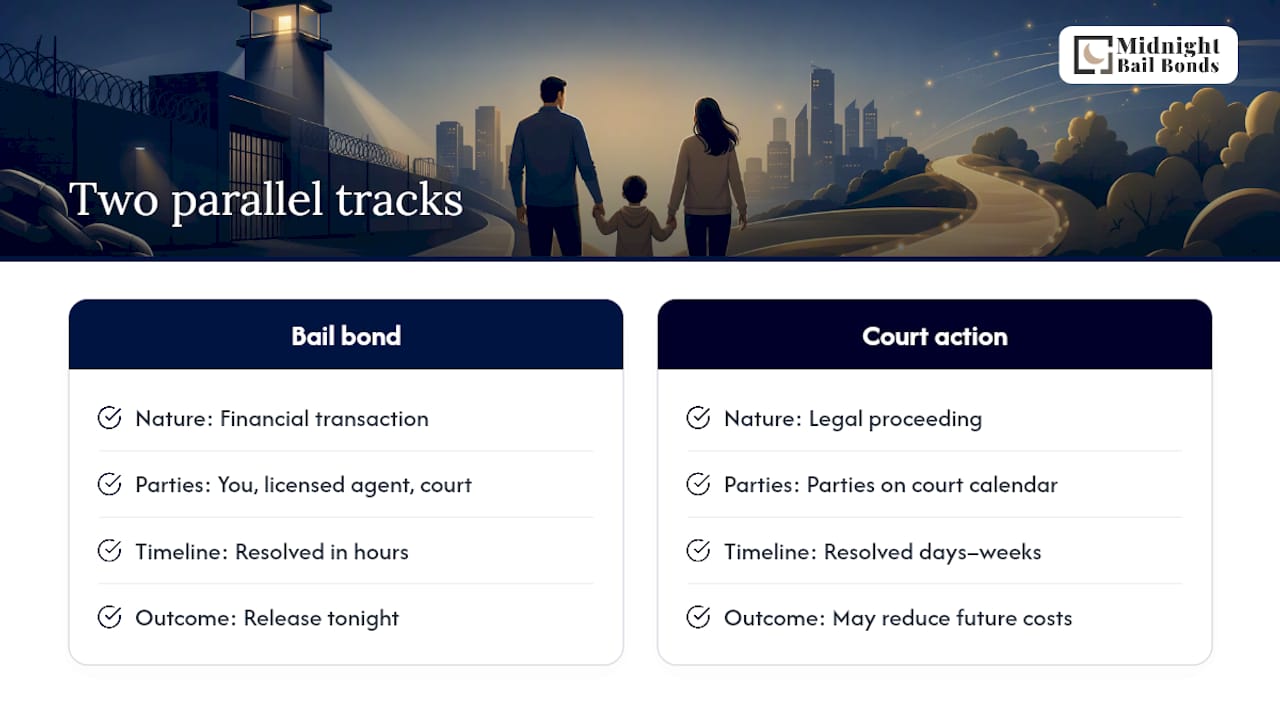
One gets your family member out tonight. The other might reduce future costs if it succeeds, but it doesn't speed up release by itself. Treat them as parallel efforts rather than sequential steps, since waiting on a court decision before calling a bail agent only extends time in custody.
A Direct Note From Midnight Bail Bonds
Families calling us at 2 a.m. aren't looking for a sales pitch. They need someone who picks up, speaks their language if needed, and explains payment terms without pressure. That's the standard we hold every agent to, and it's why collateral gets returned promptly once a bond is exonerated, not held longer than necessary.
— Jake
Call a Licensed Agent Tonight, Not Tomorrow
Waiting until morning to call an agent costs your family member another night in custody, and that's the one variable you have direct control over. Midnight Bail Bonds runs 24/7 across California with licensed, bilingual agents who can walk you through payment plans or no-collateral options the moment you call.
Have the booking number and jail location ready if you can find them, and if you can't, our inmate search tool will find them for you in minutes. We accept cash, credit or debit, Zelle, and financing, and we'll give you an itemized quote before anything gets signed. If you're near Orange County, our 24-hour Orange County team can move even faster on local paperwork. Call now, and let's get your family member home.
Sources
- How Does Bail Work - Posting Bail in California - PC 1276, 1276.5
- How flexible payment plans make bail bonds accessible when you need them most
- Bail and collateral explained
- Bail Bonds — California Department of Insurance
FAQ
What's the fastest way to get someone out of jail?
Call a 24/7 licensed bail bond agent, provide the inmate's booking details, and arrange the premium payment. Most releases happen within hours once the bond is posted, though exact timing depends on the jail's processing speed.
Is the bail bond premium refundable?
No, the premium is a non-refundable service fee, typically around 10% of the bail amount in California. Collateral, if required, is different and gets returned once the bond is exonerated.
Can I get a bail bond without collateral?
Many agencies, including Midnight Bail Bonds, offer no-collateral options for smaller bonds or when a co-signer has strong income and community ties. Eligibility varies case by case.
Does asking a court to lower bail speed up release?
No. A legal request to lower bail runs through the court's calendar and can take days to weeks, while posting a bail bond typically secures release within hours.
What information does a bail agent need to start?
The inmate's full legal name, date of birth, booking number, and the jail facility's name are the essentials. Having this ready before you call cuts down significantly on processing time.