

Missing court after bail release almost always triggers a bench warrant, forfeits the bail money, and can add a brand-new criminal charge on top of your original case. Judges typically revoke your release or set a higher, sometimes no-bail, amount, and co-signers can lose whatever they pledged. If this has already happened, the single best move is to surrender voluntarily and call your attorney or bail agent immediately, before police find you first.
TL;DR:
- Missing a court date triggers a bench warrant and the forfeiture of your bail, significantly increasing your chances of arrest and raising bail conditions if you're re-released.
- Failure to appear often results in a charge that matches the seriousness of the original offense, with penalties scaling up for prior missed court dates or if you cross state lines to avoid arrest.
- The timeframe to resolve bail forfeiture in California is typically 180 days, during which locating and surrendering yourself can prevent full bond forfeiture and additional penalties.
- Skipping bail can negatively impact your future case outcomes, lead to higher bail amounts, or prevent bail altogether in subsequent arrests due to the breach of trust.
- Noncitizens with missed court dates risk complicating immigration processes, as bail-jumping convictions can be used as evidence of flight risk or moral character issues in immigration proceedings.
Table of Contents
- Skip Bail Consequences Start With One Missed Date
- What Happens the Moment You Miss Court?
- How Serious Is a Bail Jumping Charge?
- The Money Side: Forfeiture, Premiums, and Who Else Pays
- How Long Do You Have to Fix a Forfeiture?
- What Should You Do Right Now if You Missed Court?
- Can Skipping Bail Affect Your Immigration Status?
- Does Skipping Bail Affect Other Cases or Probation?
- Does Skipping Bail Consequences Differ by State?
- Will Skipping Bail Haunt You in Future Cases?
- What Bail Agents Actually Do When You Miss Court
- How Midnightbail Helps After a Missed Court Date
- Sources
- FAQ
Skip Bail Consequences Start With One Missed Date
""Skipping bail" is the everyday term for what courts call failure to appear (FTA), sometimes called bail jumping or a release violation depending on the state. You didn't necessarily flee the country. Missing one hearing, even by accident, puts the FTA label on your file.
Most jurisdictions treat failure to appear as its own crime, graded to match the seriousness of whatever you were originally charged with. Skip out on a felony DUI case, and the FTA itself often gets charged as a felony. Skip a misdemeanor shoplifting hearing, and it usually stays a misdemeanor.
A few things courts weigh when deciding how hard to come down on you:
- Whether you had any notice of the hearing date
- How long you stayed missing before being caught or surrendering
- Whether you picked up new charges while gone
- Your prior record of missed court dates, if any
California's rule is a good example of how technical this gets. Under Penal Code § 1320.5, the law presumes you intended to evade the court if you don't show up within 14 days of your missed date. That presumption is not automatic guilt, but it flips the burden onto you to explain the gap.
What Happens the Moment You Miss Court?
The clock starts ticking within hours, not days. Here's the typical sequence:
- The judge issues a bench warrant. This isn't a formality. Once entered into law enforcement databases, it can surface during a routine traffic stop, a workplace background check, or a random ID scan, and lead straight to arrest.
- The court declares bail forfeited. Whether you posted cash or used a bond, the money or the bond amount is now at risk of being lost for good.
- Your release conditions get reviewed, and rarely in your favor. A judge who learns you missed a date has three common responses: revoke your release entirely, raise your bail substantially, or slap on a no-bail hold until trial.
The ripple effects go beyond the warrant itself. Missing court signals to a judge, and to prosecutors, that you're a flight risk. That perception alone can wreck plea negotiations that were previously headed somewhere favorable. If you're arrested on the bench warrant while also facing a new charge, most judges will not extend a second chance at pretrial release. According to legal guides on the topic, FTA is treated as an aggravating factor in nearly every jurisdiction, and it often shows up again at sentencing on the original case even after everything else gets resolved.
How Serious Is a Bail Jumping Charge?
Bail jumping penalties scale directly with the charge you were out on bail for. There's no flat, one-size-fits-all punishment; the FTA charge mirrors the grade of your underlying offense in the overwhelming majority of states, a pattern legal researchers describe as the grade-tracking rule.
Federal cases follow their own statute. Under 18 U.S.C. § 3146, penalties for failing to appear scale with the maximum sentence tied to the original federal charge, and any FTA sentence runs consecutive to, not alongside, whatever you get on the underlying case. That consecutive structure matters: it means the failure to appear adds real time on top, rather than blending into an existing sentence.
Statutory snapshot: In California, a felony failure to appear under Penal Code § 1320.5 can carry a fine up to $10,000 and up to a year in county jail or state prison, separate from any punishment on the original charge.
Certain factors push penalties even higher across most states: a prior history of missed court dates, crossing state lines to avoid arrest, or committing a new crime while out on release. States like Washington spell this out directly in statute, listing narrow, specific circumstances that can reduce or eliminate liability, such as genuinely uncontrollable circumstances documented at the time. Forgetting a court date, or a canceled bus, generally doesn't meet that bar.
The Money Side: Forfeiture, Premiums, and Who Else Pays
Skipping bail hits your wallet, and often someone else's, just as hard as it hits your freedom. What you lose depends on how the bail was posted in the first place.
If you paid cash bail directly to the court, that entire amount is at risk of forfeiture the moment the judge declares it. If you used a bail bond instead, the story is different: the premium you paid the bail company, typically a percentage of the full bail amount, was already nonrefundable the day it was posted. Skipping court doesn't just risk that premium; it puts the full bond amount on the line for the bail company, which is exactly why bondsmen move fast to locate a missing client.
A few financial realities worth knowing upfront:
- Forfeiture on cash bail can convert into an actual money judgment against you if you don't resolve it in time, collectible the same as any civil debt.
- If a family member or friend co-signed as an indemnitor and pledged a house, car, or savings as collateral, that collateral becomes exposed the moment forfeiture is declared.
- Bail companies can and do pursue indemnitors directly for the full bond amount, plus recovery costs, if the defendant isn't found in time.
- Bail premiums are generally not tax deductible, so there's no year-end silver lining to a forfeited bond.
Pro Tip: If you co-signed for someone and they've gone missing before a court date, don't wait for the bail company to call you. Reach out first. Every day that passes shrinks the window to fix things without losing collateral.
How Long Do You Have to Fix a Forfeiture?
California gives a concrete example of how these recovery windows work, and it's tighter than most families realize. Once a court declares bail forfeited, the 180-day recovery period under Penal Code § 1305 starts running immediately. If the court mails notice of the forfeiture, that deadline extends slightly, to 185 days, to account for mailing time.
What actually needs to happen during that window:
- The bail agent or indemnitor works to locate the missing defendant, often coordinating with law enforcement.
- The defendant surrenders or is arrested and brought back before the court, ideally well before the deadline.
- Someone, usually the surety or the defendant's attorney, formally petitions the court to vacate the forfeiture based on the timely return.
Miss that window entirely, and the outcome is much harsher: the court can enter summary judgment against the bail company, which then has legal grounds to collect the full bond amount from whoever signed for it. Courts retain some discretion to vacate forfeiture even after the window closes under limited exceptions, but nobody should count on that.
What Should You Do Right Now if You Missed Court?
If you're reading this because you or someone you love already missed a hearing, speed matters more than almost anything else. Here's the order that actually helps:
- Call your attorney first. They can often find out whether a warrant has been issued and what the judge's likely response will be before you walk into a courthouse blind.
- Contact your bail agent immediately. They have a direct financial interest in getting this resolved fast and can often coordinate a controlled surrender rather than a street arrest.
- Document what actually happened. Hospital records, a car accident report, or proof of a jailing in another county can support a genuine emergency defense.
- Consider voluntary surrender over waiting to get caught. Courts and prosecutors consistently treat someone who turns themselves in far better than someone dragged back in cuffs.
The legal standard for excusing a missed court date is narrow. Courts generally require proof of circumstances truly beyond your control, paired with evidence that you surrendered as soon as those circumstances lifted. A missed alarm or bad traffic almost never clears that bar.
Pro Tip: If you're not sure whether a warrant has been issued yet, don't guess. A quick inmate and warrant check can tell you exactly where things stand before you make your next move.
Can Skipping Bail Affect Your Immigration Status?
For noncitizens, missing court after bail carries risks that go well beyond the criminal case itself. A bail-jumping conviction, on top of whatever the underlying charge was, can factor into an immigration judge's assessment of moral character and flight risk in a separate immigration proceeding.
Immigration authorities and criminal courts operate on separate tracks, but they're not blind to each other. A bench warrant from a skipped court date can surface during any encounter with law enforcement, including routine stops, and that encounter can trigger a hold or a referral to immigration enforcement depending on the circumstances and the person's existing status. A new FTA or bail-jumping conviction, layered onto an existing criminal record, can also weigh against future requests for relief such as bond reduction, visa applications, or adjustment of status.
None of this operates the same way for every case; it depends heavily on the person's existing immigration status, the nature of the underlying charge, and which immigration court has jurisdiction. Someone with lawful permanent residency facing a misdemeanor FTA is in a very different position than someone without documented status facing a felony bail-jumping charge. What stays consistent is the underlying principle: courts and immigration authorities both weigh a documented history of failing to appear as evidence against granting future release, whether that release is bail or an immigration bond.

Anyone with immigration concerns tied to a missed court date should talk to an immigration attorney alongside their criminal defense lawyer, not instead of one. The two cases move on different clocks, and mistakes in one can quietly damage the other.
Does Skipping Bail Affect Other Cases or Probation?
Yes, and this is one of the more overlooked consequences. Courts don't treat a failure to appear as an isolated event confined to a single case file. If you're on probation or parole from a prior conviction when you skip bail on a new charge, that missed court date is almost always reported to your supervising officer, and it typically counts as a probation violation on its own.
A probation violation hearing runs on a lower evidentiary standard than a full criminal trial. Judges don't need proof beyond a reasonable doubt to revoke probation; they generally need only a preponderance of the evidence that a violation occurred. A documented FTA on a new case is usually enough on its own to trigger that revocation, which can send someone back to serve the remainder of a suspended sentence, entirely separate from whatever happens on the new charge.
The damage compounds if you have multiple open cases. A bench warrant issued in one county doesn't stay contained there. Once entered into shared law enforcement databases, it can surface in any county, at any traffic stop, background check, or booking, which means a missed date on a minor case in one jurisdiction can suddenly complicate an otherwise unrelated case somewhere else. Judges handling the second case will almost certainly learn about the outstanding warrant and factor it into bail decisions on that case too.
The practical lesson: a single missed court date rarely stays isolated. It ripples into probation status, parole eligibility, and any other open case tied to your name, often before you've had a chance to explain what happened.
Does Skipping Bail Consequences Differ by State?
Consequences of skipping bail vary meaningfully depending on where the case is filed, and that variation catches a lot of families off guard. The core mechanics, a bench warrant, forfeiture, and a possible new charge, show up almost everywhere. The details underneath differ sharply.
Some states impose flat statutory penalties for bail jumping regardless of the underlying charge's severity, while others, including California, tie the FTA penalty directly to the grade of the original offense through statutes like Penal Code § 1320.5. Recovery windows for forfeited bail differ too. California's roughly 180 day window is generous compared to some states, which give sureties considerably less time to locate and return a missing defendant before the bond converts to a money judgment.
Federal cases add another layer entirely. If your underlying charge is federal, 18 U.S.C. § 3146 governs the FTA penalty regardless of which state you're physically in, and federal sentencing tends to run stricter and more consistently than state-level outcomes.
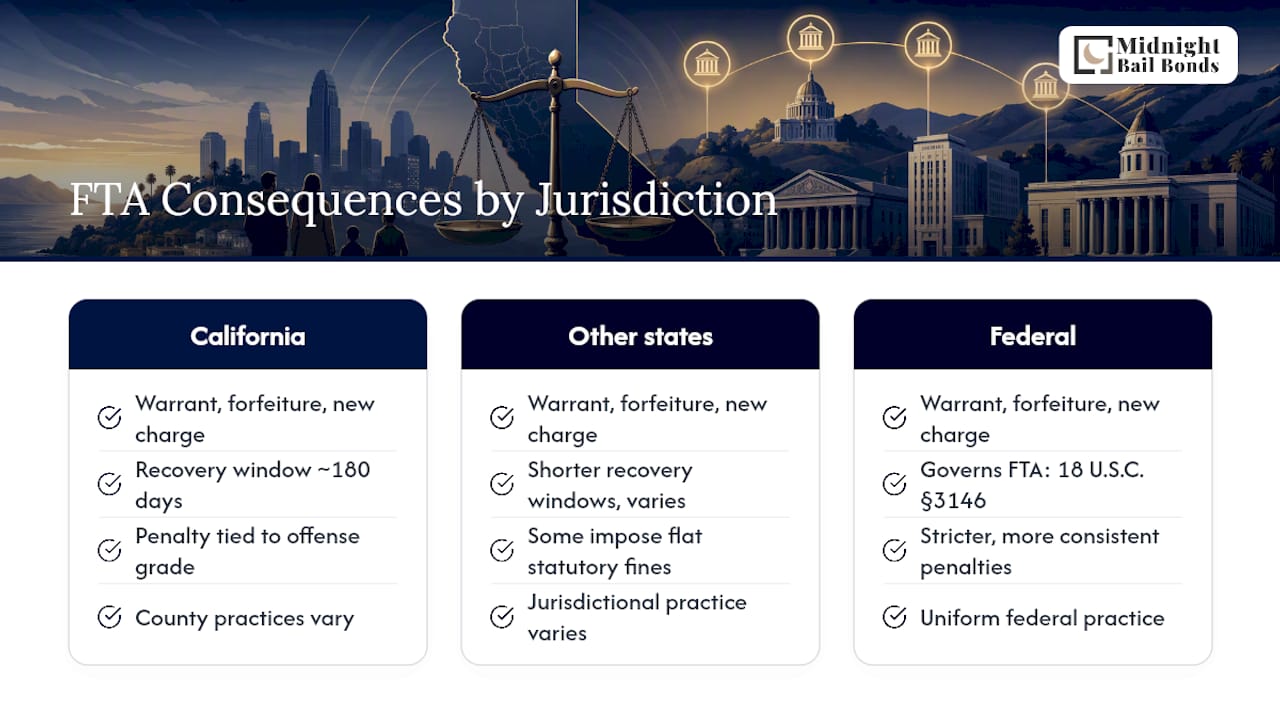
Even within a single state, county-level practice varies. Some courts issue warrants and move to forfeiture almost immediately after a missed hearing. Others build in a short grace period, sometimes a matter of days, before formalizing either action, particularly for defendants with no prior history of missed dates. None of this is something you should try to guess your way through. If you're facing a missed court date anywhere in California, an attorney or bail agent familiar with that specific county's practices can tell you far more accurately what to expect than any general rule.
Will Skipping Bail Haunt You in Future Cases?
Long after the immediate legal mess gets resolved, a documented failure to appear follows you. It becomes part of your permanent record in a way that shapes how every future court interaction goes, sometimes for years.
The most immediate long-term effect: judges set future bail higher for anyone with an FTA on their history. Pretrial risk assessments, whether done informally by a judge's gut instinct or formally through a scoring tool, weight prior failures to appear heavily. Get arrested again down the road, even for something unrelated and comparatively minor, and expect the judge to reference your prior FTA when setting terms. Some judges will deny bail altogether for a repeat offender with a documented history of not showing up.
Bail bond companies remember too. A prior skip makes it harder, and sometimes considerably more expensive, to get bonded out again, since the company is taking on more risk with someone who has a track record of vanishing before trial. Some companies will require additional collateral or a co-signer with stronger assurances the second time around, even for an unrelated charge.
Court credibility is the less tangible but arguably more damaging cost. Prosecutors and judges build informal impressions of defendants over the life of a case, and a missed court date colors every interaction that follows, including how flexible a prosecutor is willing to be on a plea deal or how a judge rules on later motions. That reputational damage doesn't show up on any official record, but it shapes outcomes in ways a defendant rarely sees directly. The single best way to avoid all of it is straightforward: never miss a date in the first place, and if circumstances make that impossible, contact the court or your attorney before the hearing, not after.
What Bail Agents Actually Do When You Miss Court
When a client misses a court date, our priority is locating and surrendering them fast, every day inside that recovery window matters, and waiting only narrows the options left to fix it. We coordinate closely with defense attorneys and, when needed, law enforcement, and having bilingual, around-the-clock support isn't a luxury in these moments; it's often the difference between a controlled surrender and a street arrest. Families should have the defendant's booking information ready and come prepared to talk through payment arrangements, because that's what lets us move immediately instead of losing hours to paperwork.
— Jake
How Midnightbail Helps After a Missed Court Date
There are services available that provide fast help after a missed court date, avoiding complicated paperwork during a crisis. If someone you love has a bench warrant right now, waiting even one more day shrinks the recovery window and raises the odds of forfeiture turning into a permanent money judgment against whoever co-signed. Some bail bond agencies run licensed agents 24/7 across California, offering bilingual support and flexible payment plans for emergencies, including bail bond options without collateral in many cases.

Start by using the free inmate search to confirm exactly where things stand, then call directly to coordinate a surrender before local police make the arrest for you. Midnightbail's agents will walk through payment options and next steps in the same call, so you're not guessing what happens after you hang up. The faster you reach out, the more options stay on the table.
This article is general information, not a substitute for advice from a qualified lawyer. Consult a qualified legal professional about your own circumstances before acting on anything here.
Sources
- California Legislative Information — Penal Code § 1320.5
- 18 U.S.C. § 3146 — Penalty for failure to appear
FAQ
What happens if a person skips bail?
A bench warrant typically gets issued almost immediately, the bail is at risk of forfeiture, and prosecutors often file a separate failure-to-appear or bail-jumping charge on top of the original case.
How serious is bail jumping?
It's usually as serious as your underlying charge; most states and federal law grade the FTA offense to match the severity of the original crime, so a felony case typically means a felony FTA charge.
How long can they hold you without bail?
There's no single national answer, since it depends on the jurisdiction and the judge's assessment of flight risk after a missed date, but a documented history of skipping court makes a no-bail hold considerably more likely.
What happens if you can't get bailed out?
You remain in custody until your case resolves or a judge revisits bail conditions, and reaching out to a bail agent like Midnightbail early can sometimes open payment plan options that make release possible sooner.
Can you fix a bail forfeiture after missing court?
In California, returning to court within the roughly 180-day recovery window generally allows the forfeiture to be vacated, though other states set different deadlines.