

The Spanish word for "bail" is fianza, and "bail bond" translates as fianza de caución or simply caución, depending on the country. "Released on bail" is libertad bajo fianza. The Collins English-Spanish Dictionary and the Washington courts' bilingual legal glossary both confirm these as standard equivalents, but exact usage shifts by state and country, so always confirm the term with your local court or a resource like Federal Defenders of New York before you act on it.
TL;DR:
- Most Latin American countries and Spanish regions use different terms for bail, so always verify local usage with official sources before acting.
- The most common Spanish terms for bail include fianza for the overall deposit and caución or fianza de caución for bail bonds, with specific phrases used for cash bail or recognition.
- Bail procedures and roles vary widely outside the US, with some systems relying solely on judicial discretion and no private bail agents involved.
- Connecting with bilingual sources and using precise, formal terminology helps avoid confusion, especially during urgent or stressful bail-related conversations.
- Clarifying the type of bail—cash, bond, recognizance, or property—affects refundability and legal responsibilities, making accurate identification essential.
Table of Contents
- Bail Terms in Spanish: The Essential Bilingual Glossary
- Bilingual Scripts: What to Say When You're Actually Dealing With Bail
- How Cash Bail, Bail Bonds, and Recognizance Translate Into Spanish
- Where Spanish Bail Vocabulary Gets Confusing Across Countries
- Getting the Pronunciation and Formality Right
- Practical Next Steps for Posting Bail in California
- False Friends: Where English and Spanish Bail Words Diverge
- Why Bail Looks Different Across Spanish-Speaking Legal Systems
- Explaining Bail Terms to Someone Learning Both the Words and the System
- A Personal Note on Getting the Words Right
- Sources
- FAQ
Bail Terms in Spanish: The Essential Bilingual Glossary
Every family navigating a bail situation runs into the same handful of words, over and over, in booking paperwork, on the phone with a bondsman, or in front of a judge. Here's what each one means and how it actually gets used.
Bail → fianza / libertad bajo fianza The general term for the money or bond that secures someone's release while their case is pending. "Fianza" alone often refers to the amount; "libertad bajo fianza" describes the legal status of being out on bail. Formal register, used in both spoken and written legal contexts. Note: in everyday civil Spanish, "fianza" also means a security deposit (think rental deposits), so context matters enormously.
Bail bond → fianza de caución or caución This is the product a bail agent sells: a guarantee, backed by a fee, that the court will get its money if the defendant skips court. Some Latin American jurisdictions use "caución" on its own; others pair it with "fianza." Formal, legal register. Usage note: don't confuse this with "bono," which is not used for bail in Spanish.
Cash bail → fianza en efectivo Straightforward: paying the full bail amount in cash directly to the court or jail. Refundable in most systems if the defendant makes every court appearance. Neutral, commonly heard from both clerks and family members.
Recognizance (release on own recognizance) → libertad bajo palabra or libertad bajo su propia responsabilidad No money changes hands. The defendant simply promises, in writing, to show up. "Bajo palabra" is more colloquial and widely understood; "bajo su propia responsabilidad" appears more often in formal court documents.
Surety → fiador (person) or garantía (the guarantee itself) A "fiador" is the person or company vouching for the defendant, similar to a co-signer on a loan. In everyday speech, a bail agent might call themselves the "fiador" of the bond.
Co-signer → cofirmante or coobligado The family member or friend who signs the bond agreement alongside the bail company, accepting financial responsibility if the defendant fails to appear. "Coobligado" carries a slightly more formal, contractual tone.
Collateral → garantía colateral or simply garantía Property, a vehicle title, or other assets pledged to secure a bond. Bail agents will say "necesitamos una garantía" ("we need collateral") when a bond isn't fully covered by cash or credit.
Bounty hunter → cazarrecompensas Used almost exclusively in a colloquial, sometimes dramatized sense. In practice, most licensed bail agents in the U.S. don't operate this way, and the formal term for someone who locates a defendant who missed court is closer to "agente de recuperación" or "agente de fianzas."
Release on bail → puesto en libertad bajo fianza The full phrase used when describing the moment of release, as in police reports or court minutes.
Exoneration (of bond) → exoneración de la fianza This is the formal release of the bail company's obligation once the case concludes and all conditions were met. It's a term you'll see on paperwork near the end of a case, not one used in casual conversation.
Bail hearing → audiencia de fianza The court proceeding where a judge sets, denies, or modifies bail. Understanding how the bail hearing process works helps families know what to expect and what questions to ask when this term comes up.
Bail conditions → condiciones de la fianza The rules attached to release, such as travel restrictions, check-ins, or no-contact orders. California courts frequently pair a bail amount with specific conditions worth understanding before your loved one is released.
A quick note on register: nearly every one of these terms is formal. You won't hear much slang around bail vocabulary, because it's fundamentally a legal transaction, and Spanish speakers, like English speakers, default to formal language when money, courts, and freedom are on the line.
Bilingual Scripts: What to Say When You're Actually Dealing With Bail
These paired examples cover the calls and conversations that come up most when a family is trying to get someone out of custody. Say them slowly, and don't worry about sounding perfectly fluent. Court staff and bail agents who work with Spanish-speaking families hear approximations of these phrases daily.
- English: "My brother was arrested and released on bail." Spanish: "Mi hermano fue arrestado y puesto en libertad bajo fianza."
- English: "How much is the bail amount?" Spanish: "¿Cuánto es el monto de la fianza?"
- English: "I want to pay the bail in cash." Spanish: "Quiero pagar la fianza en efectivo."
- English: "Is this bail refundable?" Spanish: "¿Esta fianza es reembolsable?"
- English: "I need to contact a bail bondsman." Spanish: "Necesito contactar a un agente de fianzas."
- English: "What percentage do you charge for the bond?" Spanish: "¿Qué porcentaje cobra usted por la fianza?"
- English: "Do you require collateral?" Spanish: "¿Ustedes requieren una garantía?"
- English: "Who can sign as a co-signer?" Spanish: "¿Quién puede firmar como cofirmante?"
- English: "What happens if he misses a court date?" Spanish: "¿Qué pasa si él no se presenta a la corte?"
- English: "When will the bail money be returned?" Spanish: "¿Cuándo se devolverá el dinero de la fianza?"
- English: "I would like to check on his booking status." Spanish: "Quisiera verificar su estado de detención."
Two quick pronunciation and etiquette notes: address bail agents and clerks with "usted," not "tú," even if the conversation feels informal. And when asking about the bail amount, "monto" (amount) is the word court staff expect. Saying "cantidad" works too, but "monto" sounds more precise and legal.
How Cash Bail, Bail Bonds, and Recognizance Translate Into Spanish
Every bail system in the U.S. sorts into roughly four categories, and each maps to a distinct Spanish term families should recognize on paperwork or hear from a judge.
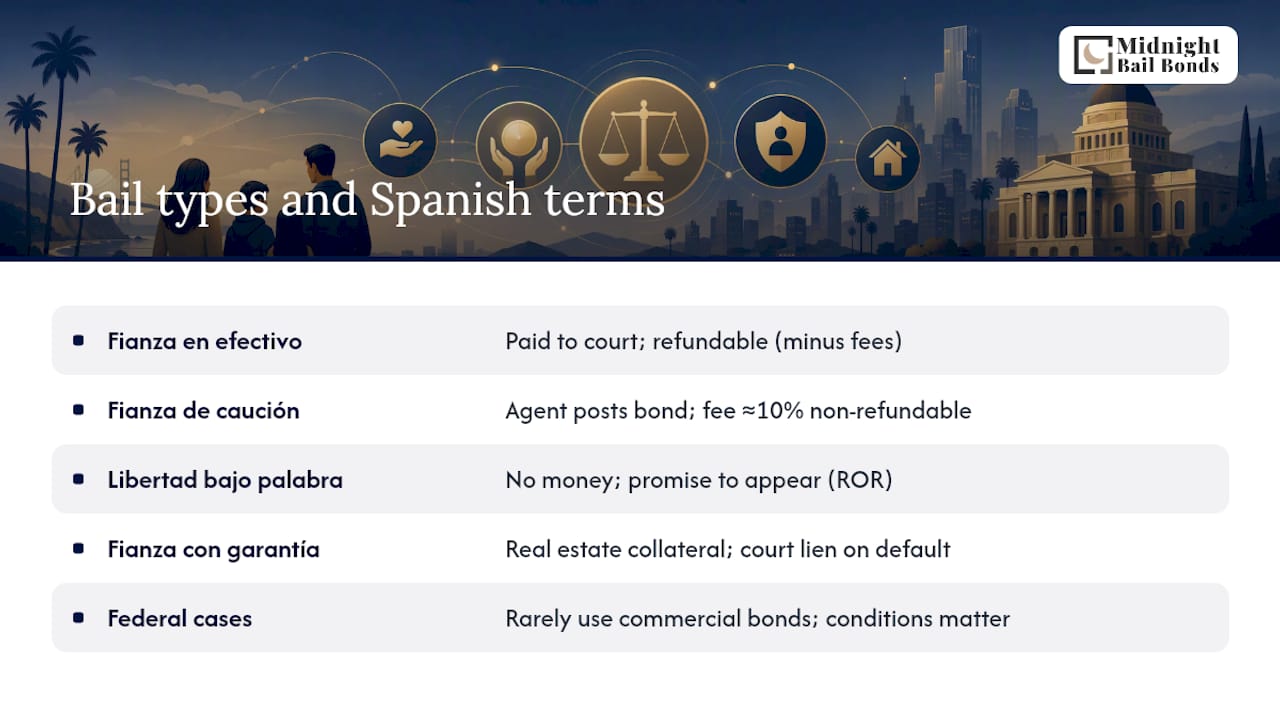
Fianza en efectivo (cash bail) means the full bail amount gets paid directly, usually to the court or jail. If the defendant attends every hearing, the money comes back, sometimes minus administrative fees. Legal Aid NYC lays out these refund conditions clearly, and the same logic applies broadly across states, even though the exact deductions vary.
Fianza de caución (surety bond) is what most people think of when they picture a "bail bond." A licensed agent posts the bond and charges a fee for the service. That fee is not held in trust and not returned, regardless of the case outcome.
Bail bond fees are typically non-refundable and run around 10 percent of the total bail amount in most states that allow commercial bail. This is the premium for the service, not a deposit toward the bail itself, according to practical guidance on how bail works.
That 10 percent distinction trips up a lot of families. Cash bail can come back. A bondsman's fee never does, no matter how the case ends.
Libertad bajo palabra (release on recognizance) requires no money at all. A judge releases the defendant based on a signed promise to appear, typically reserved for low-risk defendants with minor charges and strong community ties.
Fianza con garantía de propiedad (property bond) uses real estate as collateral instead of cash. Courts place a lien on the property, and if the defendant fails to appear, the state can move to seize it. This form is less common but still used in some counties for larger bail amounts, particularly when families understand secured versus unsecured bond structures.
Federal cases work differently from state cases. According to Federal Defenders of New York, federal judges rely far more heavily on release conditions and pretrial supervision than on commercial bail agents, and bail bond companies are rarely part of the federal process at all. If a family member is in federal custody, expect the vocabulary around "condiciones de fianza" (bail conditions) to matter more than the bail amount itself.
Where Spanish Bail Vocabulary Gets Confusing Across Countries
The single biggest trap in this vocabulary: "fianza" is not always about criminal bail. In everyday civil Spanish, especially in Spain and much of Latin America, "fianza" routinely refers to a security deposit, like the deposit a landlord holds for an apartment. SpanishDict's entry on "la fianza" shows both uses side by side, and it's worth reading if you want to see how naturally the word shifts meaning depending on context.
That means a Spanish speaker asked "¿pagaste la fianza?" might assume you mean a rental deposit, not a jail release, unless the conversation already established a criminal context. Adding a qualifier, like "fianza judicial" (judicial bail) or "fianza penal" (criminal bail), removes the ambiguity.
Bail agents themselves work very differently depending on where you are. In the U.S., licensed commercial bail agents are common in most states, though a handful, including Illinois and Kentucky, have eliminated for-profit bail altogether. In many Spanish-speaking countries, there's no equivalent private bail-bond industry at all. Release conditions are set and managed entirely by the court, with no third-party agent involved. If you're explaining the U.S. bail bond system to someone from a country without one, expect to explain the concept of a paid intermediary from scratch, not just the vocabulary.
When in doubt, skip the guesswork. Court websites and legal-aid organizations in your specific state publish jurisdiction-specific glossaries, and those definitions override any general dictionary entry.
Getting the Pronunciation and Formality Right
Fianza is pronounced fee-AHN-sah, with the stress on the second syllable. Caución is kow-see-OWN, stress on the final syllable. Libertad bajo fianza breaks down as lee-bear-TAHD BAH-ho fee-AHN-sah. None of these words are difficult to say once you slow down and hit the stressed syllable clearly.
Formality matters more than pronunciation accuracy in a courtroom. Always use "usted" when speaking to a judge, clerk, or bail agent, never "tú." Court officials expect it, and SpanishDict's guidance on addressing judges confirms that formal address is standard practice, not optional politeness.
A simple, respectful phrase that works in almost any bail conversation: "¿Cuál es el monto de la fianza, por favor?" ("What is the bail amount, please?"). It's polite, direct, and uses the correct legal term for "amount."
Practical Next Steps for Posting Bail in California
Knowing the words only helps once you can act on them. Here's the sequence that actually gets someone released, mapped to the vocabulary you now have.
- Locate the inmate. Use an inmate search tool to confirm booking status and the exact bail amount before making any calls.
- Confirm the bail amount ("el monto de la fianza"). Amounts can change after arraignment, so verify it's current.
- Decide cash vs. bond. If you can't cover the full amount, a bail bond company charges a fee (usually around 10 percent) instead.
- Prepare identification and the case number. Bring a valid photo ID and the booking or case number, referred to as "el número de caso."
- Call using a bilingual script. Say: "Necesito información sobre la fianza de [nombre]. ¿Cuál es el monto y qué formas de pago aceptan?" ("I need information about [name]'s bail. What's the amount and what payment methods do you accept?")
Pro Tip: When calling a bail agent, ask directly: "¿Es esta fianza reembolsable?" ("Is this bail refundable?"). A cash bail is often returned after the case closes; a bond company's fee never is. Getting that answer up front avoids a painful surprise later.
Midnight Bail Bonds offers bilingual, 24/7 bail bond service across California, including inmate search tools for Southern California and no-collateral bail options for families who need to move fast without extra paperwork. For anyone unsure who's even allowed to post bail on someone's behalf, it's worth reviewing who can legally post bail for a loved one before making calls.
False Friends: Where English and Spanish Bail Words Diverge
The most dangerous false friend in this vocabulary is "bond" itself. In English, a "bond" in the bail context is a guarantee backed by an agent. But "bono" in Spanish means a financial bond, like a savings bond or corporate bond, and has nothing to do with bail. Using "bono" instead of "fianza de caución" will genuinely confuse a Spanish speaker.
"Parole" is another common mix-up. English speakers sometimes use "bail" and "parole" loosely, but they're entirely different legal stages. Parole ("libertad condicional") happens after conviction and sentencing; bail happens before trial. Mixing these up in translation can lead a family to ask the wrong office for the wrong information.
"Caución" itself shifts meaning by country. In Spain, "caución" often refers broadly to any kind of guarantee or security, not specifically bail. In several Latin American countries, it's the standard term for a bail bond. A Mexican family and a Spanish family hearing "caución" might picture two different transactions.
Finally, "fiador" doesn't map cleanly to "co-signer" in every context. A "fiador" in some countries is understood as a personal guarantor in civil matters (like renting an apartment), not specifically a bail surety. Context and a follow-up question ("¿fiador de qué?") clear up the ambiguity fast.
Why Bail Looks Different Across Spanish-Speaking Legal Systems
The U.S. bail system, with its commercial bail agents, cash bonds, and county jails, has no direct parallel in most Spanish-speaking countries. Many Latin American legal systems rely on judicial discretion, house arrest, or supervised release rather than a for-profit bail industry, so terms like "agente de fianzas" (bail agent) may not translate to a familiar role for someone raised under a different system.
This gap matters practically. A recently arrived family member might not understand why a private company is involved in a family's freedom at all, since that's simply not how their home country's courts work. Taking a moment to explain that U.S. bail agents are licensed, regulated businesses, not law enforcement and not the court itself, prevents real confusion during an already stressful moment.
Spain's legal system uses "fianza" primarily in civil and administrative contexts more than in criminal pretrial release, which operates differently from the U.S. model. That means a term search in a general Spanish dictionary might return civil-law definitions first, burying the criminal bail meaning further down the entry. This is exactly why bilingual legal glossaries built specifically around courtroom vocabulary, rather than general-purpose dictionaries, serve families better in the moment they actually need the words.
Explaining Bail Terms to Someone Learning Both the Words and the System
Simplify before translating. If someone doesn't understand what bail is in English, translating "fianza" won't help them; explain the concept first in plain terms: "It's money paid so someone can wait for their court date at home instead of in jail."
Use one term consistently. Bail vocabulary already has enough regional variation without you switching between "caución," "fianza," and "fianza de caución" mid-conversation. Pick one, based on what the specific bail agent or court uses, and stick with it.
Pair every term with a real-world action. "Fianza en efectivo" means little in the abstract; "fianza en efectivo" as in "you pay this amount directly and get it back later" lands immediately. Anchoring vocabulary to the actual step someone needs to take, calling a bondsman, bringing an ID, confirming an amount, cuts through confusion far faster than a definition alone.

Write down the case number and bail amount in both languages before making calls. Miscommunication over numbers, not vocabulary, is the most common breakdown families report when contacting jails or bail companies under pressure.
A Personal Note on Getting the Words Right
The gap between knowing a Spanish word and knowing which Spanish word to use in a specific moment is where families lose time they don't have. Someone calling a jail at 2 a.m., trying to figure out whether "fianza" means the deposit their cousin mentioned or the number a clerk just read off a form, isn't dealing with a vocabulary problem. They're dealing with a system that assumes fluency in both language and legal process at the exact moment they have neither.
That's the gap this glossary tries to close: not textbook Spanish, but the specific dozen or so words and phrases that actually come up when someone you love is sitting in a cell and the clock is running. Getting "fianza en efectivo" right instead of guessing at "depósito" can be the difference between a clerk understanding you immediately and a five-minute detour of confusion neither of you has time for.
None of this replaces legal advice. Bail procedures, refund rules, and conditions vary by county and by case, so confirm specifics with the court or, when the situation calls for it, an attorney who can speak to the exact charges involved.
— Jake
This article is general information, not a substitute for advice from a qualified lawyer. Consult a qualified legal professional about your own circumstances before acting on anything here.
Sources
- Glossary of Legal Terms (English–Spanish)
- Spanish translation of 'bail' | Collins English-Spanish Dictionary
- What you need to know about bail — Legal Aid NYC
FAQ
What is the Spanish word for "bail"?
The standard translation is fianza. "Bail bond" is fianza de caución or caución, and "released on bail" is libertad bajo fianza.
What are some common court terms in Spanish?
Frequently used terms include audiencia (hearing), juez (judge), acusado (defendant), condena (sentence), and fianza (bail). Formal address with "usted" is expected in every one of these contexts.
How do you say "bail money" in Spanish?
"Bail money" is typically el dinero de la fianza or simply la fianza when the amount itself is understood from context.
What are the four types of bail?
The four main types are cash bail (fianza en efectivo), surety or bail bonds (fianza de caución), release on recognizance (libertad bajo palabra), and property bonds (fianza con garantía de propiedad). Each carries different refund rules and requirements, detailed in the legal context section above.