
In California, every person arrested has a right to release before trial except in a few serious cases. The amount is usually set by a county bail schedule, and a licensed bail agent can post the bond for a premium that is typically 10% of the bail. If someone you love was just arrested, you can search the jail roster and start a bond with Midnight Bail Bonds at any hour. Our licensed agents answer directly, in English or Spanish.
This guide explains the rules in plain language, so you know what a judge can do, how the amount is decided, what you pay and what you sign.
TL;DR
- Most people arrested in California are eligible for release before trial. The exceptions are capital crimes and certain violent or sexual felonies where release would pose a serious danger.
- Each county adopts its own bail schedule, so the same charge can carry different amounts in different counties. A judge can raise or lower the amount at arraignment.
- A bail bond premium is typically 10% of the total bail. It is non-refundable, and we publish it as 10% of the total bail.
- Many bonds can be written without collateral, and payment plans are available. Cash, cards, Zelle and financing are accepted.
- Missing a court date can forfeit the bond, so everyone involved should know every hearing date.
Table of Contents
- What California bail laws actually say
- What happens after an arrest
- Who is not eligible for simple release
- County bail schedules: why the number changes by county
- Cash bail, bail bond, own recognizance: the differences
- What a California bail bond costs
- What happens if the defendant misses court
- Recent changes and pending bills
- How Midnight Bail Bonds helps at each step
- Get a bond started tonight
- Our perspective
- FAQ
- Sources
What California bail laws actually say
California's rules start with the state constitution. Article I, section 12 says a person must be released on bail by sufficient sureties (a surety is a company or person who guarantees the bail). The exceptions are capital crimes, violent or sexual-assault felonies where release poses a substantial likelihood of great bodily harm, and felonies involving threats of great bodily harm. A judge may also release a person on their own recognizance, which is a written promise to return to court.
The same court document says that when a judge uses a financial condition such as cash bail, the court must consider the defendant's ability to pay and set an amount the person can reasonably afford. The San Francisco Superior Court's 2024 bail fact sheet adds that courts must first consider nonfinancial conditions, such as electronic monitoring, check-ins, housing or treatment. Detention or unaffordable bail requires a finding by clear and convincing evidence that less restrictive options would not protect public safety or prevent flight.
What this means for you: bail is a guarantee that the defendant comes back to court, not a punishment. The California Courts Self-Help Guide explains that the money is returned at the end of the case if the defendant appears at every hearing. The judge looks at the type of crime, whether domestic violence is involved, public safety and the risk that the person will not return.
What happens after an arrest
The first hours decide how fast someone gets home. In broad terms:
- Booking. The person is fingerprinted and entered into the jail system. Many counties let you look up the booking and the bail amount online. Our free instant inmate search shows booking information without a call.
- Pre-arraignment release. Some people are released before seeing a judge. In Los Angeles County, the pre-arraignment release protocols sort arrestees into five groups: cite and release, book and release, magistrate review, money bail, and not eligible for release. The first two generally mean $0 bail and a promise to appear.
- Arraignment. This is the first court hearing, where the charges are read. Per the Self-Help Guide, a judge may release the person on their own recognizance, release them under supervision such as home detention or an ankle monitor, set bail, or order no bail.
- Release. If bail is set and posted, the person is released and must follow every court condition and attend every hearing.
If the person is still in custody after arraignment, a judge's decision on bail is the next step. Our agents can tell you which stage a case is at and what is needed to post a bond.
Who is not eligible for simple release
Los Angeles County's FAQ explains that crimes listed in Penal Code section 1270.1, which covers most serious and violent felonies and domestic violence offenses, remain subject to traditional bail. A state staff memorandum from 2026 adds that section 1270.1 also limits pre-arraignment release for witness intimidation, stalking, criminal threats and restraining-order violations. For those charges, release before arraignment is limited to the bail schedule amount or release on recognizance, and a judge reviews conditions at arraignment.
If the case involves domestic violence, a protective order often comes with the release conditions. Gathering clear records matters for everyone in these cases. A guide on restraining order evidence explains how to collect and present material for legal proceedings, and the court and your attorney decide what to do with it.
County bail schedules: why the number changes by county
Under Penal Code section 1269b, superior court judges in each county must adopt and revise a countywide bail schedule every year. It covers bailable felonies and misdemeanors, and copies go to the jails, judges and the Judicial Council. The California Department of Insurance notes that schedules are set county by county and that the court where the case is filed has the local information.
Schedules change on a schedule of their own. San Francisco, for example, publishes a new felony and misdemeanor schedule each July 1, while San Diego's 2026 schedule took effect January 1, 2026. San Diego's schedule says bail may be given in cash or by a surety bond, and that bail for several charges is generally added together unless the lesser offenses accompany a greater one or a single act is charged under several statutes.
Because the schedule is the starting point, the amount you see at booking can change. A judge can lower it, raise it or release the person without it. Two things follow:
- Check the schedule for the county where the arrest happened, not where you live.
- Ask the agent to confirm the current amount before you pay anything.
Example: DUI amounts differ by offense
DUI shows how much the charge and prior record matter. The Fresno County schedule lists $50,000 for a DUI with a prior felony DUI, $100,000 for DUI with three or more priors, and $50,000 to $200,000 for intoxicated driving causing injury or death, depending on priors. It also adds $5,000 when a minor was in the vehicle. A first-offense misdemeanor DUI is usually a much lower figure. Our guide to felony DUI bail in California walks through costs, hearings and how to post. If the arrest was for DUI, our DUI bail bond service is built for the quick turnaround that these cases need.

For drug arrests, see what drug possession bail looks like, including a breakdown of HS 11350 county ranges and how to verify them.
Cash bail, bail bond, own recognizance: the differences
| Option | What it means | What you pay |
|---|---|---|
| Release on own recognizance | A judge releases the person on a promise to return to court | No bail money |
| Supervised or conditional release | Release with conditions such as check-ins or electronic monitoring | Usually no bail money, but conditions must be followed |
| Cash bail | The full bail amount is paid to the court | The full amount, returned at the end of the case if the defendant appears |
| Bail bond | A licensed bail company posts a surety bond guaranteeing appearance | A premium, typically 10% of the bail |
The Bureau of Justice Statistics describes pretrial release as a range of conditions from least to most restrictive, including personal recognizance, cash bail, surety or property bonds, electronic monitoring and supervision. A bond is the route most families use when the full amount is out of reach, because you pay only a fraction of the bail.
Our article on conditions of release in California and the page on bail conditions defendants and families need to know cover what a court can require once someone is out.
What a California bail bond costs
The premium is the fee you pay the bail company for posting the bond. The California Department of Insurance's 2017 overview of the bail system says agents usually charge 10% of the bail, for example $2,500 on a $25,000 bail. It also says rebates allowed under Proposition 103 can bring fees down as low as 2%.
Our published fee is 10% of the total bail. Here is how that works at three common amounts:
| Total bail | Premium at 10% |
|---|---|
| $5,000 | $500 |
| $25,000 | $2,500 |
| $50,000 | $5,000 |
The premium is non-refundable, even if the charges are later dropped. A UCLA Criminal Justice Reform Clinic report from 2017 defines it that way, and that is why it helps to know the number before you sign. Our bail bond calculator shows the premium and down payment for your amount. We also offer 1% bail bonds, 2% bail bonds and affordable bail bonds for families watching every dollar, and payment plans and financing are available. We accept cash, credit and debit cards, and Zelle.
Collateral
Collateral is something of value pledged to guarantee the bond, such as a car, jewelry or real estate. The Department of Insurance says collateral or liens are not released until the bail is paid out and the bond is exonerated, meaning the court has closed the bond. It also says a lien on real property is typically used in high-bail cases. Many of our bonds are written without collateral, so you do not need to put up a home or a car in many cases. See our no collateral bail bonds page for details.
The contract
Read the contract before you sign. The two articles below explain the terms in plain words:
- Bail bond contract terms, the 10% premium and three questions to ask
- How California law lets bondsmen charge a 10% premium
The UCLA report notes that some contracts require the premium to be paid again each year while the bond stays in effect, and some charge a minimum fee if a court date is missed. Ask your agent how the contract treats both before you sign.
What happens if the defendant misses court
The stakes of a missed hearing are high. The Department of Insurance explains that if the person fails to appear, the court orders the bail forfeited. The bond company then has 180 days, extendable by another 180 days for good cause, to locate the person and bring them back to court. The UCLA report defines forfeiture as the court requiring the full bond amount to be paid.
The practical rules are simple:
- Write down every court date, and set reminders on more than one phone.
- Keep the agent's number and the court's number together.
- If something goes wrong, such as an illness, a missed bus or a transport problem, call right away. A call before the hearing is far better than silence after it.
This is why we stay in contact with families after release. It is also why a licensed agent answering the phone at any hour is a real benefit if a problem arises the night before court.
Recent changes and pending bills
California bail law keeps moving, mostly at the county level and in the courts.
- Los Angeles County. The 2026 staff memorandum reports that from October 1, 2023 to June 17, 2026, about 47% of pre-arraignment bookings did not need magistrate review and 48% were reviewed by a magistrate. Of those reviewed, 94% were held until arraignment.
- Riverside County. After a May 2025 lawsuit, the county adopted a new schedule in October 2025 that allows book-and-release and cite-and-release without cash bail for a small number of offenses. On February 6, 2026, the Superior Court issued a preliminary injunction barring cash bail for 19 more non-violent offenses.
- Legislation. SB 562, a bail bill, passed the Senate in June 2025. As of August 13, 2026 it was held in the Assembly Appropriations Committee, so it is pending and not law.
The lesson for families: a charge that carried cash bail last year may not carry it now in some counties. Always confirm the current amount with the jail, the court or our agents.
How Midnight Bail Bonds helps at each step
When you are standing at the start of this process, speed and clarity matter most. Here is how that fits the steps above.
- Finding the person. Use our free instant inmate search for booking details and the bail amount.
- Getting the number. We give clear costs up front, based on the 10% premium.
- Paying. Payment plans, financing, cash, cards and Zelle are accepted.
- Language. Bilingual English and Spanish support is available every shift, so Spanish-speaking families can ask questions and read the contract with an agent in their own language.
- Courts and jails. We have local offices and direct relationships with jails and courts to help speed releases. See, for example, our Los Angeles County courthouse directory.
If the person has a 1275 hold, which is a hold that stops release because of immigration or a related issue, see our 1275 hold bail bond page.
Get a bond started tonight
If your loved one is in a California jail, you do not need to wait for office hours. Our licensed agents answer around the clock, and you can start from your phone with online bail bonds or learn about 24-hour bail bonds. Our fee is 10% of the total bail, with payment plans for families who need them.
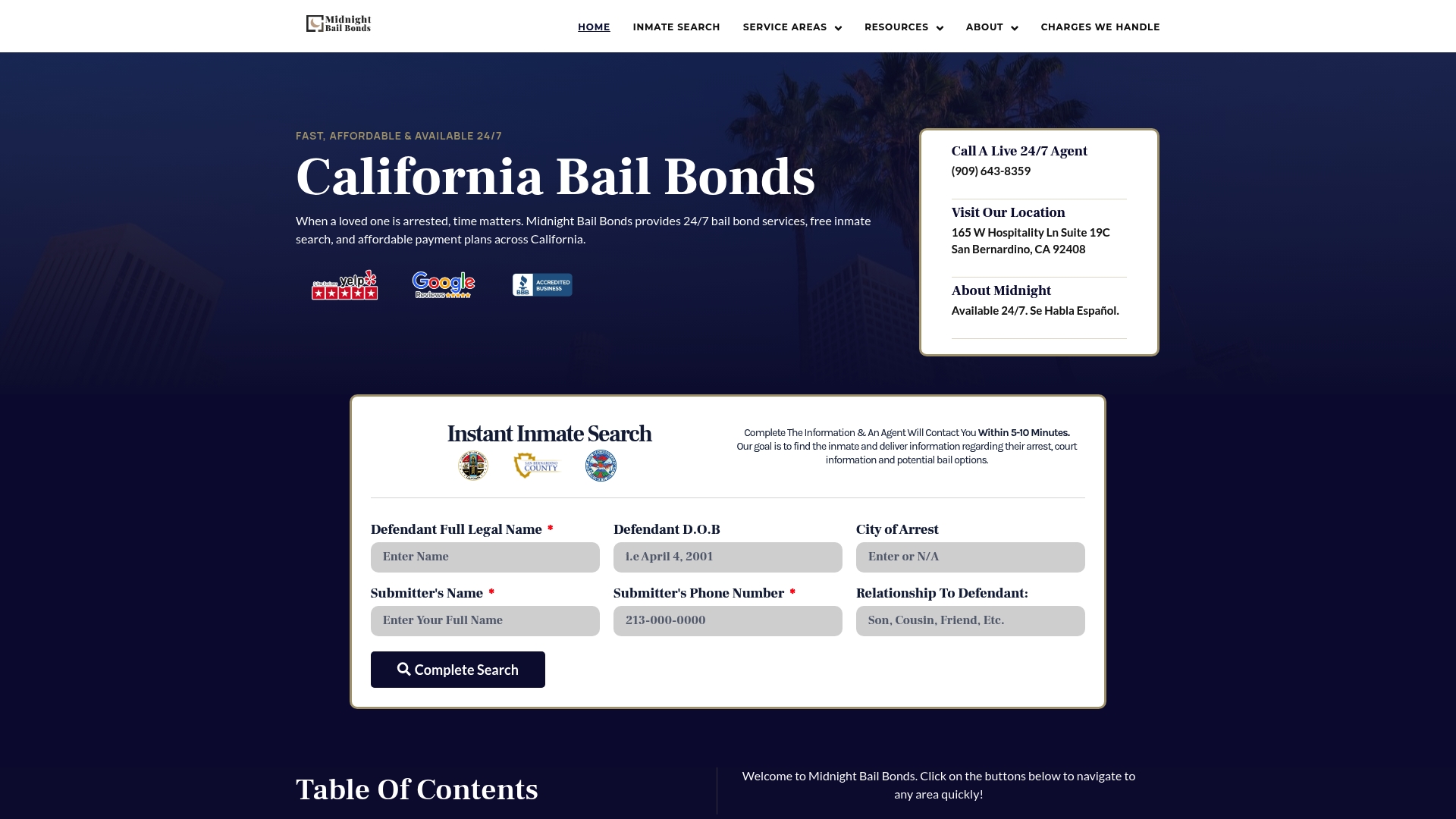
To begin, visit Midnight Bail Bonds, search the inmate's name and call us with the booking number.
Our perspective
Families come to us at the worst moment, usually late at night, with a booking number and a lot of fear. The law is clear on one thing: a person arrested in California has a right to release in nearly every case, and bail exists to bring them back to court, not to keep them in a cell.
What families need is a straight number and a person who picks up. That is why we publish our fee as 10% of the total bail, write many bonds without collateral and keep licensed agents on the phone at every hour. Each hour in custody can cost a job, a car payment or a child's school pickup.
We believe a bail bond is the practical way for most families to bring someone home while the case is decided. You pay a fraction of the bail, keep your savings, and the defendant returns to work and family while preparing for court. We also speak Spanish on every shift, because a contract only protects you if you understand it.
Know the schedule for your county, know your court dates and ask for the contract terms in writing. Do those three things and a hard night becomes a manageable week.
Jake
FAQ
How does bail work in California?
After arrest, the person is booked, and either released under a county schedule, released by a judge at arraignment or held on bail. Bail is a guarantee of court appearance. If you use a bail bond, you pay the premium, typically 10% of the bail, and the bond company guarantees the full amount to the court.
Can bail be denied in California?
Yes, but only in limited cases. The state constitution allows denial for capital crimes and for certain violent or sexual felonies where release would pose a substantial likelihood of great bodily harm. A judge must also consider ability to pay when setting a financial condition. A defense attorney can explain how this applies to a specific case.
How much does a bail bond cost in California?
The premium is typically 10% of the total bail, so a $25,000 bail has a $2,500 premium. It is non-refundable. We publish our fee as 10% of the total bail, with payment plans and financing available. Use our bail bond calculator to see your exact figure.
Do I need collateral to get a bail bond?
Not always. Collateral is something of value, such as a car or property, that secures the bond. Many of our bonds are written without collateral. An agent can tell you quickly whether your case qualifies.
Do you help Spanish-speaking families?
Yes. We offer bilingual English and Spanish support on every shift, so you can ask questions and review the contract in the language you are most comfortable with.
Sources
- California Constitution Article I, section 12, as summarized in the California Courts invitation to comment SPR 25-11
- San Francisco Superior Court bail fact sheet, 2024
- California Courts Self-Help Guide: The arraignment
- Los Angeles County pre-arraignment release protocols FAQ
- California Law Revision Commission Staff Memorandum 2026-09
- California Penal Code section 1269b
- California Department of Insurance: Bail Bonds
- San Francisco Superior Court local fees and bail schedules
- San Diego Superior Court 2026 bail schedule
- Fresno County Superior Court bail schedules
- Bureau of Justice Statistics: Pretrial Release
- California Department of Insurance: An Exploration of California's Bail System, 2017
- UCLA Criminal Justice Reform Clinic: The Devil in the Details, 2017
- California Legislature: SB 562 bill status