
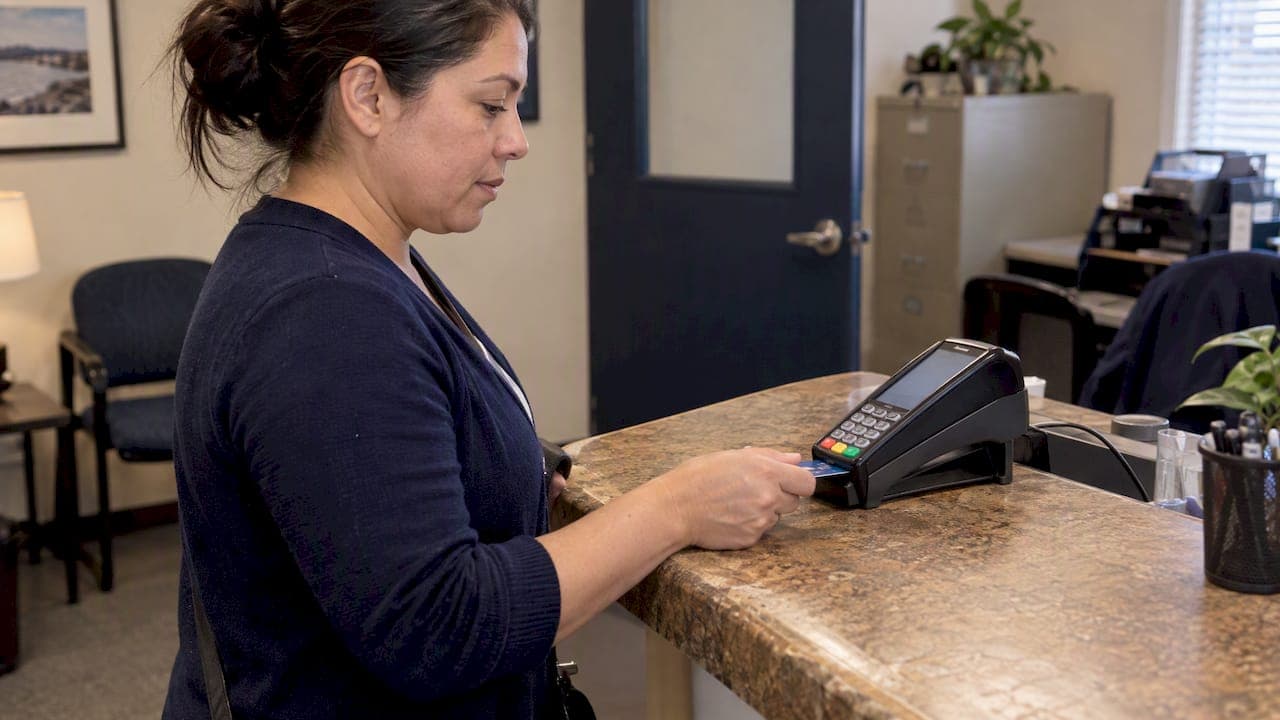
Yes, you can often pay for bail with a debit card in California, but it works in two different ways, and the difference decides how much you pay. You can pay the full bail amount to the jail or court with a card, if that county accepts cards. Or you can pay a bail bond company a fee, usually 10% of the bail, with your card, and the company posts the bond for you. For most families the second route is the one that gets someone out tonight without draining a checking account.
This guide explains both routes, what each costs, what can go wrong at the card terminal, and what to have in hand before you call.
TL;DR
- Many California jails take debit and credit cards for cash bail, but it is decided county by county, and the full bail amount is due, plus any processing fee.
- With a bail bond, you pay a premium (the standard rate is 10% of the bail) and can often put it on a debit card. That premium is not refunded when the case ends.
- Debit cards have daily spending and withdrawal limits. Call your bank first, because a declined card costs hours.
- The cardholder usually must be present or verified, and the card owner does not have to be the arrested person.
- Before you pay anyone, check whether your loved one qualifies for cite-and-release or $0 bail for that charge.
Table of Contents
- Two ways a debit card can pay for bail
- Paying cash bail with a debit card at a California jail
- Paying a bail bond premium with a debit card
- Cash bail or bond: which one makes sense?
- Before you pay anything: check for $0 bail and cite-and-release
- What you need on hand to pay by card
- Perspective: what we see when families pay by card
- Questions to ask any bail agent before you pay by card
- After the card is accepted: what happens next
- Common mistakes with debit card bail
- Get help paying bail by card tonight
- FAQ
- Sources
Two ways a debit card can pay for bail
People search "debit card bail" and mean one of two things. Keeping them apart saves money.
Cash bail. You pay the entire bail amount to the court or jail. If bail is set at $5,000, you pay $5,000. The money is returned, minus any court fees, when the case ends and the defendant has made every court appearance. The California Department of Insurance regulates the bail bond business, but cash bail itself goes straight to the court system, not to a bondsman.
Bail bond. A licensed bail agent posts a guarantee with the court on the defendant's behalf. You pay the agent a fee, called the premium. According to the California Department of Insurance's overview of the state's bail system, roughly 175,000 bonds are written in California each year, and full cash bail is posted in fewer than 2% of cases. Most families never pay the full amount. They pay the premium.

A debit card can fund either. The math is very different.
Paying cash bail with a debit card at a California jail
Card acceptance for cash bail is not a statewide rule. Each sheriff's department or court sets its own payment methods. Some examples of how it looks on the ground:
- The Orange County Sheriff's Department says cash bail may be paid by cash, credit or debit card, cashier's checks, personal checks, money orders and traveler's checks, and that bail can be posted 24/7 at the Intake Release Center cashier's office for people held there.
- The Ventura County Sheriff lists its own conditions for posting bail at the Pre-Trial Detention facility, starting with exact-amount cash and cashier's checks. Always read the county's own page rather than assuming another county's rules apply.
Where cards are accepted, the jail often routes them through a third-party payment processor, either a lobby kiosk, a phone line or a website. Those processors typically add a service fee on top of the bail. Ask what that fee is before you tap or insert the card, and ask whether it is refunded when bail is exonerated. In most cases it is not, because it goes to the processor, not the court.
The debit card limit problem
This is where debit differs from credit. Bail amounts in California commonly run into the thousands, and a debit card is tied to your checking balance and to your bank's daily limits. Three things trip people up:
- Daily purchase limits. Many banks cap point-of-sale debit spending at a few thousand dollars a day. Check your app or call the number on the back of the card.
- Fraud holds. A large charge to a government agency or a bail company at 2 a.m. can trigger a block. Tell your bank you are making the payment, or have the fraud line ready.
- Available balance. Pending charges and holds reduce what you can spend. Money that "should" be there may not be.
If the card fails, you lose time while someone sits in custody. Call your bank before you go to the jail or call an agent, not after.
Paying a bail bond premium with a debit card
This is the route most families take, and it is where debit cards work best, because the amount is smaller. The standard premium is 10% of the bail. The numbers from our own calculator logic are simple:
| Bail amount | Premium at 10% | You would pay the court directly |
|---|---|---|
| $1,000 | $100 | $1,000 |
| $5,000 | $500 | $5,000 |
| $25,000 | $2,500 | $25,000 |
| $75,000 | $7,500 | $75,000 |
The 10% figure is the industry standard, not a number written into California law. The Commission's staff memorandum on bail and pretrial release describes the system as one that relies on a non-refundable payment to a bail agent, and some agents price below 10%. That is why it pays to ask what rate you are actually being quoted. Our own 1% bail bonds and 2% bail bonds pages explain those options, and you can see how the numbers play out on our bail bond calculator.
Two trade-offs to know:
- The premium is non-refundable. If the case is dismissed, the defendant is found not guilty, or every court date is kept, you still do not get the premium back. That is the cost of not tying up the full bail amount. Full cash bail comes back at the end of the case, but only if you can afford to front it.
- A card fits a small premium far more easily than full bail. A $500 premium on a $5,000 bond is within most debit limits. $5,000 in cash bail may not be.
Using a credit card instead
Some families prefer a credit card for the premium to keep cash in the bank. If you do, watch how the charge is coded. Some issuers treat bail payments as a cash advance, which carries fees and immediate interest. We wrote about this in how to avoid cash advance fees when using a credit card for a bail bond. A debit card avoids that problem, but it comes with the limits above.
Cash bail or bond: which one makes sense?
Here is a simple way to decide.
| Question | Points to cash bail by card | Points to a bail bond |
|---|---|---|
| Is bail low, say under a few hundred dollars? | Yes, a small refundable payment may be fine | Only if the county will not take cards |
| Can you spare the full amount for months? | Yes | No |
| Does the jail charge a card processing fee? | Compare it with the premium | Compare it with the premium |
| Do you need release overnight or on a weekend? | Only if the cashier accepts cards then | Agents work day and night |
| Is the amount high, in the thousands or more? | Rarely practical | Usually the realistic choice |
A rule of thumb: if bail is small and you can afford to have it tied up, paying the court directly gets your money back. For anything larger, the premium route is the practical one, and it is why bond companies exist.
Before you pay anything: check for $0 bail and cite-and-release
California's pretrial system is changing. Per the Commission's 2026 staff memorandum, some counties have set $0 bail for specific misdemeanors, and a number of courts have set up pre-arraignment release procedures that rely on risk assessment rather than cash. Counties named in that memo include San Bernardino and San Luis Obispo.
So before you put a card down, ask the jail's booking desk, or the agent you call, three questions:
- Has bail actually been set, or will the person be released on a citation?
- Is there a $0 bail schedule for this charge in this county?
- Is there a hold, such as a probation or immigration hold, that would block release even if bail is paid?
If there is a warrant with a set amount, the Superior Court of San Luis Obispo County explains that you can post it at the court or at any law enforcement agency, so your options are not limited to the jail. Requirements differ by court, so check the one handling the case.
What you need on hand to pay by card
Bail companies and payment kiosks both verify who is paying. Expect the following:
- The physical card, and often the cardholder's government photo ID. Many companies require that the card used be the card presented.
- The defendant's full name, date of birth and booking number, if you have it. Our free instant inmate search can help you find the booking details.
- The name of the facility where the person is held.
- Contact details for the person who will sign the bond agreement, called the indemnitor or co-signer.
We list what to gather in bail bond documents: 5 details that speed release. A few minutes of preparation often shortens the whole process.
If the cardholder cannot be there in person, ask about starting the process remotely. Our online bail bonds page walks through starting from your phone.
Perspective: what we see when families pay by card
We talk to families at all hours, and the pattern is consistent. Most people call us thinking they need the full bail amount. They are relieved to learn they only need the premium, and then the next worry is, "Will my card even work?"
Our advice is practical. First, find out the bail amount and do the 10% math before you panic. Second, call your bank in advance if the amount is likely to exceed your daily limit. Third, tell the agent exactly what you can pay today and what you cannot. We accept cash, credit and debit cards, Zelle and financing, and we offer payment plans, so you do not have to put everything on one card at once.

The other thing we insist on is written terms. A bail bond is a private contract between your family and the company. Whatever is said on the phone, you should see in writing what you are paying, what the payment schedule is, whether collateral is required and what happens if the defendant misses court. Our guide to bail bond contract terms lists three questions worth asking, and the one about the premium is covered in how California lets bondsmen charge 10%.
We also write many bonds without collateral, but we will not promise it for every case. Whether collateral is needed depends on the bail amount and on the signer's situation. See secured vs. unsecured bonds for how that works.
— Jake
Questions to ask any bail agent before you pay by card
A debit card payment is hard to reverse once it is processed, so get answers first.
- What is the total premium, in dollars? Not just a percentage. Ask for a number.
- Is there a card processing fee? If yes, how much, and is it in addition to the premium?
- Can I split the premium? Payment plans exist, but terms differ. Ask for the down payment, the schedule and what happens if you are late.
- Is collateral required? Per the Department of Insurance overview, agents carry real financial risk if a defendant misses court, which is why they may ask for collateral or a credit check on larger bonds.
- What if I'm having trouble with an installment? According to the same overview, it is illegal for an agent to surrender a client solely because installment payments on the fee are difficult. You still should not skip payments, so talk to the agent early.
- What documents do I get? You should receive written agreements and receipts that match the card charge.
- Are you licensed? The Department of Insurance regulates bail agents in California and lets you check licensing.
Our affordable bail bonds page covers how we approach cost, and our no collateral bail bonds page explains when that is possible.
After the card is accepted: what happens next
Paying is the start, not the end. Here is the usual order of events:
- Paperwork. The signer completes the bond application and agreement.
- The bond is posted. The agent submits it to the jail or court.
- Processing. Jail release times vary. A Ventura County Sheriff page notes that processing times differ, and in Orange County the research we reviewed put average release processing around four hours, with a range of two to six. Busy nights and bookings in large county jails can take longer.
- Conditions. The defendant is released with a court date and possibly conditions. See bail conditions in California.
- Court appearances. Every date must be kept. Missing one can lead to a forfeiture. If it does, the Department of Insurance says the agent has 180 days to locate the defendant before the bond is forfeited, and our guide to fixing forfeited bail explains what families can do. For the legal side, read about bail forfeiture in California.
If the person is held on a 1275 hold, which delays release until a review, the timeline changes. Our 1275 hold bail bonds page explains what that means.
Common mistakes with debit card bail
- Waiting until you are at the counter to check your limit. Check beforehand.
- Assuming the jail takes cards. Some counties or specific cashier windows do not, or only at certain hours. Confirm with the facility.
- Ignoring the processing fee. A card fee on a large cash bail amount can be hundreds of dollars, and it does not come back.
- Paying the full bail when a bond would do. If you will not be able to wait months for the return, the premium route may serve you better.
- Using someone else's card without them. Many companies and kiosks require the cardholder or a verified authorization.
- Paying before checking for $0 bail or cite-and-release. Per the 2026 Commission memo, it can save real money.
- No written agreement. Never rely on verbal promises.
Get help paying bail by card tonight
If someone you love is in custody in California and you want to use a debit card, we can walk you through it. Our licensed agents answer calls directly at any hour, give you the cost upfront, and speak English and Spanish on every shift. Use the free inmate search to confirm the booking and bail amount, then start with our 24-hour bail bonds service or the Midnight Bail Bonds home page. If your loved one is in Orange County, see our Orange County bail bonds page. For DUI arrests, we also have a DUI bail bonds page.
FAQ
Can I pay bail with a debit card?
Often, yes. Many California county jails take debit and credit cards for cash bail, and many bail bond companies take them for the premium. It is set county by county and company by company, so confirm before you go.
Do I pay extra to use a card?
Sometimes. Jail card payments may carry a third-party processing fee on top of the bail amount, and some companies add a card fee of their own. Ask for the total in dollars before you pay, and ask whether the fee is refundable.
Can someone else use their debit card to bail me out?
Yes, in most cases. The person paying does not have to be the person arrested, but they usually must show the card and photo ID and may need to sign the bond agreement as the co-signer.
How much does a bail bond cost on a $5,000 bail?
At the standard 10% premium, $500. At a lower negotiated rate it can be less. Compare that with paying $5,000 in cash bail to the court, which is refunded at the end of the case but must be paid upfront.
What if my debit card limit is too low?
Ask the bank to raise the limit temporarily, split the payment across methods such as cash, Zelle or a second card, or ask the agent about a payment plan. Do not wait until the card is declined.
Sources
- California Department of Insurance: An Exploration of California's Bail System (2017)
- California Department of Insurance: Bail Bonds
- California Law Revision Commission: Staff Memorandum 2026-09, Bail, Pretrial Release, and Related Matters
- Orange County Sheriff's Department: Custody FAQs
- Ventura County Sheriff: Posting Bail
- Superior Court of California, San Luis Obispo County: Warrants