
The fastest lawful way out of jail is usually a bail bond: you locate the person, confirm the bail amount, pay a percentage of it to a licensed bondsman, and the bondsman posts it with the jail. What decides the speed is how quickly you finish those steps and how quickly the jail processes the paperwork. In California, we at Midnight Bail Bonds answer calls around the clock with licensed agents, so the first steps can start at 2 a.m. as easily as at 2 p.m.
This guide covers the steps in order, what slows a release down, what a bond costs, and the situations that need extra care, such as DUI arrests and Spanish-speaking families.
TL;DR
- Release needs three things: the person is booked, a bail amount is set, and the bail is posted. Until booking is done, nothing can be posted.
- Bail can be posted 24/7 in many jails, but release after payment still takes hours. Orange County, California, reports an average of about 4 hours, with a range of 2 to 6.
- A bail bond premium in California is 10% of the total bail amount, and we offer payment plans, and in many cases bail without collateral.
- Have the full name, date of birth, booking number and jail ready before you call. Our free inmate search helps you find them.
- A DUI arrest can add a hold until the person is safe to release. Plan the ride home in advance.
Table of Contents
- What actually happens between arrest and release
- Step-by-step: getting someone out as fast as possible
- Why release at night is slower than you expect
- What it costs, and how to keep the price manageable
- Can someone get out without paying bail?
- DUI arrests: what is different
- Spanish-speaking families: help in your language
- What to have ready before you call
- Start the bond now
- Our perspective
- FAQ
- Sources
What actually happens between arrest and release
An arrest is followed by booking: the jail records the person, takes fingerprints and photographs, checks for warrants and sets the bail amount from a schedule or a judge's order. Only after that can someone pay bail.
Booking is not instant. A county sheriff in Wisconsin tells families that booking can take 15 to 45 minutes, and to expect an hour or more when the jail is busy. In Orange County, California, bail and bond information is usually available 2 to 3 hours after booking. Calling a bondsman at minute ten may therefore get you "no bail set yet". That is not a refusal, just the jail's pace.
There are two clocks running, then:
- The paperwork clock: how fast you identify the person, agree on the bond and sign.
- The jail clock: how fast staff process the bond and finish the release.
You control the first one entirely. The rest of this guide is about making it as short as possible.
Step-by-step: getting someone out as fast as possible
1. Find the person and the booking details
Call the county jail or use an online inmate lookup for the county where the arrest happened. You want the full legal name, date of birth, booking number, the charges and the bail amount. If the bail field is blank, booking is likely still in progress. Try again in an hour or so.
We run a free instant inmate search and can look up booking information with you. Our guide to confirming jail and booking details in about 10 minutes walks through what to look for.
2. Decide who will sign
A bond needs an adult who will take responsibility for the person showing up to every court date. That person is the indemnitor, the co-signer. It is often a spouse, parent or close friend, and the arrested person can sometimes arrange it from jail by phone. The co-signer needs a government photo ID and a way to pay the premium. If you are the one in custody, see our guide to bailing yourself out.
3. Call a licensed bondsman, and call early
Early in the process means you can complete the paperwork while the jail finishes booking, so the bond is ready the moment bail is set. Our licensed agents answer directly at any hour, and many steps can be done by phone or online. See how it works in our guide to posting bail by phone or paying bail online.
4. Pay the premium and settle collateral
The premium is the fee for the bond. In California it is 10% of the total bail. On $20,000 bail, that is $2,000, and the premium is non-refundable, because it is the price of the service rather than a deposit. We accept cash, credit and debit cards, Zelle and financing, and offer flexible payment plans. In many cases we write bonds without collateral, which means you do not have to pledge a house or a car. Details are on our no-collateral bail bonds page.
5. The bond is posted and the jail processes the release
Once the bond is posted, release is in the jail's hands. We have local offices and direct working relationships with jails and courts, which is how we work to keep that stage as short as it can be.
6. Be there at the door
Release times are not announced in advance. Someone should be ready to pick the person up, and the pickup is sometimes required, as the section below on nights explains.
Why release at night is slower than you expect
People assume that because bail can be paid at 3 a.m., the person walks out at 3:05. Official county procedures show otherwise.
Posting is often available 24/7. Orange County's sheriff says bail can be posted 24/7 at the IRC Cashier's Office for people held in any of its jails. Nevada County, California, accepts bail bonds or cash bail 24 hours a day, 7 days a week.
Release is a separate step with its own rules. In Nevada County, bonded people are typically released between 8 a.m. and 8 p.m., and no one is released between 8 p.m. and 8 a.m. without a verified ride. That means the ride has to be named to the jail in advance.
Counties differ on how, and how long. Outside California the picture is similar: Jackson County, Oregon, lets people post bail after hours at a jail lobby kiosk or a secure website, while Washington County, Minnesota, has a 24/7 kiosk with limited amounts, after which the release process can take a couple of hours. Benton County, Washington, permits exact cash bail after hours and says release usually takes one to two hours if other conditions are met.
The practical lesson: do not wait for morning to start. The paperwork can be finished overnight, so the bond is in place the moment the jail processes it. For more on this, read our guide on posting bail at night and our inmate release times explainer.
Typical delays, and what you can do about each
| Delay | Why it happens | What helps |
|---|---|---|
| Bail not set yet | Booking is still in progress | Re-check in an hour; start paperwork meanwhile |
| Wrong name or booking number | Common spelling variants, aliases | Confirm with the jail's lookup before paying |
| Large bail amount | Some counties need extra identification or source-of-funds forms | Have ID and income details ready |
| Shift or count times | Jails process in batches | Ask when the next release run is |
| Person intoxicated | Jail holds until safe to release | Arrange a sober ride and expect a wait |
| Hold from another agency | A separate warrant or hold | Ask us to check the hold status |
Large bail amounts can bring extra paperwork. Lake County, Illinois, for example, requires Social Security numbers and a source-of-bond form when $10,000 or more is posted. Rules like that vary by place, so ask the bondsman what the county asks for before you go.
What it costs, and how to keep the price manageable
Bail is the amount the court sets to guarantee the person returns to court. A bondsman posts it for you in exchange for the premium, so you pay a fraction of the bail instead of all of it.
In California the premium is 10% of the total bail. Here is how that scales:
| Total bail | 10% premium |
|---|---|
| $5,000 | $500 |
| $10,000 | $1,000 |
| $25,000 | $2,500 |
| $50,000 | $5,000 |
What we do to make that easier to pay:
- Payment plans and financing, so the full premium does not have to be paid on the spot.
- Many bonds without collateral, so the family is not putting property at risk. See our affordable bail bonds page.
- Clear costs up front, so you know the number before you sign.
- Our 1% bail bond option and 2% bail bond option pages explain the lower-down-payment routes.
If you plan to put the premium on a credit card, read our note on how to avoid cash advance fees with a credit card bail bond.
If you want a sense of how other states regulate pricing, New York caps what an agent may charge, and its Department of Financial Services publishes a Bail Bond Statement of Rights. That is New York law only. In California, we give you the number before you commit.
Can someone get out without paying bail?
Sometimes. Federal law, which applies to federal charges only, lists release on personal recognizance or an unsecured appearance bond first, then release with added conditions, then detention. State courts have their own versions. In Colorado, for instance, a personal recognizance bond means nothing is paid up front, though a monetary amount may be owed if conditions are broken.
The same federal overview notes a presumption against release for serious drug, firearms or terrorism charges, and that a judge may deny bail if no conditions can ensure safety or return to court. That decision is the court's, and it comes at an arraignment or hearing, not on your timetable. A defense attorney can ask for it. If bail is set and your family wants the person home tonight, a bond is the quicker path, and that is the situation we handle every day.
Two cases matter here. If the person has already been sentenced, bail usually cannot be posted: Orange County's sheriff says so plainly in its FAQ. And if there is a hold from another agency, the person stays in custody until it is resolved. In California, a 1275 hold is one of these, and we handle bonds for it.

DUI arrests: what is different
DUI is one of the most common reasons families call us, and the main difference is the release itself. In Nevada County, people who were under the influence at the time of arrest and are eligible for release remain in custody until they can be safely released. Paying the bond does not cancel that waiting period.
What to do:
- Start the bond early, so only the sobering period is left.
- Arrange a sober driver and give the jail the name if it asks for a verified ride.
- Do not bring the person's own car keys expecting them to drive home.
See our DUI bail bonds in California page for how we handle these, including the 1% down option listed there. For anything about the charge itself, such as a license hearing or a plea, speak to a criminal defense attorney.
Spanish-speaking families: help in your language
Bail paperwork is full of legal terms. We offer bilingual English and Spanish support on every shift, so a mother or spouse can ask questions and understand what they sign without translating at 3 a.m. A bail agent should explain the premium, the co-signer's duties and court dates in a language you understand. Some public bodies provide this too: Butte County, California, makes its jail information handbook available in English and Spanish and offers it at booking.
Si llama a Midnight Bail Bonds, pida hablar en español y un agente con licencia le atenderá.
What to have ready before you call
- The arrested person's full legal name and date of birth
- The jail or county, and the booking number if you have it
- The charges and the bail amount, if posted
- A photo ID for the co-signer
- Employment and address details for the co-signer
- The payment method: cash, card, Zelle, or a request for financing
- The name of the person who will pick up the arrested person
If you are starting from scratch, our help for families with someone in jail and how to bail someone out guides cover the same ground at more length. The how long bail takes page compares timelines by state.
Start the bond now
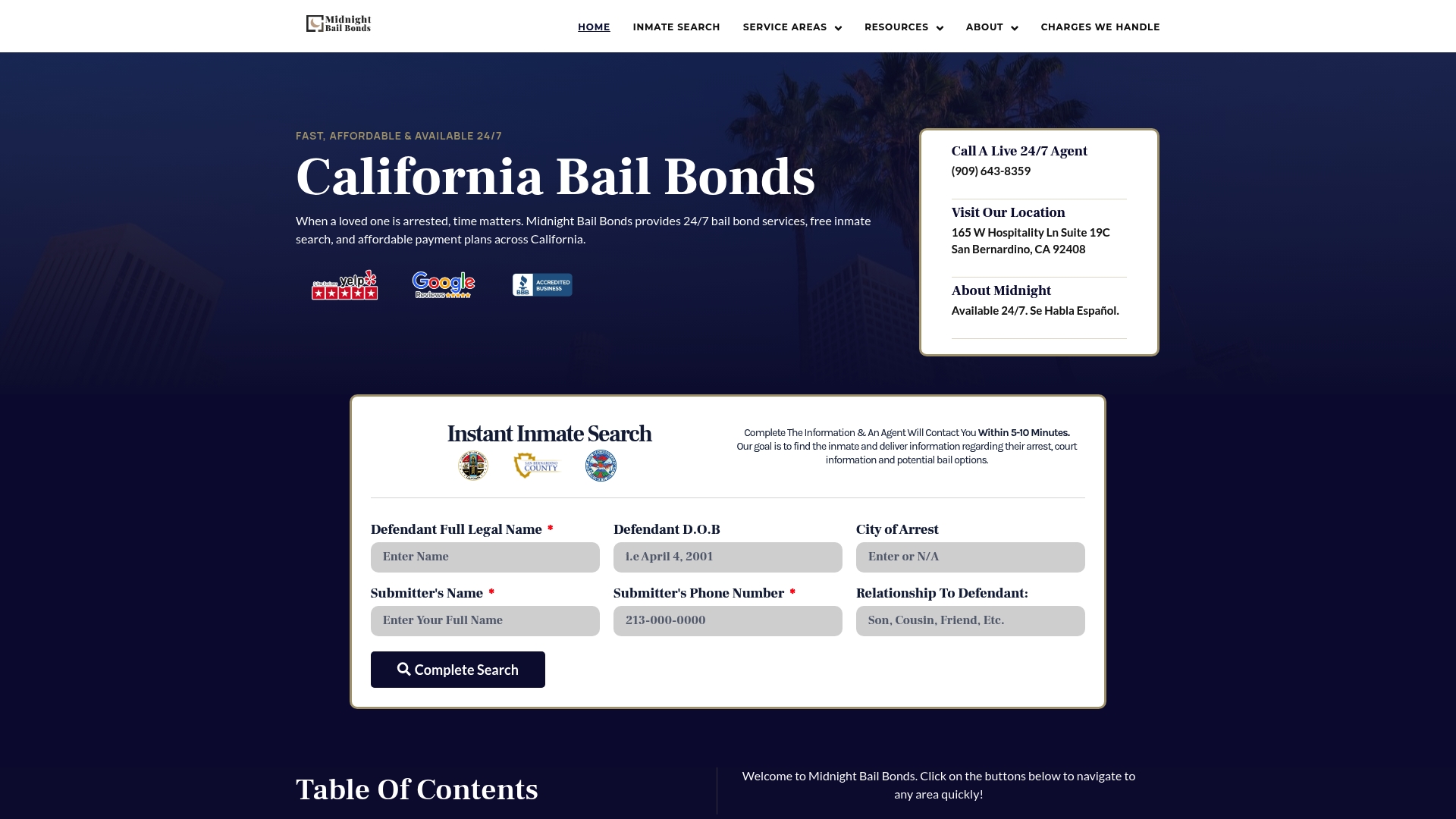
If the arrest was in California, our licensed agents are on the phone day and night. We write bail for DUI, drug, domestic violence, theft, assault, felony, misdemeanor and failure to appear charges, and we can start the bond online from your phone. Start with the Midnight Bail Bonds home page, or go straight to our 24-hour bail bonds page. In Orange County, we have a dedicated Orange County bail bonds page.
The sooner the paperwork is done, the less of the wait is yours.
Our perspective
Most families call us after the worst hour of their week. They want one thing: the person home. What we tell them is the same every time: the part you control is speed of paperwork, so use it.
That is why we keep licensed agents on the phone at every hour, why we say the cost up front, and why we write many bonds without collateral. A family should not have to choose between getting a son or daughter home and putting the house at stake. It is also why we speak Spanish on every shift. Stress is hard enough without a language barrier.
The jail will take the time it takes. Your job is to make sure nothing on your side adds to it.
Jake
FAQ
How long does it take to get out of jail after bail is paid?
It depends on the county and the hour. Orange County, California, says the average is about 4 hours, from 2 to 6 hours. Other counties report 1 to 4 hours, and some court releases can be longer. Starting the bond before bail is set cuts your side of the wait.
Can I get someone out of jail in the middle of the night?
Often you can post bail at night, since many California jails accept it 24/7. The release itself may be limited by hours or by a ride requirement, as in Nevada County. Call us as soon as you know the person is in custody and we will start the paperwork.
Do I need collateral to bail someone out?
Not always. We write many bonds without collateral, and we explain what applies to your case before you sign. We also offer payment plans and financing for the premium.
What if I do not know where they are being held?
Start with the county where the arrest took place. Use our free inmate search, or call us with the name and date of birth and we will help you find the booking record. A person can be moved between facilities in the first hours, so check again if the name does not show up.
Sources
- Orange County Sheriff's Department FAQs
- Nevada County, CA, Incarcerated Persons Release Procedures
- Jackson County, Oregon Sheriff, Posting of Bail/Release
- Washington County, WI, County Jail
- Benton County, WA, Getting Out of Jail
- Lake County, IL, Post Bond for an Inmate
- Congressional Research Service, Bail: An Abridged Overview of Federal Criminal Law
- Colorado State Public Defender, Bail and Pretrial Release
- New York DFS, Bail Bond Statement of Rights
- Butte County Sheriff's Office, Jail Information Handbook